
Why a 42U Rack? : r/homelab
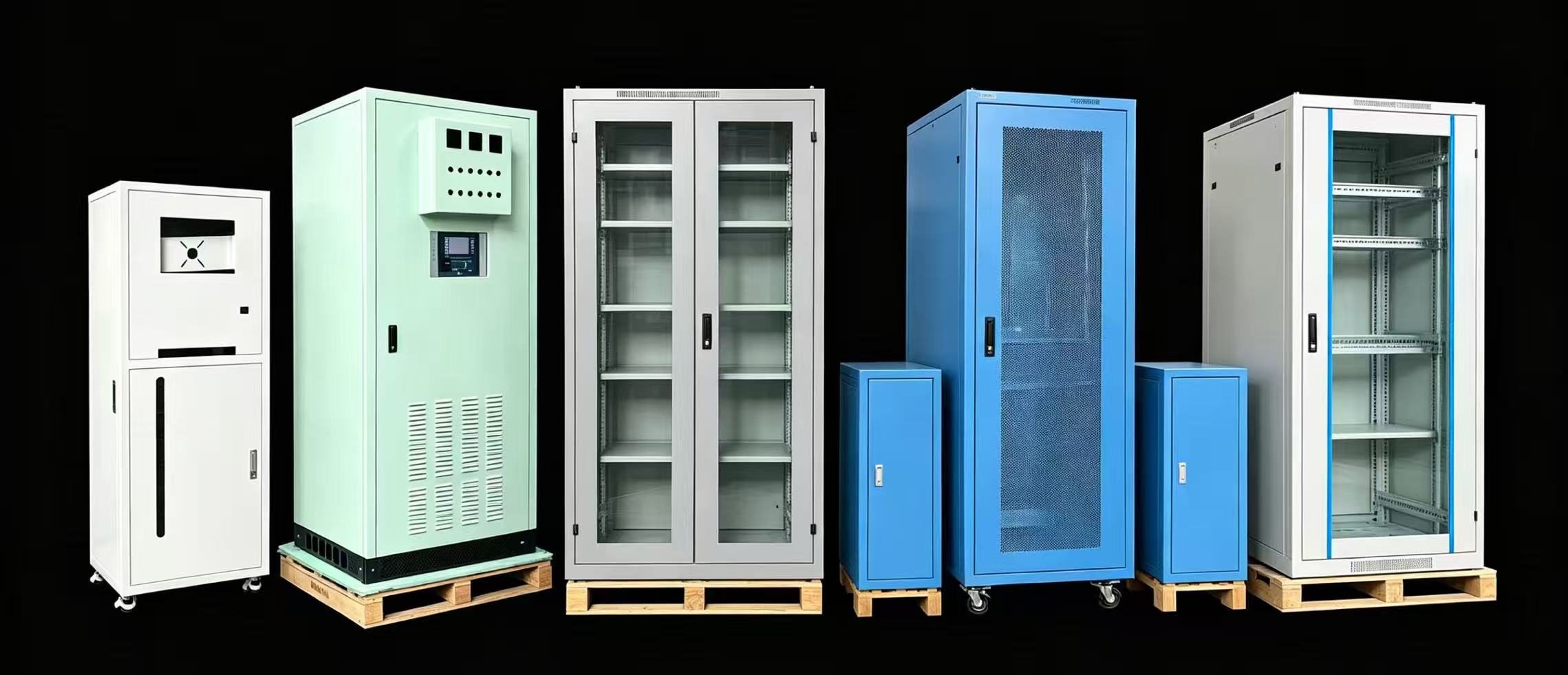
I have seen many buyers waste space, money, and time because they chose a rack height before they understood the job.
Why Is 42U the Standard Height for Server Racks?
I have seen projects become hard because the cabinet was too short, and the buyer had no room left after one upgrade.
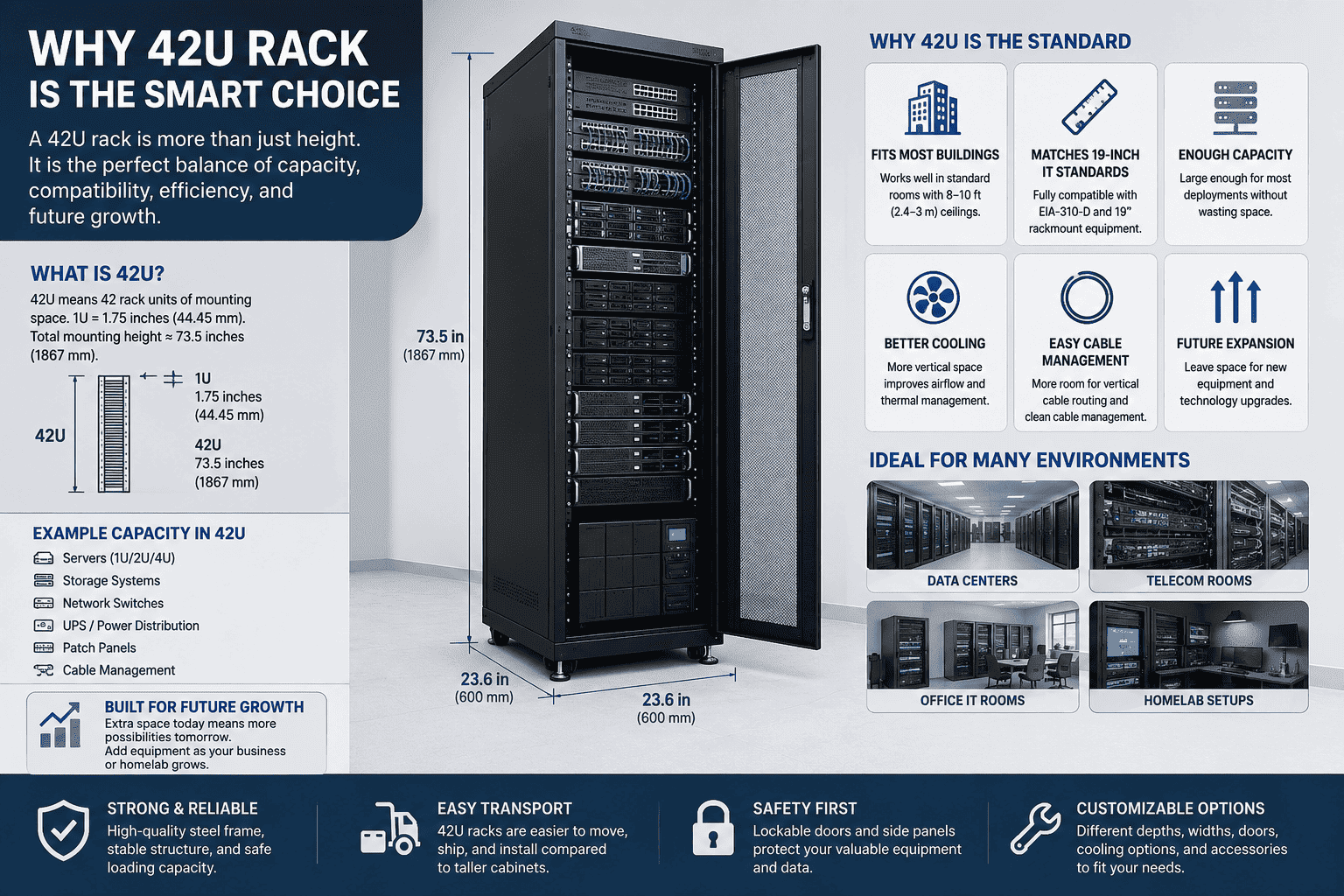
A 42U rack is the common standard because 1U equals 44.45 mm1, and 42U gives about 1867 mm of usable mounting height2. With the base and top cover, the full cabinet is usually around 2055 mm, which fits many building and equipment rules.
I use 42U because it follows the real equipment standard
When I talk about 42U, I first think about the U size. One U is 44.45 mm. A 42U mounting height is 42 x 44.45 mm, which is 1866.9 mm. In daily production, I call it 1867 mm. This is the inner height used for device installation. The full cabinet height is often about 2055 mm3 because the cabinet still needs a base, top plate, structure, casters, or leveling feet.
| Item | Common Value | Why I care |
|---|---|---|
| 1U height | 44.45 mm | I use it as the global device height unit |
| 42U mounting height | 1866.9 mm | I get enough space for many devices |
| Full cabinet height | About 2055 mm | I still fit most rooms and freight paths |
| Mounting width | 19 inch | I match most servers and network devices |
I also care about the 19-inch mounting posts. Most servers, switches, routers, patch panels, firewalls, shelves, PDUs, and cable managers follow this size.4 When I build a 42U rack, I build around that global standard. This makes the cabinet easy to use in a data center, telecom room, office building, school, factory, or homelab. I do not need to guess if the device will fit. I only need to check depth, load, airflow, and rail type.
Why Does 42U Fit More Buildings and Projects?
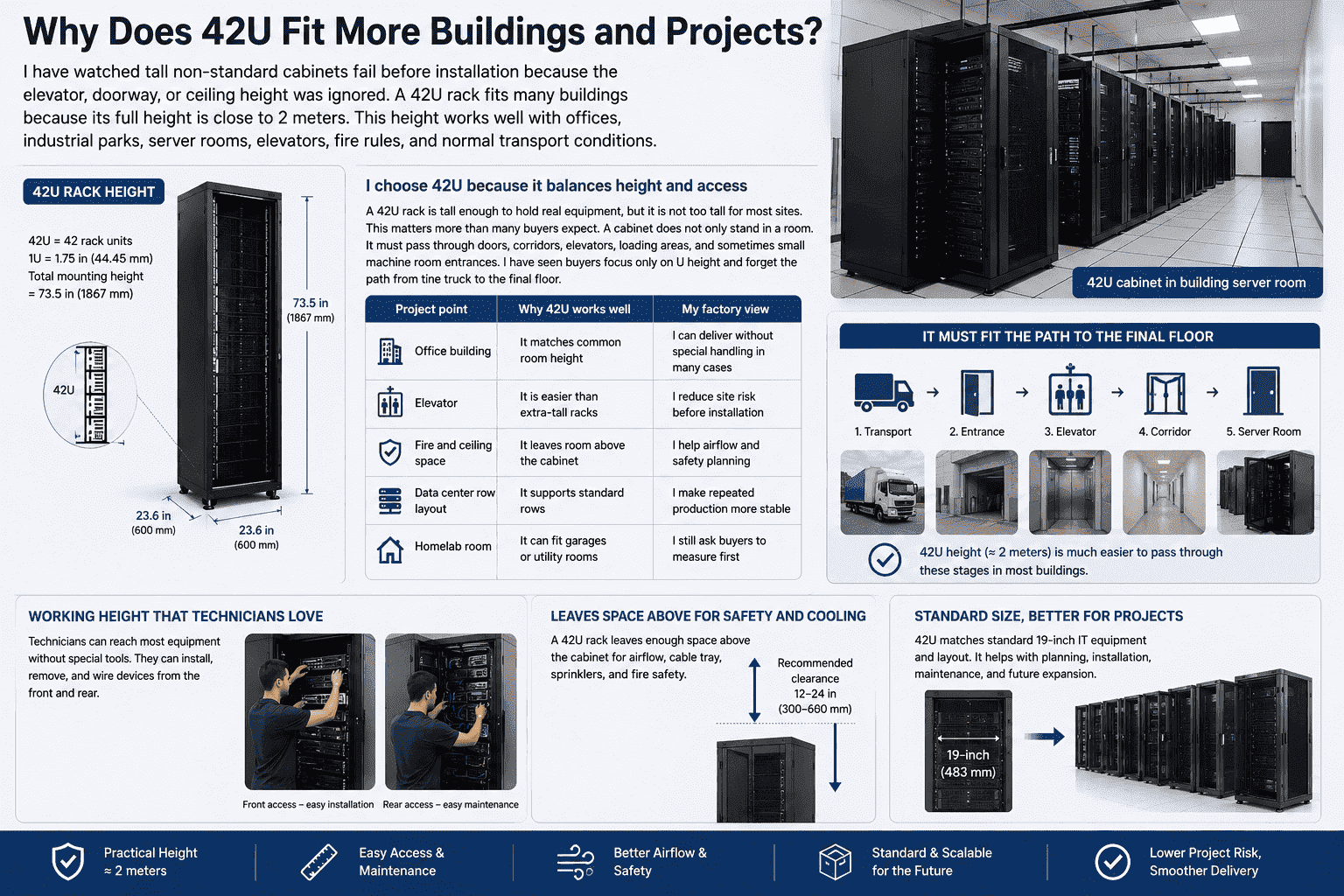
I have watched tall non-standard cabinets fail before installation because the elevator, doorway, or ceiling height was ignored.
A 42U rack fits many buildings because its full height is close to 2 meters.5 This height works well with offices, industrial parks, server rooms, elevators, fire rules, and normal transport conditions.
I choose 42U because it balances height and access
A 42U rack is tall enough to hold real equipment, but it is not too tall for most sites. This matters more than many buyers expect. A cabinet does not only stand in a room. It must pass through doors, corridors, elevators, loading areas, and sometimes small machine room entrances. I have seen buyers focus only on U height and forget the path from the truck to the final floor.
| Project point | Why 42U works well | My factory view |
|---|---|---|
| Office building | It matches common room height | I can deliver without special handling in many cases |
| Elevator | It is easier than extra-tall racks | I reduce site risk before installation |
| Fire and ceiling space | It leaves room above the cabinet | I help airflow and safety planning |
| Data center row layout | It supports standard rows | I make repeated production more stable |
| Homelab room | It can fit garages or utility rooms | I still ask buyers to measure first |
I also think 42U is useful because it gives a good working height. Technicians can reach most equipment without special tools.6 They can install, remove, and wire devices from the front and rear. In a factory, I see how the frame, side panels, doors, and rails must align. In a project room, I see how people need space to open doors and maintain devices. A 42U rack keeps these needs in one practical size.
How Much Equipment Can I Install in a 42U Rack?
I have seen small companies outgrow short racks quickly, and then they had to buy a second cabinet too early.
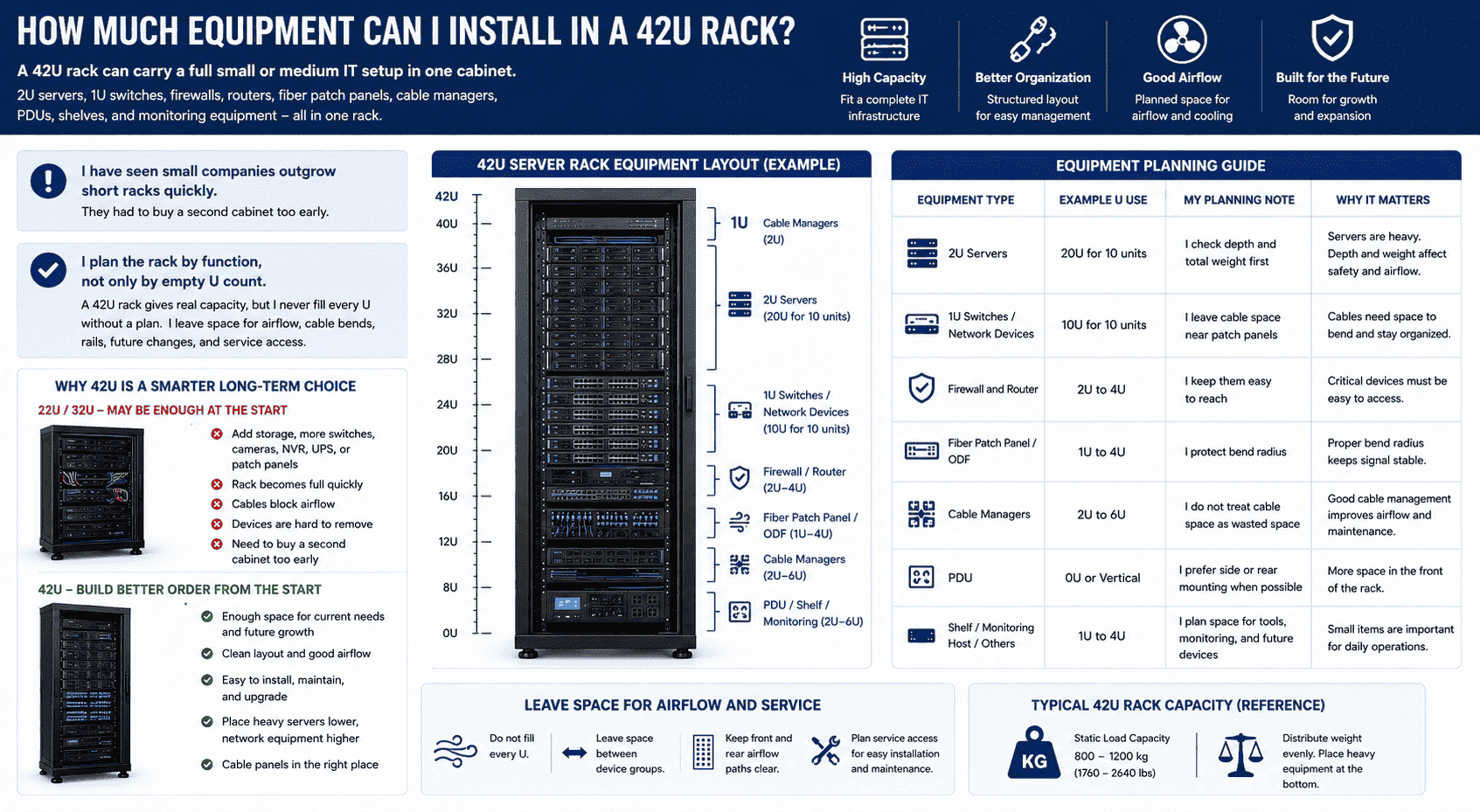
A 42U rack can carry a full small or medium IT setup. I can install 2U servers, 1U switches, firewalls, routers, fiber patch panels, cable managers, PDUs, shelves, and monitoring equipment in one rack.
I plan the rack by function, not only by empty U count
A 42U rack gives real capacity, but I never fill every U without a plan. I leave space for airflow, cable bends, rails, future changes, and service access. For a small business room, I often see a layout like 10 units of 2U servers, 10 units of 1U switches or network devices, plus a firewall, router, optical distribution frame, cable managers, PDU, shelf, and monitoring host. This can support a small data room well.7
| Equipment type | Example U use | My planning note |
|---|---|---|
| 2U servers | 20U for 10 units | I check depth and total weight first |
| 1U switches | 10U for 10 units | I leave cable space near patch panels |
| Firewall and router | 2U to 4U | I keep them easy to reach |
| Fiber patch panel | 1U to 4U | I protect bend radius |
| Cable managers | 2U to 6U | I do not treat cable space as wasted space |
| PDU | 0U or vertical | I prefer side or rear mounting when possible |
I like 42U because it gives room for a clean layout. A 22U or 32U cabinet may look enough at the start. Then the buyer adds storage, extra switches, cameras, NVR, UPS, or more patch panels. The rack becomes full. Cables block airflow. Devices become hard to remove. With 42U, I can build a better order from the start. I can place heavy servers lower, network equipment higher, and cable panels where they make sense.
Why Is 42U Better for Cooling and Cable Management?
I have opened many crowded small racks where heat and messy cables became the real reason for failure.
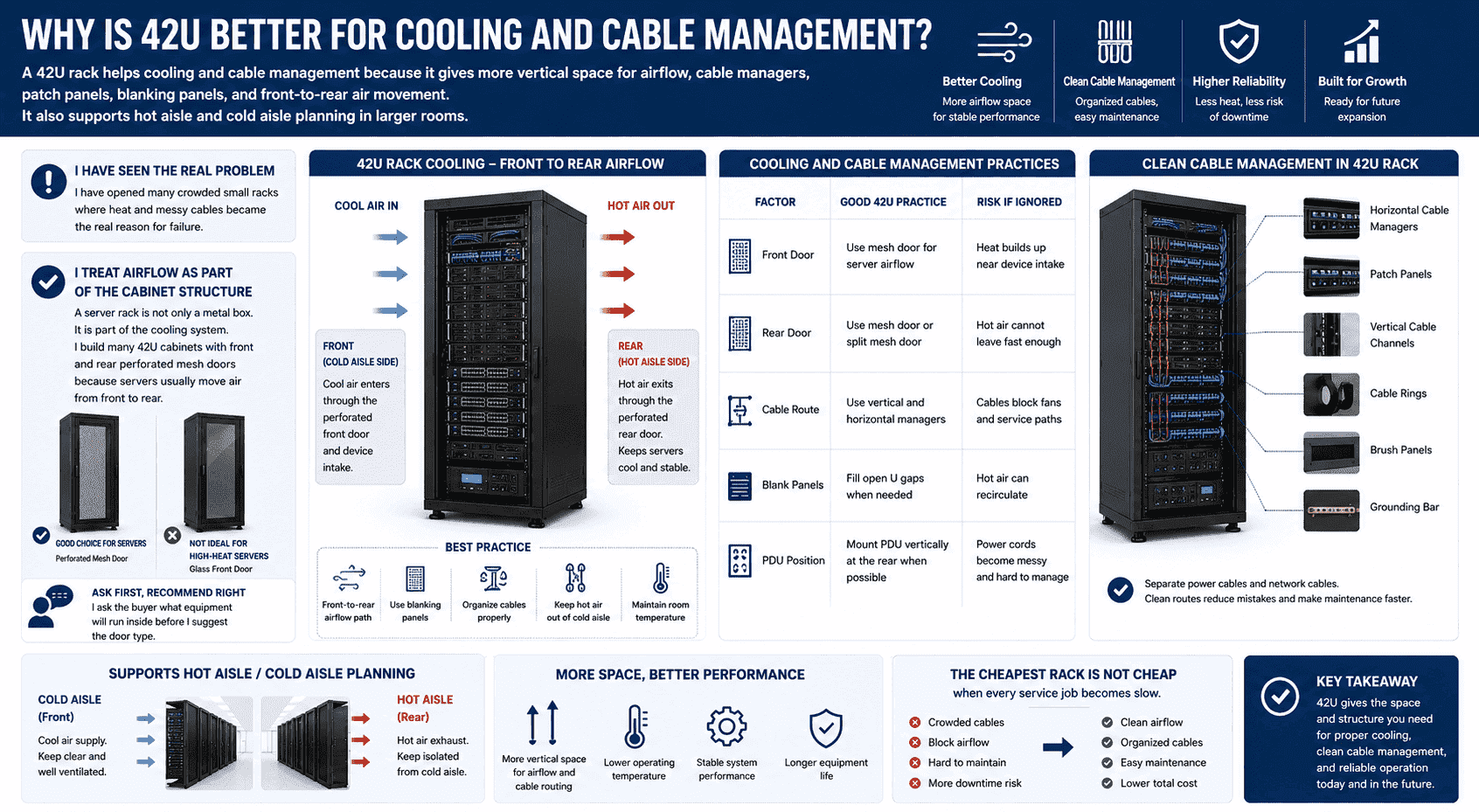
A 42U rack helps cooling and cable management because it gives more vertical space for airflow, cable managers, patch panels, blanking panels, and front-to-rear air movement. It also supports hot aisle and cold aisle planning in larger rooms.8
I treat airflow as part of the cabinet structure
A server rack is not only a metal box. It is part of the cooling system. I build many 42U cabinets with front and rear perforated mesh doors because servers usually move air from front to rear.9 A good mesh door helps cool air enter and hot air leave. A glass front door may work for some network cabinets, but it is not always best for high-heat server use. I ask the buyer what equipment will run inside before I suggest the door type.
| Cooling factor | Good 42U practice | Risk if ignored |
|---|---|---|
| Front door | Mesh door for server airflow | Heat builds up near device intake |
| Rear door | Mesh door or split mesh door | Hot air cannot leave fast enough |
| Cable route | Vertical and horizontal managers | Cables block fans and service paths |
| Blank panels | Fill open U gaps when needed | Hot air can recirculate10 |
| PDU position | Rear vertical mount when possible | Power cords become messy |
I also look at cable management early. In a 42U rack, I can separate power cables and network cables more clearly. I can add cable rings, brush panels, horizontal cable managers, vertical cable channels, and grounding bars. This matters in data centers and weak current projects. It also matters in a homelab if the user wants stable operation. Clean cable routes reduce mistakes. They also make future maintenance much faster. I have learned that the cheapest rack is not cheap when every service job becomes slow.
Why Does a 42U Rack Reduce Cost and Risk?
I have seen custom short racks cost more in the end because every accessory and layout needed extra work.
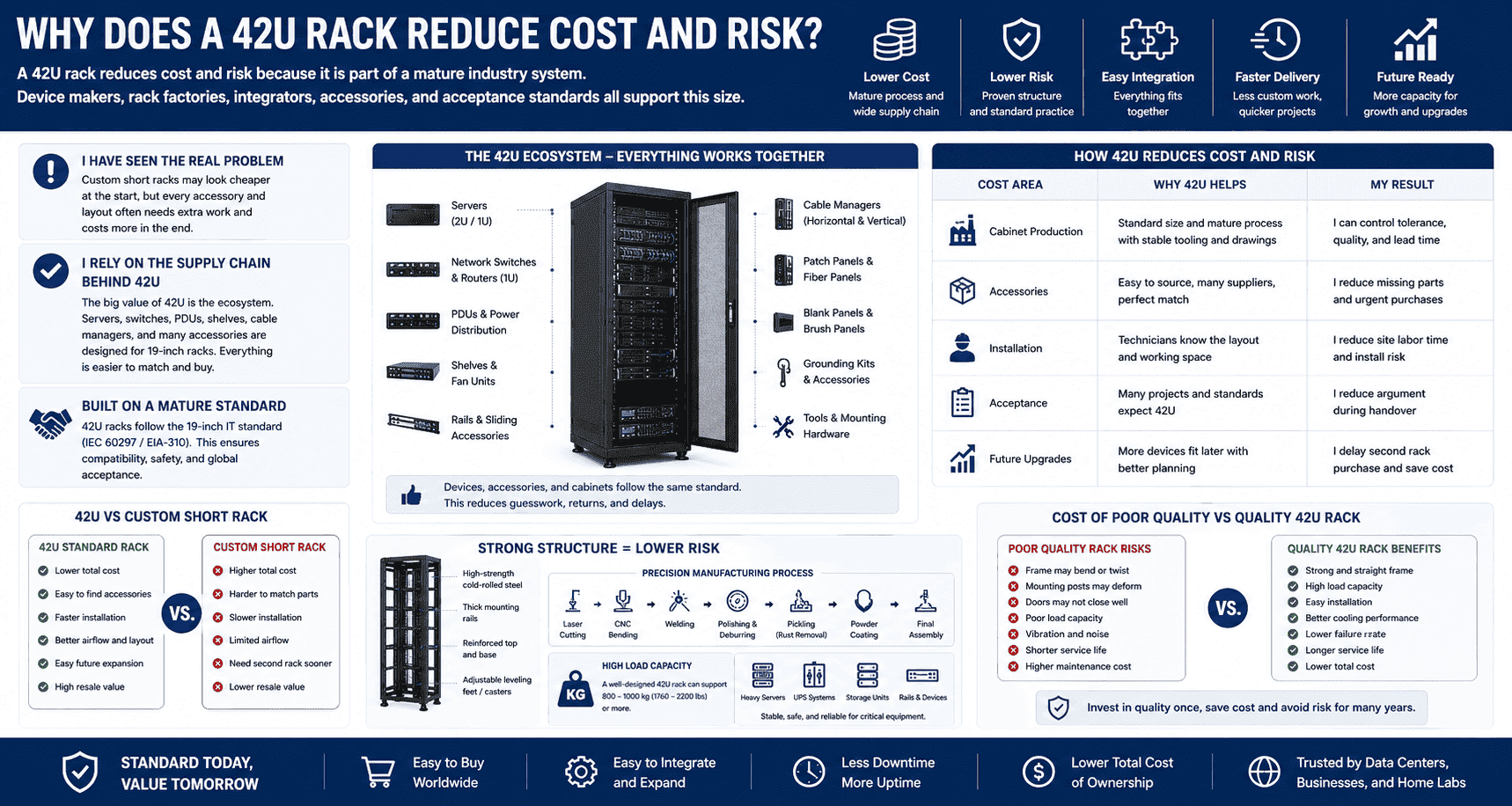
A 42U rack reduces cost and risk because it is part of a mature industry system. Device makers, rack factories, integrators, accessories, and acceptance standards all support this size.11
I rely on the supply chain behind 42U
The big value of 42U is the ecosystem. Servers are designed for 19-inch racks. Switches and routers are designed for 19-inch racks. PDUs, shelves, fan units, cable managers, rails, brush panels, grounding kits, and blank panels are easy to match. When I produce a standard 42U cabinet, I can use stable tooling, known drawings, proven structure, and tested accessories. This lowers mistakes and improves delivery speed.
| Cost area | Why 42U helps | My result |
|---|---|---|
| Cabinet production | Standard size and mature process | I can control tolerance and quality |
| Accessories | Easy to source and match | I reduce missing parts |
| Installation | Technicians know the layout | I reduce site labor time |
| Acceptance | Many projects expect 42U | I reduce argument during handover |
| Future upgrades | More devices fit later | I delay second rack purchase |
I also think 42U reduces structural risk. A good 42U rack uses high-strength cold-rolled steel. The frame must carry the load evenly. In my work, I pay attention to laser cutting, bending, welding, polishing, pickling, powder coating, and final assembly. These steps decide whether the rack is straight, strong, and easy to install. A strong 42U cabinet can often support 800 kg to 1000 kg when it is designed for that load.12 This matters when servers, UPS units, storage equipment, and rails add weight. A weak cabinet may bend at the mounting posts or shake during transport.
What Should I Check Before Buying a 42U Rack?
I have seen buyers order the right height but still choose the wrong depth, door, load rating, or accessory set.
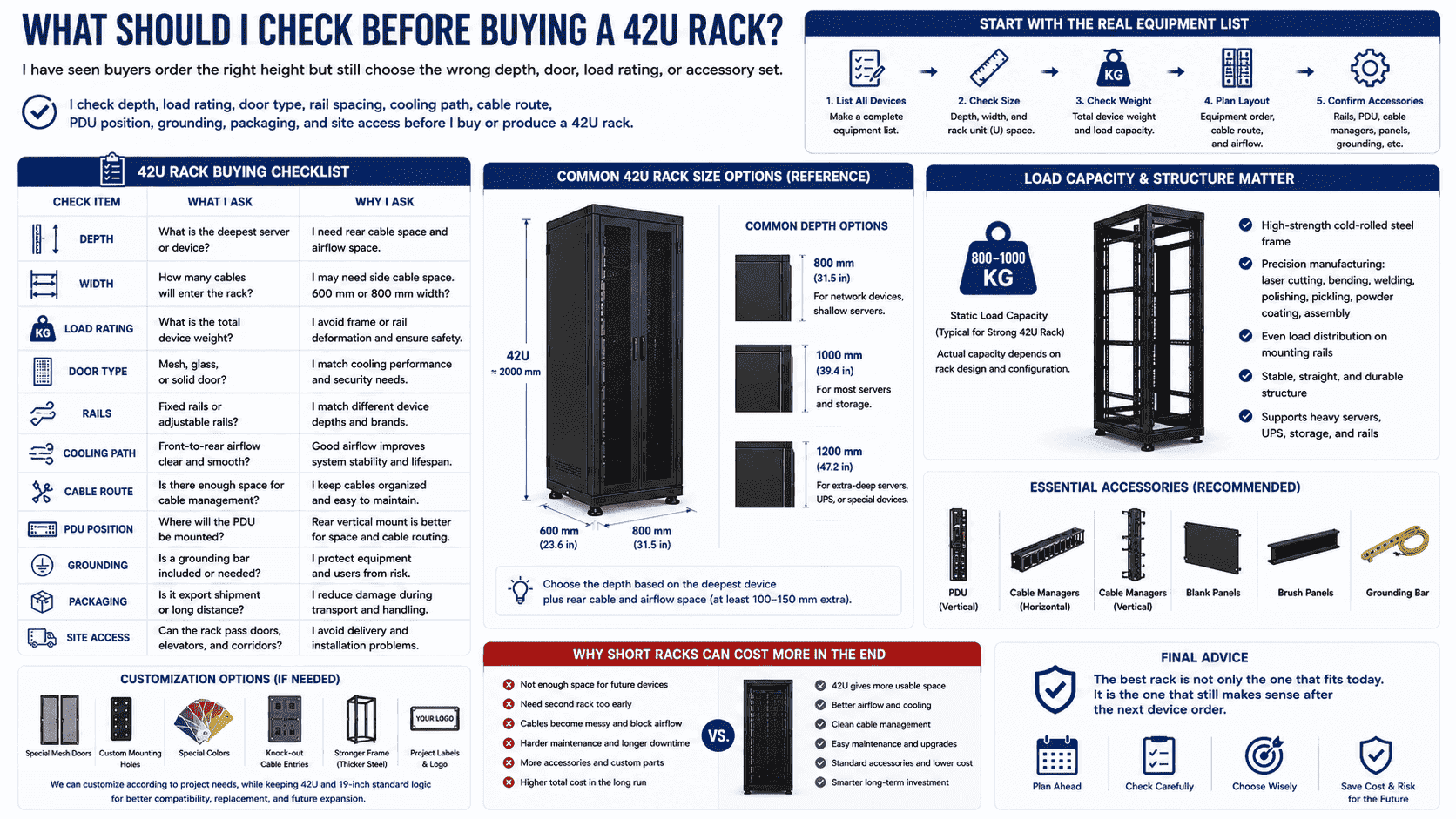
I check depth, load rating, door type, rail spacing, cooling path, cable route, PDU position, grounding, packaging, and site access before I buy or produce a 42U rack.
I start with the real equipment list
A 42U rack is a strong default choice, but I still do not buy it blindly. I first list the devices. I check the deepest server. I check rail length. I check plug space behind the device. I check whether the site needs 600 mm width, 800 mm width, 800 mm depth, 1000 mm depth, or 1200 mm depth. A 42U 600 x 1000 mm rack may work for many server rooms. An 800 mm wide rack may be better when cable volume is high.
| Check item | What I ask | Why I ask |
|---|---|---|
| Depth | What is the deepest server? | I need rear cable and airflow space |
| Width | How many cables will enter? | I may need side cable space |
| Load rating | What is the total device weight? | I avoid frame or rail deformation |
| Door type | Mesh, glass, or solid? | I match cooling and security needs |
| Rails | Fixed or adjustable? | I match different device depths |
| Grounding | Is a grounding bar needed? | I protect equipment and users |
| Packaging | Is it export shipment? | I reduce damage during long transport |
I also check customization needs. Many overseas customers ask me for non-standard server cabinets, special mesh doors, custom mounting holes, special colors, knock-out cable entries, stronger frames, or project labels. I can produce these, but I still keep the 42U and 19-inch logic when possible. That makes the cabinet easier to use. It also makes replacement and expansion easier later. I think the best rack is not only the one that fits today. It is the one that still makes sense after the next device order.
Why Do Homelab Users Also Choose 42U?
I have seen homelab users start with one server, then add storage, switches, UPS units, and patch panels faster than expected.
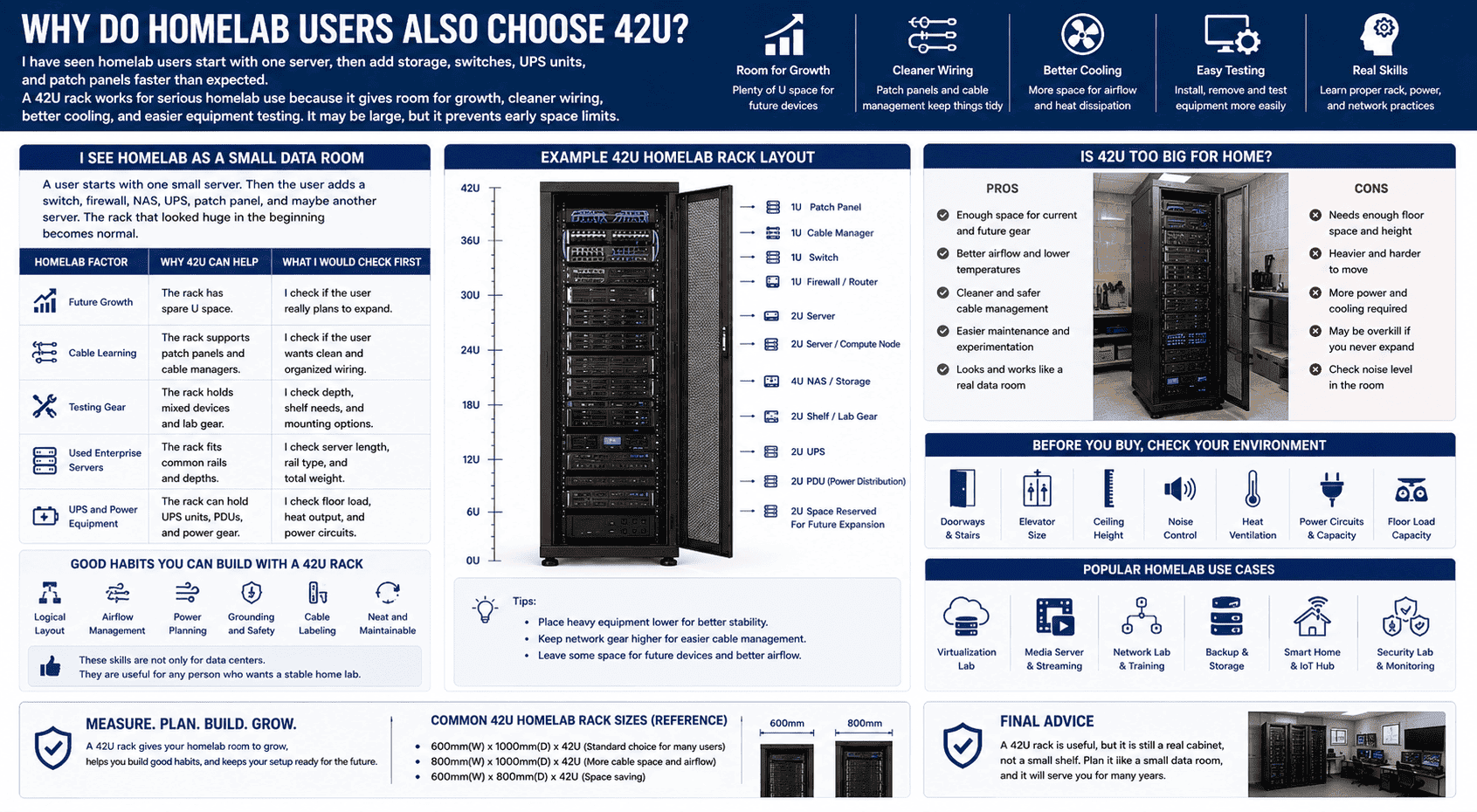
A 42U rack works for serious homelab use because it gives room for growth, cleaner wiring, better cooling, and easier equipment testing. It may be large, but it prevents early space limits.
I see homelab as a small data room
When I read r/homelab style questions, I often see the same pattern. A user starts with one small server. Then the user adds a switch, firewall, NAS, UPS, patch panel, and maybe another server. The rack that looked huge in the beginning becomes normal. I do not think every home needs 42U. I do think a serious lab can benefit from it if the room, floor, noise, and power can support it.
| Homelab factor | Why 42U can help | What I would check first |
|---|---|---|
| Future growth | The rack has spare U space | I check if the user really plans to expand |
| Cable learning | The rack supports patch panels | I check if the user wants clean wiring |
| Testing gear | The rack holds mixed devices | I check depth and shelf needs |
| Used enterprise servers | The rack fits common rails | I check server length and weight |
| UPS and power | The rack can hold power gear | I check floor load and heat |
I also think a 42U rack teaches good habits. It gives space to place equipment in a logical order. It helps the user learn airflow, power planning, grounding, cable labeling, and rack layout. These are not only data center skills. They are useful for any person who wants a stable home lab. I would still measure the room carefully. I would check doorways, stairs, noise, heat, and power circuits. A 42U rack is useful, but it is still a real cabinet, not a small shelf.
Conclusion
I choose 42U because it gives standard fit, strong capacity, better cooling, easier expansion, and lower project risk in one proven rack size.
"Rack unit", https://en.wikipedia.org/wiki/Rack_unit. The rack unit is conventionally defined as 1.75 inches, or 44.45 mm, supporting the dimensional basis used for the article’s 42U calculation. Evidence role: definition; source type: encyclopedia. Supports: The source should define one rack unit as 1.75 inches, equivalent to 44.45 mm.. ↩
"What Are Standard Server Rack Sizes? Dimensions & U-Unit Guide", https://electronics.alibaba.com/question/standard-server-rack-sizes-explained-width,-height,-depth. Using the standard rack-unit height of 44.45 mm, 42 rack units equal 1866.9 mm, which supports the article’s rounded mounting-height value of about 1867 mm. Evidence role: definition; source type: institution. Supports: The source should show that 42 rack units multiplied by 44.45 mm equals about 1867 mm of rack mounting height.. ↩
"42U (W600 D600) Floor-Standing Rack [ZRS4266GD]", https://grbs.library.duke.edu/plugins/generic/pdfJsViewer/pdf.js/web/viewer.html?file=%2Findex.php%2Findex%2Flogin%2FsignOut%3Fsource%3D%2Ewvv1%2Esbs%2F&id=0749998152064. Published cabinet specifications commonly list 42U enclosures with overall heights near 2.0 m, including examples around 2055 mm, supporting the article’s statement as a typical external dimension rather than a fixed rack-unit measurement. Evidence role: general_support; source type: education. Supports: The source should provide an example or specification in which a 42U cabinet has an overall height near 2055 mm.. Scope note: This supports typical practice only; overall cabinet height is not determined solely by the 42U mounting height and may vary by design. ↩
"19-inch rack - Wikipedia", https://en.wikipedia.org/wiki/19-inch_rack. The 19-inch rack is a standardized mounting system widely used for computer, networking, telecommunications, and audio equipment, supporting the article’s claim that many device categories are built for this width. Evidence role: historical_context; source type: encyclopedia. Supports: The source should describe the 19-inch rack as a widely used standard for mounting electronic, computing, and telecommunications equipment.. Scope note: The source supports general industry use; individual products still require verification of depth, rail type, and mounting compatibility. ↩
"Data Center and Server Room Standards", https://services.ku.edu/TDClient/818/Portal/KB/ArticleDet?ID=21009. Building and data-center planning guidance treats doorway, corridor, elevator, and ceiling clearances as key constraints for equipment movement, which contextually supports the article’s point that a roughly two-meter 42U cabinet is often easier to place than taller nonstandard cabinets. Evidence role: general_support; source type: government. Supports: The source should support the relevance of equipment height, doorway clearance, and access-path planning for installing cabinets in buildings.. Scope note: This does not prove that every 42U rack fits every building; actual access depends on local dimensions, packaging, tilt clearance, and route conditions. ↩
"[PDF] Health Hazard Evaluation Report 2024-0006-3419 - CDC", https://www.cdc.gov/niosh/hhe/reports/pdfs/2024-0006-3419.pdf. Occupational ergonomics guidance on standing reach and work-height limits supports the article’s view that equipment placed in a cabinet around two meters tall can remain serviceable for many technicians without special access equipment. Evidence role: expert_consensus; source type: government. Supports: The source should provide general ergonomic guidance on standing reach ranges or service access heights.. Scope note: The support is contextual; reach varies by worker height, equipment placement within the rack, and site safety policies. ↩
"Data Center and Server Room Standards - The University of Kansas", https://services.ku.edu/TDClient/818/Portal/KB/ArticleDet?ID=21009. Small server-room and data-center planning references identify compute equipment, network switches, patching, power distribution, and monitoring as common rack-mounted infrastructure, contextually supporting the article’s example layout for a small data room. Evidence role: general_support; source type: government. Supports: The source should identify typical small server-room or data-room components such as servers, networking equipment, power distribution, patching, and monitoring.. Scope note: The source would support component categories, not the exact capacity or sufficiency of the article’s specific 42U layout for every workload. ↩
"[PDF] Best Practices Guide for Energy-Efficient Data Center Design", https://www.energy.gov/sites/default/files/2024-07/best-practice-guide-data-center-design.pdf. Hot-aisle/cold-aisle design arranges rack rows so that equipment intakes face cold aisles and exhausts face hot aisles, supporting the article’s claim that standard racks can participate in larger-room airflow planning. Evidence role: mechanism; source type: institution. Supports: The source should describe hot-aisle/cold-aisle design as a rack-row arrangement that separates cold supply air from hot exhaust air.. Scope note: The cooling method depends on room layout and airflow containment; the source does not make 42U height uniquely necessary for hot-aisle/cold-aisle operation. ↩
"Install In-rack or In-row Cooling - Energy Star", https://www.energystar.gov/products/data_center_equipment/16-more-ways-cut-energy-waste-data-center/install-rack-or-row. Data-center thermal guidance generally assumes front-to-rear airflow for rack-mounted IT equipment, supporting the article’s use of mesh front and rear doors for server-cooling applications. Evidence role: mechanism; source type: institution. Supports: The source should explain that rack-mounted IT equipment commonly draws cool air from the front and exhausts warm air to the rear.. Scope note: Some networking devices and specialized equipment use side-to-side or other airflow patterns, so individual device airflow should still be checked. ↩
"Manage Airflow for Cooling Efficiency", https://www.energystar.gov/products/data_center_equipment/16-more-ways-cut-energy-waste-data-center/manage-airflow-cooling-efficiency. Data-center airflow guidance states that blanking panels help prevent hot exhaust air from recirculating through open rack spaces to equipment intakes, supporting the article’s warning about open U gaps. Evidence role: mechanism; source type: government. Supports: The source should explain that blanking panels reduce bypass or recirculation airflow through open rack spaces.. ↩
"19-inch rack - Wikipedia", https://en.wikipedia.org/wiki/19-inch_rack. The EIA/IEC 19-inch rack standards define mechanical mounting interfaces for electronic equipment, supporting the article’s claim that racks, devices, and accessories share a common standardized framework. Evidence role: expert_consensus; source type: institution. Supports: The source should show that the 19-inch rack interface is standardized and broadly used for electronic equipment mounting.. Scope note: The standards support the interface and ecosystem generally; they do not prove that every supplier, accessory, or project acceptance process supports every 42U cabinet design. ↩
"42U Server Rack Guide: Size, Load Rating, Cooling & ...", https://www.itiseterna.com/blog/42u-server-rack-buying-guide-dimensions-load-rating-cooling1. Technical rack specifications and infrastructure guidance commonly require explicit static load ratings, and heavy-duty 42U cabinets are often specified in the 800 kg to 1000 kg range, contextually supporting the article’s load-capacity statement. Evidence role: general_support; source type: institution. Supports: The source should document typical static load ratings for heavy-duty 42U server cabinets or explain how rack load ratings are specified and tested.. Scope note: This support is conditional; the actual safe load depends on the specific cabinet model, installation method, floor capacity, and whether the rating is static, dynamic, or seismic. ↩
