
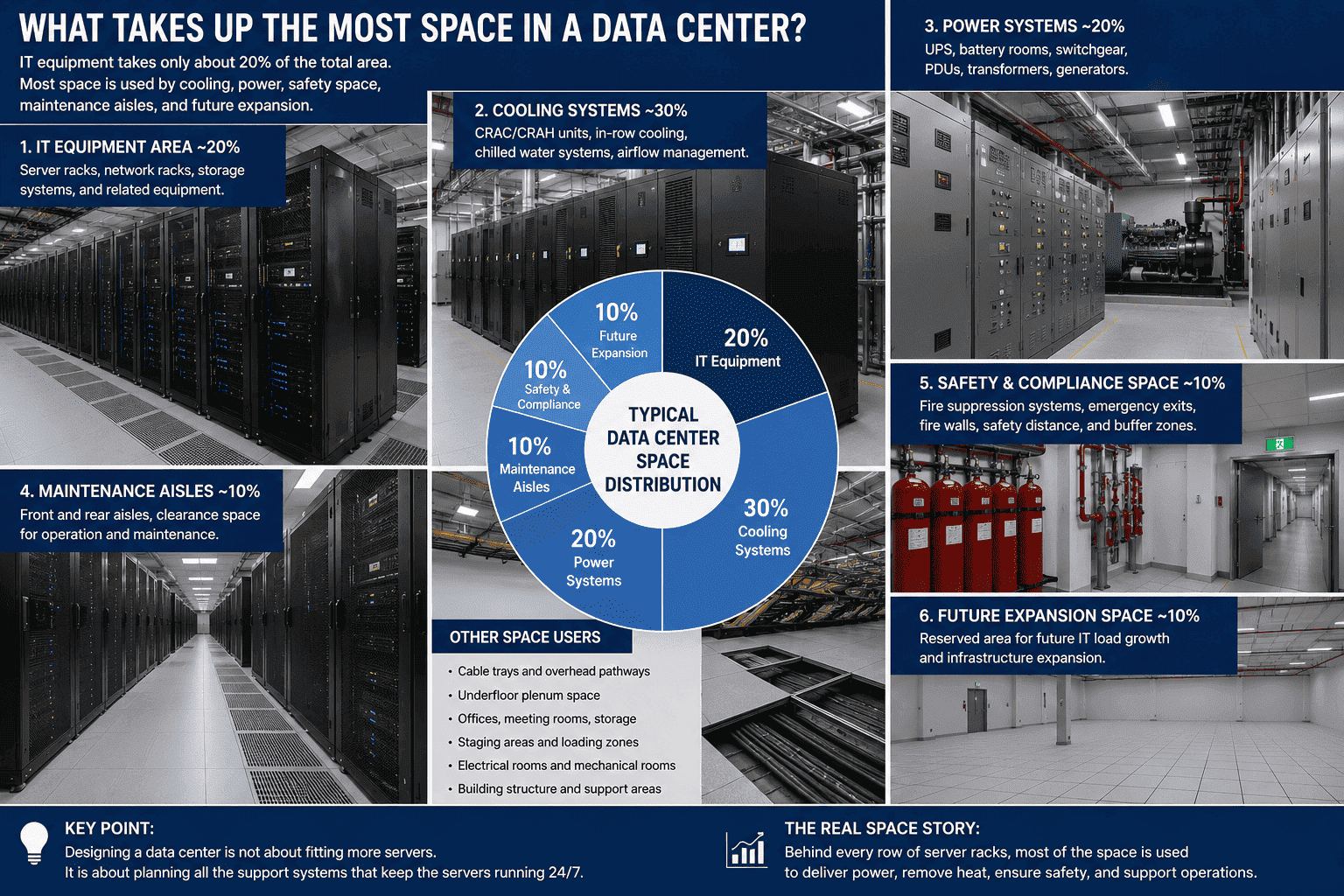
What takes up the most space in a data center?
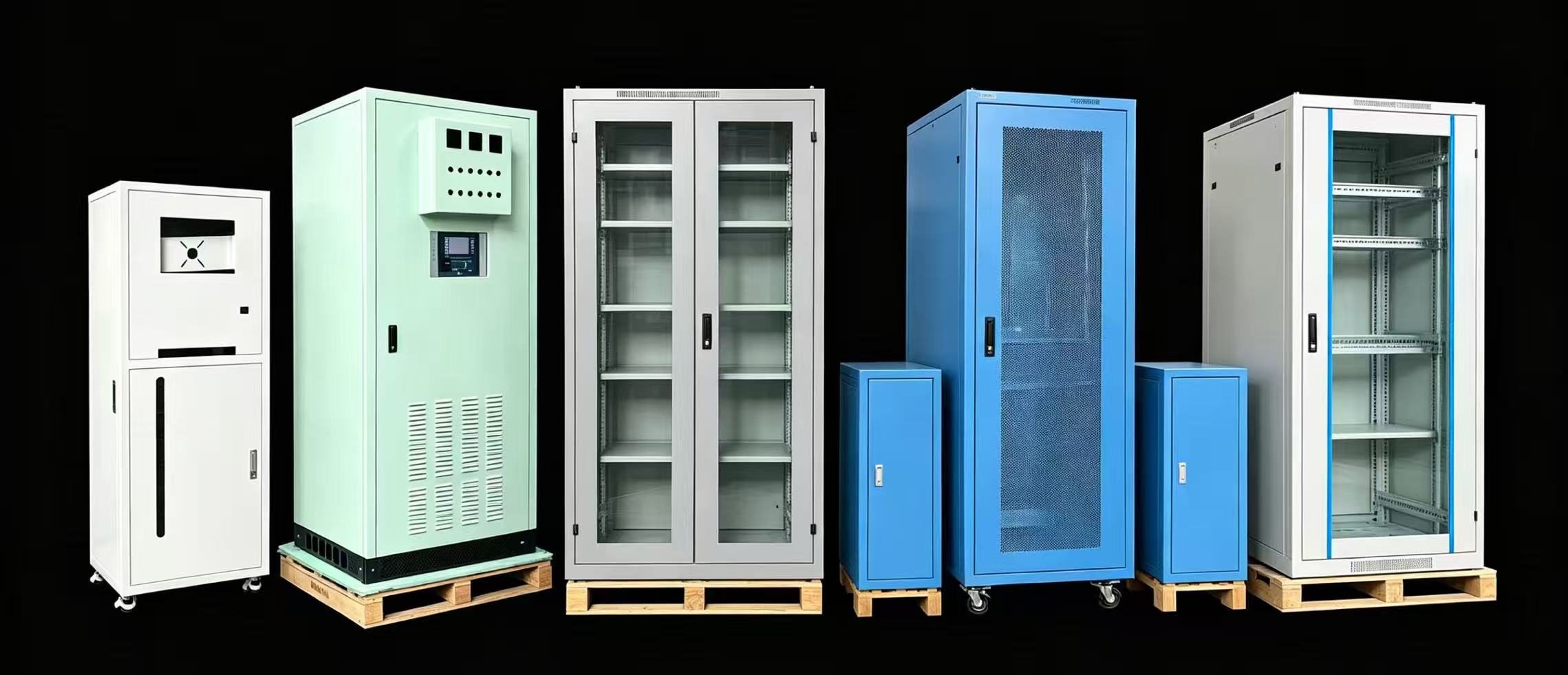
I often see buyers focus on servers first. That sounds right, but it hides a costly problem. Space is not used the way most people think.
-
Why does the cooling system take the most space?
I see many data center plans fail at the cooling stage. The servers look compact, but heat spreads fast. If cooling is weak, the whole room becomes risky.
The cooling system often takes the largest space because it must remove heat from servers every second.1 It needs chillers, CRAC or CRAH units2, pumps, pipes, air paths, hot aisles, cold aisles, and service space. It also needs backup design, because overheating can stop the data center3.
I often explain this with a simple point. A server rack is only useful when the heat can leave it. A dense cabinet can hold many servers, but every server turns power into heat4. I cannot treat that heat as a small issue. I must treat it as a design force. This is why cooling equipment becomes the space king in many data centers.
I have seen clients ask for more cabinets in the same room. I always ask one question first. Can the cooling system handle the new heat load? If the answer is no, more cabinets do not mean more value. They mean more risk.
Where does cooling space go?
| Cooling part | Why I must leave space | What happens if I ignore it |
|---|---|---|
| Chillers and outdoor units | I need space for heat exchange and service | The system loses efficiency and repair becomes hard |
| CRAC or CRAH units | I need clear air supply and return paths | Hot spots appear near racks |
| Hot aisle and cold aisle5 | I need air to move in the correct direction | Hot air mixes with cold air |
| Pipes and pumps | I need water or coolant flow support | Cooling becomes unstable |
| Service clearance | I need technicians to clean and replace parts | Downtime risk increases |
I do not see cooling as a side system. I see it as the main reason why a data center cannot be packed like a warehouse. The room must breathe. The cabinets must face the correct direction. The perforated doors must match airflow needs. The aisle width must support air and workers at the same time. In my own cabinet work, I pay close attention to mesh door open area, frame strength, and cable openings, because these small details affect the cooling result. A cabinet may look simple, but it sits inside a strict thermal system.
Why does the power system also need so much space?
I often hear people say that power is only cables and sockets. That view is too simple. A data center needs stable power, clean power, and backup power.6
The power system takes huge space because it includes transformers, switchgear, UPS units, battery rooms, generators, PDUs, busways, cable trays, grounding, and safety clearance7. It is usually the second largest space user after cooling, because every rack needs constant and protected power.
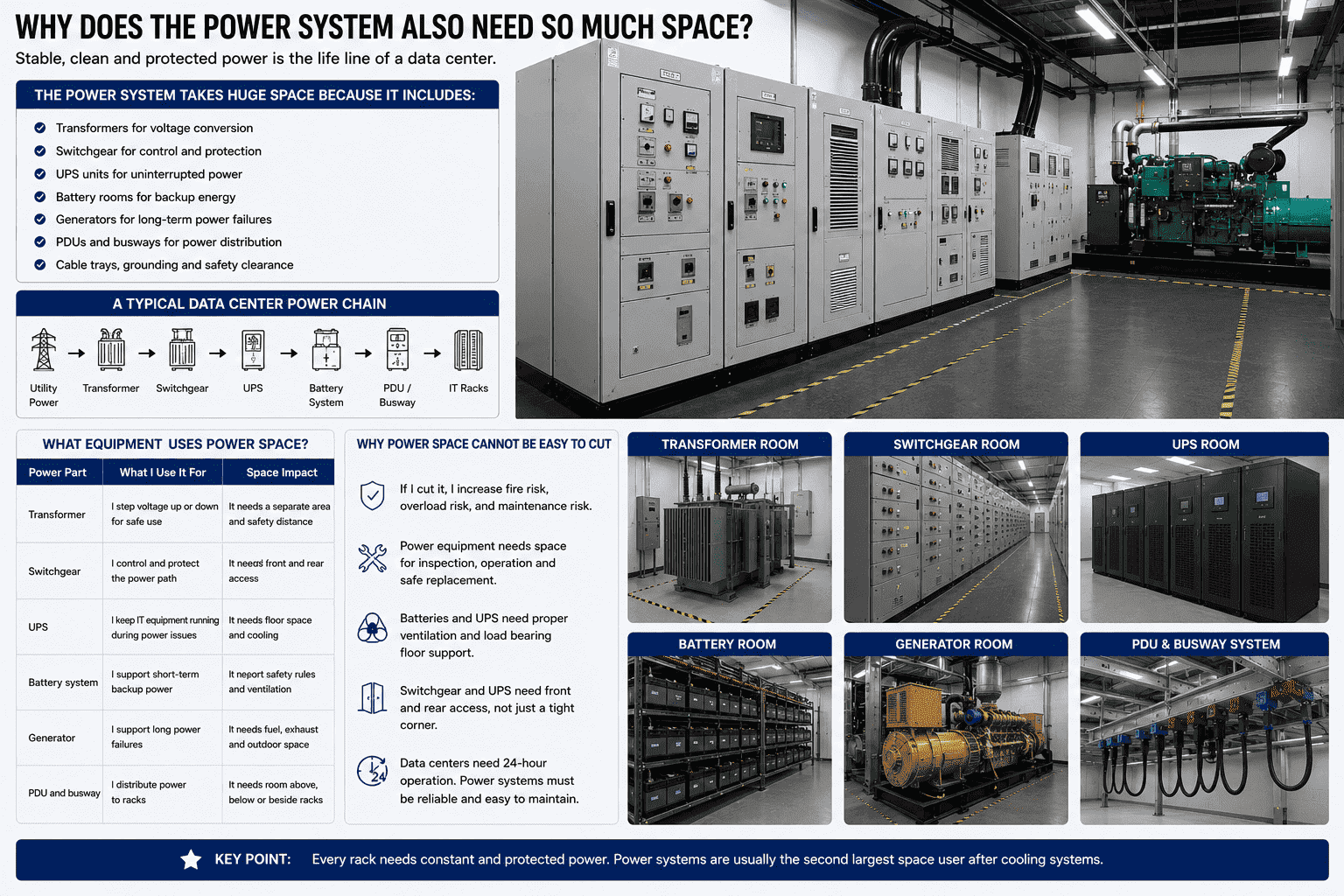
I see power as the first life line of the data center. A server cabinet without stable power is only a metal box with expensive machines inside. The rack may be 600mm wide or 800mm wide. The room may use 42U or 47U cabinets. These numbers matter. Still, the power chain behind the cabinet matters more.
Many clients look at IT load and say, “I need this many racks.” I usually think about the power side at the same time. I ask about rack power density. I ask about redundancy. I ask about single power feed or dual power feed. I ask about UPS time. These answers change the space plan. A high-density rack can save rack area, but it can increase power room area.
What equipment uses power space?
| Power part | What I use it for | Space impact |
|---|---|---|
| Transformer | I step voltage up or down for safe use | It needs a separate area and safety distance |
| Switchgear | I control and protect the power path | It needs front and rear access |
| UPS | I keep IT equipment running during power issues | It needs floor space and cooling |
| Battery system | I support short-term backup power | It needs safety rules and ventilation |
| Generator | I support long power failures | It needs fuel, exhaust, and outdoor space |
| PDU and busway | I distribute power to racks | It needs room above, below, or beside racks |
I learned that power space is not easy to cut. If I cut it, I increase fire risk, overload risk, and maintenance risk. I cannot place a large UPS where a worker cannot reach it. I cannot hide heavy batteries without thinking about ventilation and load. I cannot push switchgear against a wall and then expect safe repair. Data centers need 24-hour operation, so power equipment must be easy to inspect and replace. This is one reason why the support area grows faster than many people expect.
In cabinet manufacturing, I also see the power issue at rack level. A server rack needs good grounding, strong mounting rails, cable entry, and clear power cable paths. If the cabinet is custom made, I must match the client’s PDU position, cable size, and power layout. This is not decoration. This is part of the whole power system.
Why can’t a data center be filled with cabinets?
I have met many people who want to fill every square meter with racks. I understand the pressure. Space costs money. Empty space looks wasteful.
A data center cannot be filled with cabinets because it needs airflow aisles, installation clearance, fire safety space, cable routes, equipment removal space, and emergency maintenance space.8 These areas are not optional. They protect uptime, safety, and future expansion.
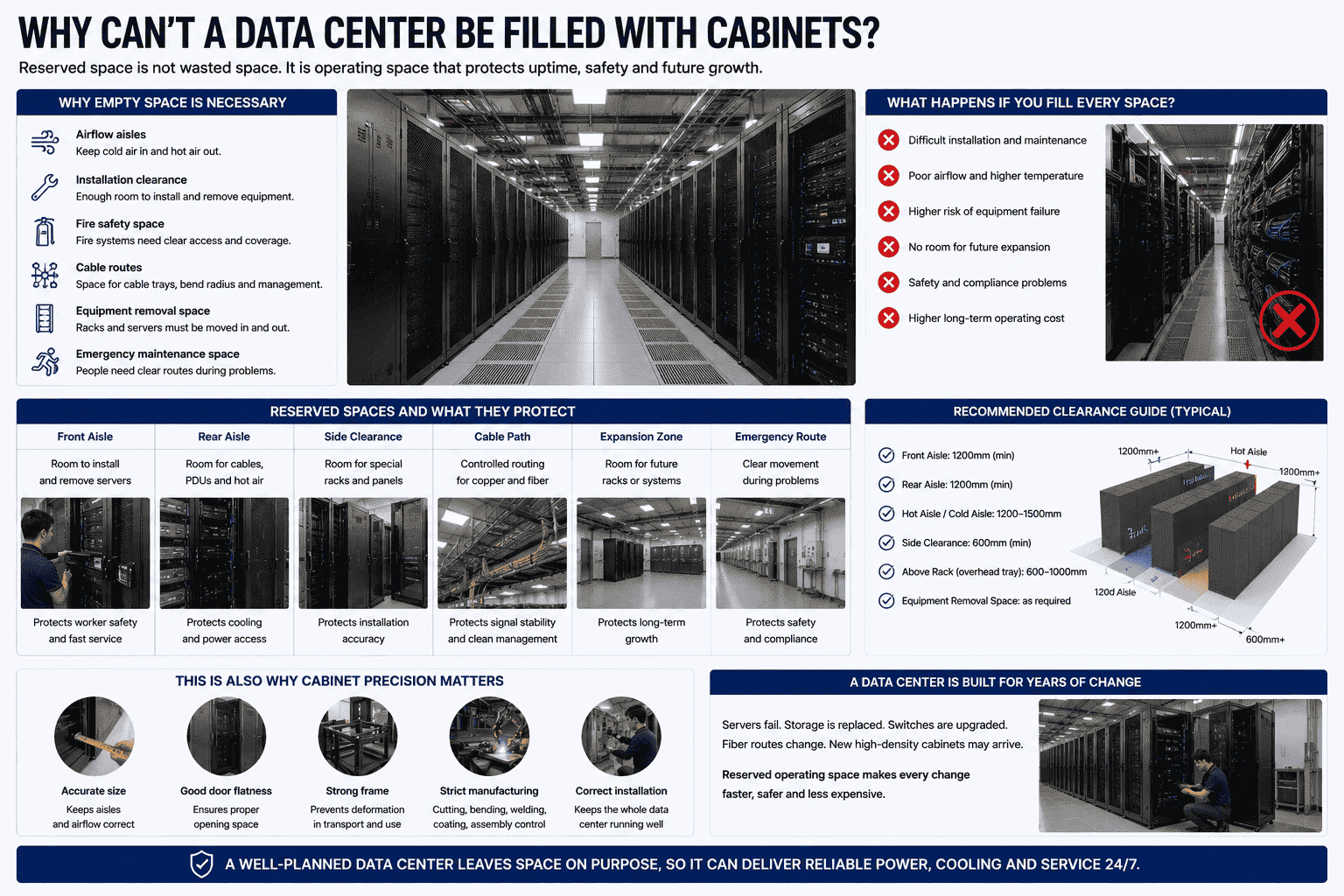
I think this is the most misunderstood part of data center planning. People see an empty aisle and think it is wasted. I see that aisle as insurance. A technician needs space to open a cabinet door. A team needs space to remove a server. A rack may need to be moved in or out. A fire system needs clear access. A cable tray needs room for later growth. These needs are real.
I once worked with a customer who wanted custom cabinets with special mesh doors for a compact equipment room. The request looked easy at first. The hard part was not the cabinet body. The hard part was keeping enough space for door opening, cable bend radius, airflow, and safe maintenance. The cabinet had to fit the room, but the room also had to remain serviceable.
What reserved space does the data center need?
| Reserved space | Why I need it | What it protects |
|---|---|---|
| Front aisle | I need room to install and remove servers | Worker safety and fast service |
| Rear aisle | I need room for cables, PDUs, and hot air | Cooling and power access |
| Side clearance | I need room for special racks and panels | Installation accuracy |
| Cable path | I need controlled routing for copper and fiber | Signal stability and clean management |
| Expansion zone | I need room for future racks or systems | Long-term growth |
| Emergency route | I need clear movement during problems | Safety and compliance |
I do not call this unused area. I call it operating space. A data center is not built only for the first day. It is built for years of changes. Servers will fail. Storage devices will be replaced. Switches will be upgraded. Fiber routes will change. New high-density cabinets may arrive. If the original design has no reserved space, every later change becomes expensive and slow.
This is also why cabinet precision matters. A cabinet with poor size control can steal a few millimeters from an aisle. That sounds small, but it matters when many racks line up. A door with bad flatness can affect opening space. A weak frame can deform during transport or installation. I have seen why a cabinet factory must control cutting, bending, welding, polishing, acid cleaning, powder coating, and assembly. The data center space plan depends on every detail being correct.
How much space do IT racks and computing equipment really take?
I know the racks create the business value. They hold the servers, storage, switches, and network equipment. Still, they are not the biggest space user.
IT racks and computing equipment often use around 20% of the total data center area in commercial facilities. They create the core value through computing, storage, and data transfer, but their physical footprint is smaller than the cooling, power, safety, and support systems around them.
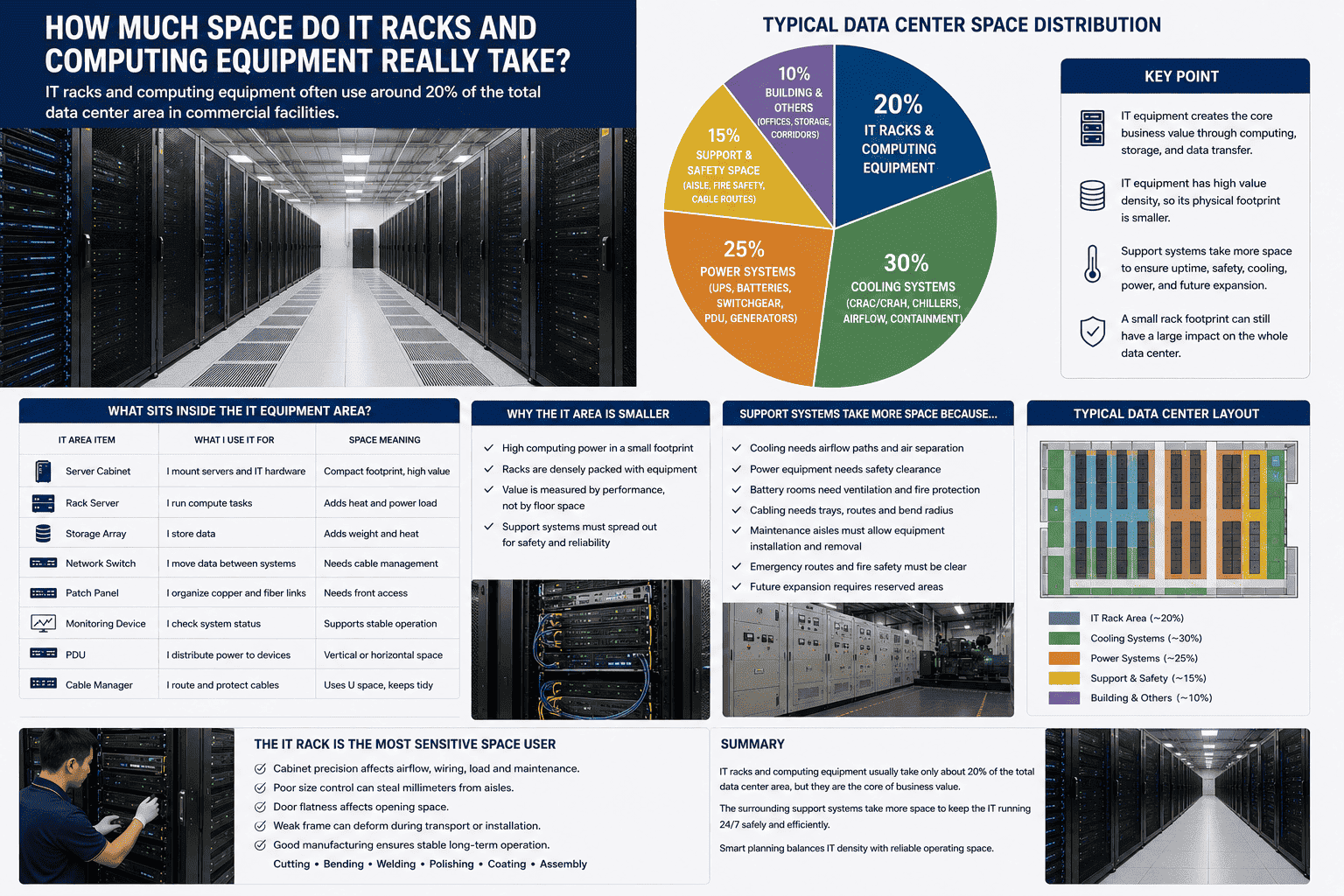
I do not want to make IT equipment sound unimportant. It is the reason the data center exists. A 42U server cabinet can hold rack servers, disk arrays, switches, patch panels, cable managers, PDUs, and monitoring devices. These devices do the useful work. They calculate, store, forward, and protect data. The customer pays for this capacity.
The key point is that IT equipment has high value density. A rack can hold a lot of computing power in a small footprint. This is why people overestimate its space share. They see value and assume area. The building tells a different story. The support systems spread out around the IT load.
What sits inside the IT equipment area?
| IT area item | What I use it for | Space meaning |
|---|---|---|
| Server cabinet | I mount servers and IT hardware | It is compact and high value |
| Rack server | I run compute tasks | It adds heat and power load |
| Storage array | I store data | It adds weight and heat |
| Network switch | I move data between systems | It needs cable management |
| Patch panel | I organize copper and fiber links | It needs front access |
| Monitoring device | I check system status | It supports operation |
I pay close attention to cabinet structure because this small space must carry heavy value. The rack must support load. The mounting rails must be accurate. The mesh door must support airflow. The frame must handle transport and long-term use. The surface coating must resist rust. The grounding must be safe. If the cabinet is non-standard, I must match special width, depth, door style, hole pattern, cable entry, and accessory layout.
This is why I always say the server cabinet is not the largest space user, but it is still the most sensitive space user. A mistake in a cabinet can affect airflow, wiring, load, and maintenance. A dense rack can also push the cooling and power systems to grow larger. So the rack footprint may be small, but its effect on the whole data center is large.
What is the real space ranking inside a data center?
I like to rank data center space by real building use, not by what looks most visible. This helps buyers avoid wrong budgets and wrong layouts.
The common space ranking is cooling system first, power system second, safety and maintenance space third, and IT computing equipment fourth. The exact share changes by design, but support infrastructure usually takes far more space than the racks themselves.
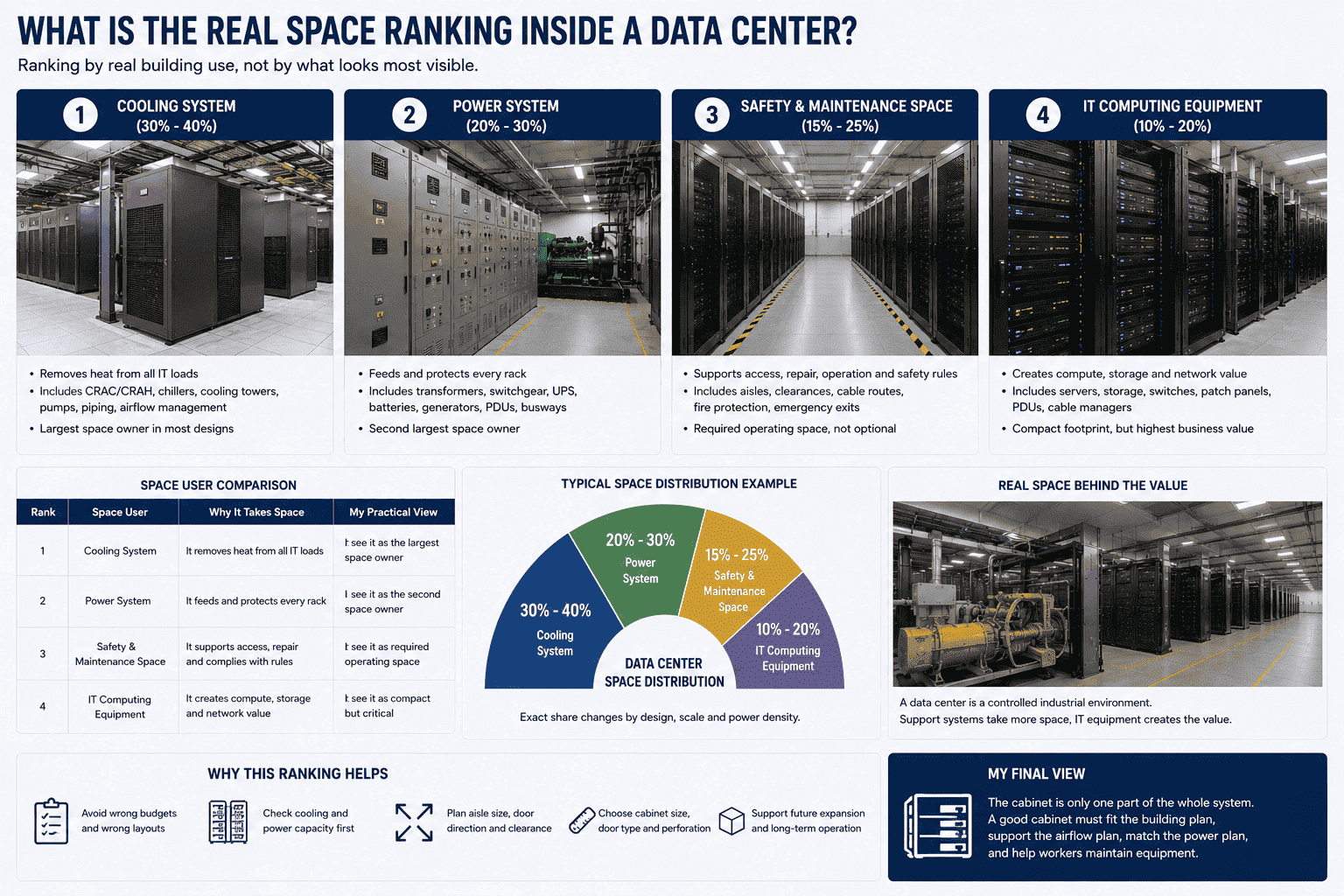
I use this ranking when I talk with clients about cabinet orders and custom cabinet projects. If a client only counts rack rows, the plan is not complete. I need to know the cooling design, power density, cable route, door direction, aisle size, and future expansion plan. These details affect cabinet size, cabinet door type, perforation rate, loading design, and packaging.
A data center is a controlled industrial environment. It needs constant power, constant temperature, fire protection, dust control, water protection, and safe access. The racks sit inside that environment. The support system is like the body. The IT equipment is like the brain. The brain matters most for value, but the body takes more space.
How I compare the main space users
| Rank | Space user | Why it takes space | My practical view |
|---|---|---|---|
| 1 | Cooling system | It removes heat from all IT loads | I see it as the largest space owner |
| 2 | Power system | It feeds and protects every rack | I see it as the second space owner |
| 3 | Safety and maintenance space | It supports access, repair, and rules | I see it as required operating space |
| 4 | IT computing equipment | It creates compute, storage, and network value | I see it as compact but critical |
I think this ranking helps people make better choices. If a buyer wants more racks, I must check whether the cooling and power systems can grow with them. If a buyer wants custom mesh doors, I must check airflow needs. If a buyer wants deeper cabinets, I must check aisle clearance. If a buyer wants high load racks, I must check floor load and frame strength.
I have made standard cabinets, non-standard cabinets, server cabinets, and custom mesh doors for many types of projects. I have learned that the cabinet is only one part of the whole system. A good cabinet must fit the building plan. It must support the airflow plan. It must match the power plan. It must help workers maintain equipment. This is why I see data center space as a system problem, not a rack count problem.
Conclusion
I see data center space clearly now. Cooling, power, and safe operation space take most area, while IT racks stay compact but critical.
"[PDF] Best Practices Guide for Energy-Efficient Data Center Design", https://www.energy.gov/sites/default/files/2024-07/best-practice-guide-data-center-design.pdf. ASHRAE thermal guidance for data processing environments treats IT equipment heat output as a primary design load that cooling systems must continuously remove to maintain allowable operating conditions. Evidence role: mechanism; source type: institution. Supports: A source should explain that data center cooling systems are designed around the continuous heat output of IT equipment and associated heat loads.. Scope note: This supports the thermal-design mechanism, while the exact claim that cooling is the largest space user remains dependent on the specific facility layout. ↩
"Install In-rack or In-row Cooling - Energy Star", https://www.energystar.gov/products/data_center_equipment/16-more-ways-cut-energy-waste-data-center/install-rack-or-row. Reference sources define CRAC and CRAH units as computer-room cooling systems used to control temperature and airflow for IT equipment spaces. Evidence role: definition; source type: encyclopedia. Supports: A source should define CRAC and CRAH units and describe their function in maintaining data center environmental conditions.. Scope note: A definition source may confirm function but may not quantify the floor area or clearance required for a specific installation. ↩
"[PDF] Temperature Management in Data Centers: Why Some (Might) Like ...", https://users.ece.cmu.edu/~gamvrosi/assets/tr_sigmetrics12.pdf. Thermal guidelines for data processing equipment specify allowable operating temperature ranges and note that operation outside these ranges can impair reliability or availability. Evidence role: mechanism; source type: institution. Supports: A source should show that IT equipment has specified environmental temperature ranges and that exceeding them can trigger failures, shutdowns, or reduced reliability.. Scope note: The source supports the risk mechanism; it may not document a specific full-facility outage caused by overheating. ↩
"How Researchers Are Driving Advances for Data Centers", https://newscenter.lbl.gov/2025/12/16/how-researchers-are-driving-advances-for-data-centers/. Data center energy analyses commonly model nearly all electrical energy consumed by IT equipment as heat released into the room, making IT power draw the principal driver of cooling load. Evidence role: mechanism; source type: research. Supports: A source should explain that the electrical energy used by IT equipment is largely dissipated as heat that must be removed by the cooling system.. ↩
"Move to a Hot Aisle/Cold Aisle Layout | ENERGY STAR", https://www.energystar.gov/products/data_center_equipment/16-more-ways-cut-energy-waste-data-center/move-hot-aislecold-aisle-layout. Research and best-practice guidance on data center airflow management describe hot-aisle/cold-aisle layouts as a method for separating cold supply air from hot equipment exhaust and reducing recirculation. Evidence role: mechanism; source type: research. Supports: A source should explain the purpose of hot-aisle/cold-aisle arrangements in separating supply and return air streams.. ↩
"What is Data Center Redundancy? N, N+1, 2N, 2N+1 - CoreSite", https://www.coresite.com/blog/data-center-redundancy-n-1-vs-2n-1. Data center infrastructure standards and availability frameworks treat redundant electrical distribution, uninterruptible power supplies, and backup generation as core elements for maintaining IT service continuity. Evidence role: expert_consensus; source type: institution. Supports: A source should establish that data center availability depends on reliable electrical distribution, power conditioning, UPS systems, and backup generation.. Scope note: The source supports the general requirement for reliable and backup power, while the exact design level varies by tier, risk tolerance, and business requirements. ↩
"[PDF] Best Practices Guide for Energy-Efficient Data Center Design", https://www.energy.gov/sites/default/files/2024-07/best-practice-guide-data-center-design.pdf. Data center electrical-design guidance identifies transformers, switchgear, UPS systems, batteries, generators, distribution units, busways, grounding, and clearance requirements as typical parts of the facility power chain. Evidence role: general_support; source type: institution. Supports: A source should identify typical components of data center electrical infrastructure and explain the need for installation and maintenance clearances.. Scope note: The source may not list every component in the same sentence, and component selection depends on the facility’s voltage, redundancy, and backup design. ↩
"Data Center and Server Room Standards", https://services.ku.edu/TDClient/818/Portal/KB/ArticleDet?ID=21009. Data center layout and safety standards require designers to provide circulation aisles, equipment service clearances, cable pathways, and emergency or fire-safety access rather than maximizing rack count alone. Evidence role: expert_consensus; source type: institution. Supports: A source should establish that data center designs require access aisles, service clearances, cable-management pathways, and fire or emergency access.. Scope note: Specific clearance dimensions vary by jurisdiction, equipment type, electrical code, and facility standard. ↩
