
What are the primary use cases for micro data centers?
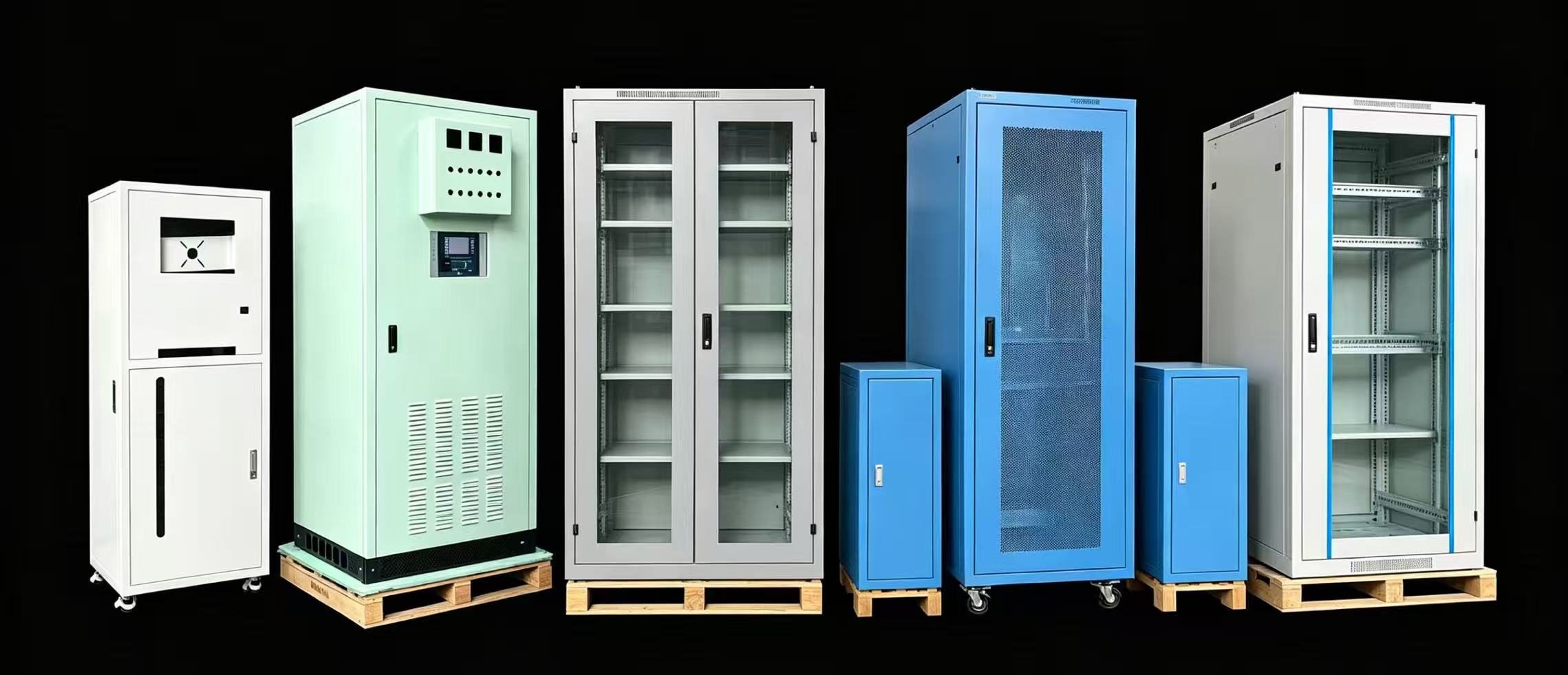
Many teams need local computing now. Large data centers take time, space, and fixed lines. I see many projects slow down because the site cannot wait.
-
How do micro data centers support industrial production?
Factories lose time when equipment data must travel too far. A small delay can hide a fault. I have seen production teams ask for local computing because downtime costs money.
Micro data centers support industrial production by placing computing, storage, and network control near machines. They help factories collect data, process line information, store records, find faults, and reduce unplanned downtime without building a full computer room.1
Factory floor data needs local response
In industrial production, data comes from machines, sensors, cameras, PLC systems, and inspection devices. I often hear the same concern from factory clients. They do not want every small signal to depend on a faraway data center. They need local response. They also need stable storage when the network is not perfect.
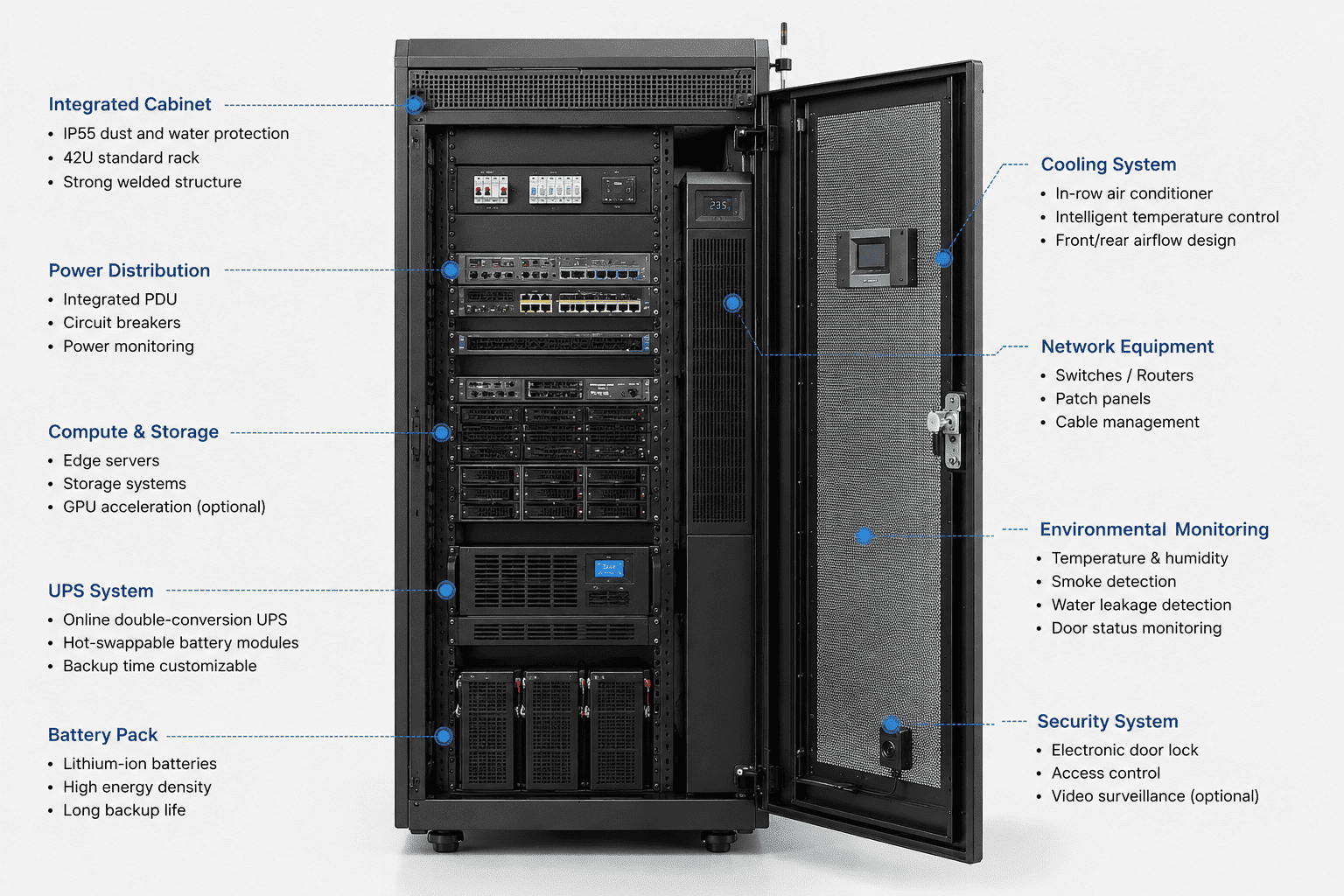
A micro data center can be placed in a production workshop, a control room, or a plant equipment area. It can hold servers, switches, UPS power, monitoring modules, and cooling parts inside one controlled cabinet. The cabinet must also handle dust, vibration, heat, and cable safety.
| Industrial need | Micro data center role | Cabinet design point |
|---|---|---|
| Machine data collection | Local data processing | Strong cable management |
| Fault warning | Fast local analysis | Stable structure |
| Video inspection | Edge storage | Good ventilation |
| Line control data | Low delay response | Safe power layout |
| Downtime reduction | Local backup | Easy maintenance access |
I pay close attention to load capacity and heat flow for these projects. A factory cabinet cannot only look neat. It must support equipment weight. It must keep airflow clear. It must allow workers to open doors and replace parts fast. This is why micro data centers fit industrial use so well.
Why are micro data centers useful for telecom sites?
Telecom sites are spread across wide areas. Large data centers cannot sit beside every user. I see telecom clients choose smaller modules because distance still matters.
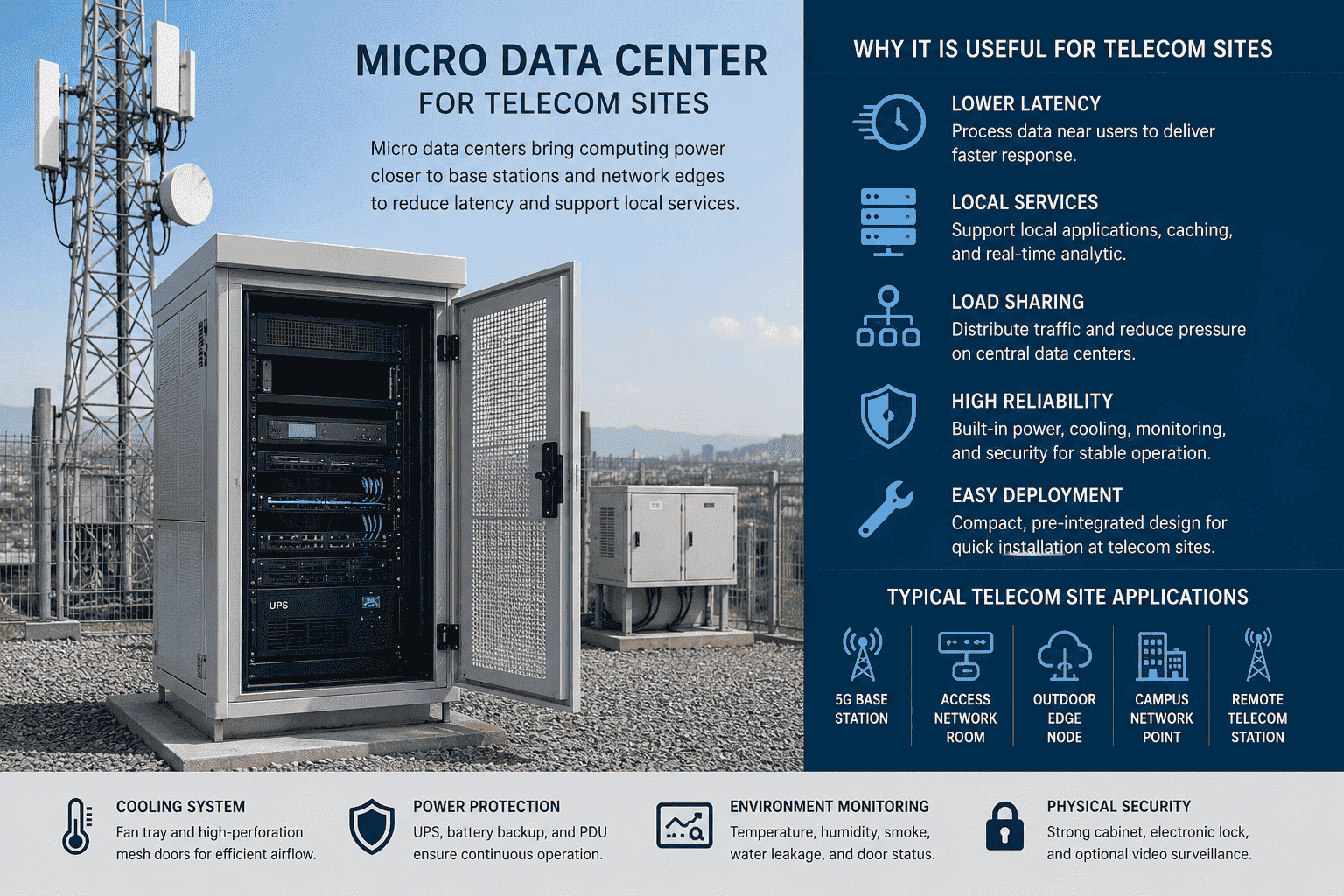
Micro data centers are useful for telecom sites because they place computing power near base stations, access rooms, and network edges. They reduce delay, support local services, and share part of the load that used to return to large central data centers.2
Telecom edge needs compact and repeatable deployment
Telecom construction needs speed. A base station, a small equipment room, or an edge access point may not have enough space for a full data room. A micro data center gives the telecom team a smaller and more repeatable way to deploy computing.3 I have seen this in cabinet customization requests. Clients care about the same details again and again. They ask for front and rear access. They ask for high-perforation mesh doors. They ask for fan trays, grounding points, and clear cable holes.
| Telecom site type | Main use | Key requirement |
|---|---|---|
| 5G base station | Edge computing | Compact size |
| Access network room | Local switching | Easy wiring |
| Outdoor node | Local service support | Strong protection |
| Campus network point | User-side computing | Low noise option |
| Remote telecom station | Load sharing | Stable power backup |
The value is clear. Telecom users need faster service. Operators need to reduce pressure on central data centers. A micro data center can sit closer to the user and handle part of the computing task. It can also be installed in a small technical room without heavy room rebuilding. For cabinet manufacturing, this means the product must be accurate. The rack hole positions, frame strength, door clearance, and surface coating all affect real site installation.
How do micro data centers fit banks and financial service points?
Financial service points are not all large headquarters. Many of them are small branches, community outlets, or self-service points. I see these sites need secure local computing.
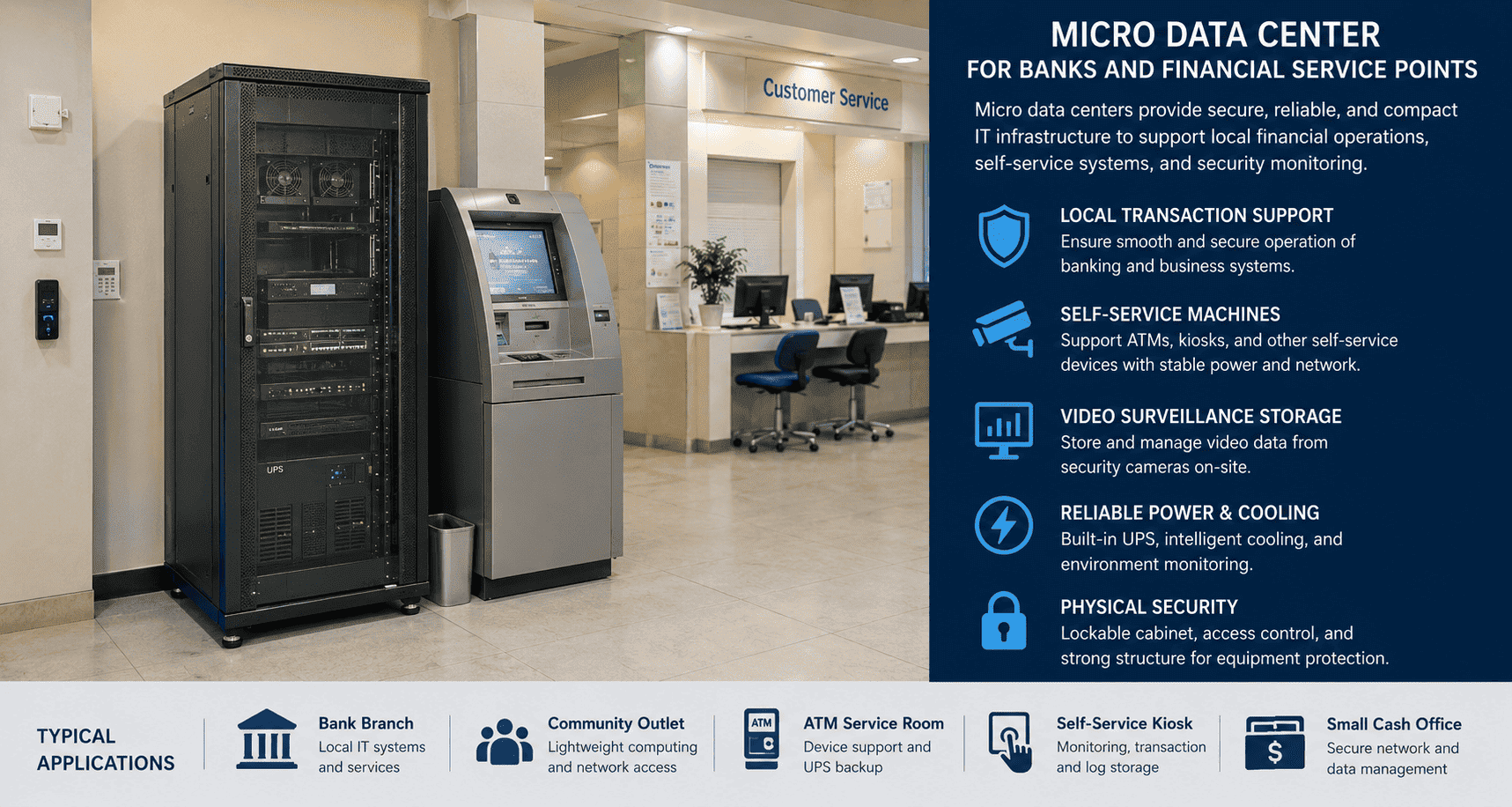
Micro data centers fit banks and financial service points by supporting local transaction systems, network equipment, video storage, self-service machines, and security monitoring.4 They offer controlled power, cooling, and physical protection in places where a full data room is not practical.
Local finance sites need security and simple operation
A bank branch needs stable IT, but it may not have a large technical team on site. A community service point may only have a small equipment area. A self-service banking site may need computing, cameras, network equipment, and power backup in one secure space. A micro data center matches this kind of light and distributed workload.
I see financial projects focus more on safety and maintenance. They want locked doors. They want clear separation between power cables and network cables. They want monitoring for temperature, humidity, smoke, door status, and power status. They also want a cabinet body that is not easy to damage.
| Financial scene | Data center function | Practical cabinet detail |
|---|---|---|
| Bank branch | Local IT support | Secure lock system |
| Community outlet | Light computing | Small footprint |
| ATM service room | Device support | UPS space |
| Self-service kiosk | Monitoring storage | Strong door design |
| Small cash office | Network access | Clean cable routing |
I also notice one simple point. Financial clients do not always want complex equipment. They want equipment that staff can understand. If a cabinet door opens smoothly, if the labels are clear, and if the power module is easy to check, the site team can maintain the system with less stress. This is a quiet but important value of micro data centers.
Why do hospitals and clinics use micro data centers?
Medical sites cannot wait for unstable data access. A clinic, a town health center, or a hospital department may need local systems that keep running.
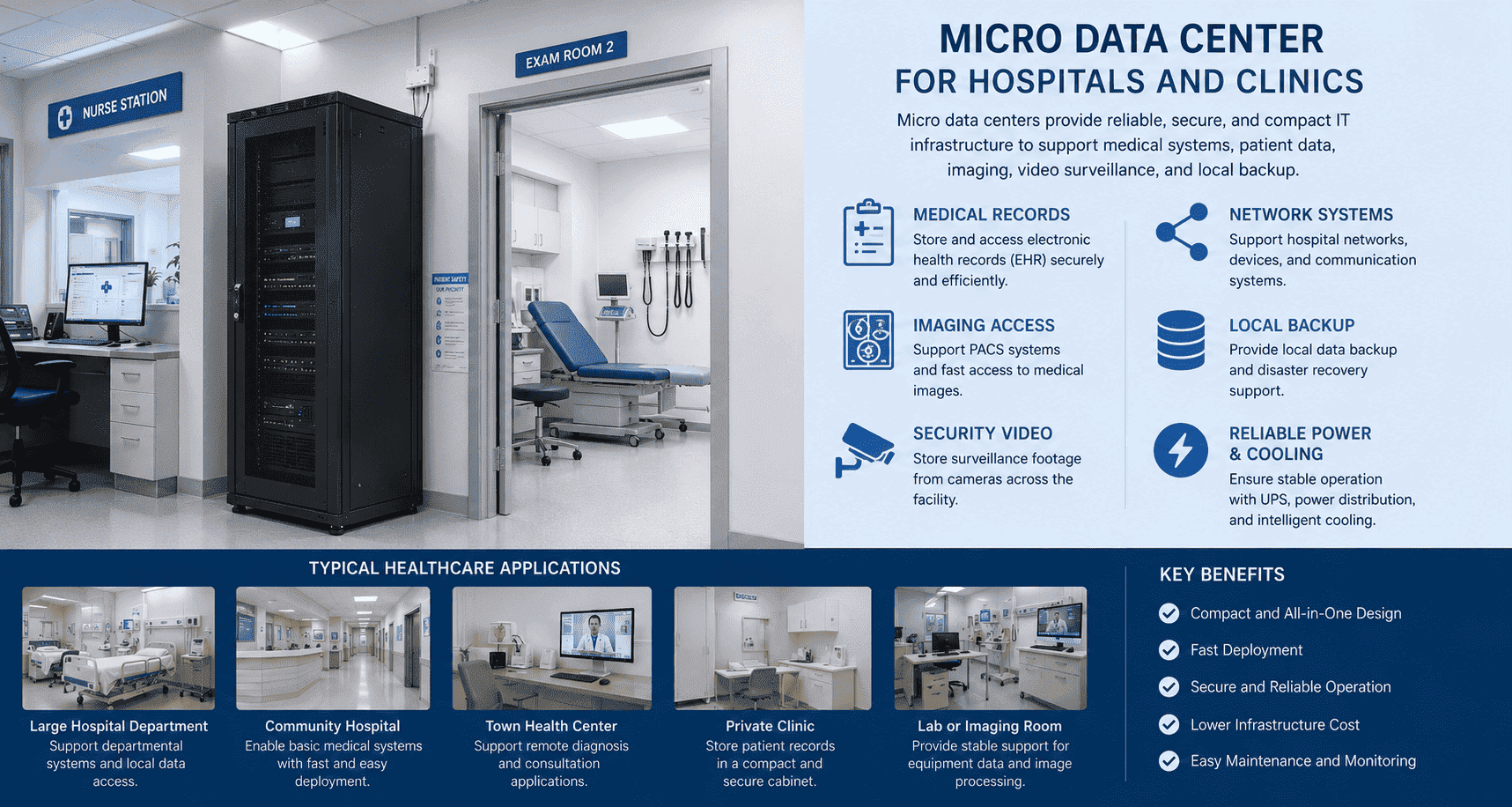
Hospitals and clinics use micro data centers to support medical records, imaging access, network systems, security video, and local backup.5 They help medical sites deploy computing fast without building a separate computer room.
Healthcare computing is not only for large hospitals
Many people think medical data centers only belong in large hospitals. I do not see it that way. I see more small healthcare sites need digital systems too. A community clinic may need registration data, drug system access, video monitoring, and local backup. A town health center may need remote consultation equipment. A private clinic may need a small but safe server system.
A micro data center is useful because it can be delivered as one controlled unit. It can include rack space, cooling, power distribution, UPS, network access, and monitoring. The site does not need to rebuild a professional machine room from zero.
| Medical site | Common need | Micro data center value |
|---|---|---|
| Large hospital department | Department data access | Local load support |
| Community hospital | Basic medical systems | Fast deployment |
| Town health center | Remote diagnosis support | Stable local computing |
| Private clinic | Patient record storage | Small secure cabinet |
| Lab or imaging room | Equipment data support | Better heat control |
I pay attention to noise, heat, dust control, and front access in these projects. Medical space is often tight. The cabinet cannot block work paths. The cooling cannot be too rough. The maintenance door must open in a safe direction. These small details make the difference between a drawing and a usable product.
How do micro data centers help smart city projects?
Smart city work creates data everywhere. Cameras, sensors, service halls, and street devices all need fast local computing. I see city projects become more distributed each year.
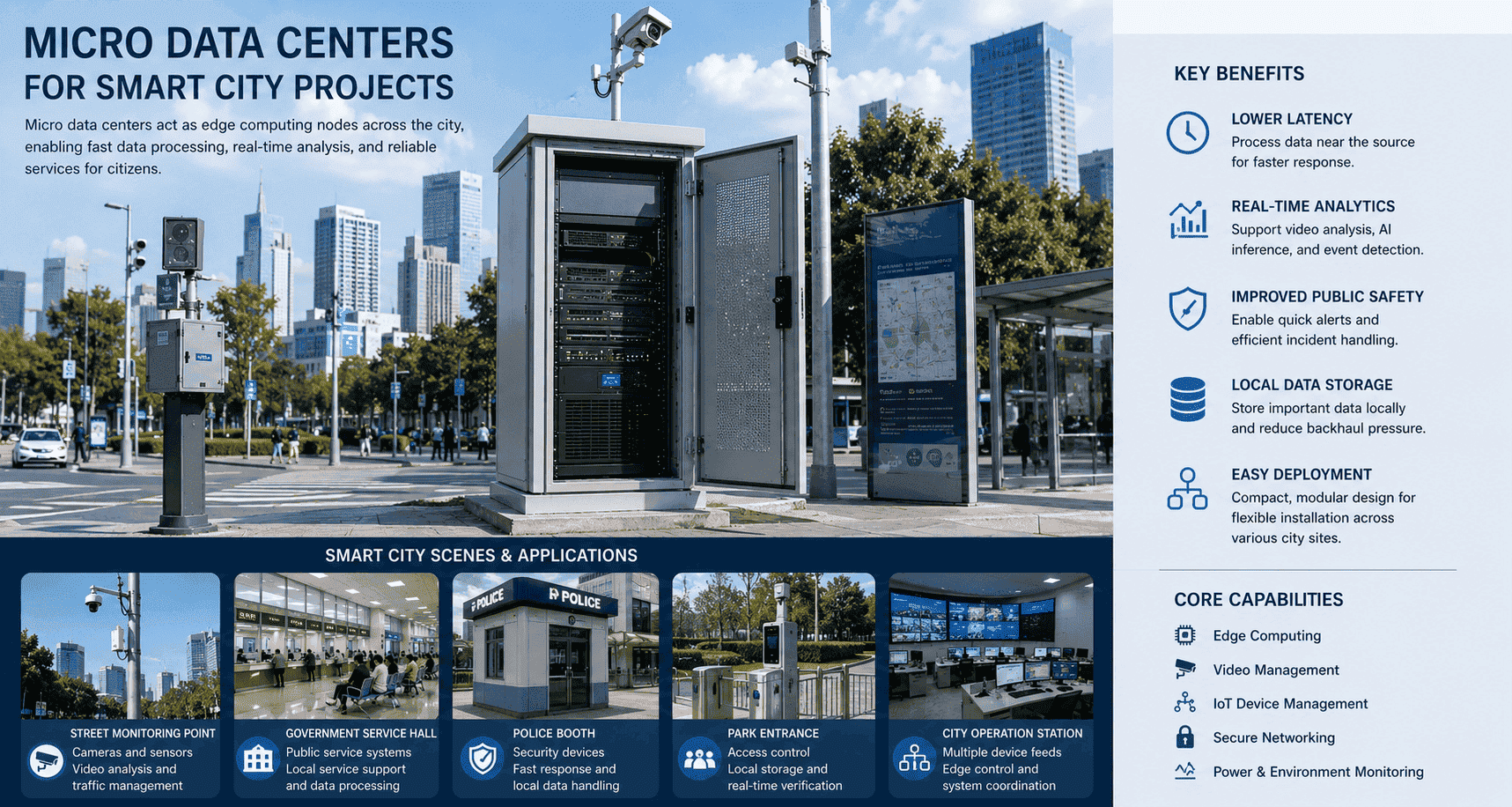
Micro data centers help smart city projects by acting as edge computing points across streets, government halls, police booths, parks, and city service stations. They support video analysis, public safety, device control, and local data storage.6
City data grows at the edge
A smart city does not work from one central machine room only. City data comes from streets, crossings, public buildings, parks, parking areas, community service halls, and security checkpoints. If all data goes back to a far central data center, the system may face delay and pressure.7 A micro data center gives the city a smaller computing point close to each area.
I have seen cabinet requests for street-level control points and service stations. These projects often ask for strong protection, organized wiring, and easy service access. Some sites need indoor cabinets. Some sites need more protected outdoor or semi-outdoor structures.
| Smart city scene | Data source | Local computing purpose |
|---|---|---|
| Street monitoring point | Cameras and sensors | Video analysis |
| Government service hall | Public service systems | Local service support |
| Police booth | Security devices | Fast response |
| Park entrance | Access control | Local storage |
| City operation station | Many device feeds | Edge control |
Micro data centers become the small end points of city computing. They do not replace large data centers. They work with them. I think this is important. The large data center still handles heavy central work. The micro data center handles fast local work. This split makes the city system more flexible and more realistic.
Why are micro data centers important for transport and logistics?
Transport sites move all the time. Roads, airports, warehouses, and logistics hubs need systems that respond fast. I often see central computing alone fail this need.
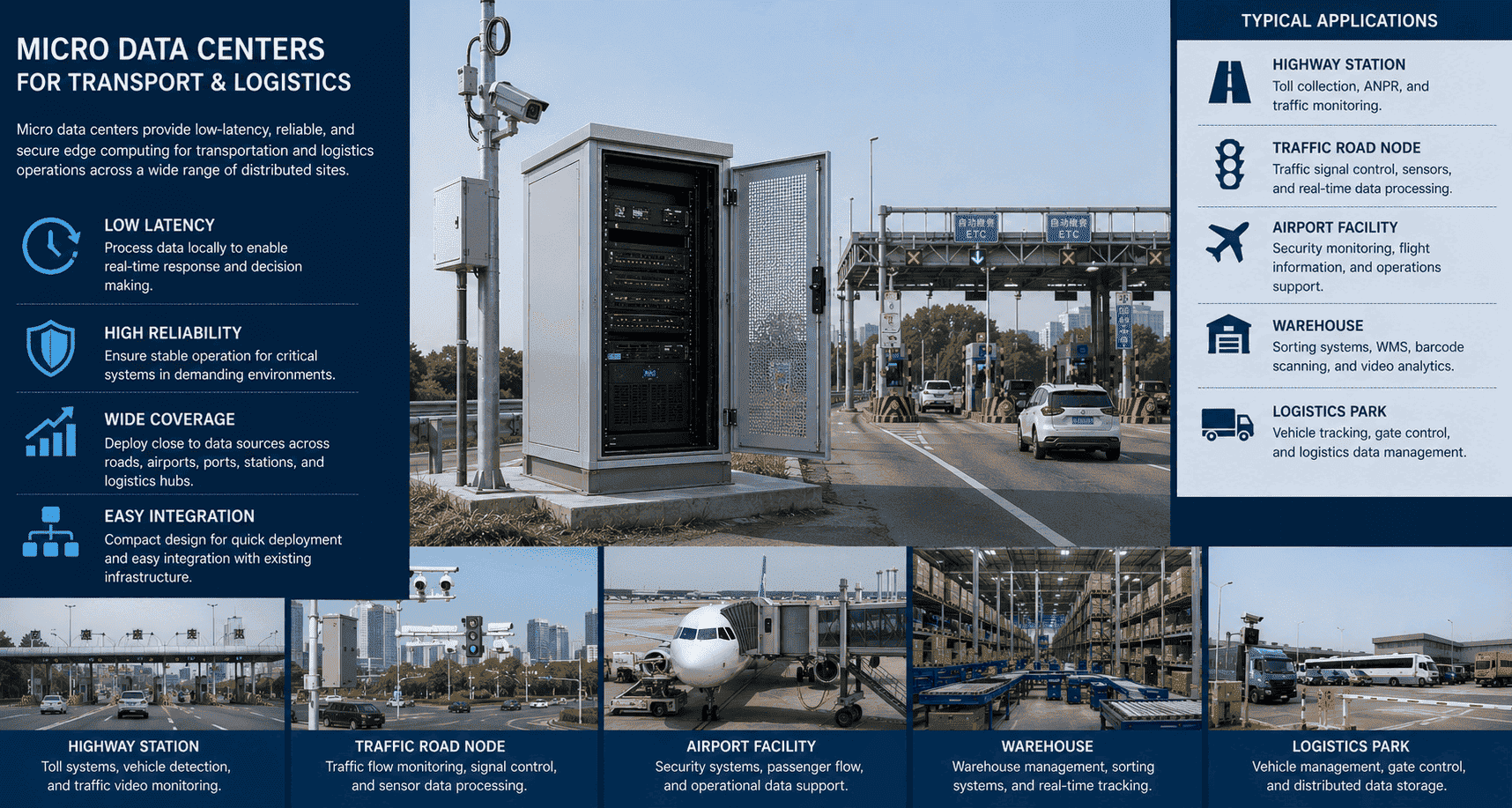
Micro data centers are important for transport and logistics because they support local traffic control, video monitoring, warehouse systems, aviation equipment, road sensors, and logistics tracking.8 They help distributed sites process data with low delay and high stability.
Transport data needs low delay and wide coverage
Transport is different from a normal office. A road camera, a toll station, an airport gate, and a warehouse sorting line all create time-sensitive data. These sites are spread out. They may also run day and night. A micro data center fits this environment because it can be placed close to the actual operation point.
In logistics, a warehouse may use barcode systems, cameras, sorting machines, handheld terminals, and warehouse management software. If the network to a central data center is slow, the whole line may suffer. Local computing can keep key tasks running.
| Transport scene | Main data type | Micro data center use |
|---|---|---|
| Highway station | Toll and camera data | Local processing |
| Traffic road node | Sensor and signal data | Fast response |
| Airport facility | Security and operation data | Stable edge support |
| Warehouse | Sorting and tracking data | Local system support |
| Logistics park | Vehicle and gate data | Distributed storage |
I also see that transport cabinets often need practical design. The cabinet may need stronger frames because site handling can be rough. It may need better ventilation because equipment runs for long hours. It may need better door mesh because heat load can be high. These are not small decoration points. They decide whether the system can run safely in daily use.
How do micro data centers serve energy sites and emergency backup?
Energy and emergency sites need reliable computing when conditions are not ideal. I see these projects care less about appearance and more about stable operation.
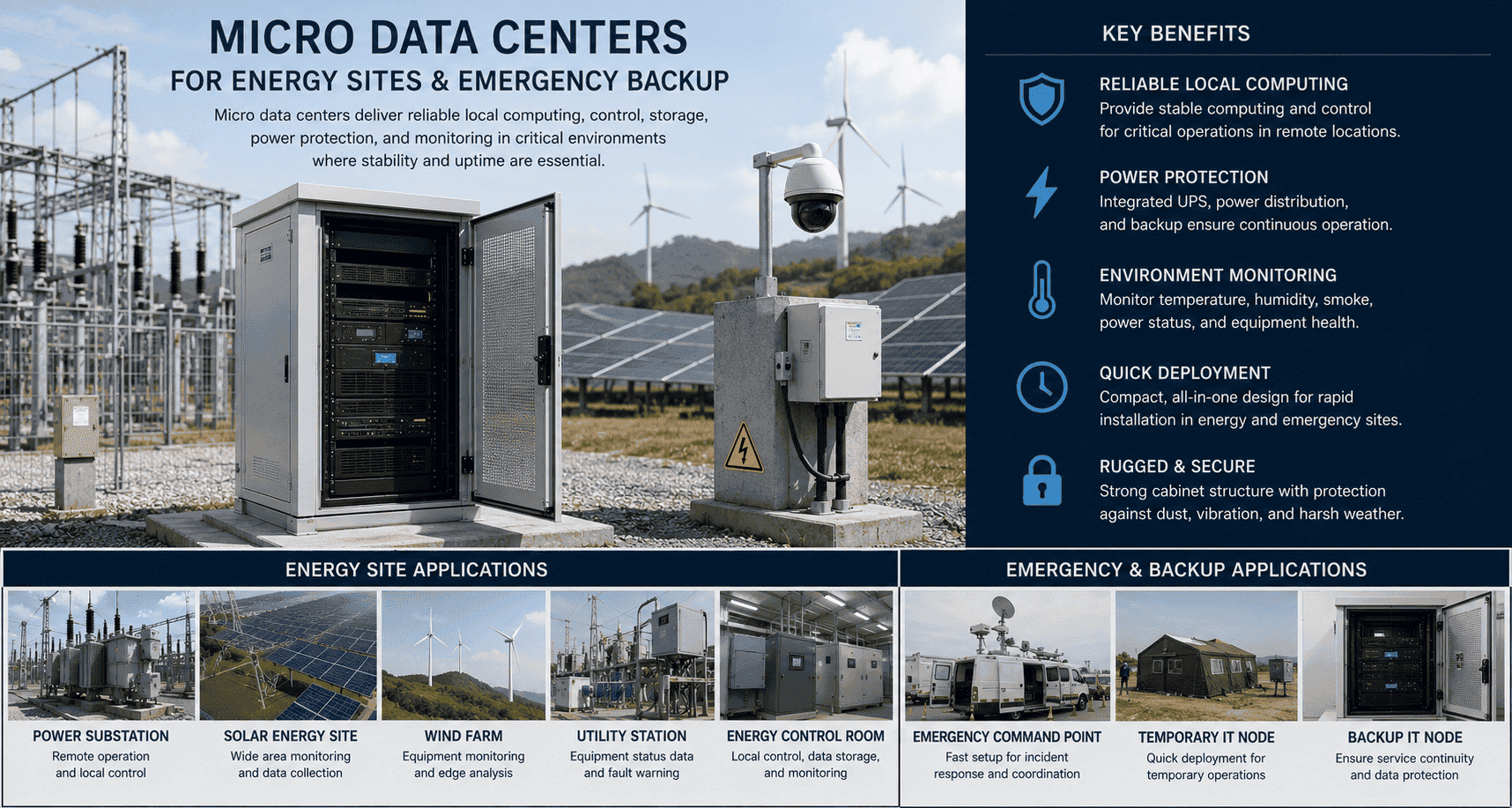
Micro data centers serve energy sites and emergency backup by providing local computing, control, storage, power protection, and monitoring in power plants, substations, renewable energy sites, command vehicles, and temporary emergency points.
Critical sites need strong local support
Energy sites often sit far from city centers. Power plants, substations, solar farms, wind farms, and utility stations all need local control systems. A micro data center can support monitoring, equipment control, data storage, security video, and remote management. It gives the site a stable local computing base.
Emergency backup also needs this type of equipment. A temporary command point may need servers, network devices, storage, UPS, and cooling very quickly. A micro data center can be moved or installed faster than a traditional data room. It can help teams build a working digital base under time pressure.
| Site type | Main problem | Micro data center value |
|---|---|---|
| Power substation | Remote operation | Local control support |
| Solar or wind site | Wide area monitoring | Edge data collection |
| Utility station | Equipment status data | Fault warning |
| Emergency command point | Fast setup need | Quick deployment |
| Backup IT node | Service continuity | Power and cooling inside |
I believe cabinet quality matters most in these sites. The frame must hold the load. The welding must be stable. The surface coating must protect the steel. The door and side panels must fit well. The power and airflow layout must be clear. A micro data center is not only an IT idea. It is also a physical product that must survive real use.
Conclusion
I see micro data centers as practical edge infrastructure. They bring secure, compact, and fast computing to the places where real data work happens.
"Possible Applications of Edge Computing in the ... - PMC", https://pmc.ncbi.nlm.nih.gov/articles/PMC9002468/. Research on industrial edge computing and predictive maintenance shows that local processing of machine and sensor data can support real-time fault detection and maintenance decisions, which can reduce unplanned downtime; the evidence supports the mechanism rather than proving that every micro data-center deployment achieves this outcome. Evidence role: mechanism; source type: paper. Supports: A research source should explain how industrial edge computing supports local sensor-data processing, fault detection, and predictive maintenance that can reduce downtime.. Scope note: The support is contextual because performance depends on the factory system, analytics model, network design, and maintenance process. ↩
"MEC/Cloud Orchestrator to Facilitate Private/Local Beyond 5G ...", https://pmc.ncbi.nlm.nih.gov/articles/PMC9325042/. ETSI and related multi-access edge computing literature explains that placing computing resources near radio or access networks can reduce latency, support local services, and lessen backhaul traffic to centralized cloud facilities. Evidence role: mechanism; source type: institution. Supports: A telecom standards or research source should explain that edge computing near access networks can reduce latency, support location-aware services, and reduce traffic sent to central clouds.. ↩
"Prefabricated modular data center solutions - Flex", https://flex.com/resources/prefabricated-modular-data-center-solutions. Literature on modular and prefabricated data centers describes standardized units as a way to deploy computing capacity in smaller, distributed sites, supporting the article’s point about repeatable telecom-edge deployment. Evidence role: general_support; source type: paper. Supports: A research or institutional source should describe modular data centers as standardized units that can be deployed in smaller distributed locations.. Scope note: The evidence would support modular deployment in general and may not address the author's specific cabinet-manufacturing details. ↩
"[PDF] Business Continuity Planning Booklet - FDIC", https://www.fdic.gov/regulations/examinations/supervisory/insights/sisum06/bcp.pdf. Financial-sector IT guidance describes banks’ dependence on distributed information systems, telecommunications, ATMs, security controls, and business-continuity arrangements, providing contextual support for housing such functions in localized infrastructure. Evidence role: general_support; source type: government. Supports: A financial regulatory or institutional source should show that financial institutions rely on distributed IT, telecommunications, ATMs, security systems, and continuity controls at branch or service locations.. Scope note: The source may support the operational need for local infrastructure without specifically naming micro data centers as the required solution. ↩
"ONC - Office of the National Coordinator for Health IT", https://healthit.gov/. Government health IT materials identify electronic health records and related clinical information systems as core components of modern care delivery, while medical-imaging literature describes networked storage and access requirements for imaging data; this supports the healthcare functions named here, though not the necessity of a micro data center in every clinic. Evidence role: general_support; source type: government. Supports: A health IT source should document that clinical organizations depend on electronic health records, imaging systems, networks, and data availability.. Scope note: The evidence supports healthcare IT needs generally; local deployment choices depend on facility size, regulations, workload, and connectivity. ↩
"Edge-Computing Video Analytics for Real-Time Traffic ... - PMC", https://pmc.ncbi.nlm.nih.gov/articles/PMC6540244/. Research on edge computing for smart cities describes the use of edge nodes for camera and sensor data processing, video analytics, public-safety services, device coordination, and local storage, supporting these stated smart-city functions. Evidence role: mechanism; source type: paper. Supports: A smart-city edge-computing paper should describe local processing and storage for camera, sensor, public-safety, and device-control workloads.. ↩
"[PDF] Latency Comparison of Cloud Datacenters and Edge Servers", https://par.nsf.gov/servlets/purl/10184999. Technical literature on edge computing explains that sending large volumes of distributed sensor or user data to centralized cloud facilities can increase latency and network load, while processing nearer the edge can reduce those constraints. Evidence role: mechanism; source type: research. Supports: A technical source should explain that centralized cloud processing of distributed data can increase latency and bandwidth consumption, while edge processing can reduce these burdens.. ↩
"Real-Time Video Analytics Empowered by Machine Learning and ...", https://digital.lib.washington.edu/researchworks/items/2211a661-201d-427d-acb2-29f109966d2b. Research on edge computing for intelligent transportation systems and logistics describes local processing for traffic sensors, video analytics, vehicle or goods tracking, and operational control, supporting the transport and logistics workload list in this article. Evidence role: general_support; source type: paper. Supports: A transportation or logistics edge-computing source should connect local processing with traffic sensing, video analytics, warehouse operations, and tracking applications.. Scope note: The evidence is likely to support the application categories rather than prove that micro data centers are the only or preferred implementation. ↩
