
What purpose do micro data centers serve?
Data grows fast. Central rooms feel far away. Teams wait for response, pay more for bandwidth, and still worry about local uptime.
Micro data centers serve local computing, storage, cooling, power, monitoring, and security needs near the data source.1 I use them to reduce delay, support edge workloads, protect data, and deploy reliable IT capacity without building a full data center.
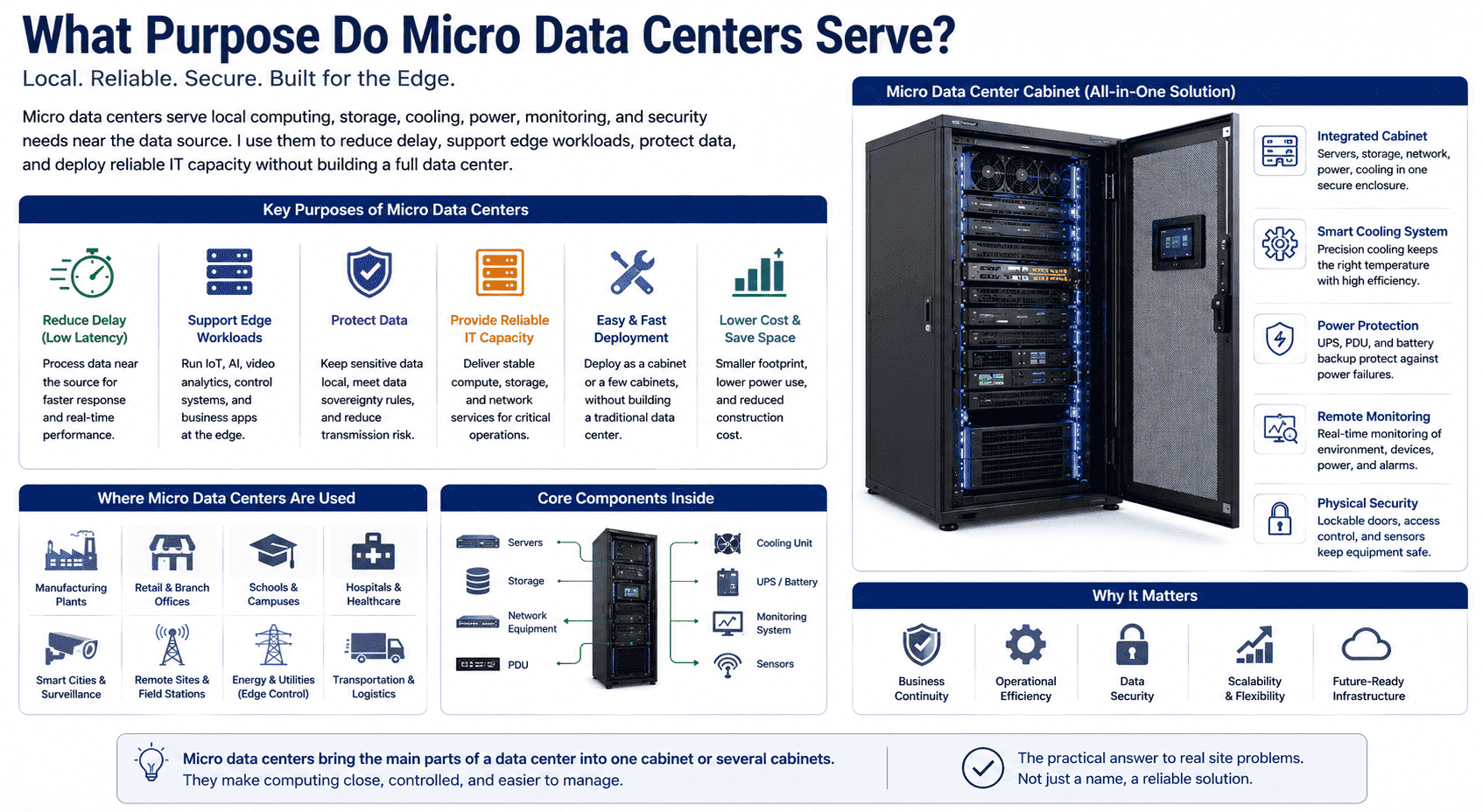
I have seen many customers ask this question only after a site problem happens. A camera system loses video. A factory line stops reporting data. A campus network room overheats. A small edge cabinet becomes a serious business risk. I see micro data centers as a practical answer to these problems, not as a fancy new name. They bring the main parts of a data center into one cabinet or several cabinets. They make computing close, controlled, and easier to manage.
Why do I see micro data centers as the bridge between cloud and field sites?
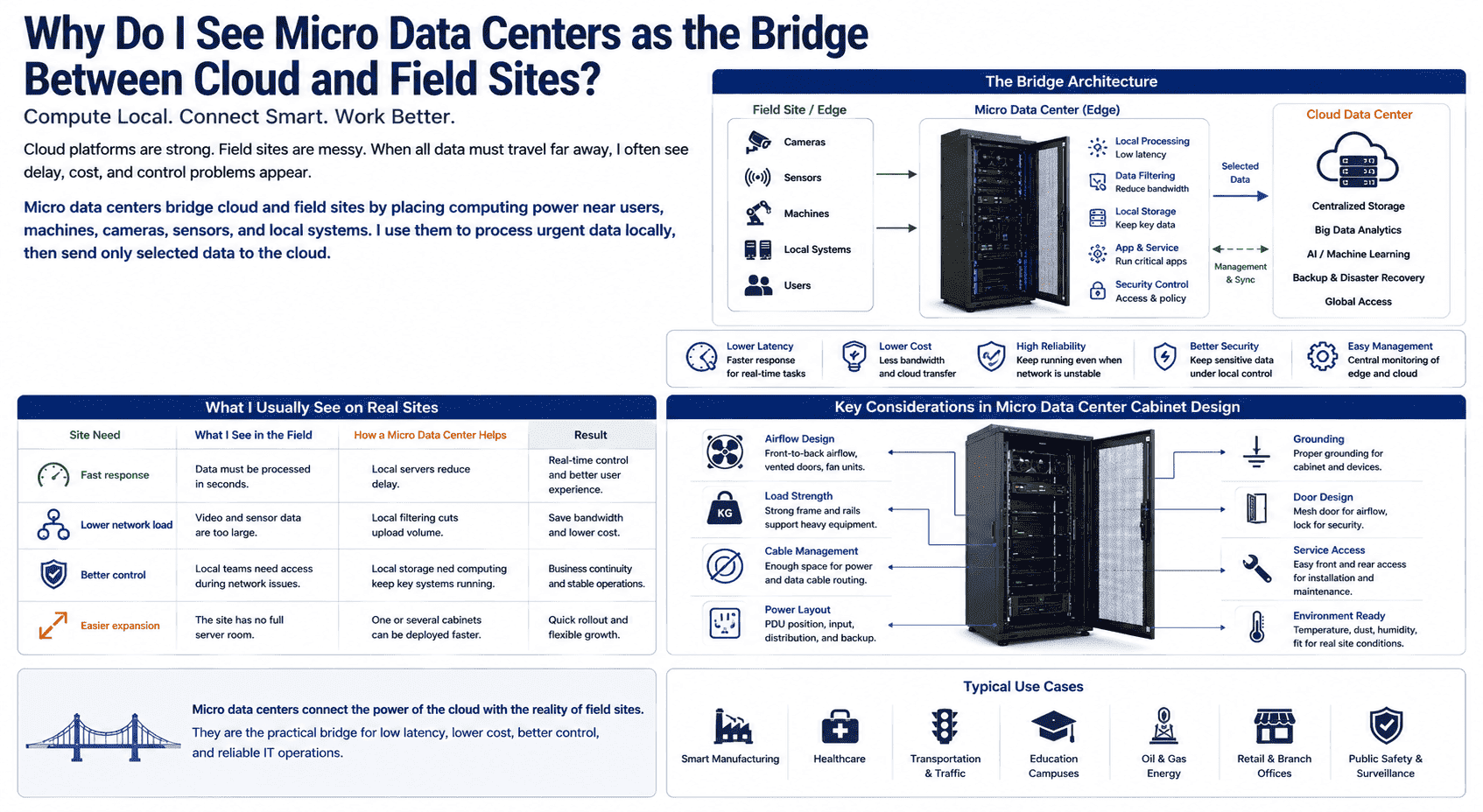
Cloud platforms are strong. Field sites are messy. When all data must travel far away, I often see delay, cost, and control problems appear.
Micro data centers bridge cloud and field sites by placing computing power near users, machines, cameras, sensors, and local systems.2 I use them to process urgent data locally, then send only selected data to the cloud.3
What I usually see on real sites
I often meet customers who already use cloud services. They are not against the cloud. Their real problem is that some work cannot wait for the cloud. A factory needs machine data in real time. A hospital needs local access to medical images and systems. A traffic site needs video review and event alerts without long delay. A campus wants local storage for security video. In these cases, I see a micro data center as a middle layer. It does not replace the cloud. It supports the cloud.
| Site need | What I see in the field | How a micro data center helps |
|---|---|---|
| Fast response | Data must be processed in seconds | Local servers reduce delay |
| Lower network load | Video and sensor data are too large | Local filtering cuts upload volume |
| Better control | Local teams need access during network issues | Local storage and computing keep key systems running |
| Easier expansion | The site has no full server room | One or several cabinets can be deployed faster |
From my cabinet manufacturing work, I also see that the physical structure matters. A micro data center is not only a server in a box. It needs proper airflow, load strength, cable space, power layout, grounding, door design, and service access. If the cabinet is weak or poorly ventilated, the whole system becomes unstable. This is why I always treat the cabinet as part of the computing system, not just as a shell.
Why does a micro data center reduce delay in edge computing?
Remote computing can be slow when data must travel through many network paths. I see delay become a real issue when systems need instant action.
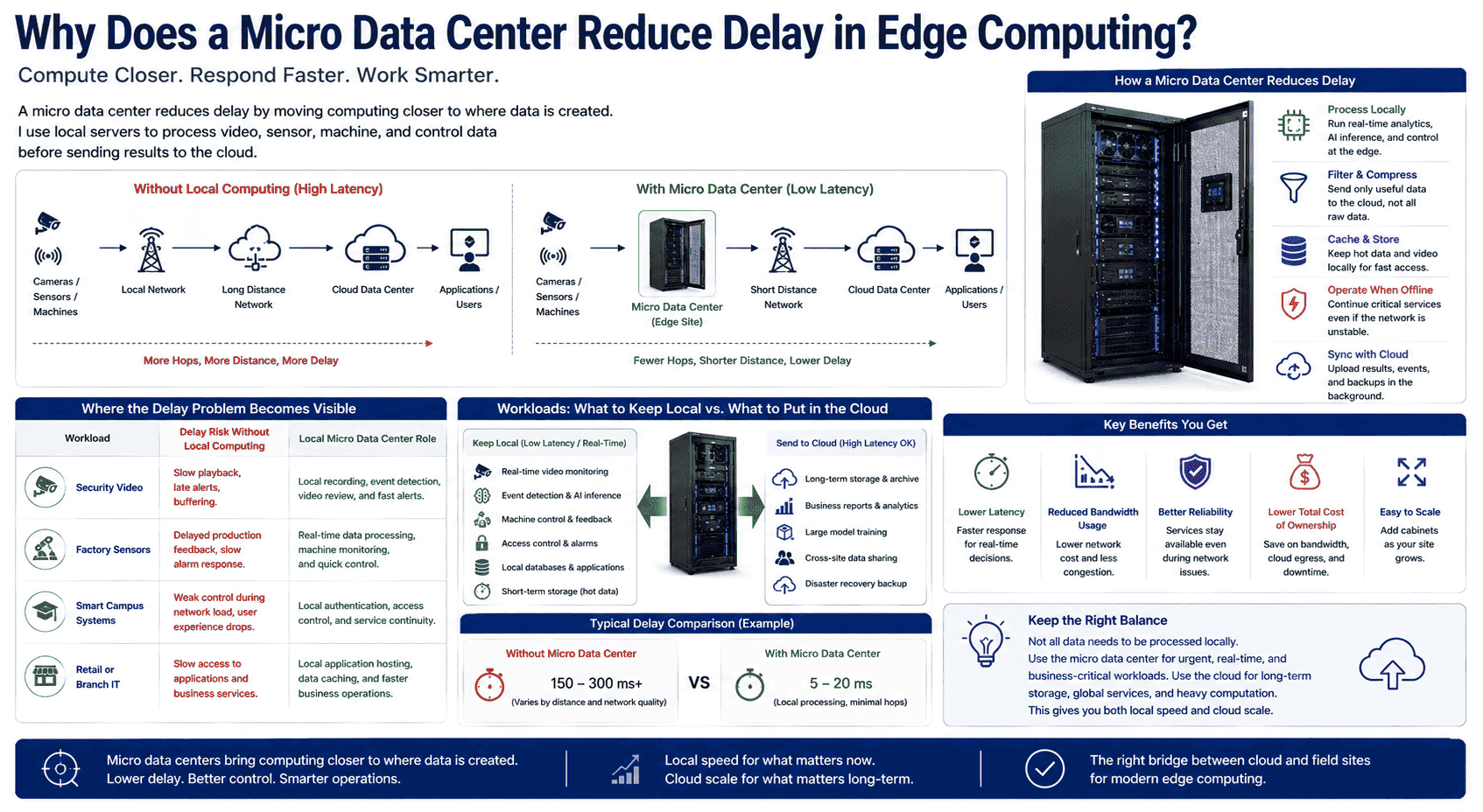
A micro data center reduces delay by moving computing closer to where data is created.4 I use local servers to process video, sensor, machine, and control data before sending results to the cloud.
Where the delay problem becomes visible
I once worked with a customer who had several remote sites with cameras and access control systems. Their main server was far away. Most days, the system worked. On busy days, video playback was slow, alarms arrived late, and staff blamed the network. The real issue was not one single part. The whole structure sent too much raw data across a long path. A local micro data center changed that structure. The site could keep video storage, event filtering, and basic alarm handling local.
| Workload | Delay risk without local computing | Local micro data center role |
|---|---|---|
| Security video | Slow playback and late alerts | Local storage and event review |
| Factory sensors | Delayed production feedback | Local data processing |
| Smart campus systems | Weak control during network load | Local service continuity |
| Retail or branch IT | Slow access to basic services | Local application hosting |
I do not claim that every workload needs local computing. Some data can go to the cloud with no problem. Low-frequency reports, long-term archives, and large model training can stay in central cloud systems. I think the right purpose of a micro data center is to handle the urgent part first. It filters, cleans, stores, and processes the data that matters now. Then it sends useful results or backup records to the cloud. This gives the customer both local speed and cloud scale.
Why is a micro data center easier to deploy than a traditional server room?
A full server room needs space, wiring, cooling, fire safety, monitoring, and many site changes.5 I see many small sites struggle before the first server runs.
A micro data center is easier to deploy because it integrates cabinets, servers, cooling, UPS power, monitoring, fire protection, cabling, and security into a standard module that can be tested before delivery.6
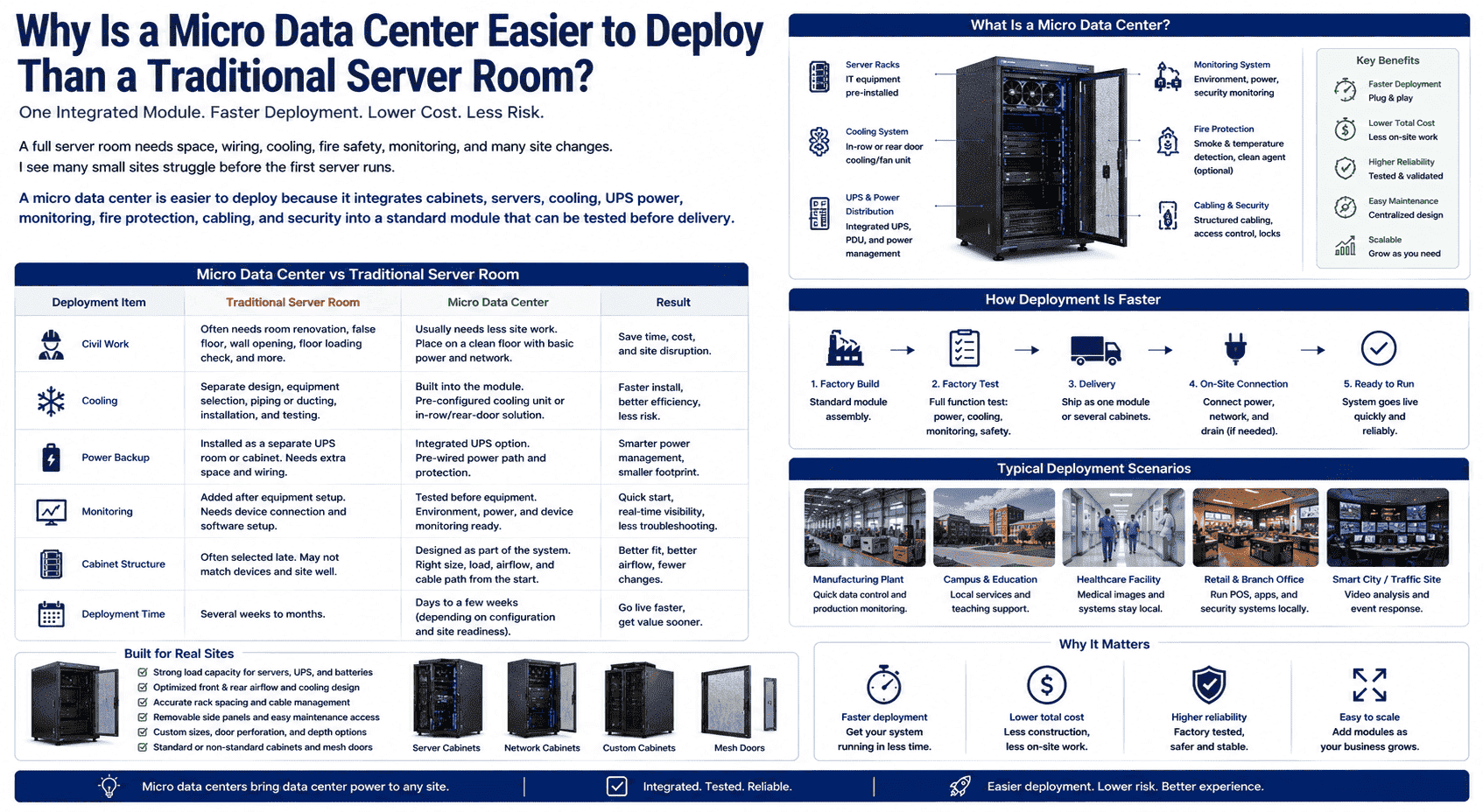
What makes deployment faster
In many projects, the customer does not have a clean server room. They may have a small office, a utility room, a factory corner, or a campus control room. In the past, they needed to rebuild the space before placing IT equipment. That took time and budget. With a micro data center, I see a different path. The system can be built around one cabinet or a small row of cabinets. The cooling, UPS, monitoring, and cable paths can be designed as one set.
| Deployment item | Traditional room | Micro data center |
|---|---|---|
| Civil work | Often needs room renovation | Usually needs less site work |
| Cooling | Separate design and installation | Built into the module |
| Power backup | Installed as a separate system | Integrated UPS option |
| Monitoring | Added after equipment setup | Tested before shipment |
| Cabinet structure | Often selected late | Designed as part of the system |
This is also where our factory experience becomes important. We often support standard network cabinets, server cabinets, non-standard cabinets, and custom mesh doors. For a micro data center, small details matter. The cabinet may need stronger load capacity, better front and rear airflow, exact rack spacing, clean cable management, and removable side panels. Some sites need special door perforation for higher airflow. Some need a different depth for servers and power modules. I prefer to solve these issues before production. It is much cheaper than fixing them after installation.
Why do micro data centers improve local data security and compliance?
Data security becomes harder when every record travels far away. I see some industries need local control for legal, safety, or internal policy reasons.
Micro data centers improve security and compliance by keeping sensitive data near the source, controlling local access, recording device status, and sending only approved data to central cloud systems.7
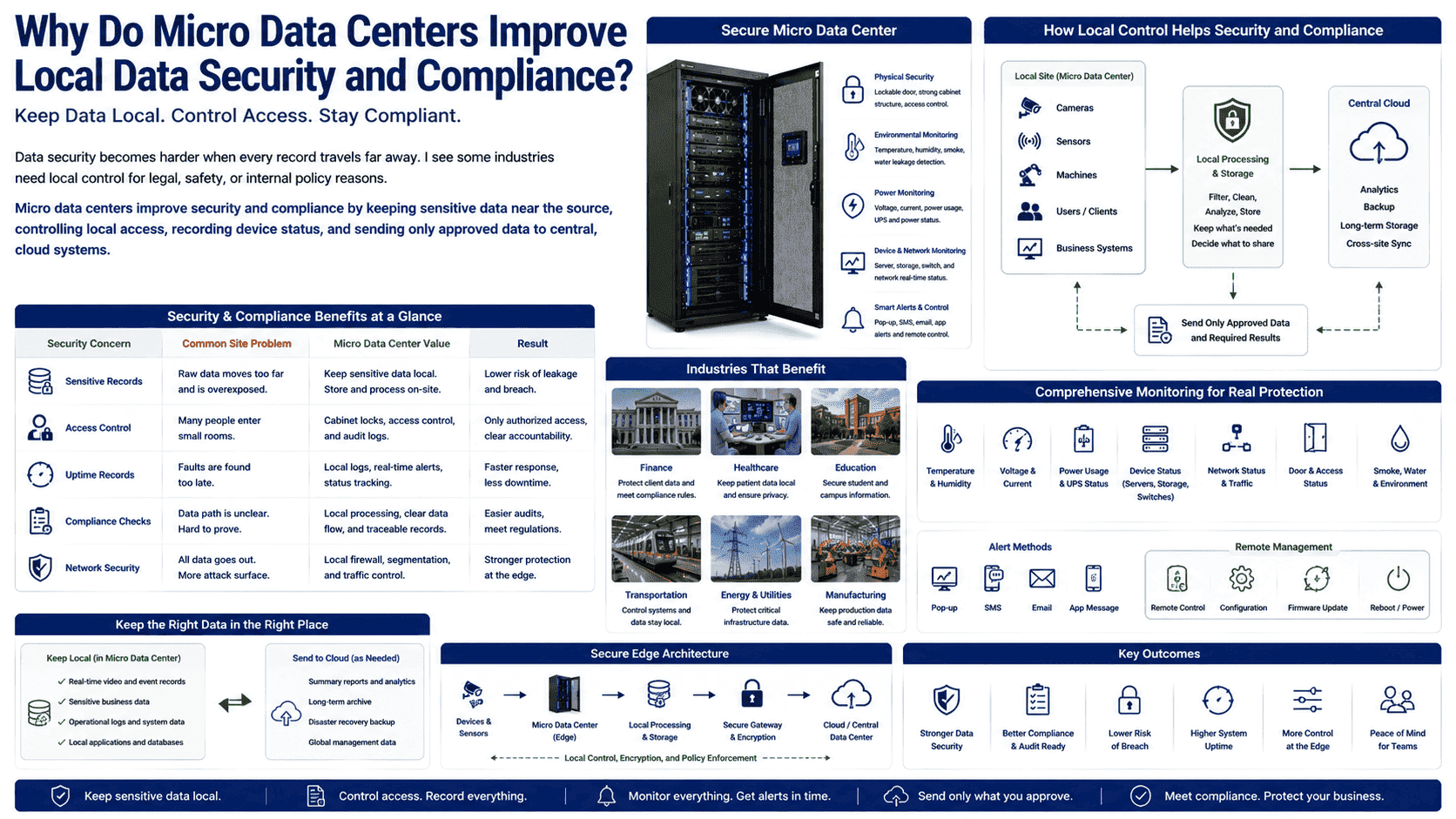
How local control helps
I see this need often in finance, healthcare, education, transport, and energy projects.8 The customer may not want all raw data to leave the site. Sometimes they cannot do that because of rules. Sometimes they just need better control. A micro data center gives them a physical and digital control point. Servers, storage, switches, UPS, sensors, locks, cameras, and alarms can stay in one controlled cabinet area. The customer can decide what gets stored locally, what gets cleaned, and what gets uploaded.
| Security concern | Common site problem | Micro data center value |
|---|---|---|
| Sensitive records | Raw data moves too far | Local storage reduces exposure |
| Access control | Many people enter small rooms | Cabinet locks and monitoring help |
| Uptime records | Faults are found too late | Logs and alerts show real status |
| Compliance checks | Data path is unclear | Local processing makes data flow clearer |
I also think physical security is easy to ignore. A server can be attacked through the network, but it can also fail because a room is hot, a cable is pulled, or the cabinet door is left open. A good micro data center should monitor temperature, humidity, voltage, current, power use, device status, and network state.9 It should send alarms by pop-up, SMS, or app message. I have seen this help customers avoid simple but costly problems. They do not need a person standing beside the cabinet all day. They need clear alerts and remote control when something changes.
Why is the cabinet structure important in a micro data center?
Many people talk about servers first. I understand that. Still, I see the cabinet structure decide whether the system runs safely for years.
The cabinet structure is important because it supports equipment weight, controls airflow, protects cables, holds power and cooling parts, and gives service teams safe access during maintenance.10
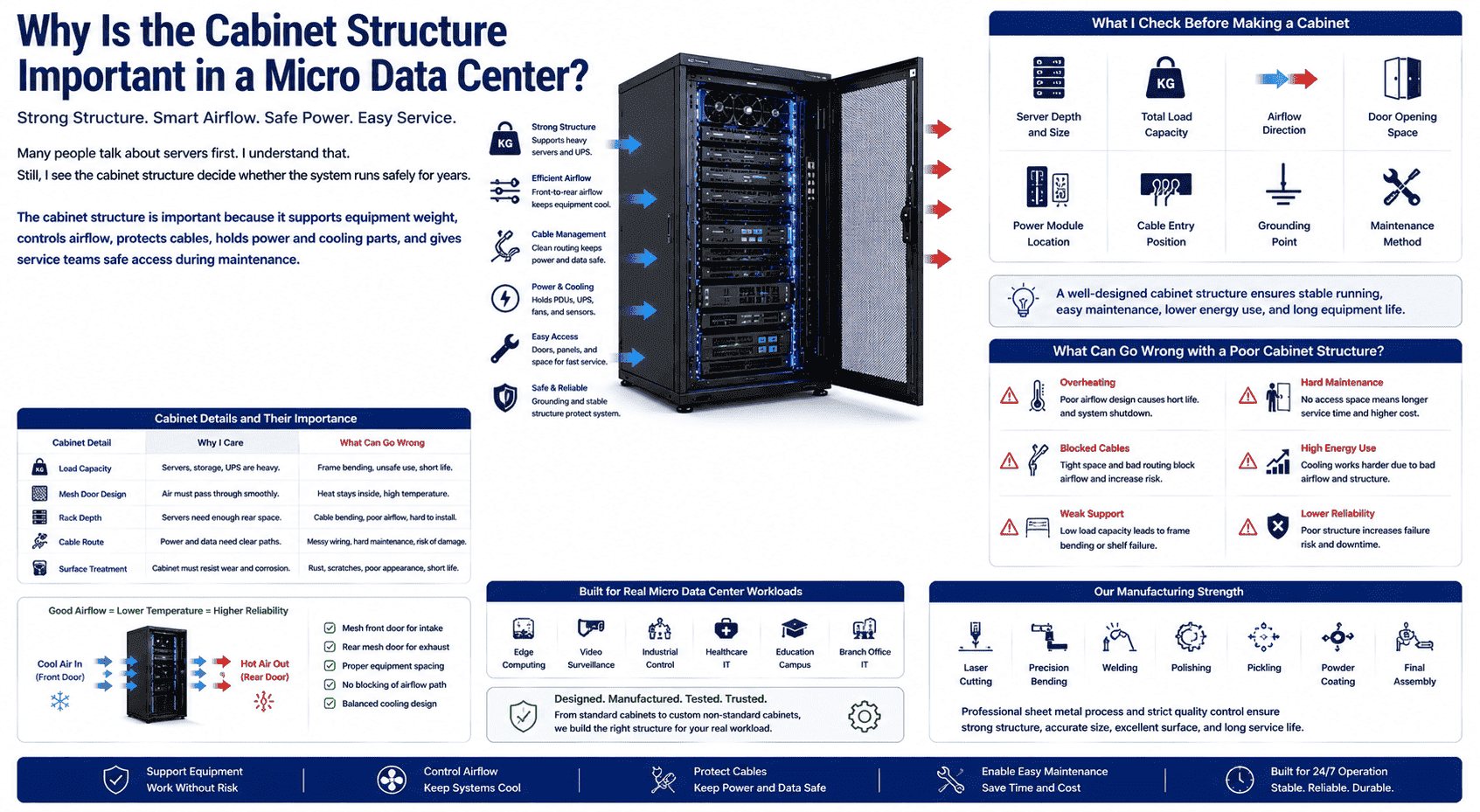
What I check before making a cabinet
In our work, I do not treat the cabinet as a simple metal box. I check the server depth, total load, airflow direction, door opening space, power module location, cable entry, grounding point, and maintenance method. A micro data center often has dense equipment. The heat is higher. The wiring is tighter. The service work is more frequent. If the structure is not planned, the customer may face hot spots, blocked cables, weak shelves, or difficult repair work.
| Cabinet detail | Why I care | What can go wrong |
|---|---|---|
| Load capacity | Servers and UPS units are heavy | Frame bending or unsafe use |
| Mesh door design | Air must pass through smoothly | Heat stays inside the cabinet |
| Rack depth | Servers need enough rear space | Cable bending and poor airflow |
| Cable route | Power and data need clear paths | Messy wiring and hard maintenance |
| Surface treatment | Cabinet must resist wear | Rust, scratches, and poor appearance |
I usually explain this with a simple example. A customer may buy strong servers and a good UPS, but the cabinet may have low ventilation. The cooling system then works harder, and the server fans run louder. Power use rises. Fault risk rises.11 The customer thinks the cooling system is bad, but the real cause may be airflow resistance. This is why we use proper sheet metal processing, laser cutting, precision bending, welding, polishing, pickling, powder coating, and final assembly control. For standard or custom cabinets, I believe the structure must match the real workload.
Why do different industries use micro data centers in different ways?
Every industry creates data in a different place. I see the best design change when the site, workload, and risk level change.
Different industries use micro data centers to support local computing, video storage, control systems, branch applications, and real-time data handling in factories, hospitals, schools, transport sites, energy stations, parks, and communities.
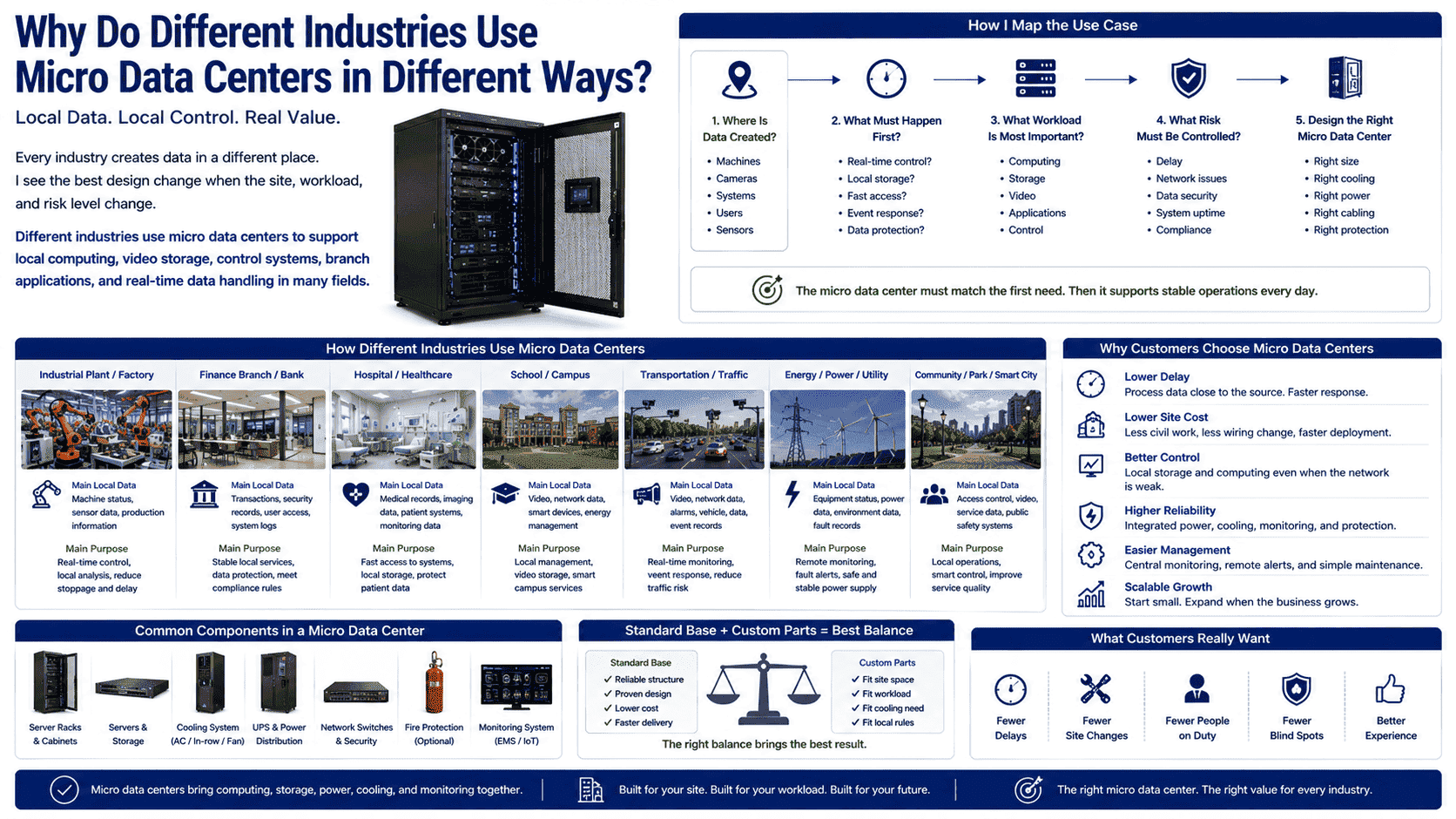
How I map the use case
I do not start by asking how many cabinets the customer wants. I start by asking where the data is created and what must happen first. In a factory, the answer may be machine status and production control. In a hospital, the answer may be local system access and data safety. In a school or campus, the answer may be video storage, network service, and smart power systems. In transport, the answer may be real-time monitoring and event response. The micro data center must match that first need.
| Industry or site | Main local data | Main purpose of micro data center |
|---|---|---|
| Industrial plant | Machine and sensor data | Real-time control and local analysis |
| Finance branch | Transaction and security data | Stable local services and protection |
| Hospital | Records, images, and systems | Fast access and controlled storage |
| School or campus | Video, network, smart devices | Local management and storage |
| Transport | Cameras, signals, and alarms | Fast event response |
| Energy site | Equipment status and safety data | Remote monitoring and fault alerts |
| Community or park | Access, video, and service data | Local operations and smart control |
I see one common point across these industries. The customer does not want more equipment for its own sake. The customer wants fewer delays, fewer site changes, fewer people on duty, and fewer blind spots. A micro data center helps because it is modular and integrated. It can be built in a standard way, but it can still be adjusted for the site. This balance is important. Too much standard design may not fit the field. Too much custom design may cost more and take longer. I think the best result is a standard base with careful custom parts where the site really needs them.
Conclusion
I use micro data centers to bring reliable computing, power, cooling, storage, and monitoring close to real data sources without building a full data center.
"Data center - Wikipedia", https://en.wikipedia.org/wiki/Data_center. A neutral definition of micro data centers describes them as compact data center environments that combine computing resources with supporting power, cooling, and monitoring infrastructure near the point of use. Evidence role: definition; source type: encyclopedia. Supports: A neutral source should define micro data centers as small, self-contained data center environments that support computing and infrastructure close to users or data sources.. Scope note: This would support the general definition, but it may not verify every listed component in all commercial implementations. ↩
"Leveraging IoT, Cloud, and Edge Computing with AI - PMC - NIH", https://pmc.ncbi.nlm.nih.gov/articles/PMC11945247/. Edge computing literature characterizes edge resources as an intermediate layer that brings computation and storage closer to users, sensors, and devices while complementing centralized cloud services. Evidence role: general_support; source type: research. Supports: A research or standards source should support that edge computing architectures place computation and storage closer to data sources and users, complementing centralized cloud computing.. Scope note: This supports the architectural role of edge computing generally; it may not refer specifically to every micro data center deployment. ↩
"Edge Computing and Cloud Computing for Internet of Things - MDPI", https://www.mdpi.com/2227-9709/11/4/71. Studies of edge computing note that local preprocessing, filtering, and aggregation can reduce the volume of raw sensor or video data transmitted to centralized cloud infrastructure. Evidence role: mechanism; source type: paper. Supports: A peer-reviewed source should explain that edge processing can filter, aggregate, or analyze data locally before forwarding selected outputs to cloud systems, reducing transmitted data volume.. Scope note: This supports the mechanism in general; the actual reduction depends on workload type, filtering policy, and network design. ↩
"An Efficient Computation Offloading Strategy with Mobile Edge ...", https://pmc.ncbi.nlm.nih.gov/articles/PMC7923021/. Edge computing research explains that placing computation closer to end devices can reduce communication latency by shortening network paths and avoiding repeated transfers to distant cloud data centers. Evidence role: mechanism; source type: paper. Supports: A technical paper should support that reducing physical and network distance between data sources and compute resources can reduce communication latency for suitable workloads.. Scope note: This is a general network and architectural effect; end-to-end latency still depends on application design, local hardware, and network congestion. ↩
"Data Center and Server Room Standards", https://services.ku.edu/TDClient/818/Portal/KB/ArticleDet?ID=21009. Data center facility guidance identifies power distribution, cooling, fire protection, cabling, monitoring, and dedicated space as core infrastructure considerations for server rooms and data centers. Evidence role: general_support; source type: institution. Supports: A standards or institutional source should document that server rooms and data centers require coordinated planning for power, cooling, fire protection, cabling, monitoring, and physical space.. Scope note: This supports the general facility requirements; the extent of site modification varies by project scale and local code. ↩
"[PDF] Modular/Container Data Centers Procurement Guide", https://datacenters.lbl.gov/sites/default/files/Modular_Data_Center_Procurement_Guide%20GSA.pdf. Literature on modular data centers describes pre-engineered modules that integrate IT racks with supporting power, cooling, and monitoring systems, allowing much of the configuration and testing to occur before installation. Evidence role: general_support; source type: research. Supports: A neutral source should support that modular data centers use pre-engineered or preassembled components, which can simplify deployment compared with building conventional rooms from separate subsystems.. Scope note: This supports deployment simplification as a general feature; it does not prove that every micro data center is faster or easier to deploy in every site condition. ↩
"Privacy Issues in Edge Computing", https://www.cs.wm.edu/~liqun/paper/book-privacy-21.pdf. Edge computing security and privacy studies note that local processing and selective transmission can support data minimization and reduce exposure of sensitive raw data sent to centralized services. Evidence role: general_support; source type: paper. Supports: A source should support that local processing and data minimization at the edge can reduce exposure of sensitive raw data and help organizations enforce access and transmission policies.. Scope note: This is contextual support for security and compliance benefits; actual compliance depends on legal requirements, system configuration, access controls, and governance procedures. ↩
"Data privacy in healthcare: Global challenges and solutions - PMC", https://pmc.ncbi.nlm.nih.gov/articles/PMC12138216/. Government critical-infrastructure and cybersecurity guidance commonly identifies sectors such as energy, transportation, financial services, healthcare, and education as domains where security, continuity, and data protection are significant operational concerns. Evidence role: historical_context; source type: government. Supports: A government or institutional source should show that sectors such as energy, transportation, financial services, healthcare, and education are treated as critical or regulated domains with significant security and continuity concerns.. Scope note: This supports the broader sector relevance; it does not demonstrate that every project in these sectors requires a micro data center. ↩
"[PDF] Thermal Guidelines and Temperature Measurements in Data Centers", https://datacenters.lbl.gov/sites/default/files/FINAL%20Thermal%20Guidelines%20and%20Temp%20Measurements%209-15-2020.pdf. Data center operations guidance treats environmental and power monitoring, including temperature, humidity, and electrical conditions, as important controls for maintaining equipment reliability and availability. Evidence role: expert_consensus; source type: institution. Supports: A standards or institutional source should support monitoring environmental and power conditions, such as temperature, humidity, and electrical status, as part of data center reliability management.. Scope note: This supports the need for monitoring categories generally; the exact alarm channels and monitored variables vary by system design. ↩
"Rack and Stack in Data Centers: Complete Guide - Camali Corp", https://camalicorp.com/news/data-center/rack-and-stack-in-data-centers-complete-guide/. Data center design guidance emphasizes that rack and cabinet configuration affects equipment support, airflow management, cable routing, power distribution, and maintenance access. Evidence role: general_support; source type: institution. Supports: A technical or institutional source should support that rack/cabinet design influences equipment support, airflow paths, cabling organization, and service access in IT environments.. Scope note: This supports the general importance of cabinet design; it does not validate a specific cabinet model or manufacturing method. ↩
"[PDF] WP50-Data Center Efficiency and IT Equipment Reliability at Wider ...", https://datacenters.lbl.gov/sites/default/files/WP50-Data%20Center%20Efficiency%20and%20IT%20Equipment%20Reliability%20at%20Wider%20Operating%20Temperature%20and%20Humidity%20Ranges.pdf. Research on data center thermal management shows that restricted airflow and elevated equipment temperatures can increase fan and cooling energy requirements and contribute to higher risk of thermal-related equipment faults. Evidence role: mechanism; source type: paper. Supports: A paper or thermal-guidance source should explain that restricted airflow and elevated temperatures cause server fans and cooling systems to work harder and can increase reliability risks.. Scope note: This supports the thermal mechanism generally; measured power increase and failure probability depend on equipment design, workload, and ambient conditions. ↩
