
What Is the Exact Height of a 42U Server Rack?
I see buyers lose time when rack height looks simple. One wrong number can break room layout, delivery plans, and final acceptance.
The exact mounting height of a 42U server rack is 1866.9 mm, or about 1867 mm / 73.5 inches. This comes from 42 × 44.45 mm. The common overall outside cabinet height is about 2057 mm, because the shell, top, base, and structure add height.
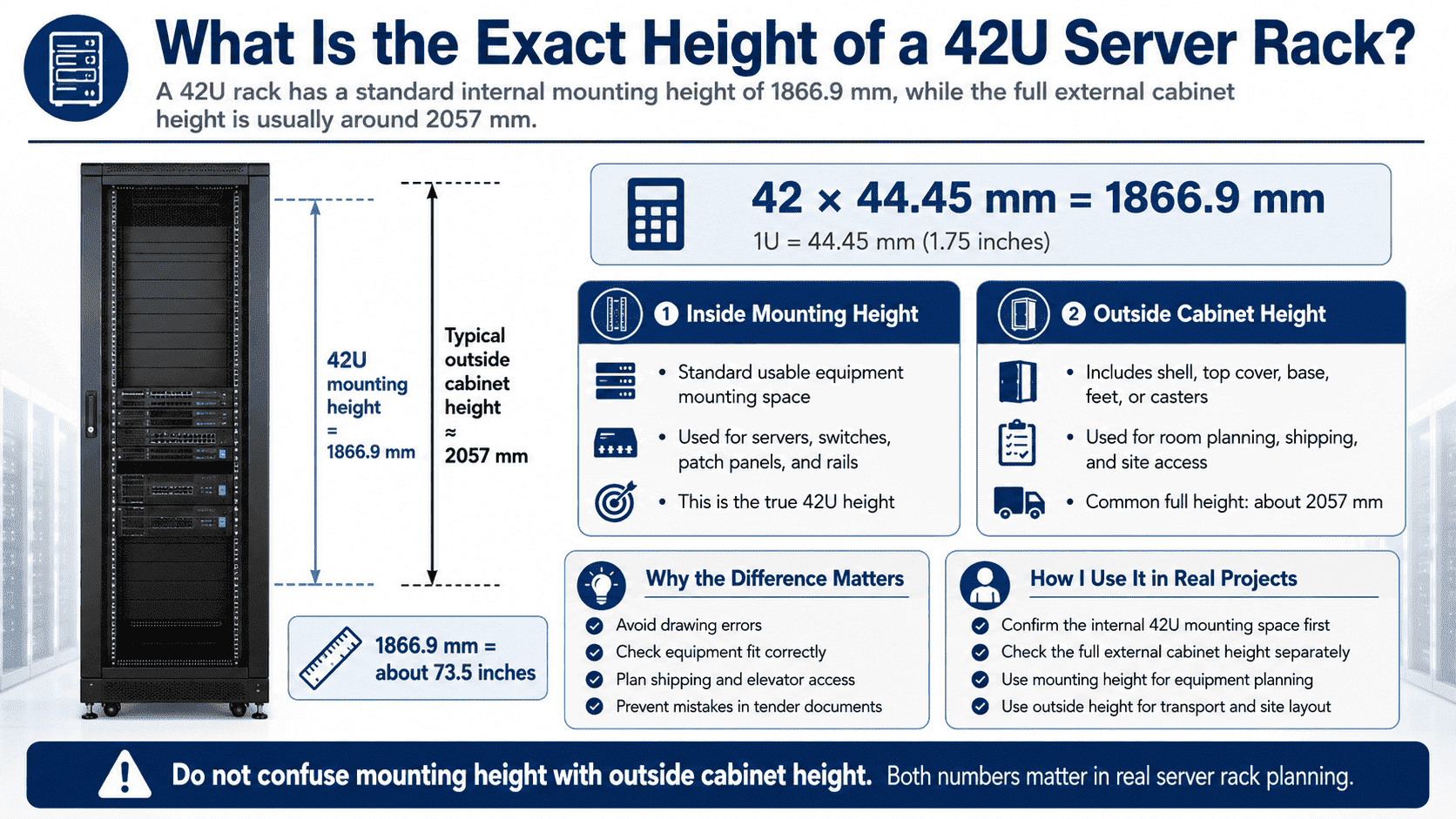
I have seen this question appear in data center projects, enterprise server rooms, IT purchasing meetings, and tender documents. The problem is not only the number. The real problem is that many people mix two different heights. One is the standard mounting height inside the rack. The other is the full outside height of the cabinet shell. If I use the wrong one in drawings, shipping plans, or equipment lists, the project can go wrong very fast. I will break down the exact number, the standard behind it, and the way I use it when I produce and check 42U server racks.
Is 1866.9 mm the real standard height of a 42U rack?
I often see people use 2 meters as a rough answer. That rough answer can create wrong drawings and wrong purchase orders.
The real 42U mounting height is 1866.9 mm. I get this number from the international rack unit rule: 1U equals 1.75 inches, or 44.45 mm1. So 42U equals 42 × 44.45 mm2.
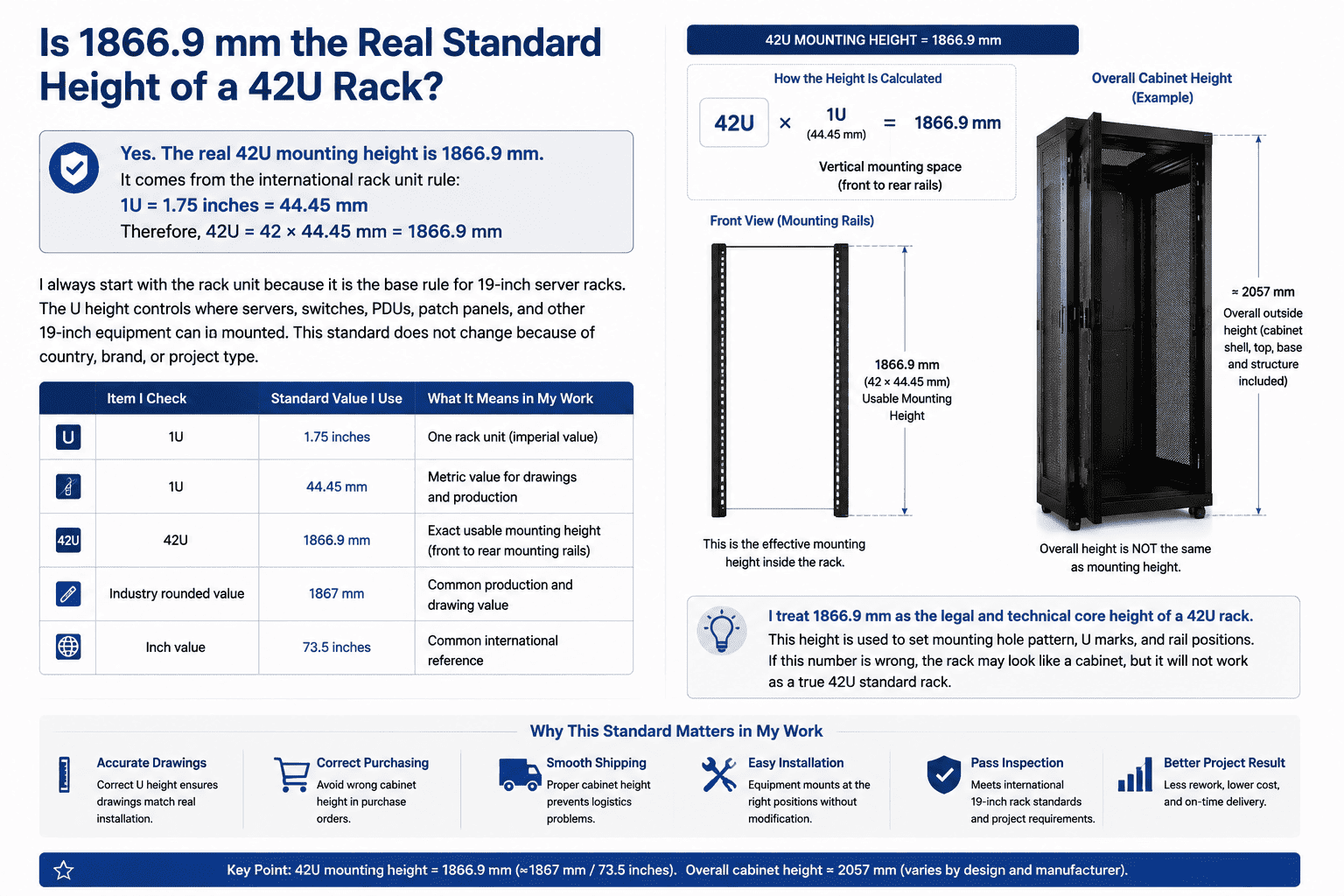
I always start with the rack unit because it is the base rule for 19-inch server racks. I do not start with the outside cabinet size. The U height controls where servers, switches, PDUs, patch panels, and other 19-inch equipment can be mounted.3 This standard does not change because of country, brand, or project type.4 A compliant 42U rack uses the same vertical mounting rule in China, Europe, the United States, the Middle East, and other markets.
| Item I check | Standard value I use | What it means in my work |
|---|---|---|
| 1U | 1.75 inches | One rack unit |
| 1U | 44.45 mm | Metric value for drawings |
| 42U | 1866.9 mm | Exact usable mounting height |
| Industry rounded value | 1867 mm | Common production and drawing value |
| Inch value | 73.5 inches | Common international reference |
I treat 1866.9 mm as the legal and technical core height of a 42U rack. This height means the effective vertical mounting space between the front and rear mounting rails. It does not mean the full cabinet shell height. When I make a rack, I use this height to set the mounting hole pattern, the U marks, and the rail positions. If this number is wrong, the rack may still look like a cabinet, but it will not work as a true 42U standard rack.
Why is the outside height usually about 2057 mm?
I have seen buyers compare 1867 mm with 2057 mm and think one factory must be wrong. The confusion can delay the order.
The 1866.9 mm value is the inside mounting height. The 2057 mm value is the common overall outside cabinet height.5 The outside height includes the top frame, bottom frame, shell, base, leveling feet, or other structure.6
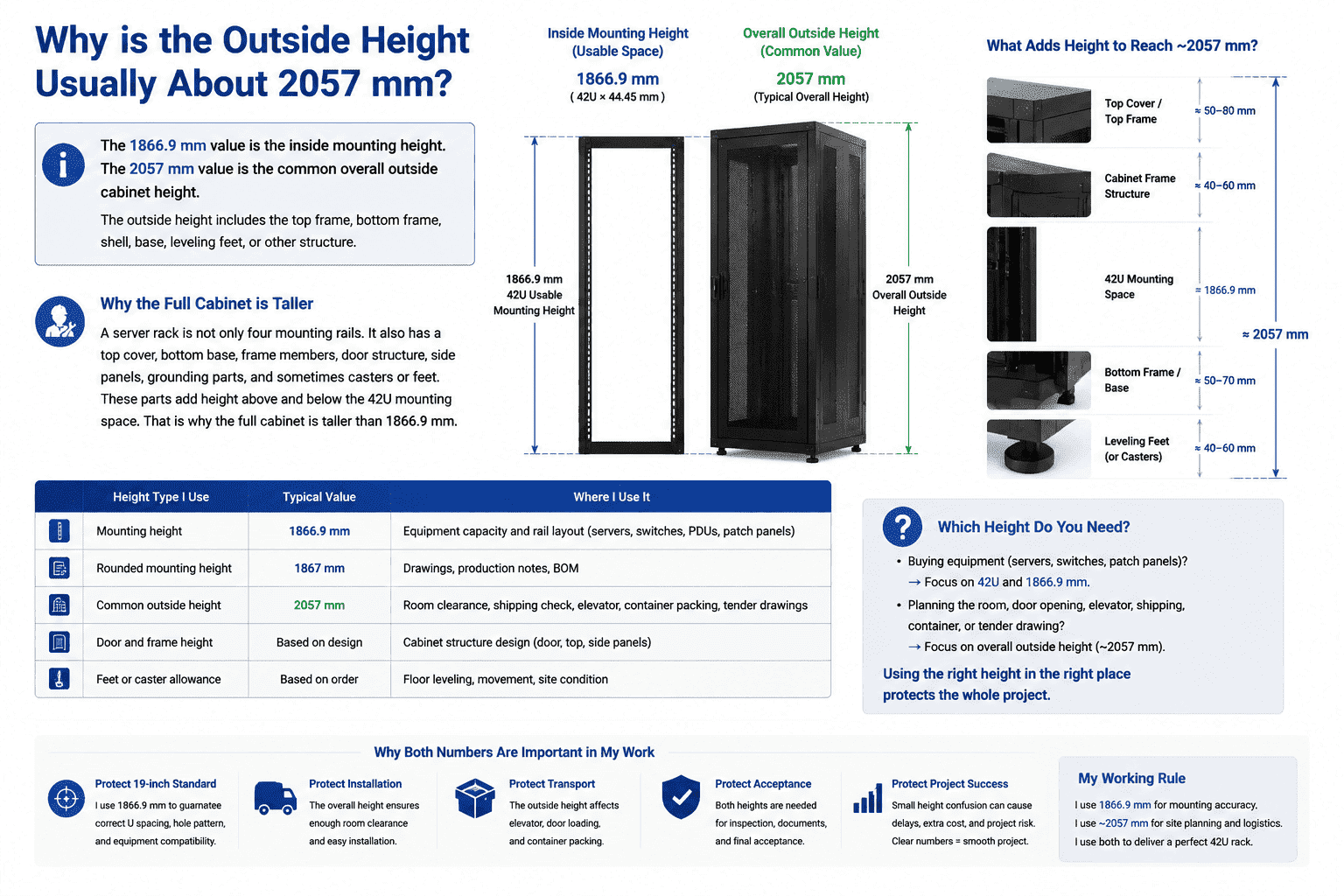
I explain this point often because it affects site planning. A server rack is not only four mounting rails. It also has a top cover, bottom base, frame members, door structure, side panels, grounding parts, and sometimes casters or feet. These parts add height above and below the 42U mounting space. That is why the full cabinet is taller than 1866.9 mm.
| Height type I use | Typical value | Where I use it |
|---|---|---|
| Mounting height | 1866.9 mm | Equipment capacity and rail layout |
| Rounded mounting height | 1867 mm | Drawings and production notes |
| Common outside height | 2057 mm | Room clearance and shipping check |
| Door and frame height | Based on design | Cabinet structure design |
| Feet or caster allowance | Based on order | Floor and movement planning |
I always ask the customer which height they need before I answer too fast. If the customer is buying servers, switches, or patch panels, I talk about 42U and 1866.9 mm. If the customer is planning the room height, door opening, elevator loading, container packing, or tender drawing, I talk about the full outside height. This small difference can protect the whole project. In my factory work, I use both numbers at the same time. I use 1866.9 mm to protect the 19-inch equipment standard. I use the outside height to protect installation, transport, and acceptance.
Can I install forty-two 1U devices in one 42U rack safely?
I know the math looks easy. Forty-two units should fit forty-two 1U devices. In real rooms, that thinking can create heat and cable problems.
A 42U rack gives 42U of standard mounting space, but I do not plan it as a safe place for forty-two full 1U servers in every project.7 I reserve space for airflow, cables, power, blanking panels, and service access.
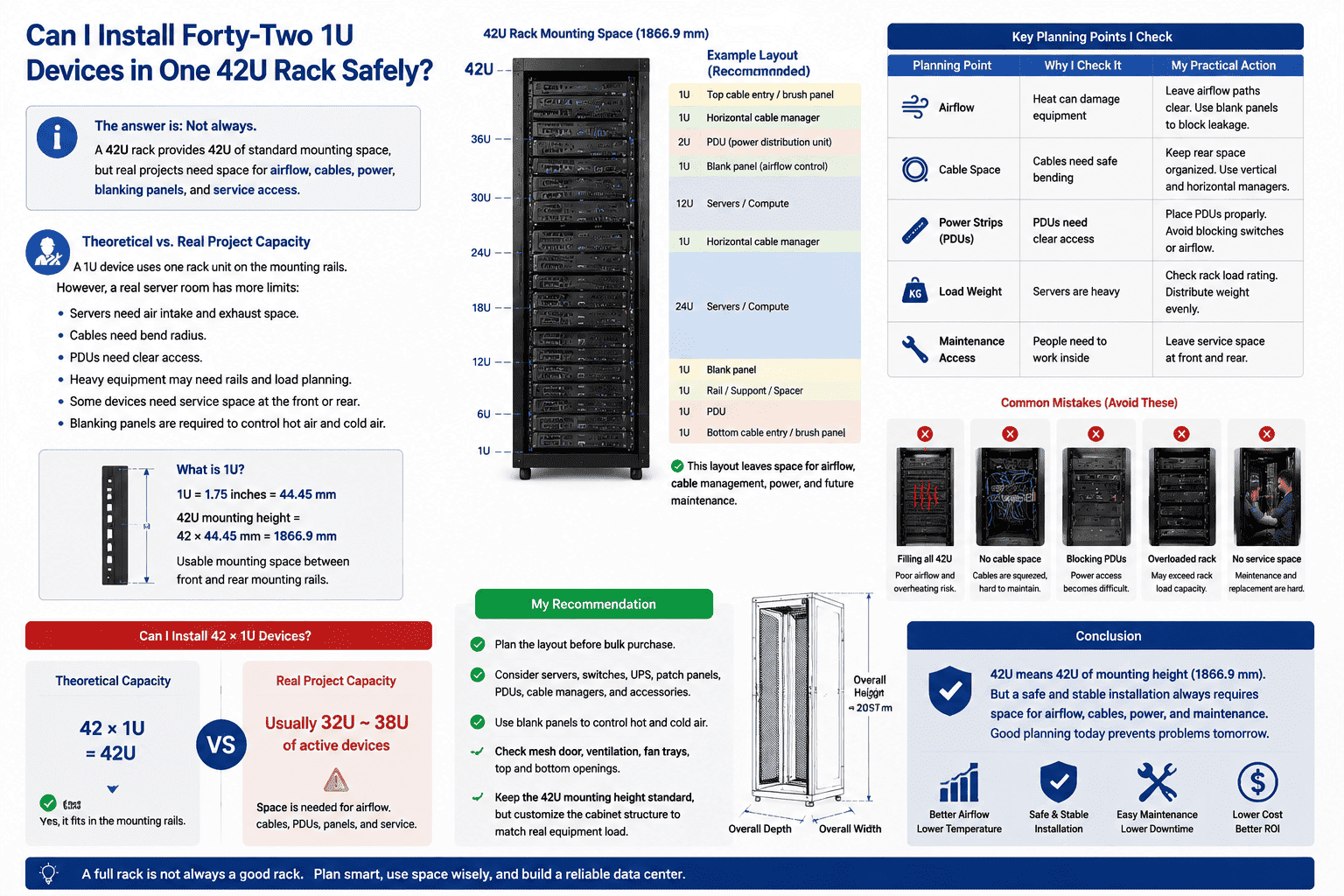
I separate theoretical mounting capacity from real project capacity. A 1U device uses one rack unit on the mounting rails. The height rule supports this. Yet a real server room has more limits. Servers need air intake and exhaust space.8 Cables need bend radius.9 PDUs need clear access. Heavy equipment may need rails and load planning. Some devices need service space at the front or rear. Some projects also require blanking panels to control hot air and cold air.
| Planning point I check | Why I check it | My practical action |
|---|---|---|
| Airflow | Heat can damage equipment | I leave airflow paths clear |
| Cable space | Cables need safe bending | I keep rear space organized |
| Power strips | PDUs need access | I avoid blocking switches |
| Load weight | Servers are heavy | I check rack load rating |
| Maintenance | People need to work inside | I leave service space |
I do not tell a customer that 42U means they should fill every unit without thought. That answer is too simple. In many enterprise rooms, I recommend a layout plan before mass purchase. I look at the type of servers, network switches, UPS equipment, patch panels, and accessories. I also check whether the rack uses mesh doors, perforated doors, fan trays, or special ventilation designs. In a custom rack project, I may change the door mesh rate, cable entry, top opening, bottom plate, or side structure. I still keep the 42U mounting height standard, but I adjust the cabinet structure around the real equipment load.
How does the 19-inch standard connect with 42U height?
I meet customers who think 19 inches refers to the cabinet width. That mistake can lead to wrong custom rack designs.
The 19-inch standard mainly refers to the mounting width for equipment10, while the U value controls vertical height. A 42U rack combines both rules: 19-inch equipment width and 42 rack units of height.
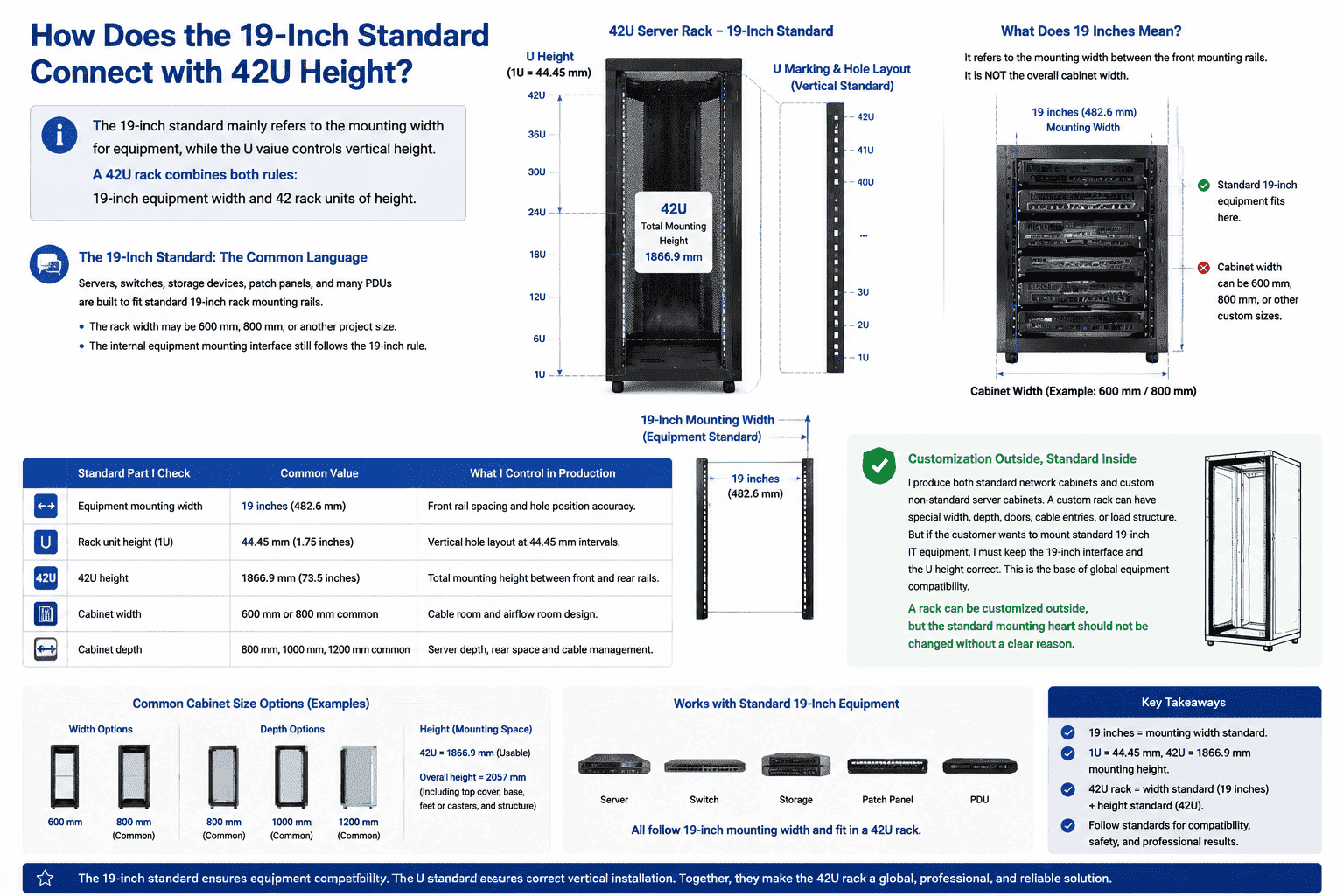
I use the 19-inch standard as the common language between cabinet production and IT equipment installation. Servers, switches, storage devices, patch panels, and many PDUs are built to fit standard 19-inch rack mounting rails. The rack width may be 600 mm, 800 mm, or another project size, but the internal equipment mounting interface still follows the 19-inch rule.11
| Standard part I check | Common value | What I control in production |
|---|---|---|
| Equipment mounting width | 19 inches | Front rail spacing and hole position |
| Rack unit height | 44.45 mm | Vertical hole layout |
| 42U height | 1866.9 mm | Total rail mounting height |
| Cabinet width | 600 mm or 800 mm common | Cable room and airflow room |
| Cabinet depth | 800 mm, 1000 mm, 1200 mm common | Server depth and rear space |
I care about this because I produce both standard network cabinets and custom non-standard server cabinets. A custom rack can have a special width, special depth, special door, special cable entry, or special load structure. Yet if the customer wants to mount standard 19-inch IT equipment, I must keep the 19-inch interface and the U height correct. This is the base of global equipment compatibility. A rack can be customized outside, but the standard mounting heart should not be changed without a clear reason. I see this as the difference between custom engineering and random modification.
What should I write in a tender or purchase order?
I have seen tenders fail because the rack height line used only one vague number. A clear specification can prevent dispute later.
I write both values in the purchase order: “42U standard 19-inch server rack, mounting height 1866.9 mm / 1867 mm, common overall cabinet height about 2057 mm, subject to final structure drawing.”
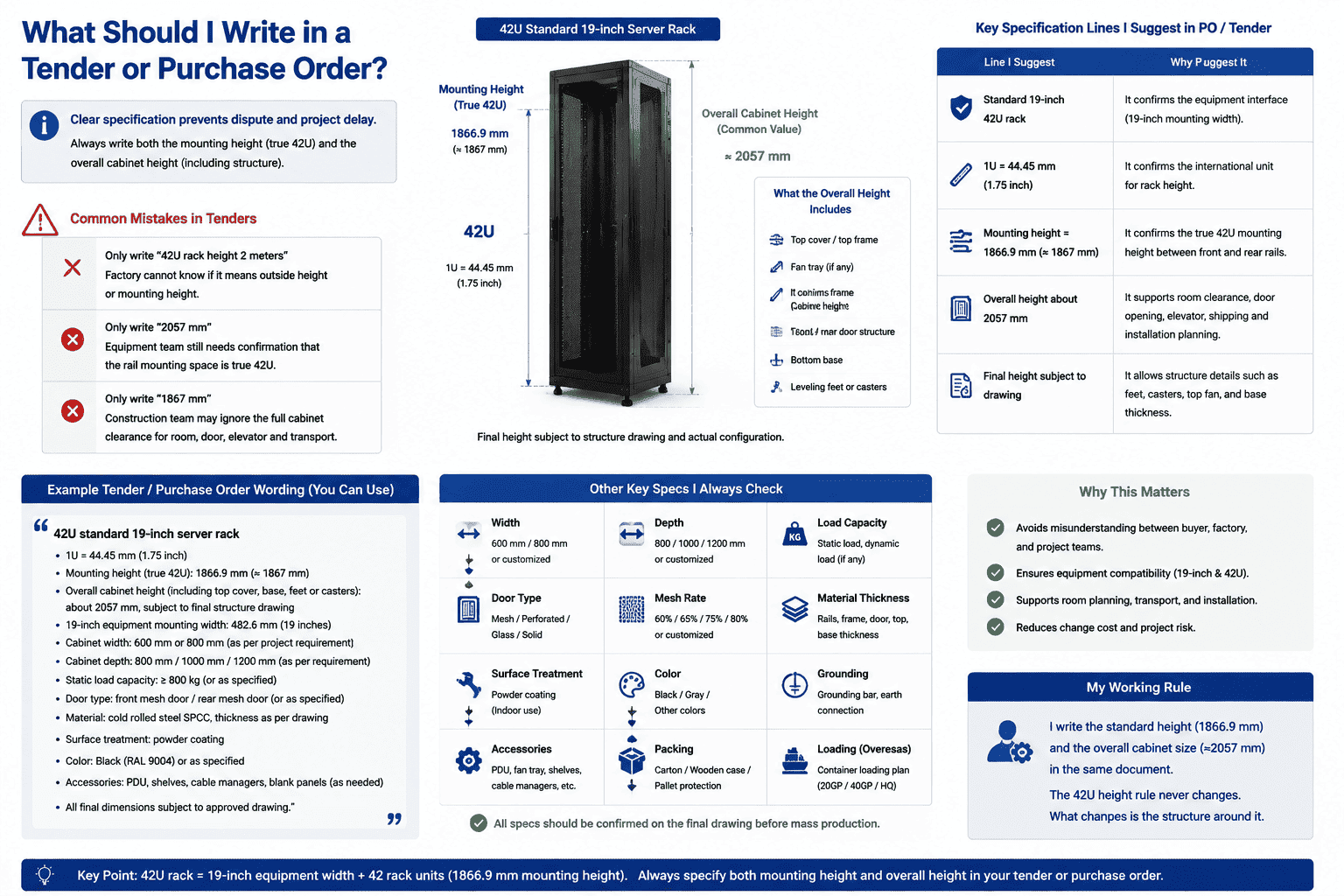
I like clear purchase language because it protects both the buyer and the manufacturer. If the buyer writes only “42U rack height 2 meters,” the factory may not know whether the buyer means outside height or mounting height. If the buyer writes only “2057 mm,” the equipment team may still need confirmation that the rail mounting space is true 42U. If the buyer writes only “1867 mm,” the construction team may ignore the full cabinet clearance.
| Line I suggest | Why I suggest it |
|---|---|
| Standard 19-inch 42U rack | It confirms the equipment interface |
| 1U = 44.45 mm | It confirms the international unit |
| Mounting height = 1866.9 mm | It confirms the true 42U height |
| Overall height about 2057 mm | It supports room and transport planning |
| Final height subject to drawing | It allows feet, casters, top fan, and base details |
In my own order review, I also check width, depth, static load, dynamic load, door type, mesh rate, material thickness, surface treatment, color, grounding, packaging, and accessories. For overseas orders, I also check container loading and carton or pallet protection. A 42U rack is a standard product, but it still needs exact communication. I have worked on standard stock rack orders and non-standard custom cabinet orders. In both cases, the 42U height rule stays the same. What changes is the structure around it. That is why I write the standard height and the full cabinet size in the same document.
How do I verify a 42U rack before shipment?
I do not rely only on the product name. A cabinet label can say 42U, but I still measure the key points.
I verify a 42U rack by checking the mounting rail hole layout, the total 42U vertical mounting space, the 19-inch equipment interface, and the full cabinet outside height against the approved drawing.
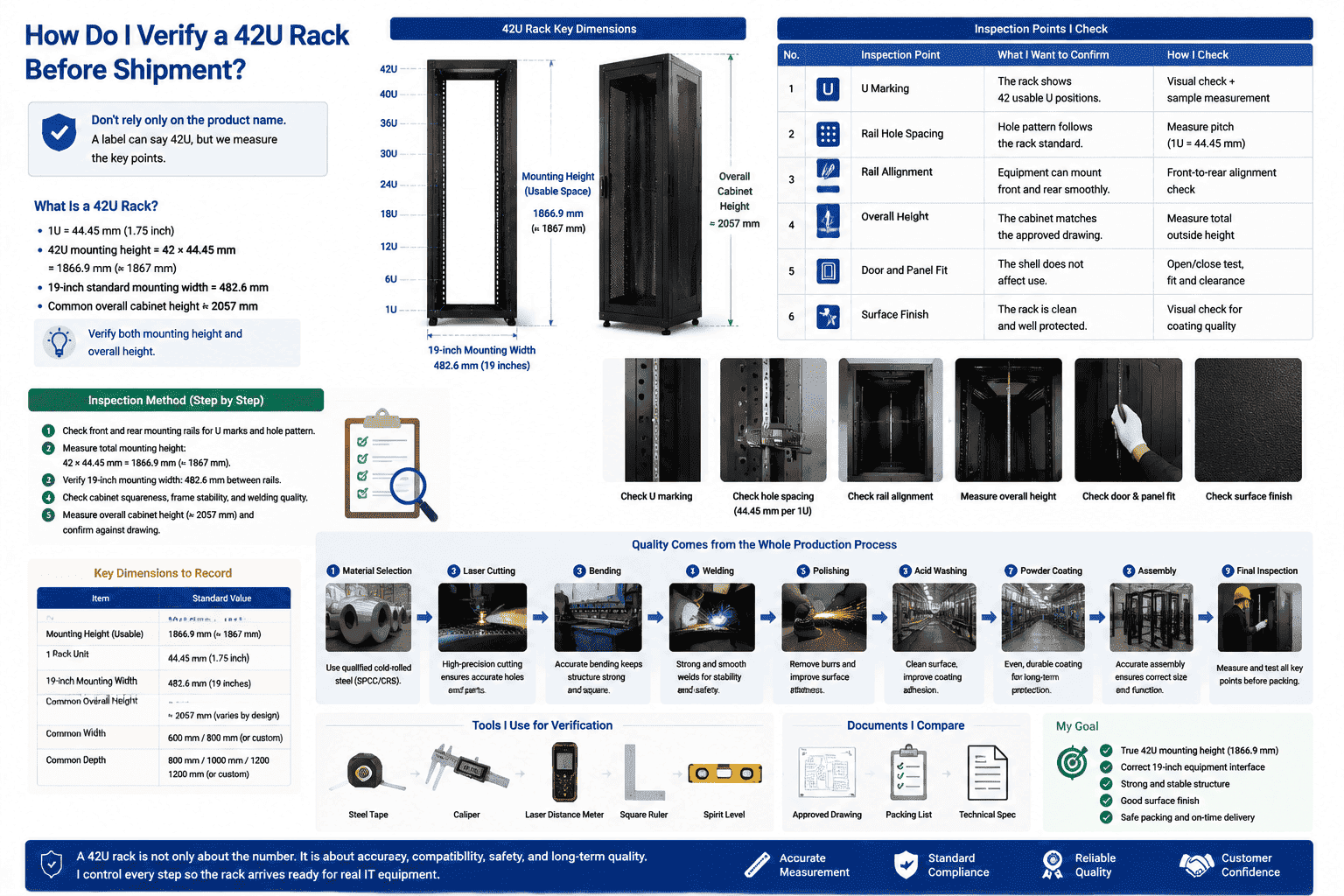
I use a practical inspection method in production. First, I check the front and rear mounting rails. I confirm the U marks and the hole pattern. Second, I check whether the usable mounting height follows 42 × 44.45 mm. Third, I check the rail spacing for 19-inch equipment. Fourth, I check whether the frame is square and stable. Fifth, I check the outside cabinet height, because the customer may need that value for room clearance or shipment.
| Inspection point I use | What I want to confirm |
|---|---|
| U marking | The rack shows 42 usable U positions |
| Rail hole spacing | The pattern follows the rack standard |
| Rail alignment | Equipment can mount front and rear |
| Overall height | The cabinet matches the approved drawing |
| Door and panel fit | The shell does not affect use |
| Surface finish | The rack is clean and protected |
I also care about production process because height accuracy does not come from the final inspection only. It starts from material selection, laser cutting, bending, welding, polishing, acid washing, powder coating, and final assembly. If the frame is not controlled well, the rack may twist. If the rails are not positioned well, the equipment may not fit smoothly. If the coating is poor, the rack may not meet long-term use needs. I see the 42U number as one part of a bigger quality system. I must control every step if I want the rack to arrive ready for real IT equipment.
Conclusion
I define a 42U rack by its 1866.9 mm mounting height, and I plan the cabinet by its full outside height, often about 2057 mm.
"Rack unit - Wikipedia", https://en.wikipedia.org/wiki/Rack_unit. The cited source defines a rack unit as 1.75 inches, equivalent to 44.45 mm, which supports the dimensional basis used for calculating 42U mounting height. Evidence role: definition; source type: encyclopedia. Supports: The source should define one rack unit as 1.75 inches, or 44.45 mm.. ↩
"Rack unit - Wikipedia", https://en.wikipedia.org/wiki/Rack_unit. Because one rack unit is defined as 44.45 mm, multiplying that unit by 42 yields a nominal 42U mounting height of 1866.9 mm. Evidence role: general_support; source type: encyclopedia. Supports: The source should establish the rack-unit size from which the 42U mounting-height calculation is derived.. Scope note: The source may define the unit rather than explicitly calculating the 42U total. ↩
"19-inch rack - Wikipedia", https://en.wikipedia.org/wiki/19-inch_rack. The cited rack-standard reference explains that rack units and mounting-hole spacing define the vertical positions available for installing rack-mounted equipment. Evidence role: mechanism; source type: institution. Supports: The source should explain that rack units organize the vertical mounting space and hole positions for rack-mounted equipment.. ↩
"19-inch rack - Wikipedia", https://en.wikipedia.org/wiki/19-inch_rack. International and industry rack standards such as IEC 60297 and EIA-310 provide common dimensional rules for 19-inch rack interfaces, supporting the claim that compliant racks use consistent rack-unit spacing. Evidence role: expert_consensus; source type: institution. Supports: The source should show that 19-inch rack dimensions and rack-unit spacing are governed by recognized international or industry standards.. Scope note: The source supports compliant standardized racks generally; it does not guarantee that every product sold in every market is compliant. ↩
"42U Server Racks & Cabinets, price ⚡️ - sysracks", https://sysracks.com/catalog/racks-by-size/42u/?srsltid=AfmBOoptnMHxc7DppTvYaBslpcKxLfohjXNhqUpXURzMf92wu9UYd9qO. Published 42U cabinet specifications commonly list an external height near 2057 mm, supporting the article’s distinction between nominal mounting height and overall cabinet height. Evidence role: general_support; source type: other. Supports: The source should document that many 42U cabinet specifications list an overall external height around 2057 mm.. Scope note: Overall height is product-specific and can change with casters, leveling feet, top accessories, or frame design. ↩
"19-inch rack - Wikipedia", https://en.wikipedia.org/wiki/19-inch_rack. Technical rack-dimension references distinguish the standardized mounting interface from the enclosure’s external dimensions, which may include frame members, bases, feet, or casters. Evidence role: mechanism; source type: institution. Supports: The source should distinguish rack mounting space from external enclosure dimensions and show that enclosure structures affect total height.. Scope note: The source supports the design principle; the exact added height depends on the specific cabinet construction. ↩
"[PDF] Best Practices Guide for Energy-Efficient Data Center Design", https://www.energy.gov/sites/default/files/2024-07/best-practice-guide-data-center-design_0.pdf. Data center infrastructure guidance treats rack utilization as a function of cooling, power distribution, cabling, load capacity, and maintenance access, not merely the number of available rack units. Evidence role: general_support; source type: institution. Supports: The source should support that rack population must account for cooling, power, cabling, weight, and service constraints, not just available rack units.. Scope note: The source provides general planning principles rather than a universal maximum number of 1U servers for every 42U rack. ↩
"Manage Airflow for Cooling Efficiency - Energy Star", https://www.energystar.gov/products/data_center_equipment/16-more-ways-cut-energy-waste-data-center/manage-airflow-cooling-efficiency. Data center cooling literature explains that IT equipment relies on controlled intake and exhaust airflow paths to remove heat and maintain acceptable operating conditions. Evidence role: mechanism; source type: research. Supports: The source should explain that servers depend on controlled intake and exhaust airflow to manage heat.. ↩
"What is the Bend Radius & Durability of Fiber Optic Cable?", https://store.cablesplususa.com/cabling-insider-blog/what-is-the-bend-radius-and-durability-of-fiber-optic-cable/?srsltid=AfmBOoo09UpbeJppx0KJBoz-X6fdLtWtfDVLNMCqwThBvaSlNjPLp09l. Structured-cabling guidance specifies minimum bend-radius limits for installed cables, supporting the need to reserve rack space for safe cable routing. Evidence role: mechanism; source type: institution. Supports: The source should state that cables have minimum bend-radius limits that must be maintained during installation.. Scope note: Exact bend-radius values vary by cable type, construction, and manufacturer. ↩
"19-inch rack", https://en.wikipedia.org/wiki/19-inch_rack. A 19-inch rack is defined by its standardized equipment mounting frame, supporting the article’s point that the 19-inch dimension describes the mounting interface rather than the cabinet’s total outside width. Evidence role: definition; source type: encyclopedia. Supports: The source should define a 19-inch rack in terms of the standardized mounting frame or equipment mounting width.. ↩
"19-inch rack - Wikipedia", https://en.wikipedia.org/wiki/19-inch_rack. Rack-interface standards specify the 19-inch mounting arrangement independently of the enclosure’s external cabinet width, allowing cabinets of different widths to retain compatibility with 19-inch equipment. Evidence role: general_support; source type: institution. Supports: The source should support that standardized 19-inch mounting rails can be used within cabinets of different external widths.. Scope note: The source supports the dimensional principle; available cabinet widths are determined by individual designs and procurement specifications. ↩
