
What Does RU Mean in Server Racks & Why Is It Important?
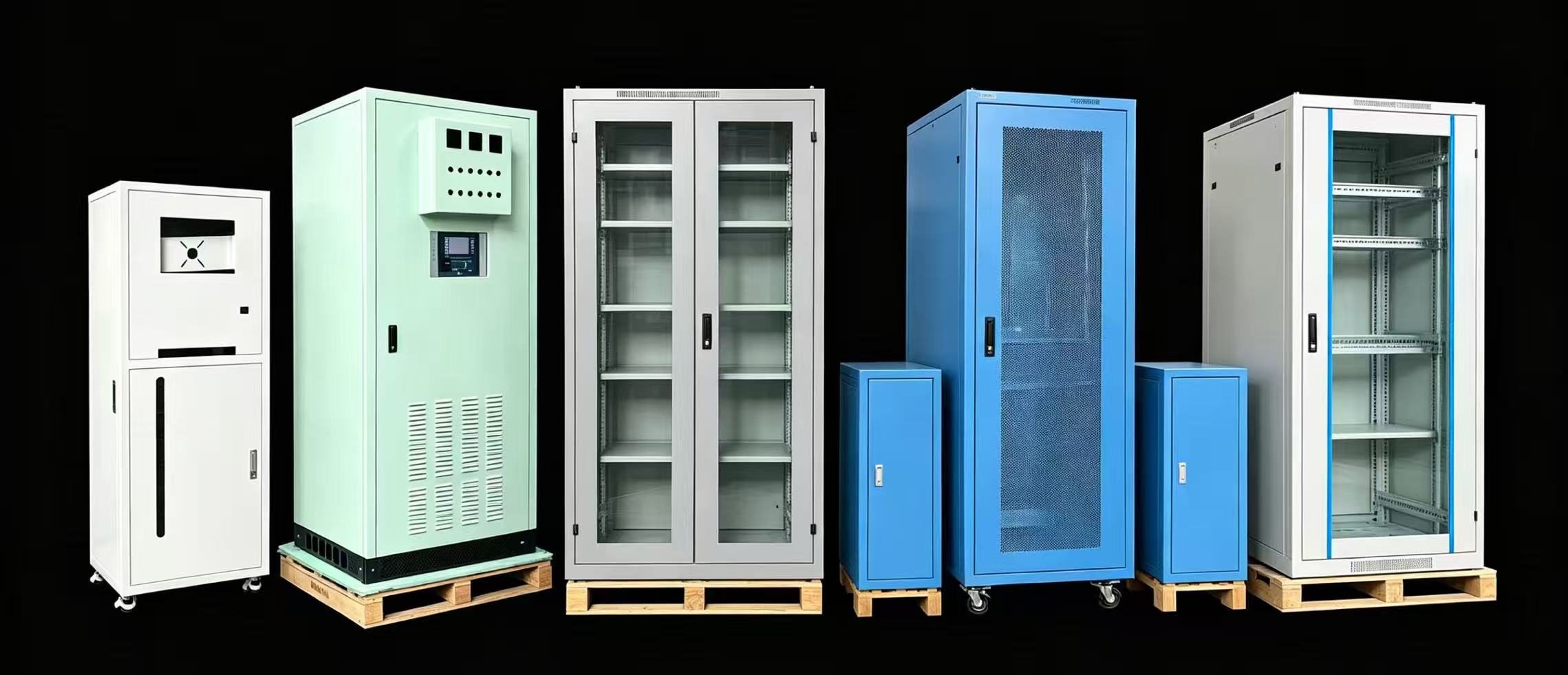
A rack looks simple. But one wrong U count can waste space, block airflow, and make a clean data center look unplanned.
-
What Is One RU in Exact Size?
A small size mistake can become a big installation problem. If I miss only a few millimeters, the device may not fit.
1RU is exactly 1.75 inches high, which is 44.45 mm. I treat this as a fixed global standard for rack-mounted equipment. 2RU is 88.90 mm, and 4RU is 177.80 mm.
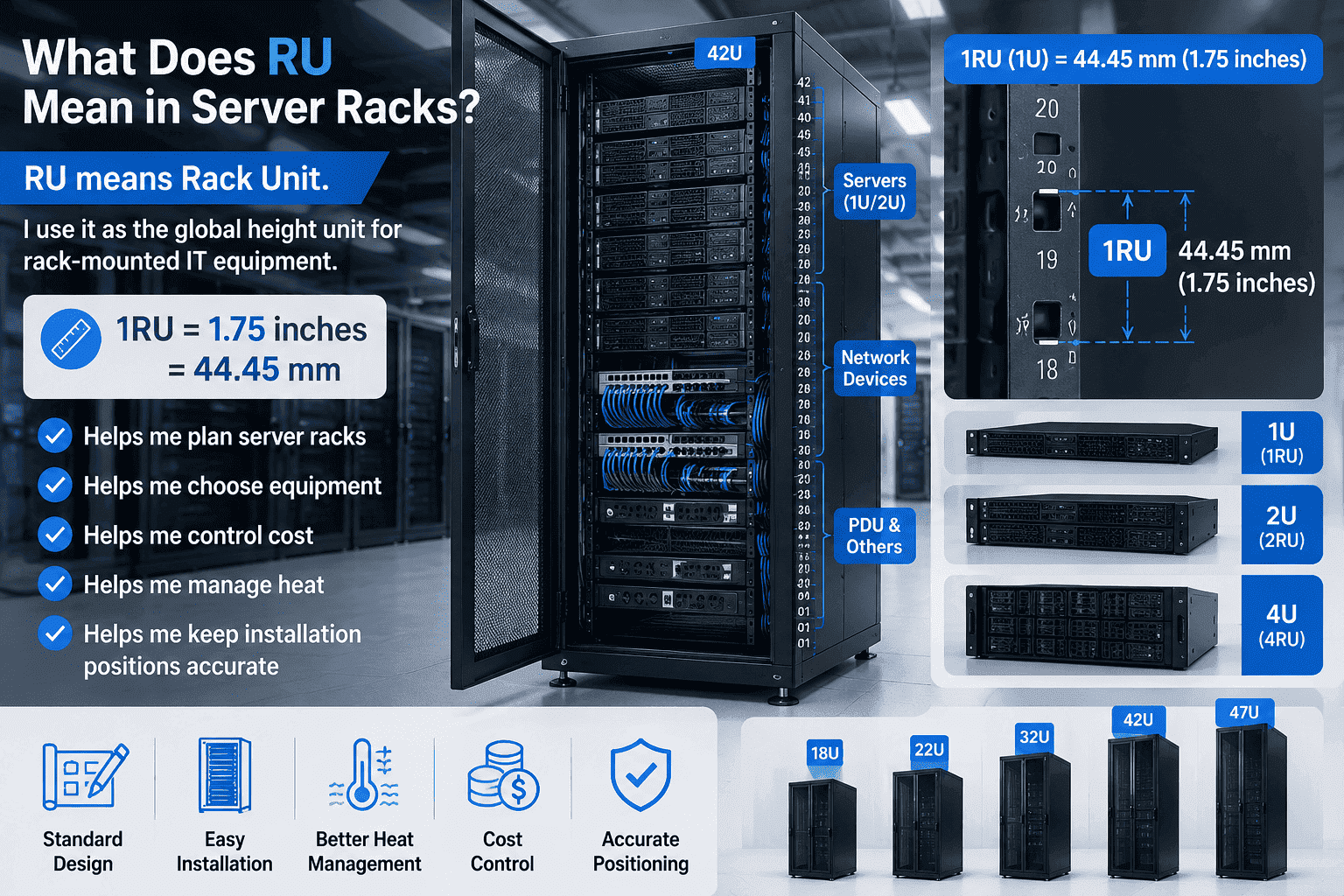
The fixed height behind every rack device
I use RU to describe the vertical space inside a rack. RU is short for Rack Unit. In Chinese projects, I often hear people call it “U数” or “机架单元.” It is the standard height unit used for rack-mounted servers, switches, storage devices, UPS units, PDU panels, patch panels, cable managers, and other equipment.1
The key point is simple. 1RU is not an estimated height. It is a hard standard. A formal rack-mounted device must be designed around this size.2 When I produce a cabinet, I must make the mounting posts and holes match this system. When a customer buys a 1U server from another country, it should still match a standard rack made in my factory if both sides follow the same rule.3
| RU size | Height in inches | Height in millimeters | Common equipment example |
|---|---|---|---|
| 1U | 1.75 in | 44.45 mm | Thin server, patch panel |
| 2U | 3.50 in | 88.90 mm | Server, UPS module |
| 4U | 7.00 in | 177.80 mm | Storage server, larger UPS |
I often explain it this way to customers. RU is like the grid line of the whole rack system. The equipment does not “roughly” fit. It fits because the height, holes, and layout all follow the same grid. This is why RU matters before we talk about color, door style, depth, or loading capacity.
Why Does RU Decide Rack Planning Before Installation?
A cabinet can look large from outside. But if I plan the U space poorly, the inside becomes crowded very fast.
RU decides the usable vertical installation height inside a server rack. A 42U rack means the rack has 42 rack units of effective mounting space for equipment placement.4
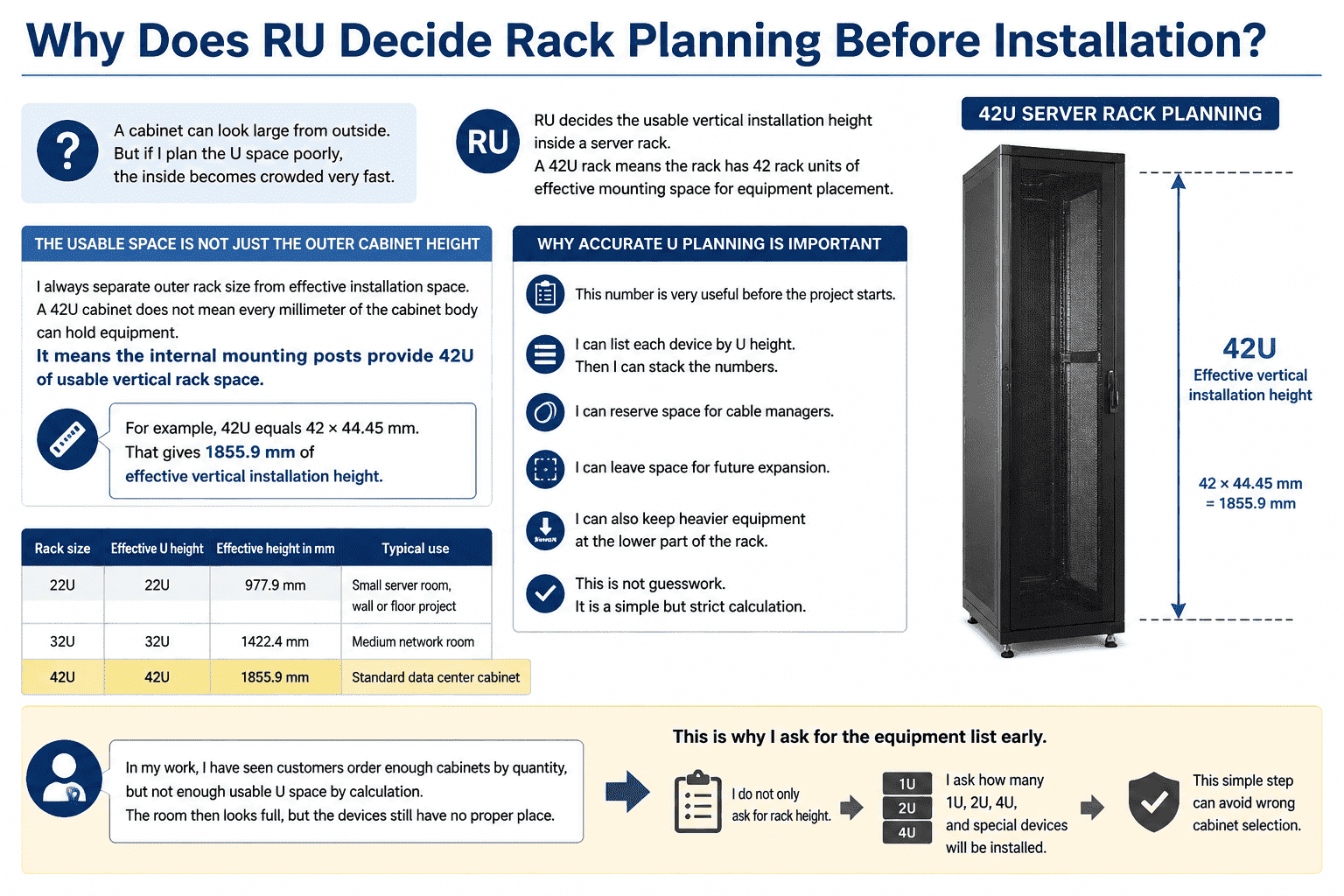
The usable space is not just the outer cabinet height
I always separate outer rack size from effective installation space. A 42U cabinet does not mean every millimeter of the cabinet body can hold equipment. It means the internal mounting posts provide 42U of usable vertical rack space. For example, 42U equals 42 × 44.45 mm. That gives 1855.9 mm of effective vertical installation height.
This number is very useful before the project starts. I can list each device by U height. Then I can stack the numbers. I can reserve space for cable managers. I can leave space for future expansion. I can also keep heavier equipment at the lower part of the rack. This is not guesswork. It is a simple but strict calculation.
| Rack size | Effective U height | Effective height in mm | Typical use |
|---|---|---|---|
| 22U | 22U | 977.9 mm | Small server room, wall or floor project |
| 32U | 32U | 1422.4 mm | Medium network room |
| 42U | 42U | 1855.9 mm | Standard data center cabinet |
In my work, I have seen customers order enough cabinets by quantity, but not enough usable U space by calculation. The room then looks full, but the devices still have no proper place. This is why I ask for the equipment list early. I do not only ask for rack height. I ask how many 1U, 2U, 4U, and special devices will be installed. This simple step can avoid wrong cabinet selection.
How Does RU Affect Equipment Selection and Cost Control?
A project can lose money before installation starts. The common cause is not the rack price. It is wrong space planning.
RU helps me choose equipment and control cost because every rack-mounted device takes a clear vertical space. I can calculate cabinet quantity, cable space, cooling needs, and future expansion by U count.5

I use U count to stop hidden waste
I have learned that RU planning is one of the cheapest ways to control project cost. It does not require a special tool. It only requires a clear device list. If a customer tells me they have 20 pieces of 2U servers, I know they already need 40U before adding switches, UPS, patch panels, cable managers, blank panels, and spare space. If they choose only one 42U cabinet, the cabinet may look enough on paper. But the real layout may fail because a good rack also needs cable space, airflow space, and future space.
| Item | Example U count | Why I reserve it |
|---|---|---|
| Servers | 1U, 2U, 4U each | Main computing equipment |
| Switches | 1U or 2U | Network connection |
| Patch panels | 1U or 2U | Cabling organization |
| Cable managers | 1U or 2U | Front and rear cable routing |
| UPS | 2U to 6U or more | Power backup |
| Spare space | 10% to 30%6 | Future expansion and airflow |
I also use RU to compare different equipment choices. A 1U device may save space, but it may need stronger cooling.7 A 4U device may use more U space, but it may offer easier maintenance. I cannot say one is always better. I must look at rack quantity, room size, heat load, wiring plan, and maintenance habits. When I build custom non-standard cabinets, I still start from this U logic. Even when the structure is special, the equipment side still needs a clear rack unit plan.
Why Do Rack Mounting Holes Follow RU Positions?
A rack without accurate hole positions is only a metal box. It cannot become a professional server cabinet.
Rack mounting holes follow RU positions so equipment can be fixed at a standard height.8 This keeps devices aligned, secure, easy to install, and easy to inspect.
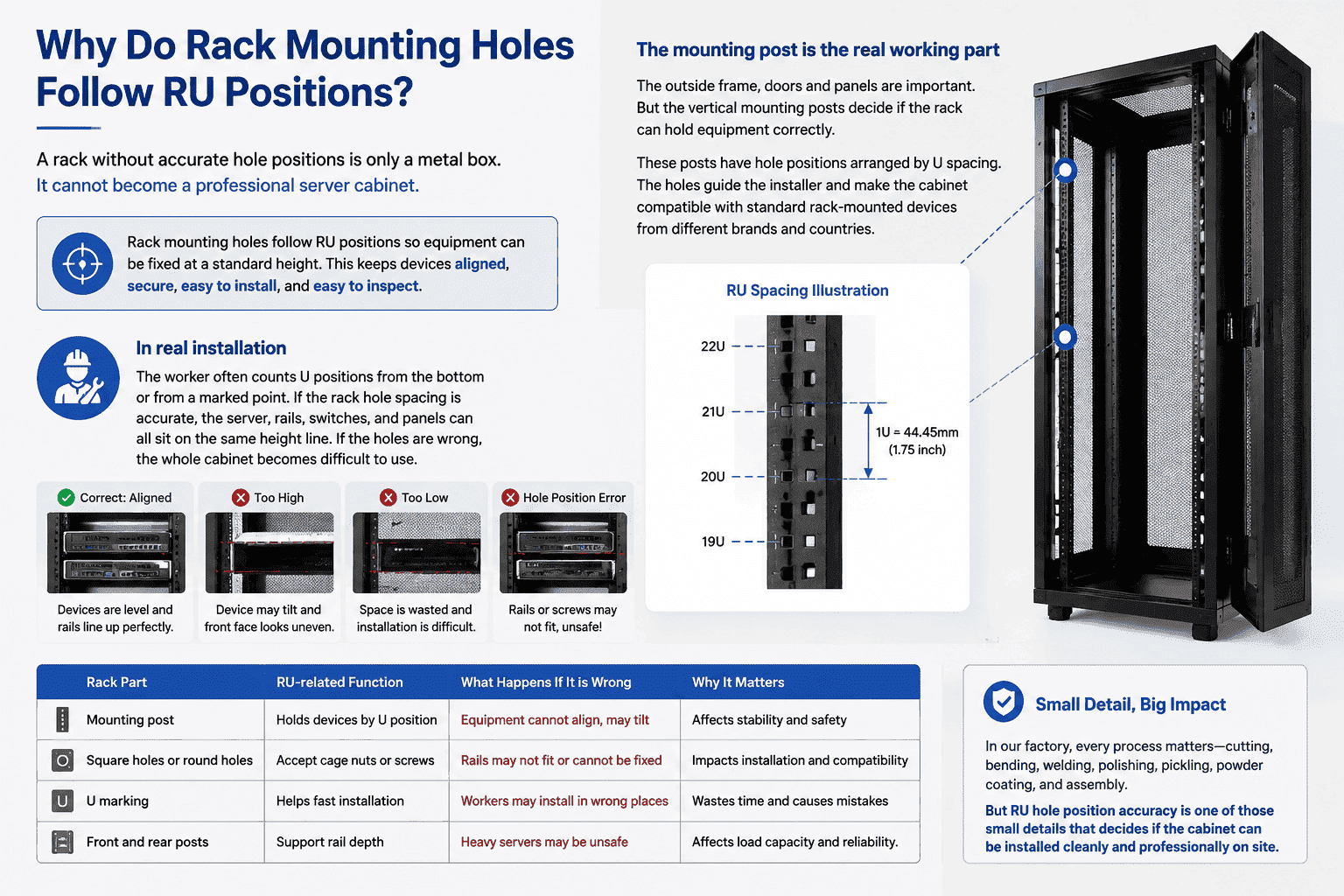
The mounting post is the real working part
When I produce a server rack, I pay close attention to the mounting posts. The outside frame is important. The door and side panels are important. But the vertical mounting posts decide if the rack can hold equipment correctly. These posts have hole positions arranged by U spacing. The holes guide the installer. They also make the cabinet compatible with standard rack-mounted devices from different brands and countries.
In real installation, the worker often counts U positions from the bottom or from a marked point. If the rack hole spacing is accurate, the server, rails, switches, and panels can all sit on the same height line. If the holes are wrong, the whole cabinet becomes difficult to use. The device may tilt. The rails may not line up. The front face may look uneven. The final inspection may fail.
| Rack part | RU-related function | What happens if it is wrong |
|---|---|---|
| Mounting post | Holds devices by U position | Equipment cannot align |
| Square holes or round holes | Accept cage nuts or screws | Rails may not fit |
| U marking | Helps fast installation | Workers may install in wrong places |
| Front and rear posts | Support rail depth | Heavy servers may be unsafe |
In my factory, I care about cutting, bending, welding, polishing, pickling, powder coating, and assembly. But I also know that a good cabinet must be accurate in the small details. RU hole position is one of those small details. It looks simple. But it decides if the cabinet can be installed cleanly on site.
Why Is RU Important for Cooling and Cable Management?
A cabinet can hold devices and still fail. If I ignore airflow and cables, the equipment may run hot and become hard to maintain.
RU helps me leave space for airflow, blank panels, cable managers, and service access. It makes cooling and wiring part of the rack plan, not an afterthought.
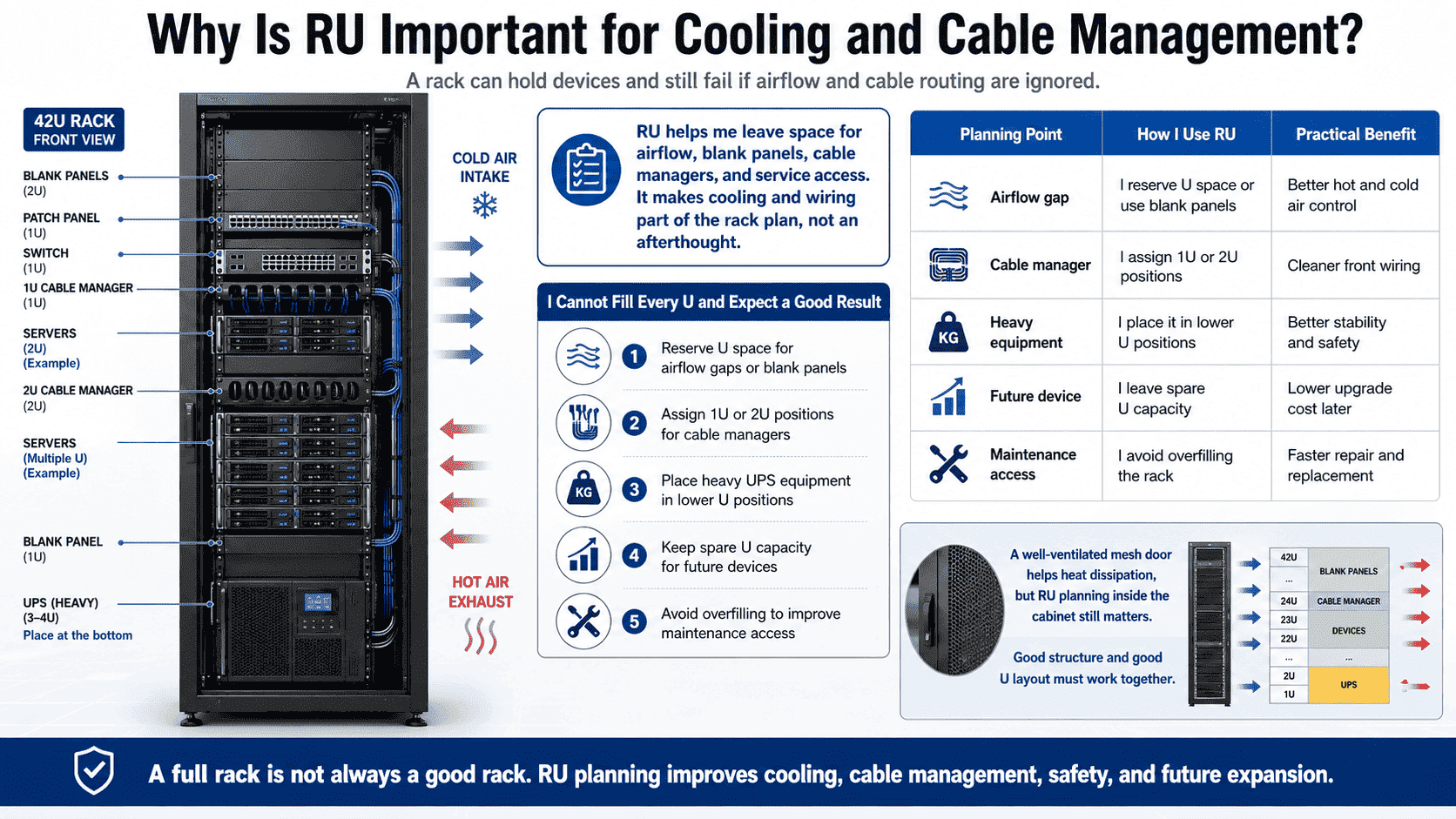
I cannot fill every U and expect a good result
I often tell customers that a full rack is not always a good rack. If every U space is filled without thought, heat and cables become serious problems. Servers need cold air intake and hot air exhaust. Switches need front or rear access. Cable managers need space to guide fiber, copper cable, and power cords. PDU position also affects the rear space. All of these items are connected to U planning.
RU allows me to place devices in a clean order. I may put heavy UPS units near the bottom. I may place patch panels and switches near cable entry points. I may use blank panels to block open spaces and improve airflow direction. I may leave a few U spaces for future devices, not because I want to waste space, but because future changes always happen in real projects.
| Planning point | How I use RU | Practical benefit |
|---|---|---|
| Airflow gap | I reserve U space or use blank panels | Better hot and cold air control |
| Cable manager | I assign 1U or 2U positions | Cleaner front wiring |
| Heavy equipment | I place it in lower U positions | Better stability and safety |
| Future device | I leave spare U capacity | Lower upgrade cost later |
| Maintenance access | I avoid overfilling the rack | Faster repair and replacement |
In many overseas projects, customers ask for batch standard racks and custom mesh doors. Mesh door open area matters for heat, but RU planning still matters inside the cabinet. A well-ventilated door cannot fix a badly planned rack. The rack needs both good structure and good U layout.
What Mistakes Happen When RU Is Ignored?
Most rack problems do not appear in the drawing stage. They appear when the installer tries to mount the real device.
When RU is ignored, teams often choose the wrong rack height, leave no space for cables, overload one area, block airflow, or fail final inspection.
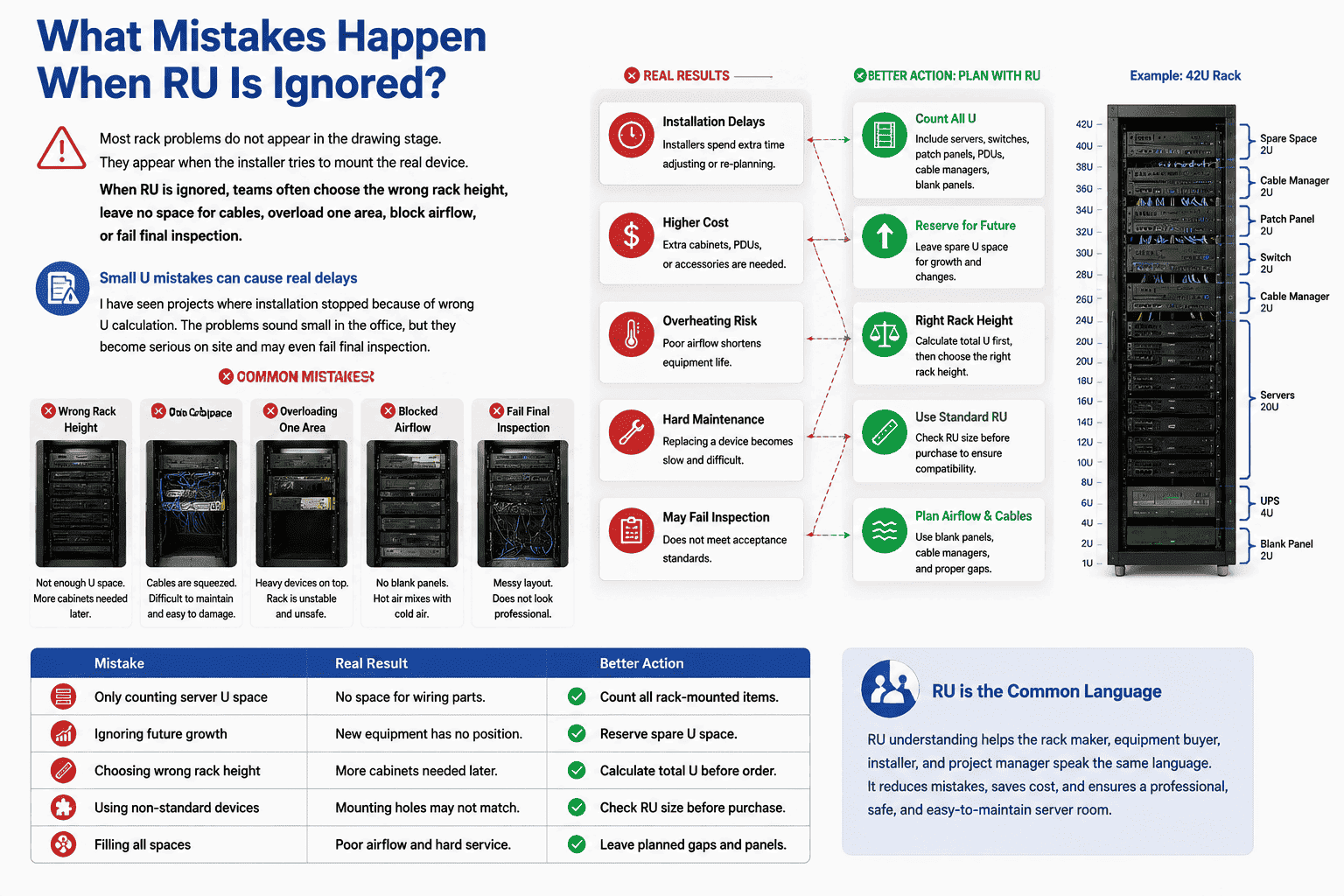
I have seen small U mistakes cause real delays
I have seen projects where the cabinet arrived on time, but installation still stopped. The reason was not always product damage. Sometimes the problem was a wrong U calculation. The customer counted only servers and forgot patch panels. Sometimes they counted the cabinet as 42U but did not consider cable managers. Sometimes they selected a non-standard device that did not follow normal rack unit height. These problems sound small in the office. They become serious on site.
Formal data center projects usually need clear equipment parameters, cabinet specifications, and installation drawings. RU is the common unit in those documents. If a rack or device does not follow RU rules, the project may face trouble during acceptance. The inspector needs to see standard mounting, safe layout, and proper space use. A random arrangement does not look professional, and it may not pass.
| Mistake | Real result | Better action |
|---|---|---|
| Only counting server U space | No space for wiring parts | Count all rack-mounted items |
| Ignoring future growth | New equipment has no position | Reserve spare U space |
| Choosing wrong rack height | More cabinets needed later | Calculate total U before order |
| Using non-standard devices | Mounting holes may not match | Check RU size before purchase |
| Filling all spaces | Poor airflow and hard service | Leave planned gaps and panels |
I believe RU understanding can reduce project mistakes. It helps the rack maker, equipment buyer, installer, and project manager speak the same language. This is why I treat RU as the base of rack manufacturing and server room planning.
Conclusion
RU is the basic height language of server racks. When I plan it well, I improve fit, airflow, cost, installation, and future expansion.
"Rack unit", https://en.wikipedia.org/wiki/Rack_unit. General technical references describe the rack unit as the conventional measure for the vertical height of rack-mounted computing, networking, and telecommunications equipment. Evidence role: general_support; source type: encyclopedia. Supports: Rack units are commonly used to describe the height of rack-mounted computer, networking, and telecommunications equipment.. Scope note: The source supports the general convention, not each listed device category individually. ↩
"Rack specifications", https://www.ibm.com/docs/en/n-series?topic=specifications-requirements. Rack-mount dimensional standards specify equipment panel heights in rack-unit increments, which is the basis for designing standard rack-mounted devices around the 1U height grid. Evidence role: definition; source type: institution. Supports: Rack-mount standards define panel and equipment heights in rack-unit increments.. Scope note: The source supports standards-based equipment design; it does not prove that every product sold as rack-mounted complies. ↩
"19-inch rack", https://en.wikipedia.org/wiki/19-inch_rack. The 19-inch rack standards define common equipment, panel, and mounting dimensions, supporting mechanical compatibility when both the rack and device conform to the same standard. Evidence role: general_support; source type: institution. Supports: Common 19-inch rack standards are intended to define shared dimensions that enable equipment and racks from different manufacturers to fit together.. Scope note: The source supports dimensional interoperability in principle, not compatibility for every rail kit, depth, load rating, or accessory. ↩
"Rack unit", https://en.wikipedia.org/wiki/Rack_unit. Technical references explain that rack heights expressed as values such as 42U refer to the number of rack-unit positions available for mounting equipment. Evidence role: definition; source type: encyclopedia. Supports: Rack height labels such as 42U denote the number of rack units available in the rack's vertical mounting space.. ↩
"Install In-rack or In-row Cooling", https://www.energystar.gov/products/data_center_equipment/16-more-ways-cut-energy-waste-data-center/install-rack-or-row. Data-center design guidance treats equipment inventory and rack layout as inputs to cabinet count, cabling organization, power and cooling capacity, and future expansion planning. Evidence role: general_support; source type: institution. Supports: Data-center planning guidance treats rack layout, equipment inventory, cabling, power, cooling, and future capacity as connected design variables.. Scope note: The source supports the planning relationship generally; it may not state that U count alone is sufficient to calculate all listed needs. ↩
"Understanding Data Center Capacity Planning - Device42", https://www.device42.com/data-center-infrastructure-management-guide/data-center-capacity-planning/. Capacity-planning guidance supports reserving unused rack capacity for future growth and operational flexibility, which provides context for a 10%–30% spare-space planning range. Evidence role: general_support; source type: institution. Supports: Capacity-planning guidance commonly includes reserving unused rack or infrastructure capacity for future growth and operational flexibility.. Scope note: The source may support the practice of reserving capacity without directly validating the exact 10%–30% range. ↩
"[PDF] Best Practices Guide for Energy-Efficient Data Center Design", https://www.energy.gov/sites/default/files/2024-07/best-practice-guide-data-center-design_0.pdf. Research on high-density server racks shows that compact equipment configurations can raise heat flux and cooling-management demands, supporting the claim that space-saving 1U devices may require stronger cooling. Evidence role: mechanism; source type: paper. Supports: Higher rack density and compact server designs can increase heat flux and cooling requirements.. Scope note: The source supports the thermal mechanism generally; actual cooling needs depend on device power draw, fan design, airflow path, and room cooling architecture. ↩
"Rack Rail Hole Spacing Explained", https://www.audiorax.com/rack-rail-hole-spacing-explained?srsltid=AfmBOorI6iTc85PuaIJKUrfVd89jteTKgCZSjF9Pk6SFRNaB3B9TFko8. Rack-mount standards specify mounting-hole patterns and vertical spacing in relation to rack-unit positions, enabling equipment to be fixed at standardized heights. Evidence role: definition; source type: institution. Supports: Rack standards define vertical mounting-hole spacing in relation to rack-unit positions.. ↩
