
What Are Data Center Racks and Cabinets?
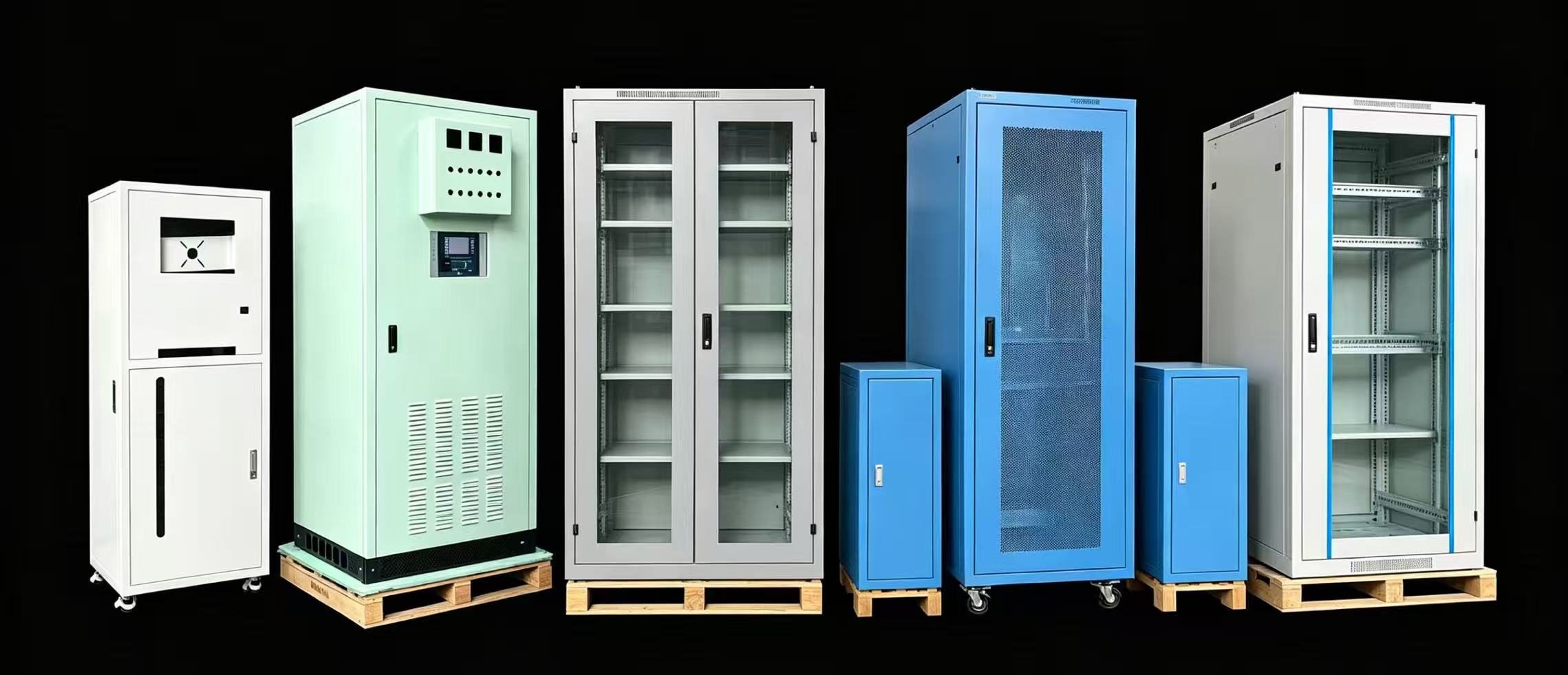
Many buyers confuse racks and cabinets. This creates wrong orders, weak layouts, and future maintenance pain. I see this problem often in real projects.
-
What Is a Data Center Rack?
Some buyers only ask for “a rack” and think every rack is the same. This can cause wrong structure, weak depth, or poor cable access.
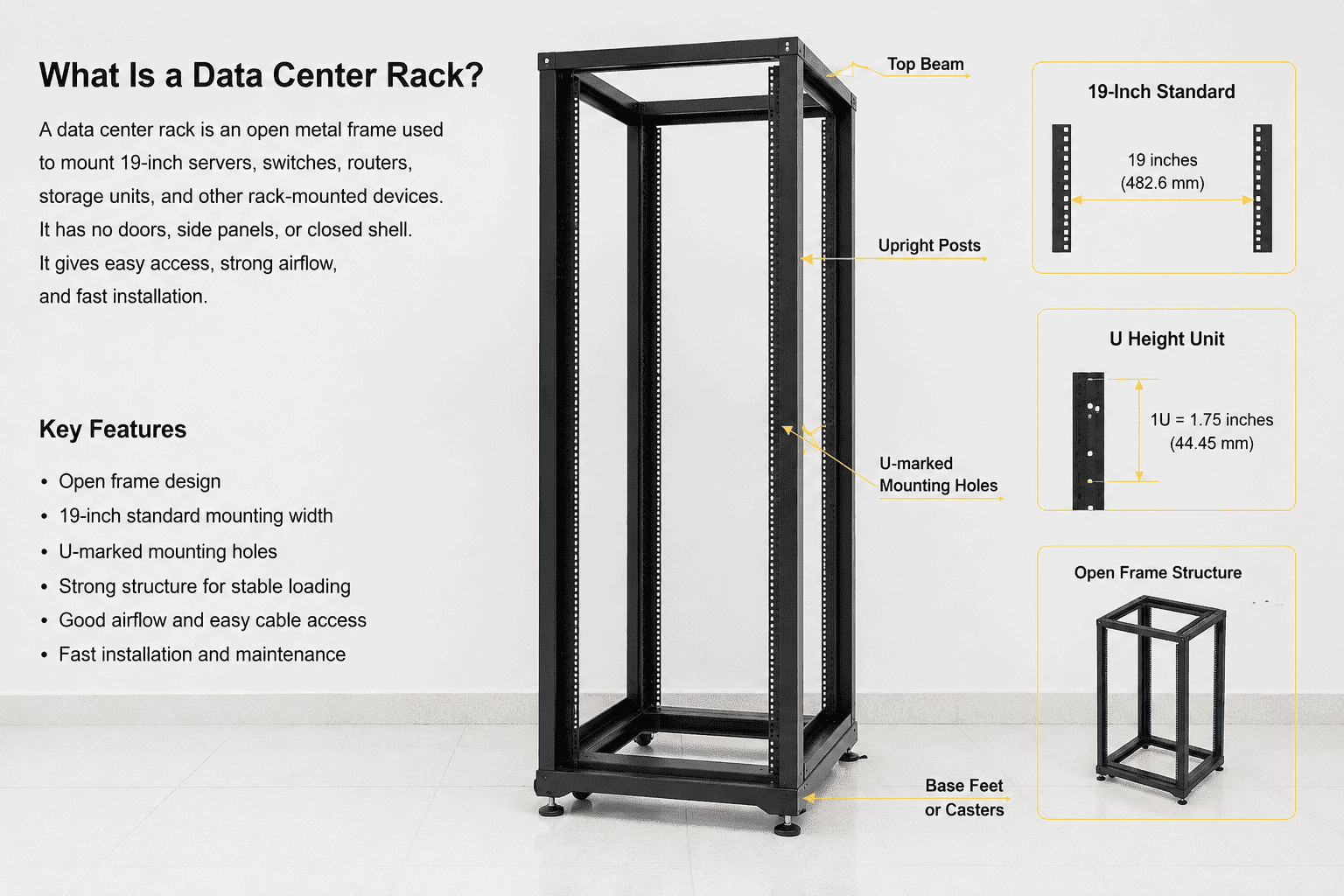
A data center rack is an open metal frame used to mount 19-inch servers, switches, routers, storage units, and other rack-mounted devices.1 It has no doors, side panels, or closed shell. It gives easy access, strong airflow, and fast installation.
The basic meaning of a rack
I usually explain a rack as the most direct carrying frame in a data center. It is an open structure. It does not have a front door. It does not have a rear door. It does not have side panels. It does not have a top cover in the same way a cabinet does. The core structure is simple, but it must be accurate. A standard rack normally includes four upright posts, horizontal beams, mounting holes, support brackets, grounding parts, and sometimes base feet or casters.
The most common installation width follows the 19-inch standard. The vertical height is measured by U. One U equals 1.75 inches.2 This standard helps engineers install different equipment in the same frame. A switch from one brand, a server from another brand, and a patch panel from a third brand can still fit the same rack if they follow the standard.
What I focus on when I make racks
| Part | What I check | Why it matters |
|---|---|---|
| Upright posts | Hole distance and straightness | Equipment must align well |
| Beams | Thickness and strength | The rack must not shake |
| Mounting holes | Standard spacing | Devices must install fast |
| Grounding parts | Stable contact | Safety must be protected |
| Surface coating | Clean and even finish | Rust and scratch risk must be lower |
In real production, an open rack looks easier than a full cabinet. In fact, I still treat it with care. If the holes are not accurate, the equipment will not sit straight. If the frame is not square, the rack will twist after loading. If the surface is not well treated, it may rust in a humid equipment room. I have seen customers focus only on the price of the rack. Later, they found that poor accuracy cost them more time during installation. A good rack should feel simple, but it should not be rough. It should be open, but it should still be stable.
What Is a Data Center Cabinet?
A cabinet looks like a box, but it is not just a box. A weak cabinet can trap heat, block cables, and reduce equipment safety.
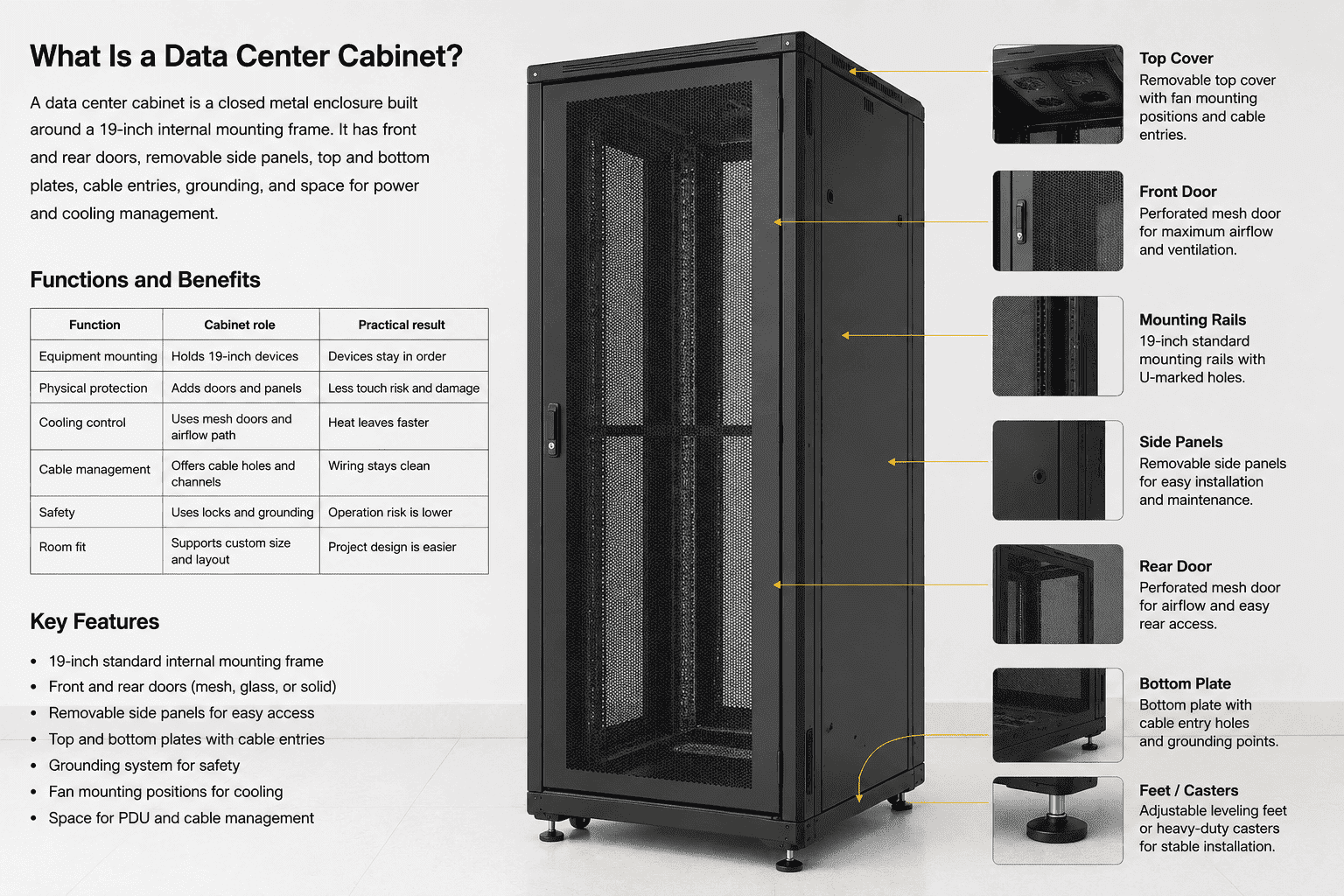
A data center cabinet is a closed metal enclosure built around a 19-inch internal mounting frame.3 It has front and rear doors, removable side panels, top and bottom plates, cable entries, grounding, and space for power and cooling management.
The basic meaning of a cabinet
I describe a cabinet as a protected equipment room inside the data center room. It keeps the same 19-inch mounting base inside, but it adds a full enclosure outside. A standard network cabinet or server cabinet usually has a front door, a rear door, left and right removable side panels, a top cover, a bottom plate, mounting rails, cable holes, fan positions, grounding kits, and sometimes PDU mounting space.
The door type can change based on the use. A network cabinet may use a tempered glass front door or a mesh door. A server cabinet usually uses perforated mesh front and rear doors because servers need strong airflow.4 Some projects need custom mesh doors with special hole patterns, open area ratios, locks, hinges, or size changes. I often receive this type of request from overseas customers because each data room has different equipment density and cooling design.
What a cabinet does for the equipment
| Function | Cabinet role | Practical result |
|---|---|---|
| Equipment mounting | Holds 19-inch devices | Devices stay in order |
| Physical protection | Adds doors and panels | Less touch risk and damage |
| Cooling control | Uses mesh doors and airflow path | Heat leaves faster |
| Cable management | Offers cable holes and channels | Wiring stays clean |
| Safety | Uses locks and grounding | Operation risk is lower |
| Room fit | Supports custom size and layout | Project design is easier |
A cabinet has a stronger sense of unity than an open rack. It is one independent enclosure. This matters in many real projects. When I build a cabinet, I need to think about raw material thickness, laser cutting accuracy, bending angle, welding points, polishing, acid cleaning, powder coating, door flatness, panel fit, and final assembly. If one step is poor, the customer can see it at once. A door may not close smoothly. A side panel may shake. A rail may not line up. A server may not slide in well. This is why I always say the cabinet is a precision sheet metal product, not only a metal box.
What Is the Main Difference Between a Rack and a Cabinet?
Many people use the two words in the same way. This is easy, but it can lead to the wrong product for the room.
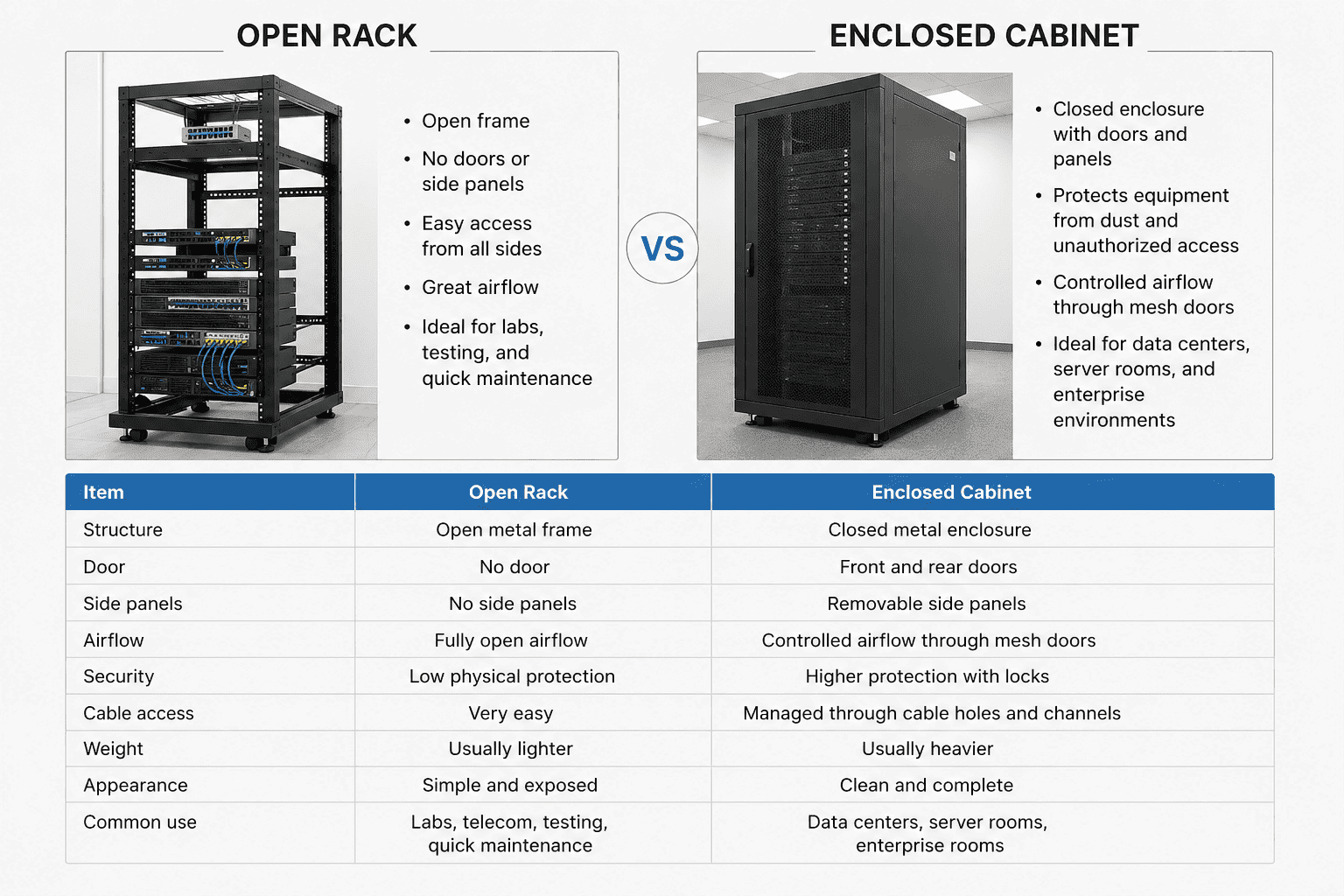
The main difference is structure. A rack is open and has no outer shell. A cabinet is closed and has doors, panels, top and bottom covers. A rack focuses on access and airflow. A cabinet adds protection, safety, cable control, and environment control.5
Open frame versus closed enclosure
I often explain the difference with one simple sentence. A rack is a skeleton. A cabinet is a skeleton with a protective shell. Both can hold standard equipment. Both can follow 19-inch mounting rules. Both can use U height. The real difference is the level of enclosure, protection, and management.
An open rack gives great access from all sides. Engineers can plug cables, check devices, and replace equipment quickly. It is also light and easy to move or assemble. This is useful in labs, test rooms, telecom spaces, and controlled machine rooms where open access is important.
A cabinet gives a more complete system. It protects equipment from touch, dust, and casual access.6 It also helps guide airflow if the door mesh ratio and equipment layout are planned well.7 It gives a cleaner appearance and better security. This is why most enterprise data centers, cloud rooms, and server rooms prefer cabinets.
Rack and cabinet comparison
| Item | Open Rack | Enclosed Cabinet |
|---|---|---|
| Structure | Open metal frame | Closed metal enclosure |
| Door | No door | Front and rear doors |
| Side panels | No side panels | Removable side panels |
| Airflow | Fully open airflow | Controlled airflow through mesh doors |
| Security | Low physical protection | Higher protection with locks |
| Cable access | Very easy | Managed through cable holes and channels |
| Weight | Usually lighter | Usually heavier |
| Appearance | Simple and exposed | Clean and complete |
| Common use | Labs, telecom, testing, quick maintenance | Data centers, server rooms, enterprise rooms |
I have seen projects where an open rack was the better choice. The customer needed fast equipment changes every week. The room was controlled, and security was not a major problem. I have also seen projects where only a cabinet made sense. The equipment was expensive. The cable volume was high. The room needed a neat layout and locked access. The best choice is not always the most expensive one. The best choice is the one that matches load, airflow, access, safety, and future maintenance.
Why Do Data Centers Need Racks and Cabinets?
A data center without a strong mounting structure becomes a pile of hot, heavy, and tangled equipment. That is a real risk.
Data centers need racks and cabinets to standardize equipment installation, support heavy hardware, manage cables, improve airflow, protect devices, and make maintenance easier.8 They create the physical base for servers, storage, networks, UPS units, and power systems.
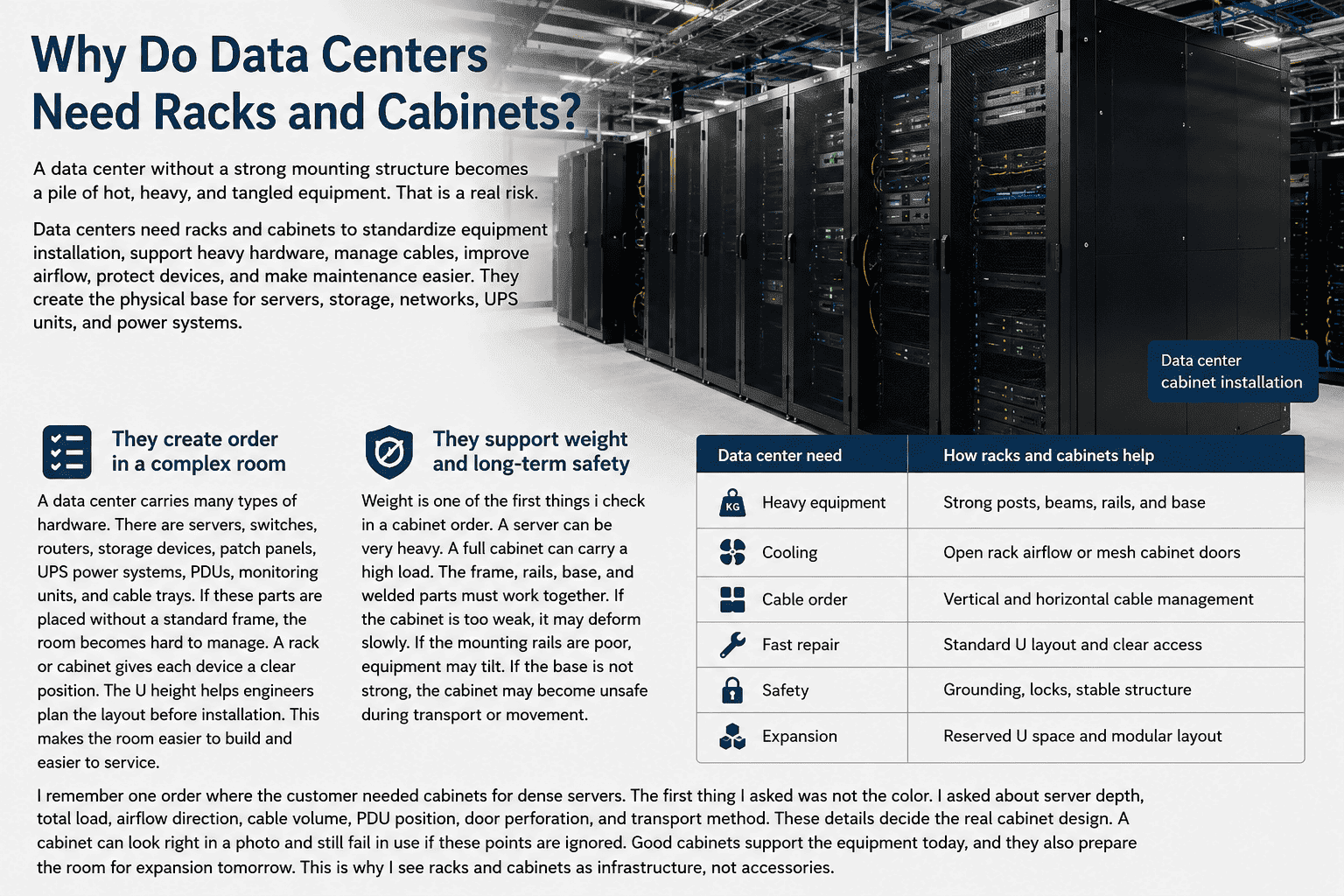
They create order in a complex room
A data center carries many types of hardware. There are servers, switches, routers, storage devices, patch panels, UPS power systems, PDUs, monitoring units, and cable trays. If these parts are placed without a standard frame, the room becomes hard to manage. A rack or cabinet gives each device a clear position. The U height helps engineers plan the layout before installation.9 This makes the room easier to build and easier to service.
They support weight and long-term safety
Weight is one of the first things I check in a cabinet order. A server can be very heavy. A full cabinet can carry a high load. The frame, rails, base, and welded parts must work together. If the cabinet is too weak, it may deform slowly. If the mounting rails are poor, equipment may tilt. If the base is not strong, the cabinet may become unsafe during transport or movement.
| Data center need | How racks and cabinets help |
|---|---|
| Heavy equipment | Strong posts, beams, rails, and base |
| Cooling | Open rack airflow or mesh cabinet doors |
| Cable order | Vertical and horizontal cable management |
| Fast repair | Standard U layout and clear access |
| Safety | Grounding, locks, stable structure |
| Expansion | Reserved U space and modular layout |
I remember one order where the customer needed cabinets for dense servers. The first thing I asked was not the color. I asked about server depth, total load, airflow direction, cable volume, PDU position, door perforation, and transport method. These details decide the real cabinet design. A cabinet can look right in a photo and still fail in use if these points are ignored. Good cabinets support the equipment today, and they also prepare the room for expansion tomorrow. This is why I see racks and cabinets as infrastructure, not accessories.
How Should I Choose Between a Rack and a Cabinet?
Choosing by price alone is dangerous. The cheaper structure can become expensive when heat, cables, or safety problems appear later.
I choose between a rack and a cabinet by checking room security, cooling design, equipment weight, cable volume, maintenance style, dust risk, and project image. A rack is best for open access. A cabinet is best for protection and control.
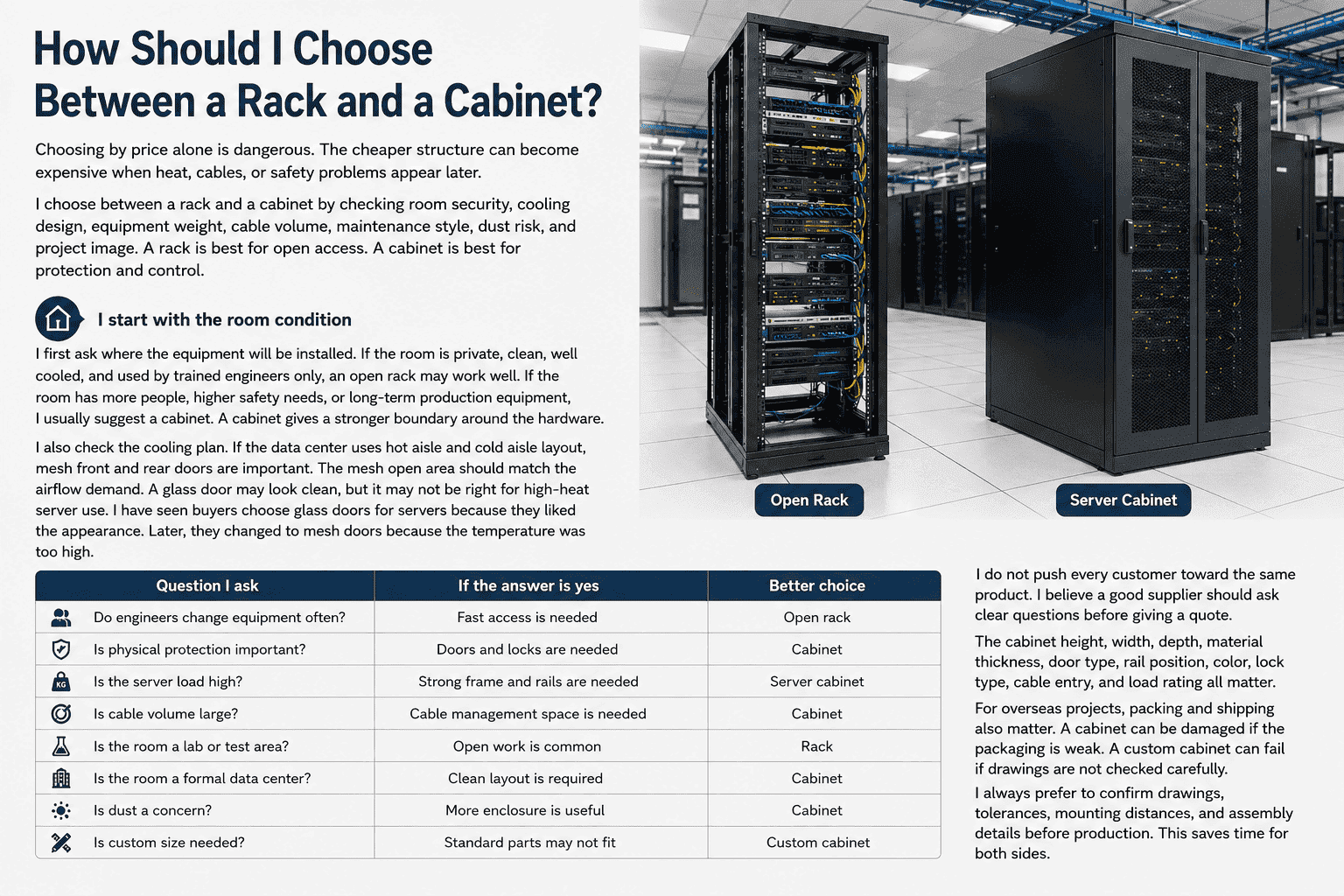
I start with the room condition
I first ask where the equipment will be installed. If the room is private, clean, well cooled, and used by trained engineers only, an open rack may work well. If the room has more people, higher safety needs, or long-term production equipment, I usually suggest a cabinet. A cabinet gives a stronger boundary around the hardware.
I also check the cooling plan. If the data center uses hot aisle and cold aisle layout, mesh front and rear doors are important.10 The mesh open area should match the airflow demand. A glass door may look clean, but it may not be right for high-heat server use.11 I have seen buyers choose glass doors for servers because they liked the appearance. Later, they changed to mesh doors because the temperature was too high.
I check equipment and service needs
| Question I ask | If the answer is yes | Better choice |
|---|---|---|
| Do engineers change equipment often? | Fast access is needed | Open rack |
| Is physical protection important? | Doors and locks are needed | Cabinet |
| Is the server load high? | Strong frame and rails are needed | Server cabinet |
| Is cable volume large? | Cable management space is needed | Cabinet |
| Is the room a lab or test area? | Open work is common | Rack |
| Is the room a formal data center? | Clean layout is required | Cabinet |
| Is dust a concern? | More enclosure is useful | Cabinet |
| Is custom size needed? | Standard parts may not fit | Custom cabinet |
I do not push every customer toward the same product. I believe a good supplier should ask clear questions before giving a quote. The cabinet height, width, depth, material thickness, door type, rail position, color, lock type, cable entry, and load rating all matter. For overseas projects, packing and shipping also matter. A cabinet can be damaged if the packaging is weak. A custom cabinet can fail if drawings are not checked carefully. I always prefer to confirm drawings, tolerances, mounting distances, and assembly details before production. This saves time for both sides.
What Makes a Good Data Center Cabinet Manufacturer?
A poor cabinet may pass a quick look, but it will show problems during installation. This is where manufacturing experience matters.
A good data center cabinet manufacturer controls the full process from material selection, laser cutting, bending, welding, polishing, acid cleaning, powder coating, assembly, inspection, and packing. The result should be accurate, strong, clean, and ready for real equipment use.
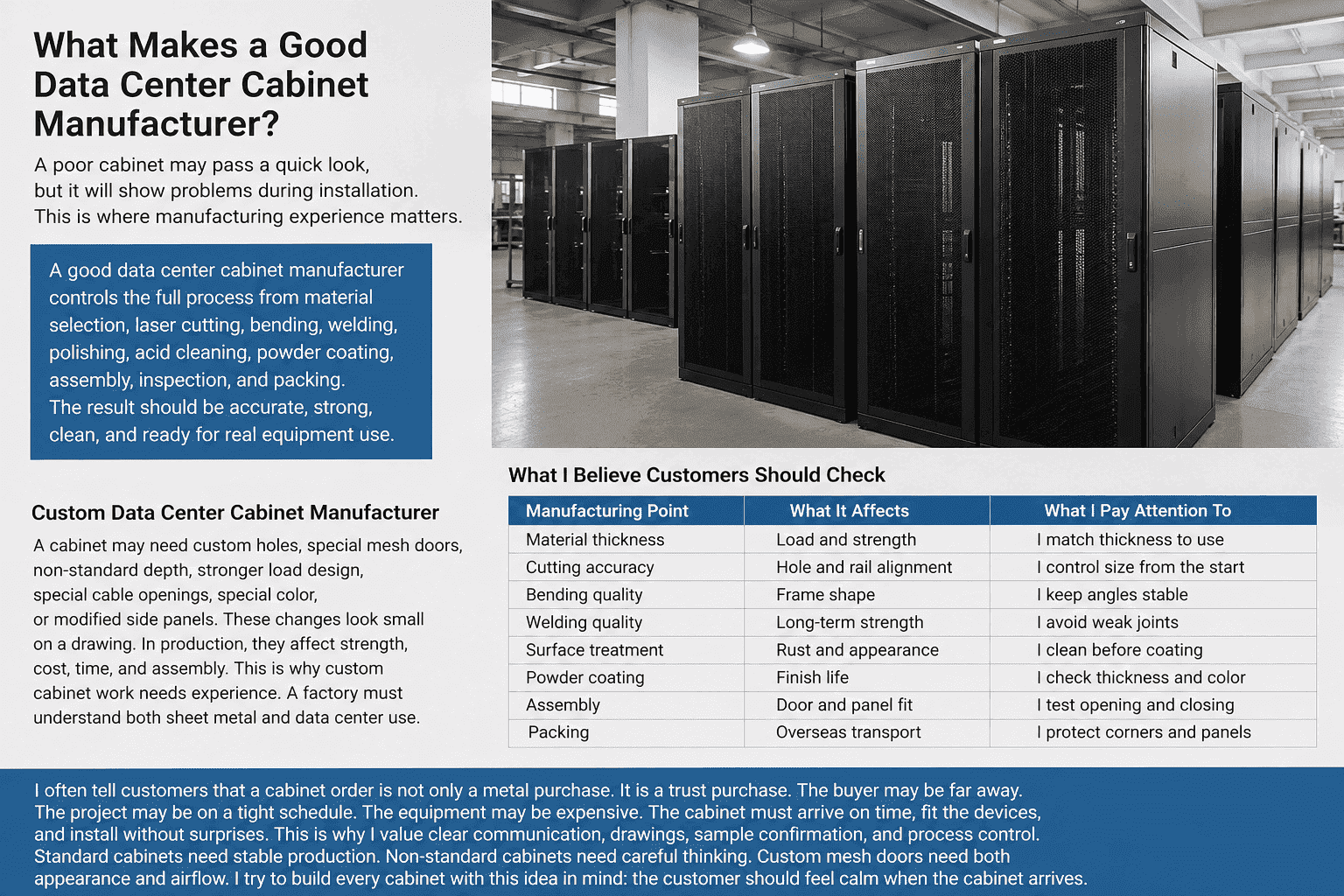
I look at process control
I have worked in sheet metal cabinet manufacturing for many years. I know that quality is not made at the final inspection only. It starts from the material. The steel sheet must have the right thickness and flatness. The laser cutting must be accurate. The bending angle must be stable. The welding must be clean and strong. The surface must be polished before treatment. The powder coating must be even. The final assembly must be checked with real structure logic, not only with the eyes.
A cabinet may need custom holes, special mesh doors, non-standard depth, stronger load design, special cable openings, special color, or modified side panels. These changes look small on a drawing. In production, they affect strength, cost, time, and assembly. This is why custom cabinet work needs experience. A factory must understand both sheet metal and data center use.
What I believe customers should check
| Manufacturing point | What it affects | What I pay attention to |
|---|---|---|
| Material thickness | Load and strength | I match thickness to use |
| Cutting accuracy | Hole and rail alignment | I control size from the start |
| Bending quality | Frame shape | I keep angles stable |
| Welding quality | Long-term strength | I avoid weak joints |
| Surface treatment | Rust and appearance | I clean before coating |
| Powder coating | Finish life | I check thickness and color |
| Assembly | Door and panel fit | I test opening and closing |
| Packing | Overseas transport | I protect corners and panels |
I often tell customers that a cabinet order is not only a metal purchase. It is a trust purchase. The buyer may be far away. The project may be on a tight schedule. The equipment may be expensive. The cabinet must arrive on time, fit the devices, and install without surprises. This is why I value clear communication, drawings, sample confirmation, and process control. Standard cabinets need stable production. Non-standard cabinets need careful thinking. Custom mesh doors need both appearance and airflow. I try to build every cabinet with this idea in mind: the customer should feel calm when the cabinet arrives.
Conclusion
Data center racks and cabinets carry, protect, cool, and organize critical equipment. I choose them by structure, load, airflow, security, and real project needs.
"19-inch rack - Wikipedia", https://en.wikipedia.org/wiki/19-inch_rack. A neutral technical reference describes open-frame racks as mounting structures for standardized rack-mounted information technology and networking equipment. Evidence role: definition; source type: education. Supports: The source should describe open-frame racks as structures for mounting servers, networking hardware, and other 19-inch rack equipment.. Scope note: The source may support the general definition of open-frame racks rather than every listed equipment category. ↩
"Rack unit - Wikipedia", https://en.wikipedia.org/wiki/Rack_unit. A technical reference on rack units states that one rack unit, abbreviated U, is equal to 1.75 inches of vertical rack height. Evidence role: definition; source type: encyclopedia. Supports: The source should define a rack unit and state that 1U equals 1.75 inches.. ↩
"19-inch rack - Wikipedia", https://en.wikipedia.org/wiki/19-inch_rack. A technical standards reference identifies rack cabinets as enclosed structures that provide standardized internal mounting for rack equipment. Evidence role: definition; source type: institution. Supports: The source should define equipment cabinets as enclosed rack structures using standardized mounting dimensions.. Scope note: The source may define rack cabinets generally and may not use the exact phrase data center cabinet. ↩
"[PDF] Best Practices Guide for Energy-Efficient Data Center Design", https://www.energy.gov/sites/default/files/2024-07/best-practice-guide-data-center-design_0.pdf. Research and guidance on data center thermal management explain that perforated rack doors facilitate airflow through server cabinets, supporting the use of mesh front and rear doors for heat-producing equipment. Evidence role: mechanism; source type: research. Supports: The source should explain that perforated rack or cabinet doors allow front-to-back airflow and help remove heat from server equipment.. Scope note: The source supports the cooling mechanism; it may not prove that all or most server cabinets use this door type. ↩
"Enclosed Rack vs. Open-Frame Rack - Emcor Enclosures", https://www.emcorenclosures.com/blog/open-frame-vs-enclosed-rack/. A technical educational source comparing open racks and enclosed rack cabinets supports the distinction that open frames emphasize accessibility and airflow, while enclosed cabinets provide additional protection, security, and cable-management functions. Evidence role: general_support; source type: education. Supports: The source should compare open racks and enclosed cabinets in terms of access, airflow, protection, security, and cable management.. Scope note: The source would support the general comparison, while actual performance depends on cabinet design, equipment layout, and site conditions. ↩
"NEMA 12 Dust & Water Resistant Racks - Server Racks Online", https://www.server-rack-online.com/dust-water-resistant/?srsltid=AfmBOoq0jD59Rfu-rEZcvKQTarrDlUwTvUc9pjsMWv-mISoX172mwSzY. Technical guidance on equipment enclosures states that cabinets provide a physical barrier that can reduce accidental contact, limit casual access, and help shield equipment from some environmental contaminants. Evidence role: general_support; source type: institution. Supports: The source should explain that equipment enclosures or cabinets provide physical barriers against contact, environmental contaminants, and unauthorized access.. Scope note: The level of dust and access protection depends on enclosure design, sealing, filtration, locks, and site operating practices. ↩
"[PDF] Thermal Guidelines and Temperature Measurements in Data Centers", https://datacenters.lbl.gov/sites/default/files/FINAL%20Thermal%20Guidelines%20and%20Temp%20Measurements%209-15-2020.pdf. Data center thermal-management literature indicates that rack airflow is affected by door perforation or open-area characteristics and by the arrangement of equipment and airflow paths within the rack. Evidence role: mechanism; source type: research. Supports: The source should show that rack door open area, airflow path, and equipment layout affect cooling performance.. Scope note: This supports the mechanism in general; it does not establish a universal mesh ratio suitable for every cabinet. ↩
"Security Guidelines for Storage Infrastructure", https://nvlpubs.nist.gov/nistpubs/SpecialPublications/NIST.SP.800-209.pdf. Data center infrastructure guidance describes racks and cabinets as physical systems for mounting equipment, organizing cabling, supporting airflow management, limiting physical exposure, and enabling maintenance access. Evidence role: general_support; source type: institution. Supports: The source should describe the infrastructure role of racks and cabinets in organizing, supporting, cooling, protecting, and maintaining data center equipment.. Scope note: The source may address these functions across multiple sections rather than in a single sentence. ↩
"Rack unit - Wikipedia", https://en.wikipedia.org/wiki/Rack_unit. Educational material on rack units explains that U measurements define vertical equipment space in a rack and are used to plan equipment placement and available capacity. Evidence role: general_support; source type: education. Supports: The source should explain that rack units are used to measure vertical equipment space and plan rack layouts.. ↩
"Move to a Hot Aisle/Cold Aisle Layout | ENERGY STAR", https://www.energystar.gov/products/data_center_equipment/16-more-ways-cut-energy-waste-data-center/move-hot-aislecold-aisle-layout. Thermal-management guidance for hot-aisle/cold-aisle data centers explains that cooling performance depends on maintaining front-to-back airflow paths through server racks, making perforated or mesh cabinet doors relevant to airflow. Evidence role: mechanism; source type: research. Supports: The source should explain hot-aisle/cold-aisle airflow principles and the need for unobstructed front-to-back airflow through racks or cabinets.. Scope note: The source supports the airflow rationale; specific door requirements still depend on equipment heat load, fan design, and cabinet geometry. ↩
"Move to a Hot Aisle/Cold Aisle Layout | ENERGY STAR", https://www.energystar.gov/products/data_center_equipment/16-more-ways-cut-energy-waste-data-center/move-hot-aislecold-aisle-layout. Research on rack-level cooling shows that restricting cabinet-door airflow can increase thermal risk for server equipment, supporting caution against solid or low-airflow doors in high-heat deployments. Evidence role: mechanism; source type: research. Supports: The source should show that cabinet door obstruction affects airflow and that high-heat server equipment generally requires adequate front and rear airflow.. Scope note: This is contextual support; a glass door may be acceptable in low-density cabinets or designs with alternative airflow provisions. ↩
