
What is the difference between a rack and a chassis of PLC?
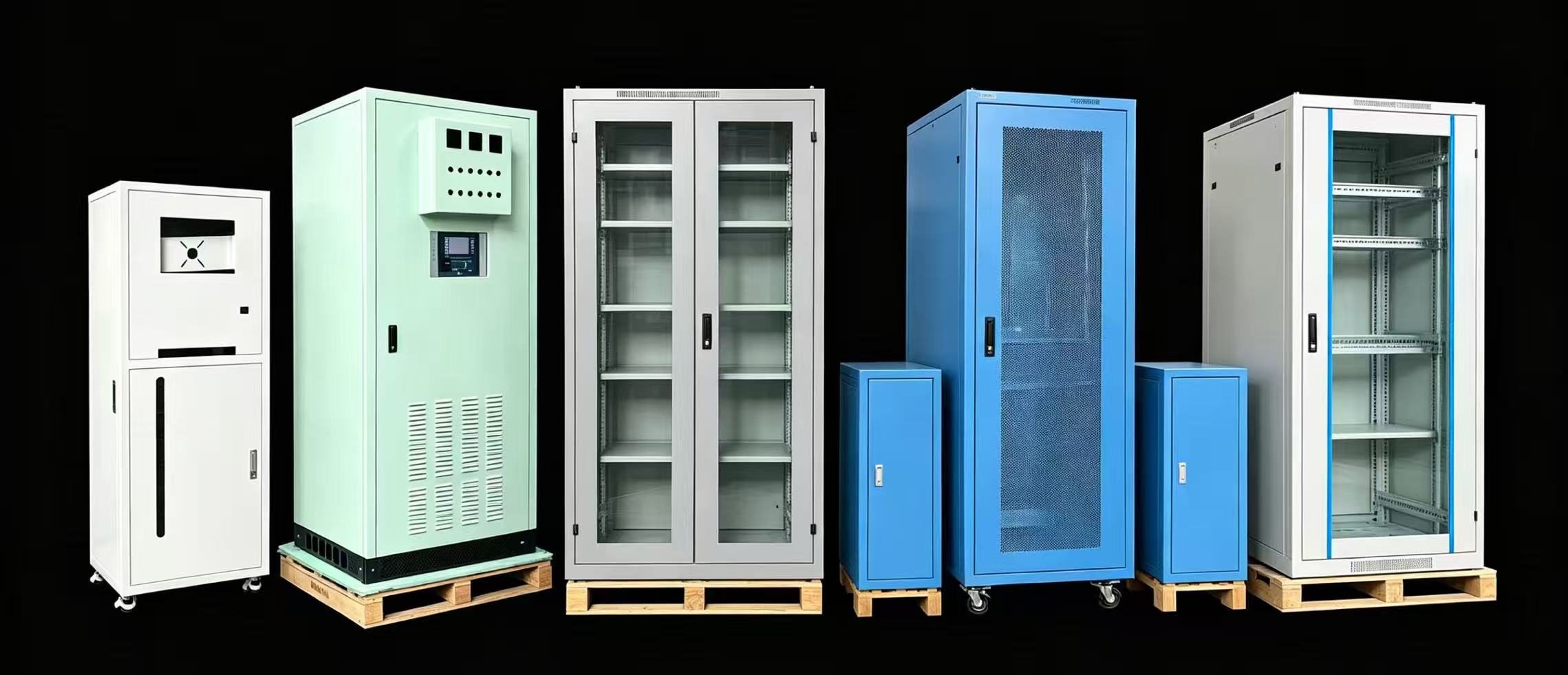
I often see good automation projects slowed down by one small naming mistake. People say rack, chassis, and cabinet as if they are the same.
A PLC rack or chassis is the internal base that holds PLC modules and connects power and signals through a backplane. A PLC cabinet is the outer metal enclosure that protects the full electrical control system. I treat the rack as the system carrier and the cabinet as the safety shell.
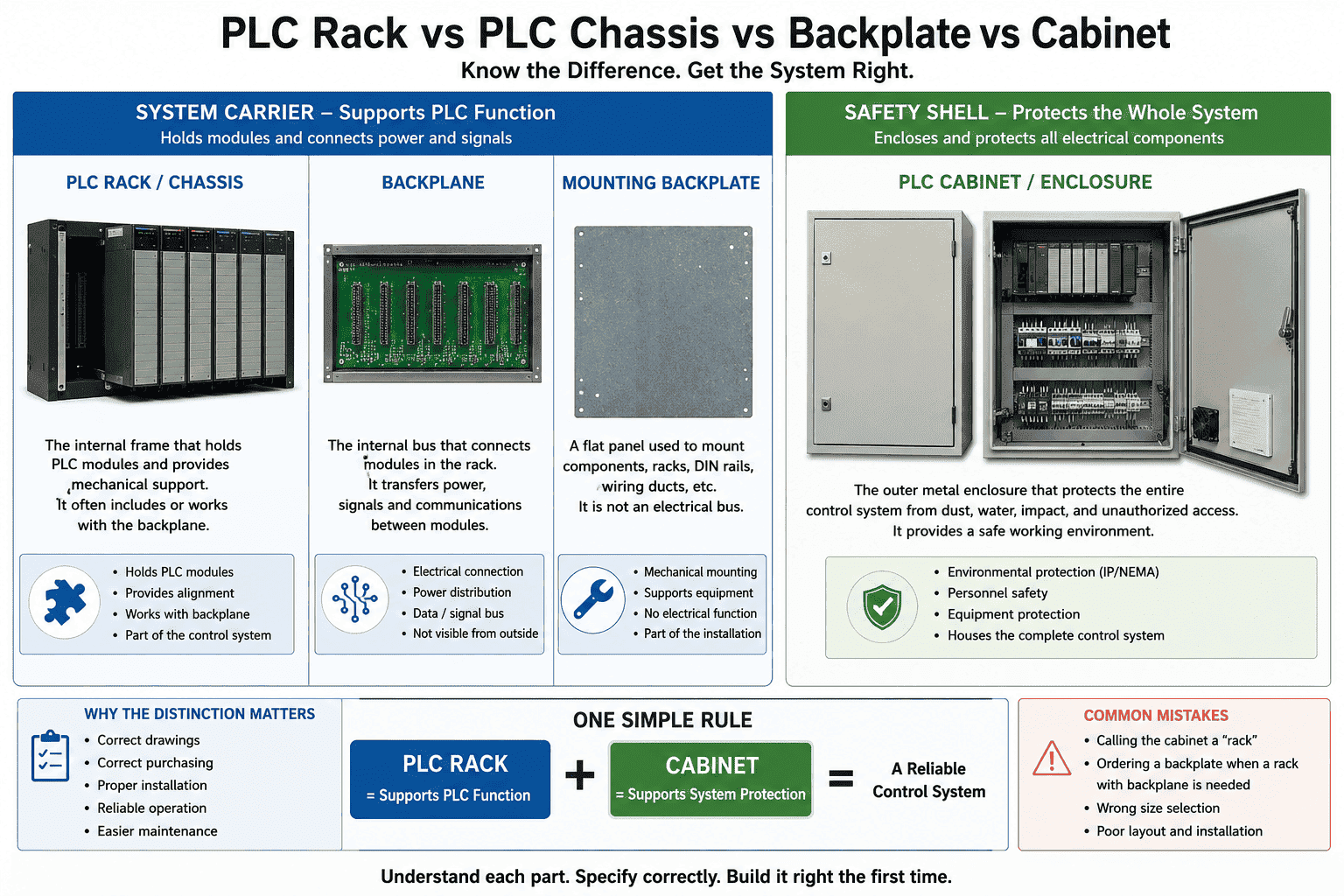
I have worked with many control cabinet builds. I have also seen technicians mix up PLC rack, PLC chassis, mounting backplate, and cabinet. This mistake looks small at first. It can cause wrong drawings, wrong purchasing, and poor installation. I use one simple rule. The PLC rack supports PLC function. The cabinet supports system protection.
What is a PLC rack or chassis in a control system?
I often see a PLC project fail at the wiring stage. The modules look correct, but the base is wrong. I solve this by checking the rack first.
A PLC rack, also called a PLC chassis, is the base frame or backplane that holds PLC modules.1 It provides slots, power paths, and signal paths for CPU modules, power modules, I/O modules, and communication modules.2
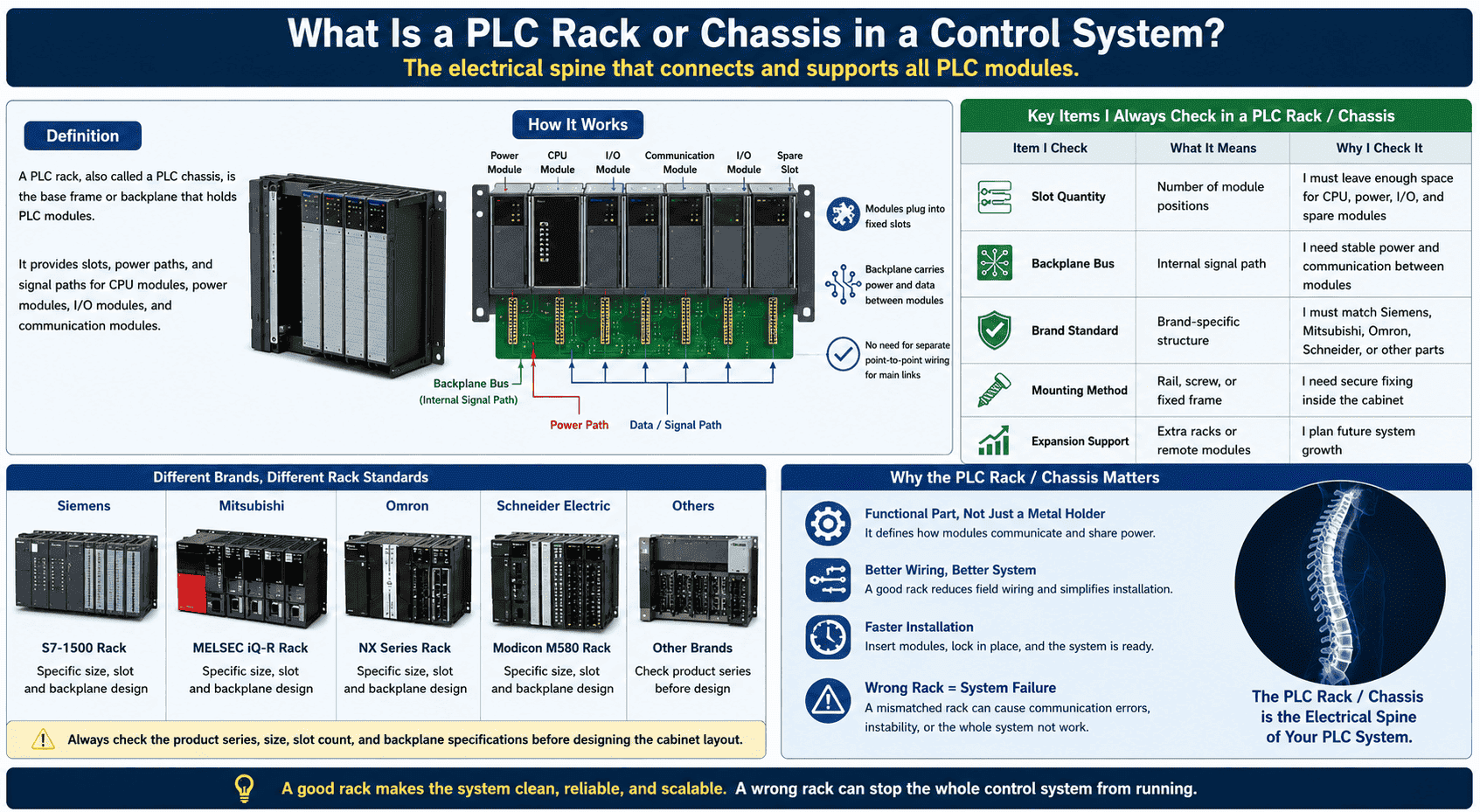
I see the PLC rack as the electrical spine of a PLC system. Many people in the field call it a PLC base plate, slot base, frame, backplane, or mounting base. These names may change by country, brand, or worker habit. The core function does not change. The rack lets PLC modules plug into fixed slots. The internal backplane then carries power and data signals. This means each module does not need separate point-to-point wiring for its main link.3 I only need to insert the module into the correct slot and lock it in place.
Different PLC brands have different rack rules.4 Siemens, Mitsubishi, Omron, Schneider, and other brands use their own size, slot, and bus design. I always check the product series before I design the cabinet layout.
| Item I check | What it means | Why I check it |
|---|---|---|
| Slot quantity | Number of module positions | I must leave enough space for CPU, power, I/O, and spare modules |
| Backplane bus | Internal signal path | I need stable power and communication between modules |
| Brand standard | Brand-specific structure | I must match Siemens, Mitsubishi, Omron, Schneider, or other parts |
| Mounting method | Rail, screw, or fixed frame | I need secure fixing inside the cabinet |
| Expansion support | Extra racks or remote modules | I plan future system growth |
In my work, I treat the PLC rack as a functional part, not just a metal holder. It decides how the PLC modules talk to each other. It also decides how clean the system wiring can be. A good rack makes installation faster. A wrong rack can stop the whole control system from running.
What is a PLC cabinet in industrial automation?
I have seen PLC modules installed well, but the whole system still becomes unsafe. Dust, water, heat, and cable disorder can damage the project. I use a cabinet to control this risk.
A PLC cabinet is the outer electrical control enclosure.5 It houses the PLC rack and other control parts. It protects, fixes, organizes, and supports wiring for the full electrical control system.6
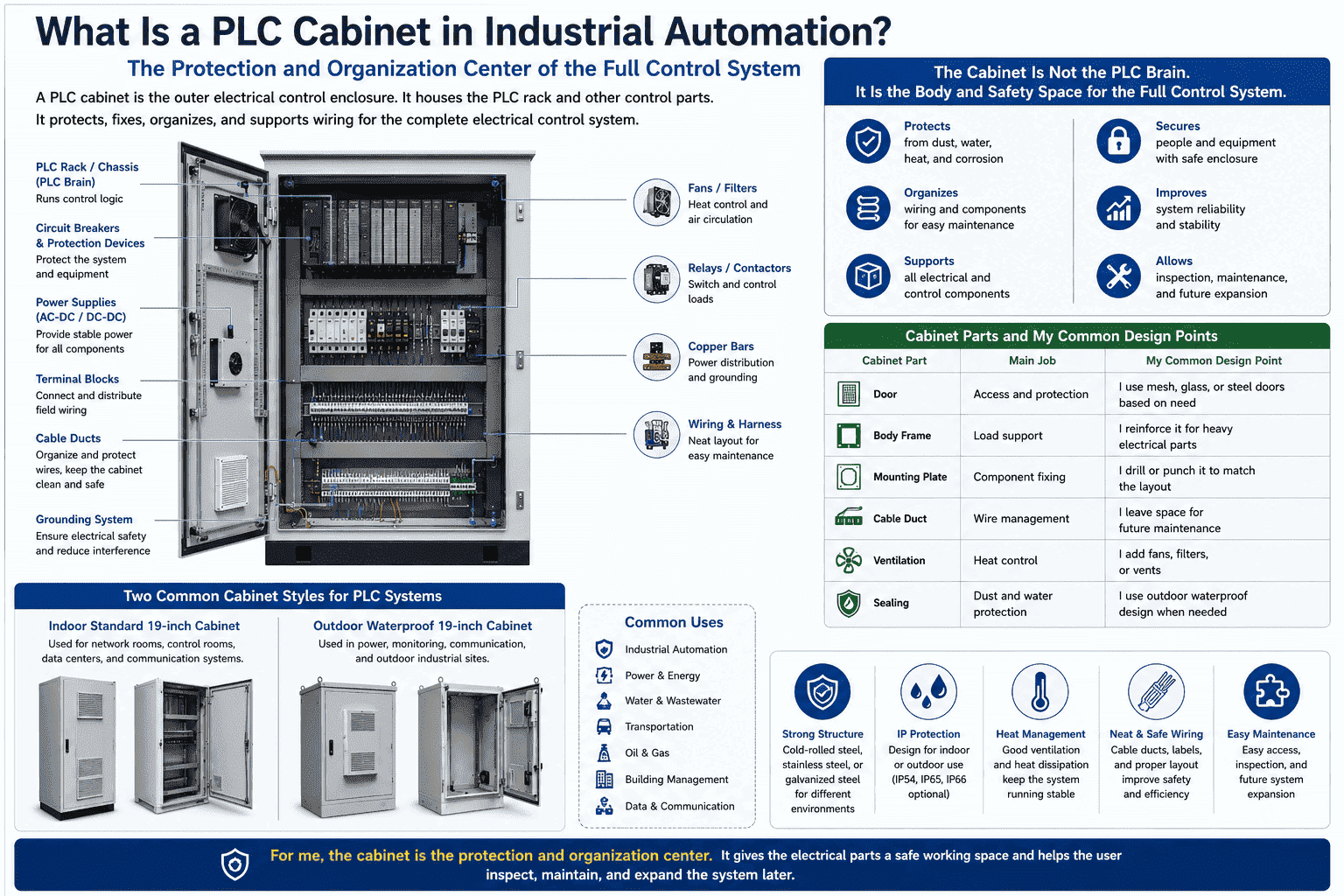
I build and customize cabinets as structural protection products. A cabinet is not the PLC brain. It is the body and safety space for the full control system. I use cold-rolled steel, stainless steel, or galvanized steel to make the enclosure.7 I choose the material based on the indoor or outdoor environment. I also consider moisture, corrosion, load, and heat.
Inside one cabinet, I can install many parts.8 I can install the PLC rack, circuit breakers, relays, terminal blocks, switching power supplies, cable ducts, copper bars, fans, filters, and grounding parts. The PLC rack runs the control logic. The cabinet keeps the complete electrical system fixed, protected, and clean.
| Cabinet part | Main job | My common design point |
|---|---|---|
| Door | Access and protection | I use mesh, glass, or steel doors based on need |
| Body frame | Load support | I reinforce it for heavy electrical parts |
| Mounting plate | Component fixing | I drill or punch it to match the layout |
| Cable duct | Wire management | I leave space for future maintenance |
| Ventilation | Heat control | I add fans, filters, or vents |
| Sealing | Dust and water protection | I use outdoor waterproof design when needed |
I often design two common styles. One style is an indoor standard 19-inch cabinet.9 It is used for network rooms, control rooms, data centers, and communication systems. The other style is an outdoor waterproof 19-inch cabinet. It is used in power, monitoring, communication, and outdoor industrial sites. Both styles can work with PLC systems when the internal layout is designed correctly.
For me, the cabinet is the protection and organization center. It gives the electrical parts a safe working space. It also helps the user inspect, maintain, and expand the system later.
How do the PLC rack and PLC cabinet work together?
I have seen buyers ask for only a cabinet when they actually need a full PLC mounting solution. I have also seen buyers ask for a rack when they need protection. I separate the two roles first.
The PLC rack carries and connects PLC modules. The PLC cabinet protects and organizes the full electrical system. They work together as a pair. One supports function. The other supports safety and environment.
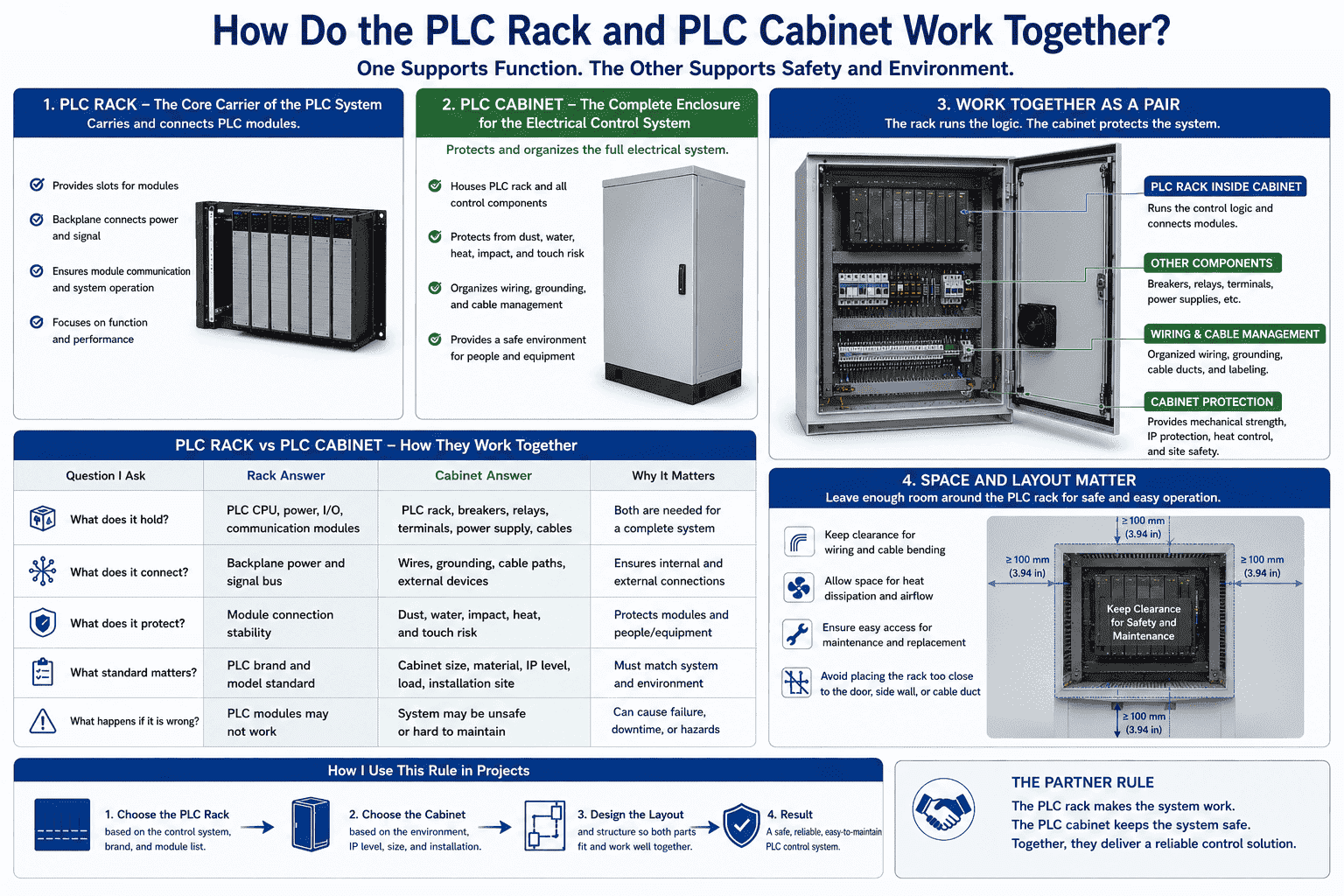
I often describe the relationship in a simple way. The PLC rack is the core carrier of the PLC system. The cabinet is the complete enclosure for the electrical control system. The rack focuses on module operation. The cabinet focuses on physical protection, wiring order, heat control, and site safety.
When I design a PLC control cabinet, I do not treat the rack and cabinet as competing products. I treat them as partners. The rack must match the PLC brand and module list. The cabinet must match the project environment and installation space. If either one is wrong, the full system can suffer.
| Question I ask | Rack answer | Cabinet answer |
|---|---|---|
| What does it hold? | PLC CPU, power, I/O, communication modules | PLC rack, breakers, relays, terminals, power supply, cables |
| What does it connect? | Backplane power and signal bus | Wires, grounding, cable paths, external devices |
| What does it protect? | Module connection stability | Dust, water, impact, heat, and touch risk |
| What standard matters? | PLC brand and model standard | Cabinet size, material, IP level, load, installation site |
| What happens if it is wrong? | PLC modules may not work | System may be unsafe or hard to maintain |
I also pay attention to space. The cabinet must leave enough room around the PLC rack.10 I need space for wiring, heat, cable bending, and maintenance. A rack may look small on paper. It can become hard to service if I put it too close to the door, side wall, or cable duct.
I use this rule in many projects. I choose the PLC rack based on the control system. I choose the cabinet based on the working environment. I then adjust the cabinet structure so both parts can work well together.
Why do automation workers often confuse rack, chassis, and cabinet?
I have seen this confusion in workshops, drawings, and purchase orders. One word can mean different parts to different people. I avoid trouble by asking for function and drawing first.
Automation workers confuse these terms because “rack,” “chassis,” “backplane,” and “cabinet” are used differently by brands and suppliers. In PLC work, rack and chassis often mean the module base. Cabinet means the outer enclosure.
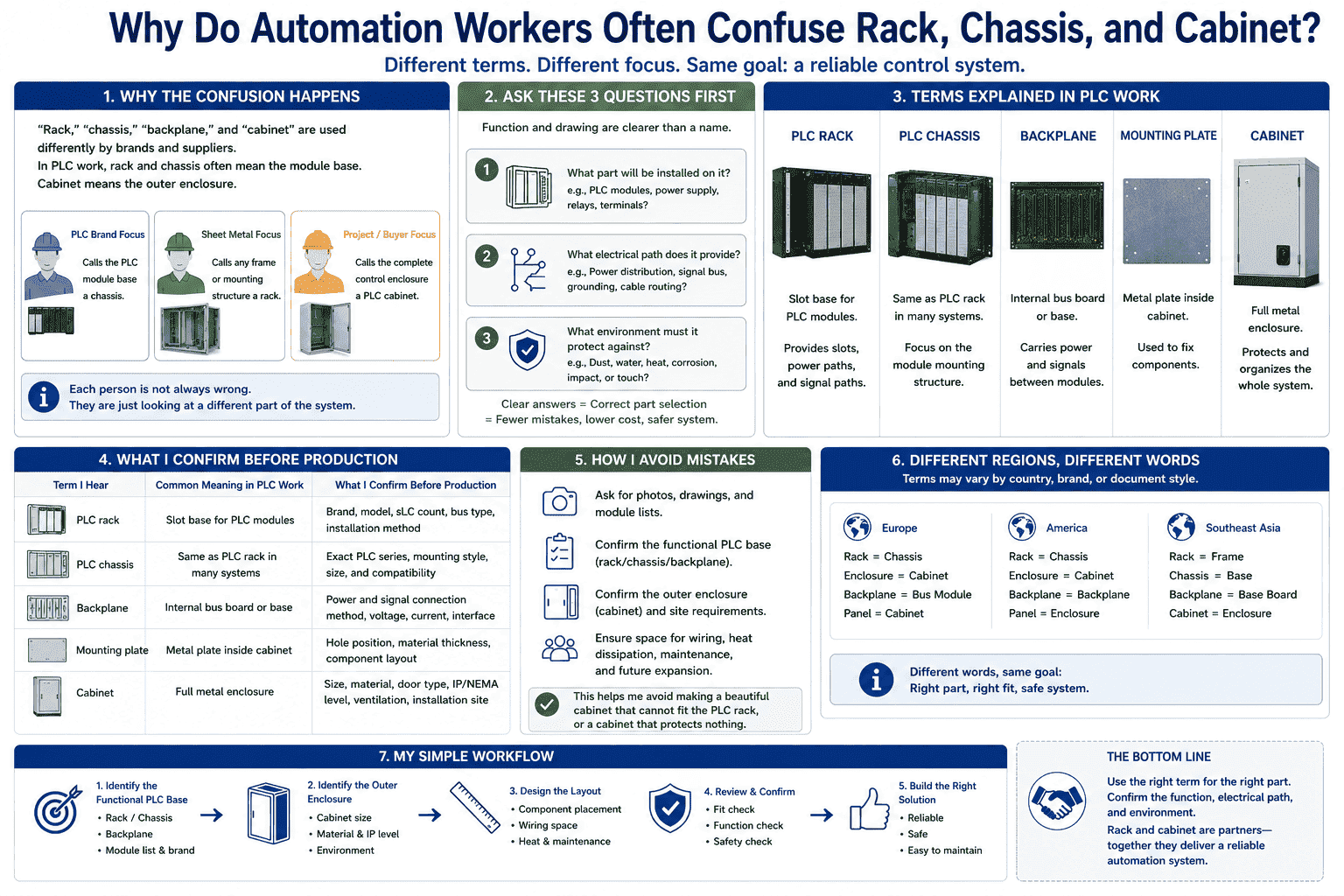
I think the confusion comes from daily work habits. Some workers focus on PLC brands. They call the PLC module base a chassis. Some workers focus on sheet metal. They call any frame a rack. Some buyers focus on the full project. They call the complete control enclosure a PLC cabinet. Each person is not always wrong. They are just looking at a different part of the system.
I usually solve this by asking three basic questions. What part will be installed on it? What electrical path does it provide? What environment must it protect against? These questions are clearer than the name alone.
| Term I hear | Common meaning in PLC work | What I confirm before production |
|---|---|---|
| PLC rack | Slot base for PLC modules | Brand, model, slot count, bus type |
| PLC chassis | Same as PLC rack in many systems | Exact PLC series and mounting style |
| Backplane | Internal bus board or base | Power and signal connection method |
| Mounting plate | Metal plate inside cabinet | Hole position and component layout |
| Cabinet | Full metal enclosure | Size, material, door, protection level |
In my own factory communication, I try not to rely on only one word. I ask for photos, drawings, module lists, and site requirements. This helps me avoid making a beautiful cabinet that cannot fit the PLC rack. It also helps me avoid designing a cabinet that protects nothing from water, dust, or heat.
For overseas clients, this step is even more important. Europe, America, and Southeast Asia may use different terms in project files. I keep the discussion simple. I first identify the functional PLC base. I then identify the outer enclosure. This keeps the order clear.
How should I choose the right PLC rack and cabinet for a project?
I have seen low-cost choices become expensive later. A small rack can block expansion. A weak cabinet can bend, rust, or leak. I choose from the project condition first.
I choose the PLC rack by PLC brand, module quantity, slot type, and future expansion. I choose the PLC cabinet by size, material, load, protection level, heat control, wiring space, and indoor or outdoor use.
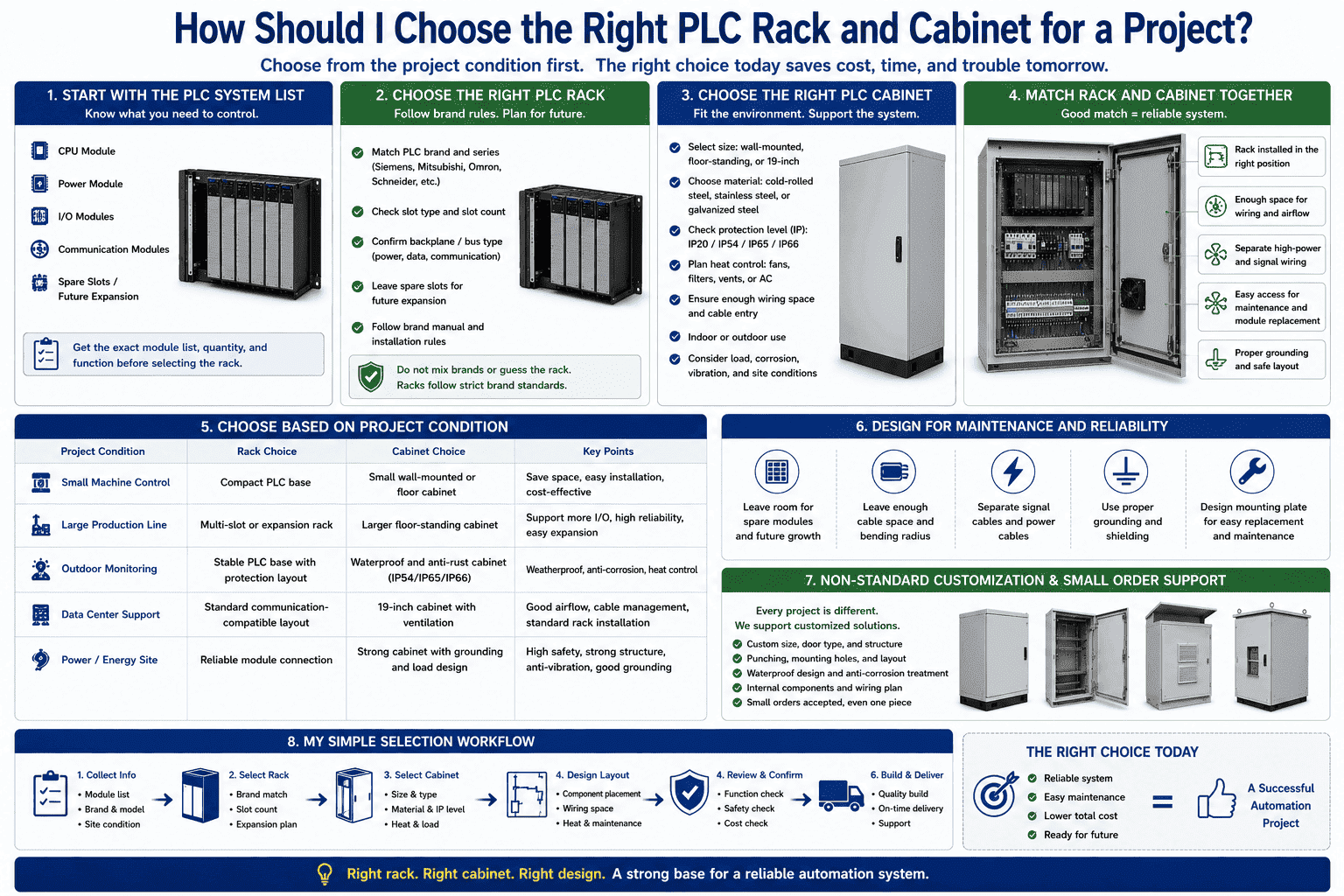
I start with the PLC system list. I need to know the CPU, power module, I/O modules, communication modules, and spare slots. I then check the brand manual. I do not guess the rack. PLC racks follow strict brand standards. A Siemens rack cannot be treated the same as a Mitsubishi or Omron rack.
Then I move to the cabinet. I check where the cabinet will be used. Indoor use may need a standard industrial cabinet or 19-inch cabinet. Outdoor use may need waterproof structure, sealing, rainproof top, anti-rust treatment, and better coating. If the site has dust, moisture, heat, or vibration, I adjust the structure.
| Project condition | Rack choice | Cabinet choice |
|---|---|---|
| Small machine control | Compact PLC base | Small wall-mounted or floor cabinet |
| Large production line | Multi-slot or expansion rack | Larger floor-standing cabinet |
| Outdoor monitoring | Stable PLC base with protection layout | Waterproof and anti-rust cabinet |
| Data center support | Standard communication-compatible layout | 19-inch cabinet with ventilation |
| Power or energy site | Reliable module connection | Strong cabinet with grounding and load design |
I also keep future maintenance in mind. I leave room for spare modules. I leave cable space. I avoid placing the PLC rack too close to high-current parts. I separate signal cables and power cables as much as possible.11 I use proper grounding. I also design the mounting plate so technicians can replace parts without removing half of the cabinet.
In my own production, I support non-standard customization because many PLC projects do not fit one standard cabinet. I can customize size, door type, punching, mounting holes, load-bearing structure, waterproof design, anti-corrosion treatment, and internal layout. I can also support small orders, even one piece, because many automation projects need trial cabinets or special project cabinets before mass use.
What mistakes should I avoid when designing a PLC control cabinet?
I have seen many cabinet problems come from early design shortcuts. The parts can be good, but the layout can still be bad. I avoid mistakes before metal cutting starts.
I avoid choosing the cabinet before confirming the PLC rack, module list, wiring space, heat needs, grounding plan, and site environment. I also avoid treating the rack and cabinet as the same part.
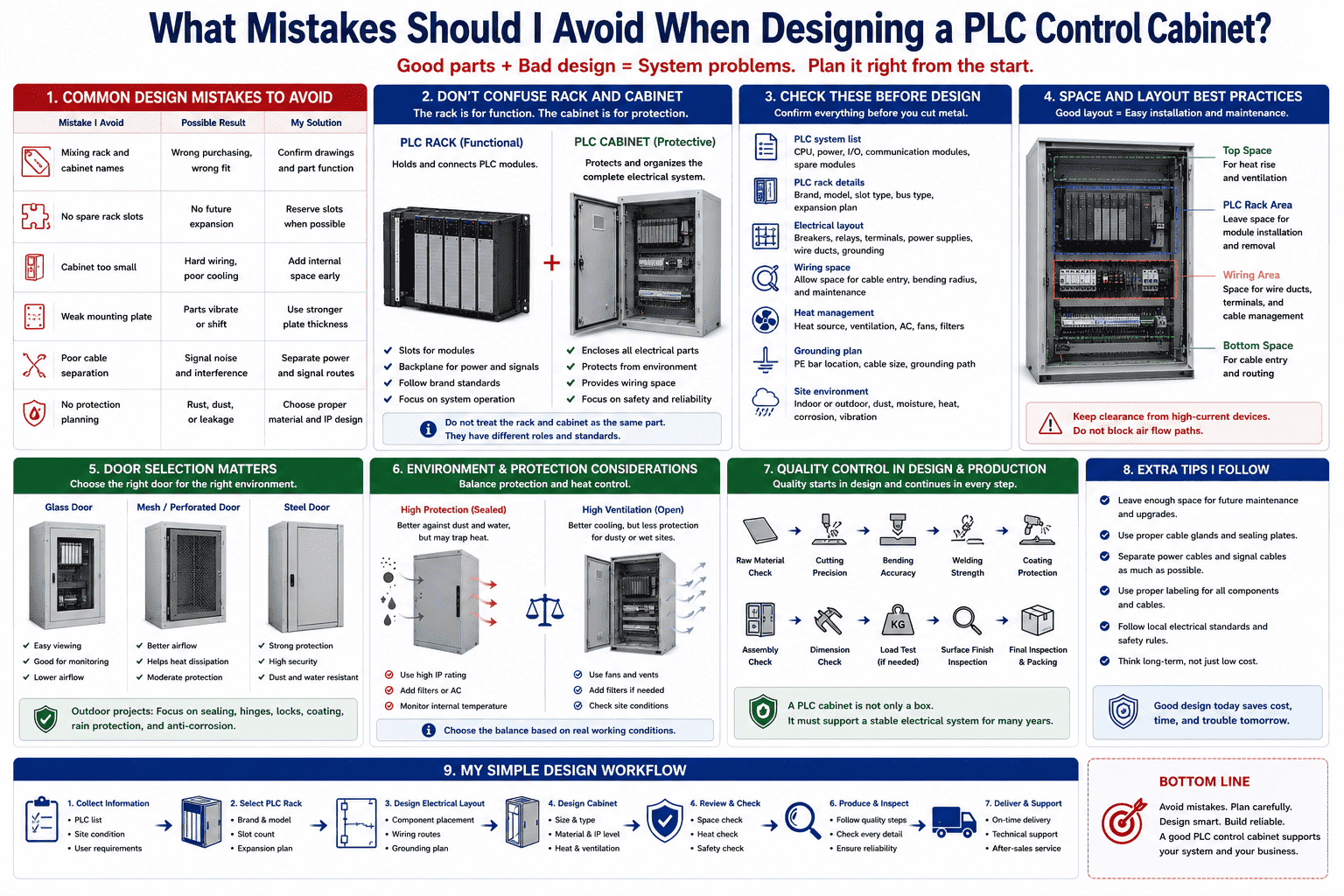
I usually check the full electrical layout before production. The PLC rack needs enough space for module installation and removal. The cabinet needs enough space for wire ducts, terminals, breakers, relays, and power supplies. If the cabinet is too small, workers may force cables into tight areas. This can create heat, noise, and maintenance problems.
I also check heat and protection. A sealed cabinet may protect against dust and water, but it may trap heat. An open ventilation design may cool better, but it may not suit a dusty or wet site. I choose the balance based on real working conditions.
| Mistake I avoid | Possible result | My solution |
|---|---|---|
| Mixing rack and cabinet names | Wrong purchasing | I confirm drawings and part function |
| No spare rack slots | No future expansion | I reserve slots when possible |
| Cabinet too small | Hard wiring and poor cooling | I add internal space early |
| Weak mounting plate | Parts vibrate or shift | I use stronger plate thickness |
| Poor cable separation | Signal noise | I separate power and signal routes |
| No protection planning | Rust, dust, or leakage | I choose proper material and IP design |
I also avoid ignoring the door. A glass door helps viewing. A mesh door helps airflow. A steel door gives stronger protection. For outdoor projects, I focus on sealing, hinges, locks, coating, and rain protection. For industrial sites, I focus on strength, grounding, and safe access.
My quality control is also part of the design process. I check raw materials, cutting, bending, welding, coating, assembly, dimensions, load, and surface finish. A PLC cabinet is not only a box. It must support a stable electrical system for many years.
Conclusion
I treat the PLC rack as the functional module carrier and the PLC cabinet as the protective system enclosure. Both are needed for safe PLC operation.
"Programmable logic controller - Wikipedia", https://en.wikipedia.org/wiki/Programmable_logic_controller. A neutral reference on programmable logic controllers describes modular PLC systems as using a rack or chassis/backplane to hold and interconnect functional modules. Evidence role: definition; source type: encyclopedia. Supports: A modular PLC can use a rack or chassis/backplane to mount and interconnect CPU, power, I/O, and communication modules.. ↩
"PLC Hardware - PLC Backplane & Other PLC Components", https://library.automationdirect.com/plc-hardware/. Technical education materials on modular PLCs explain that the backplane or rack provides module slots and distributes power and communication signals among installed PLC modules. Evidence role: mechanism; source type: education. Supports: The PLC backplane supplies electrical connections, including power distribution and communication paths, between modules installed in the rack.. ↩
"PLC Backplane Communication Buses and Protocols Guide", https://industrialmonitordirect.com/blogs/knowledgebase/plc-backplane-protocols-electrical-layers-and-communication-architectures?srsltid=AfmBOoouJ02rnG1lgdqPpbYQvI_egw3C3bjiItY55F-g1vEDg4l5iual. PLC training references describe the backplane bus as the shared electrical interconnection for modular PLC components, which contextualizes why separate point-to-point wiring is not normally required for their main internal links. Evidence role: mechanism; source type: education. Supports: A PLC backplane bus provides shared interconnections among modules, reducing the need for separate inter-module point-to-point wiring.. Scope note: The source may support the mechanism generally rather than prove that every PLC module design eliminates all separate wiring. ↩
"[PDF] 1756 ControlLogix Chassis Specifications - Literature Library", https://literature.rockwellautomation.com/idc/groups/literature/documents/td/1756-td006_-en-e.pdf. Manufacturer and standards-based PLC documentation specify rack, slot, and bus requirements by product family, supporting the claim that rack selection depends on the PLC brand and series. Evidence role: general_support; source type: institution. Supports: PLC chassis, rack, and slot configurations are specified by manufacturer and product family, so modules are not universally interchangeable across rack systems.. Scope note: This support is contextual because it demonstrates product-specific rack requirements through examples rather than through a single universal standard. ↩
"Industrial control system - Wikipedia", https://en.wikipedia.org/wiki/Industrial_control_system. References on electrical enclosures define them as cabinets or housings that contain and protect electrical equipment, supporting the description of a PLC cabinet as the outer control enclosure. Evidence role: definition; source type: encyclopedia. Supports: An electrical enclosure is a cabinet or box used to house and protect electrical or electronic equipment.. ↩
"Essential Components of Industrial Control Panels", https://www.c3controls.com/blog/key-components-of-industrial-control-panels?srsltid=AfmBOoo_LlxjsomoPTuJTBj8NkB57JvstSI85J0wi6swc57YQGMA86zp. Industrial control panel standards and enclosure guidance describe control-panel enclosures as housings for electrical components and wiring, supporting their role in protection, mounting, and organization. Evidence role: general_support; source type: institution. Supports: Industrial control panels use enclosures to house, protect, and organize control components and wiring.. ↩
"Wall-Mount Type 4 Enclosure,W/Back Panel 36x30x8", https://www.nemaenclosures.com/carbon-steel-wall-mount-type-4-enclosure-36x30x8-concealed-quarter-turn-latch/?srsltid=AfmBOooYyf-aeqriT_EXEsaFwr3VDYmxEN4VIzNTNKD2sBUWzJok7V4f. Enclosure material guidance from standards organizations and technical references identifies steel, stainless steel, and galvanized steel as common enclosure materials and relates material choice to environmental exposure and corrosion resistance. Evidence role: general_support; source type: institution. Supports: Steel, stainless steel, and galvanized steel are recognized material options for electrical enclosures, with selection influenced by environmental and corrosion conditions.. ↩
"Electrical Control Panel Components – Each Part Explained", https://simcona.com/blog/electrical-control-panel-components. Industrial control panel references define such panels as assemblies of control and power components installed in an enclosure, supporting the statement that a PLC cabinet may contain many components beyond the PLC rack. Evidence role: definition; source type: institution. Supports: Industrial control panels typically include combinations of control, power, protection, wiring, and terminal components within an enclosure.. ↩
"Rack unit", https://en.wikipedia.org/wiki/Rack_unit. References on the 19-inch rack standard describe it as a standardized equipment-mounting format used in telecommunications, networking, and data-center environments, supporting the article’s use of a standard indoor 19-inch cabinet category. Evidence role: historical_context; source type: encyclopedia. Supports: The 19-inch rack is a standardized mounting frame widely used for electronic, telecommunication, networking, and data-center equipment.. Scope note: This supports the general standard form factor and common applications, not the suitability of every 19-inch cabinet for PLC installations. ↩
"1926.403 - General requirements. | Occupational Safety and Health ...", http://www.osha.gov/laws-regs/regulations/standardnumber/1926/1926.403. Electrical safety regulations and code-based guidance require sufficient working space and access around electrical equipment, providing general support for leaving room around a PLC rack inside a cabinet. Evidence role: general_support; source type: government. Supports: Electrical installation rules and safety guidance require adequate access and space around electrical equipment for safe operation and maintenance.. Scope note: The source may address electrical working space broadly rather than prescribe an exact clearance for every PLC rack model. ↩
"How to Manage Control Cabling in High-Interference (EMI) Industrial ...", https://www.showmecables.com/blog/post/manage-control-cabling-high-interference-emi-environments?srsltid=AfmBOoovbnIwL133FHwJ8lnh83i0pKFjqQ4IQg3Tq4d7eiAIdGiVGt45. Electromagnetic compatibility guidance for industrial control wiring describes separation of power and signal conductors as a method for reducing unwanted electrical coupling and signal interference. Evidence role: mechanism; source type: institution. Supports: Physical separation of power and signal wiring is a recognized electromagnetic compatibility practice to reduce coupling of noise into low-level control signals.. ↩
