
What Is the Best Keyless Cabinet Lock for Data Centres?
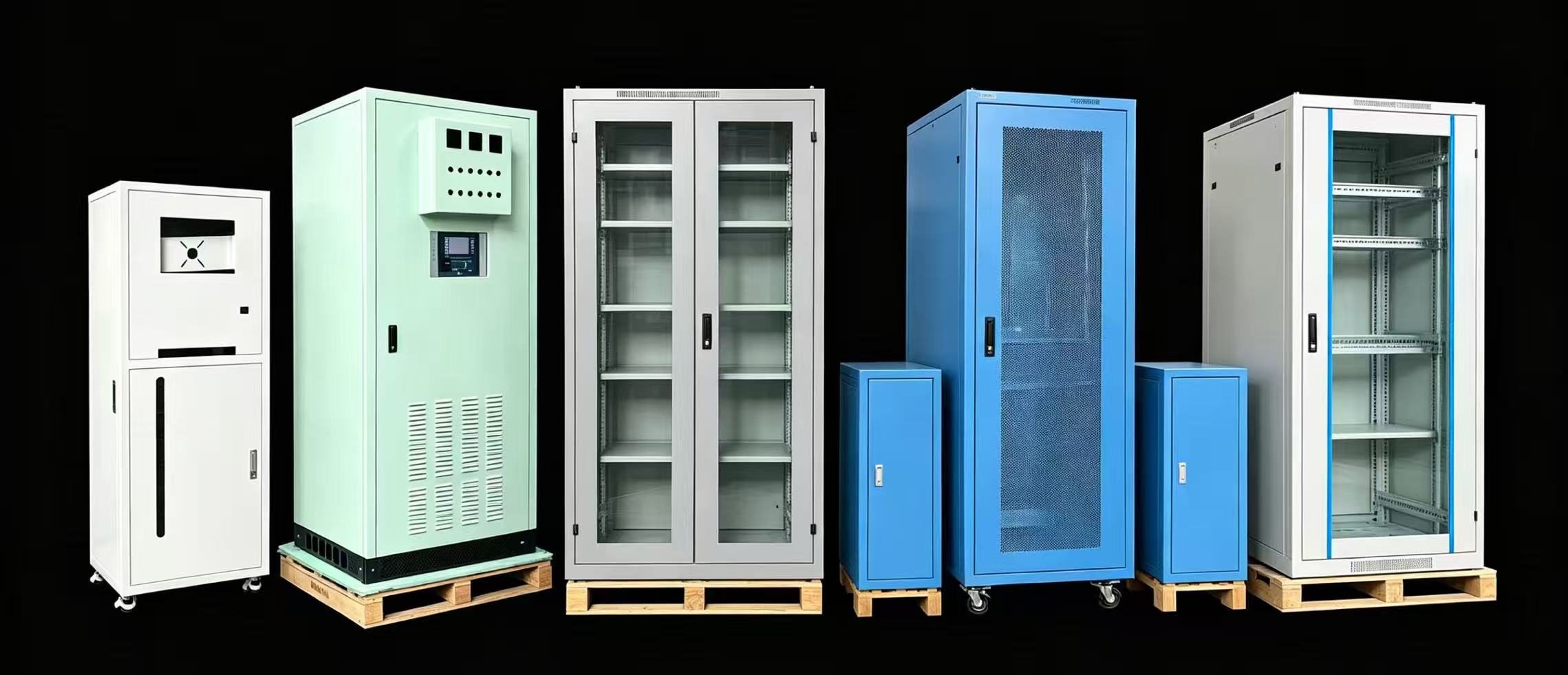
I often see good cabinets lose value because the lock is weak, shared, or hard to trace after a problem.
I choose the best keyless cabinet lock by checking security compliance first, long-term stability second, system fit third, daily operation fourth, functions fifth, and cost last. I do not believe one lock fits every data centre. I match the lock to the site risk, staff model, and cabinet structure.
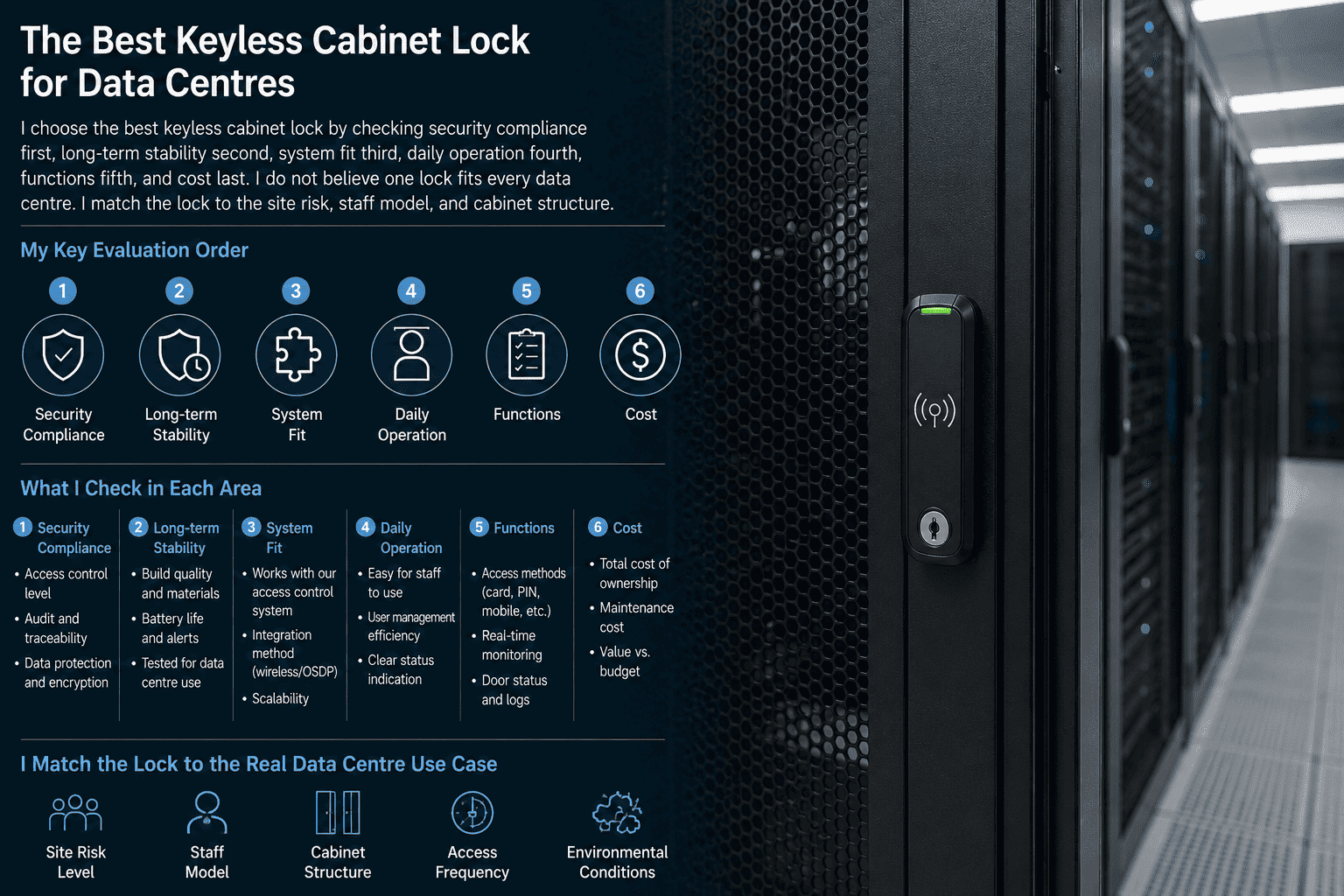
I have worked with many server cabinet and custom cabinet projects. I have seen that a lock is not a small part when the cabinet holds servers, switches, storage, and power hardware. I also know that a bad lock can create a big problem during audit, repair, or emergency access. If I want a real answer, I must look beyond the word “smart.” I must look at the whole data centre use case.
Why do I no longer treat a cabinet lock as a simple accessory?
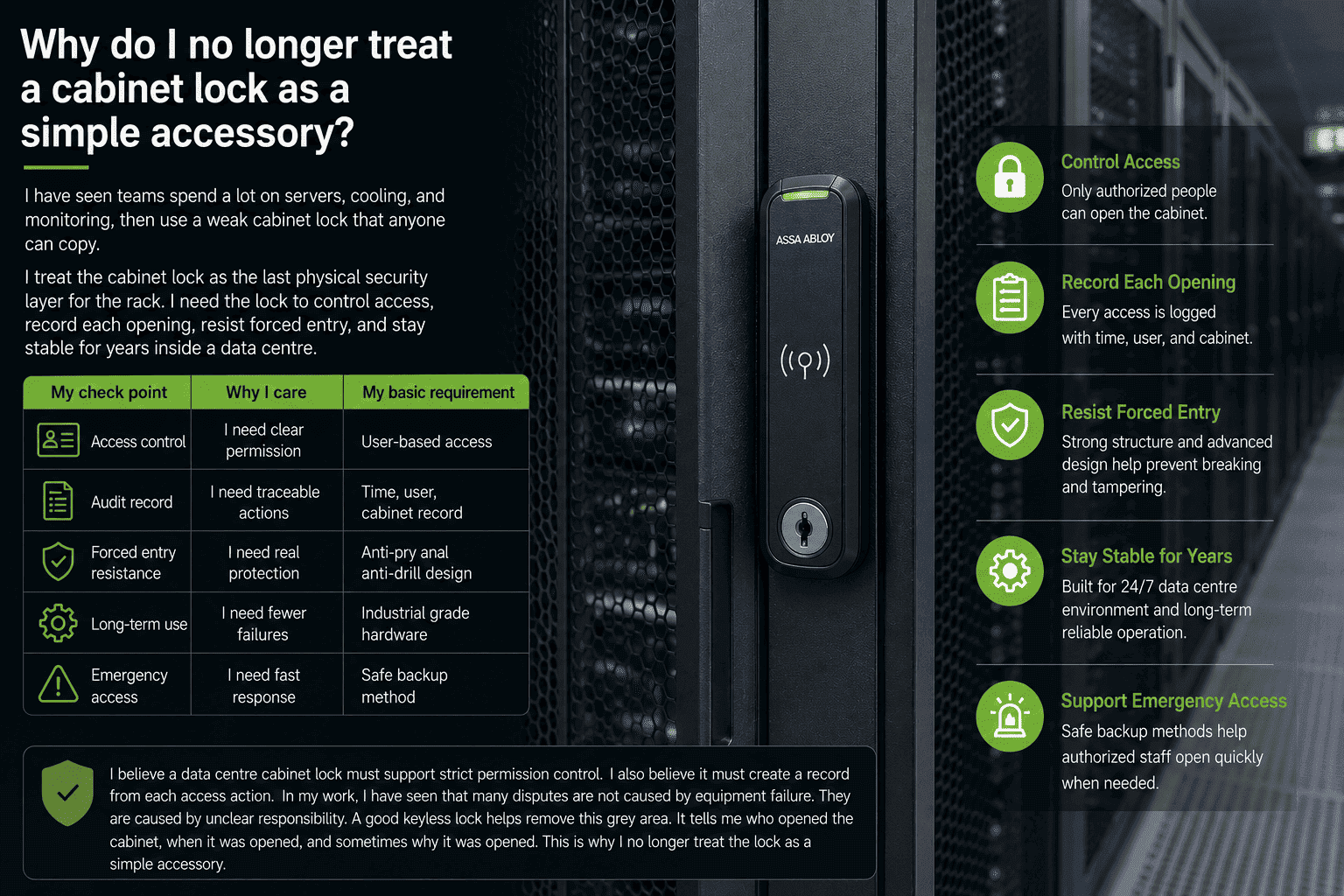
I have seen teams spend a lot on servers, cooling, and monitoring, then use a weak cabinet lock that anyone can copy.
I treat the cabinet lock as the last physical security layer for the rack1. I need the lock to control access, record each opening2, resist forced entry, and stay stable for years inside a data centre.
When I build or supply server cabinets, I look at the lock as part of the cabinet structure. I do not see it as a small handle. The lock affects equipment safety, audit records, staff responsibility, and fault response. A normal mechanical key has clear problems. Many keys look similar. Many keys can be copied.3 Some keys are shared by several people. When a problem happens, I may not know who opened the cabinet. This is a real risk in IDC rooms, financial rooms, telecom rooms, and AI computing centres.
I use a simple check table before I recommend a lock:
| My check point | Why I care | My basic requirement |
|---|---|---|
| Access control | I need clear permission | User-based access |
| Audit record | I need traceable actions | Time, user, cabinet record |
| Forced entry resistance | I need real protection | Anti-pry and anti-drill design |
| Long-term use | I need fewer failures | Industrial grade hardware |
| Emergency access | I need fast response | Safe backup method |
I believe a data centre cabinet lock must support strict permission control. I also believe it must create a record from each access action. In my work, I have seen that many disputes are not caused by equipment failure. They are caused by unclear responsibility. A good keyless lock helps remove this grey area. It tells me who opened the cabinet, when it was opened, and sometimes why it was opened. This is why I no longer treat the lock as a simple accessory.
Which security level should I choose first?
I have seen buyers start with price, but I think that is the wrong first step for a serious data centre.
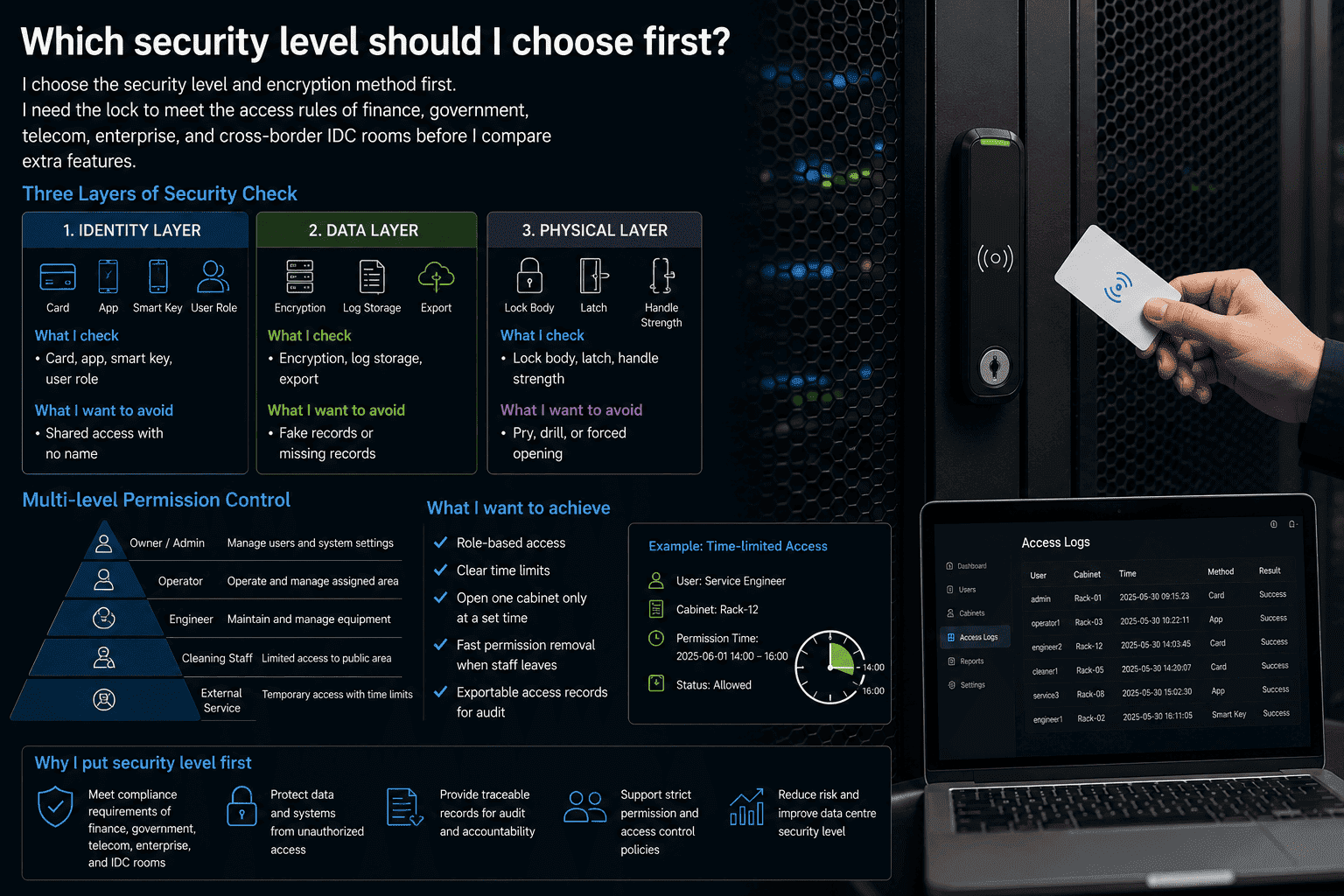
I choose the security level and encryption method first. I need the lock to meet the access rules of finance, government, telecom, enterprise, and cross-border IDC rooms4 before I compare extra features.
When I select a keyless cabinet lock, I place compliance security at the top. I do this because many data centres are not normal office rooms. They are controlled areas. They may support banks, cloud services, public systems, carriers, or overseas business. If the lock has weak encryption or weak permission design, the cabinet may fail the security idea even if the door looks strong.
I usually divide the security check into three layers:
| Security layer | What I check | What I want to avoid |
|---|---|---|
| Identity layer | Card, app, smart key, user role | Shared access with no name |
| Data layer | Encryption, log storage, export | Fake records or missing records |
| Physical layer | Lock body, latch, handle strength | Pry, drill, or forced opening |
I also care about multi-level permission5. A data centre often has owners, operators, engineers, cleaning staff, and outside service teams. I do not want all of them to open the same cabinet with the same power. I want one person to manage users. I want another person to open only assigned racks. I want records to be exported when an audit comes. I want permission to be removed fast when a worker leaves the project6.
I prefer locks that support role-based access. I also prefer locks with clear time limits. For example, I may allow a service engineer to open one cabinet only from 2 p.m. to 4 p.m. on one day. This is practical. It is not just a nice feature. It reduces risk in a real machine room.
Should I choose an active powered lock or a passive smart key lock?
I have seen both lock types work well, but I have also seen both fail when they are used in the wrong place.
I choose an active powered lock when I need app control, Bluetooth, remote access, or local electronics. I choose a passive smart key lock when I want no battery inside the lock and less maintenance on many cabinets.
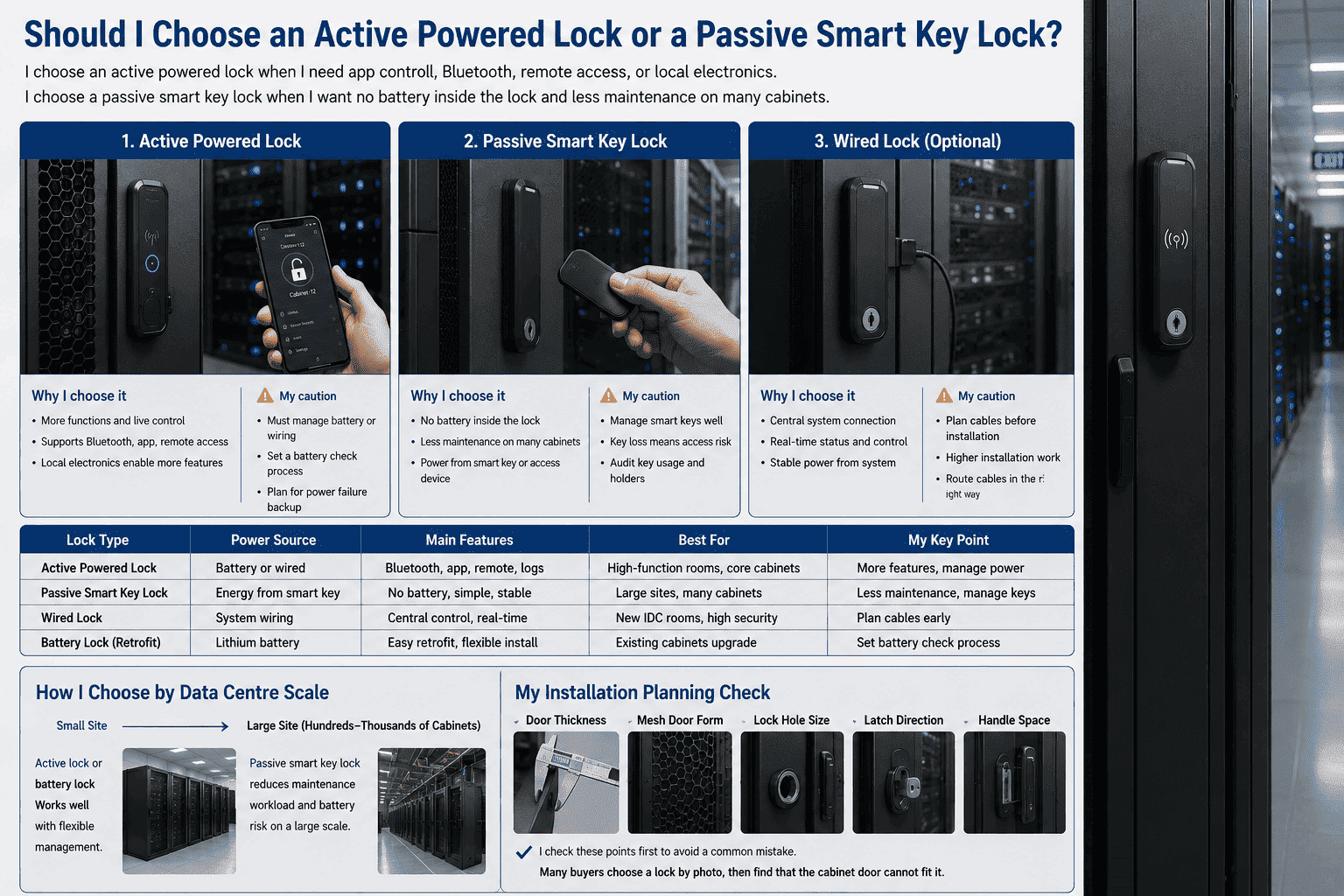
In my view, keyless cabinet locks for data centres are often split into two practical types. The first type is active powered. It may use a lithium battery inside the lock. It may also use wiring from the cabinet or room system. It can support Bluetooth, app control, remote modes, and richer electronic functions. The second type is passive induction powered. The lock body has no battery and no internal power wiring. It gets power from a smart key or smart access device when the user operates it.
I compare them like this:
| Lock type | My reason to choose it | My caution |
|---|---|---|
| Active powered lock | I need more functions and live control | I must manage battery or wiring |
| Passive smart key lock | I need less maintenance in large sites | I must manage smart keys well |
| Wired lock | I need central system connection | I must plan cables before installation |
| Battery lock | I need flexible retrofit | I must set a battery check process |
I do not say one type is always better. I look at the data centre scale. If a site has hundreds or thousands of cabinets, battery maintenance can become a real workload7. If the lock has a dead battery at the wrong time, the team may face delay. Passive locks reduce this risk because there is no battery inside the lock. But passive locks also depend on smart key control. If the smart key management is weak, the whole system becomes weak.
For new high-level rooms, I like to discuss the lock plan early with the cabinet design. This helps me reserve holes, brackets, wire paths, and handle space. For retrofit projects, I check the existing door thickness, mesh door form, lock hole size, and latch direction first. This avoids a common mistake. Many buyers choose a lock by photo, then find that the cabinet door cannot fit it.
What material and mechanical strength should I trust?
I have seen locks with smart functions break at the handle, so I never judge a lock only by software.
I trust high-strength zinc alloy or stainless steel lock bodies8 for data centre use. I also check anti-pry strength, anti-drill design, vibration resistance, latch fit, and over 100,000 opening cycles9.
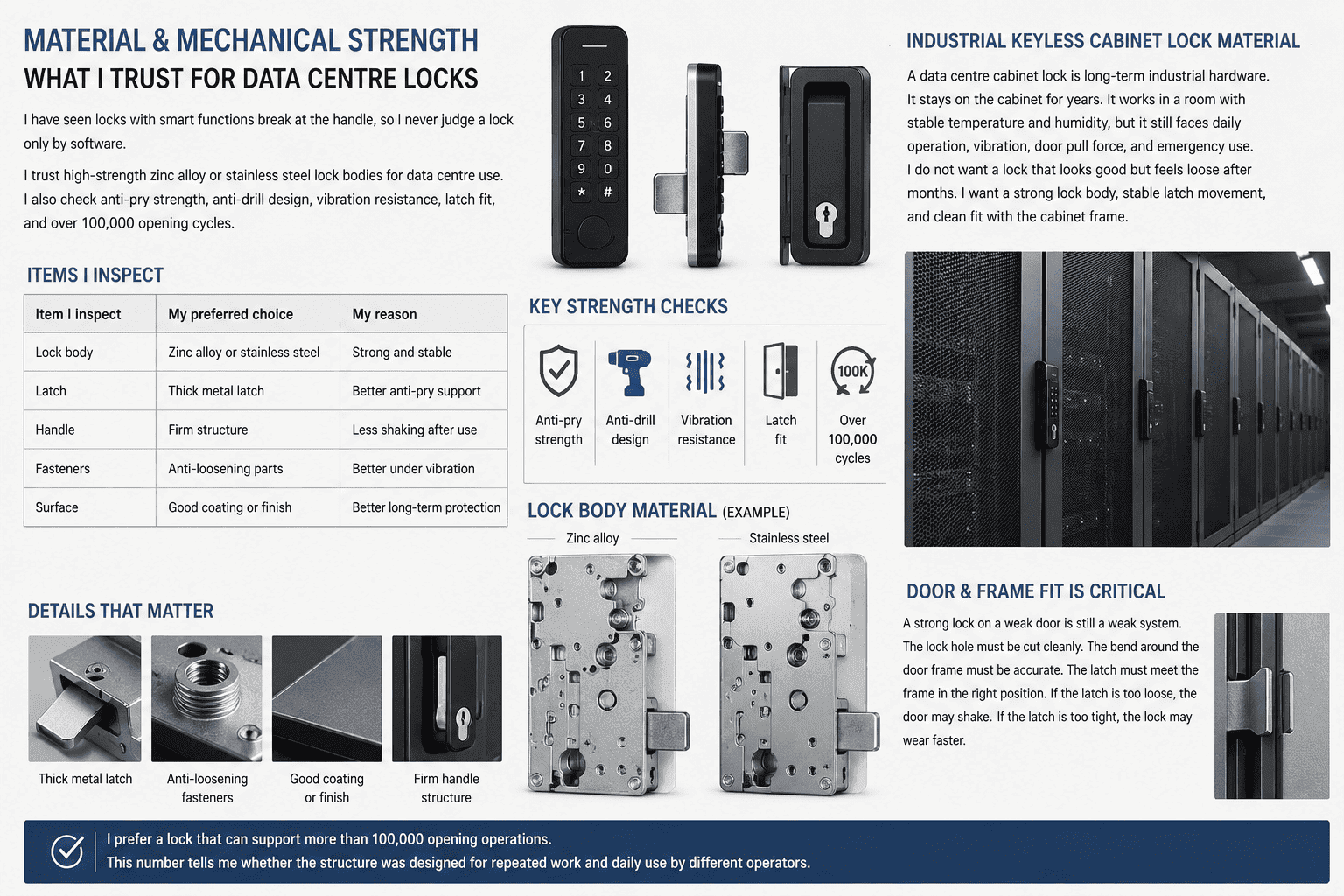
A data centre cabinet lock is long-term industrial hardware. It stays on the cabinet for years. It works in a room with stable temperature and humidity, but it still faces daily operation, vibration, door pull force, and emergency use. I do not want a lock that looks good but feels loose after months. I want a strong lock body, stable latch movement, and clean fit with the cabinet frame.
I use this material and strength check:
| Item I inspect | My preferred choice | My reason |
|---|---|---|
| Lock body | Zinc alloy or stainless steel | Strong and stable |
| Latch | Thick metal latch | Better anti-pry support |
| Handle | Firm structure | Less shaking after use |
| Fasteners | Anti-loosening parts | Better under vibration |
| Surface | Good coating or finish | Better long-term protection |
In my factory work, I pay attention to the cabinet door as much as the lock. A strong lock on a weak door is still a weak system.10 A mesh door must have enough flatness and strength around the lock area. The lock hole must be cut cleanly. The bend around the door frame must be accurate. The latch must meet the frame in the right position. If the latch is too loose, the door may shake. If the latch is too tight, the lock may wear faster.
I also care about opening cycle life. For a serious data centre, I prefer a lock that can support more than 100,000 opening operations. This number is not just a lab number for me. It tells me whether the structure was designed for repeated work. I also check whether the lock can handle daily use by different operators. Some people close doors gently. Some people pull hard. A reliable industrial lock must accept both.
How should I match the lock to real data centre operation?
I have seen a lock fail not because it was poor, but because it did not fit the team’s work process.
I match the lock to the operation model. I check staff levels, audit needs, emergency rules, remote management needs, cabinet quantity, and service frequency before I decide the lock type.
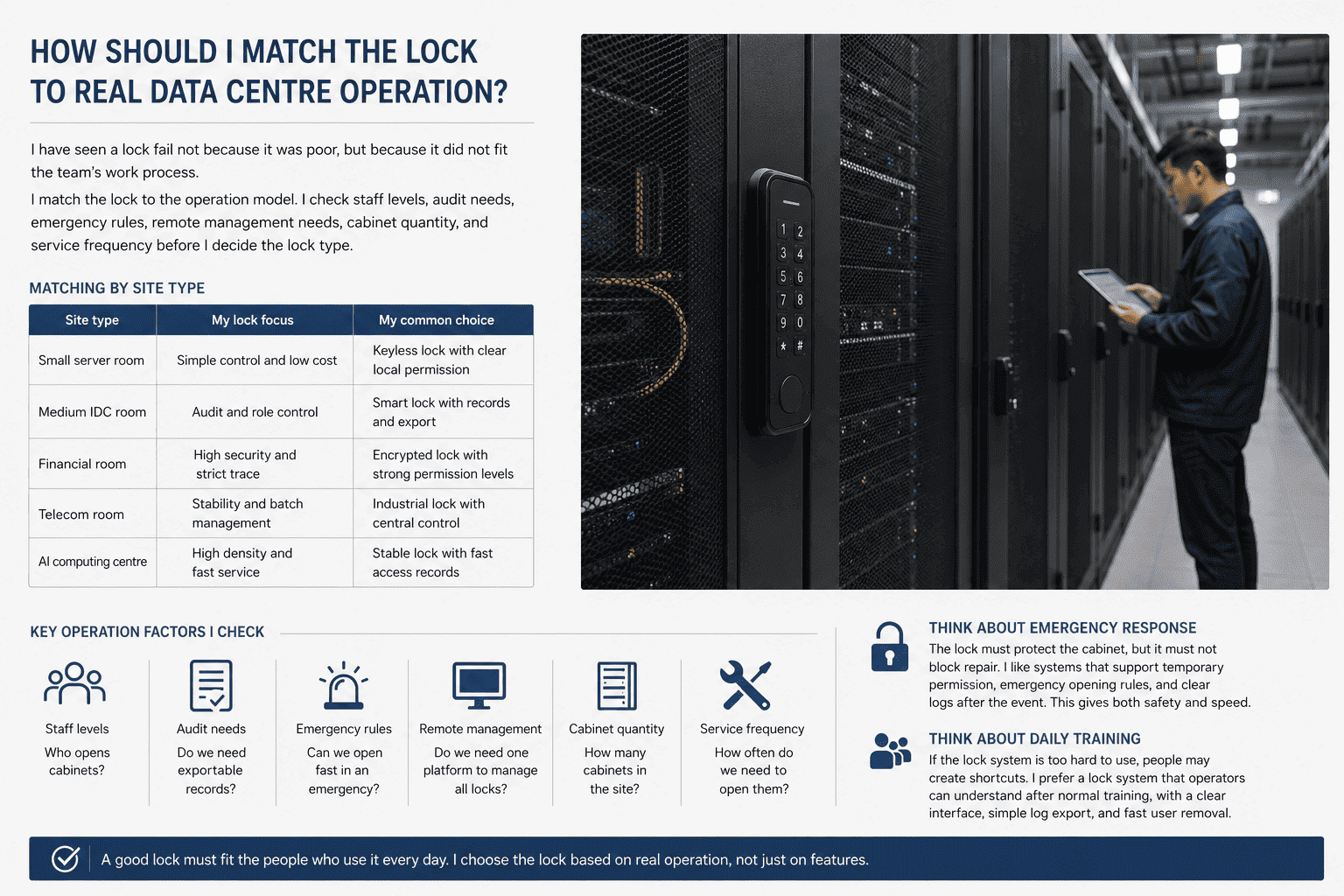
A good lock must fit the people who use it every day. I always ask how the data centre team works. I ask who opens cabinets. I ask how often they open them. I ask whether outside engineers enter the room. I ask whether the site needs exportable records. I ask whether the operation team wants one platform to manage all cabinet locks. These questions sound simple, but they decide the real lock choice.
I use a basic matching table:
| Site type | My lock focus | My common choice |
|---|---|---|
| Small server room | Simple control and low cost | Keyless lock with clear local permission |
| Medium IDC room | Audit and role control | Smart lock with records and export |
| Financial room | High security and strict trace | Encrypted lock with strong permission levels |
| Telecom room | Stability and batch management | Industrial lock with central control |
| AI computing centre | High density and fast service | Stable lock with fast access records |
I also think about emergency response. In a real data centre, no one wants to wait too long when a device has a fault. The lock must protect the cabinet, but it must not block repair. I like systems that support temporary permission, emergency opening rules, and clear logs after the event11. This gives both safety and speed.
I also think about daily training. If the lock system is too hard to use, people may create shortcuts.12 They may share access cards. They may leave smart keys in unsafe places. They may ask one manager to open every cabinet. This breaks the security design. I prefer a lock system that operators can understand after normal training. I want the interface to be clear. I want the log export to be simple. I want user removal to be fast.
How do I balance functions and cost without buying the wrong lock?
I have seen buyers pay for many functions they never use, and I have seen others save money then replace all locks later.
I balance cost by ranking needs in order. I place compliance, stability, compatibility, operation, functions, and price in that order. I do not let the lowest price decide a data centre lock.
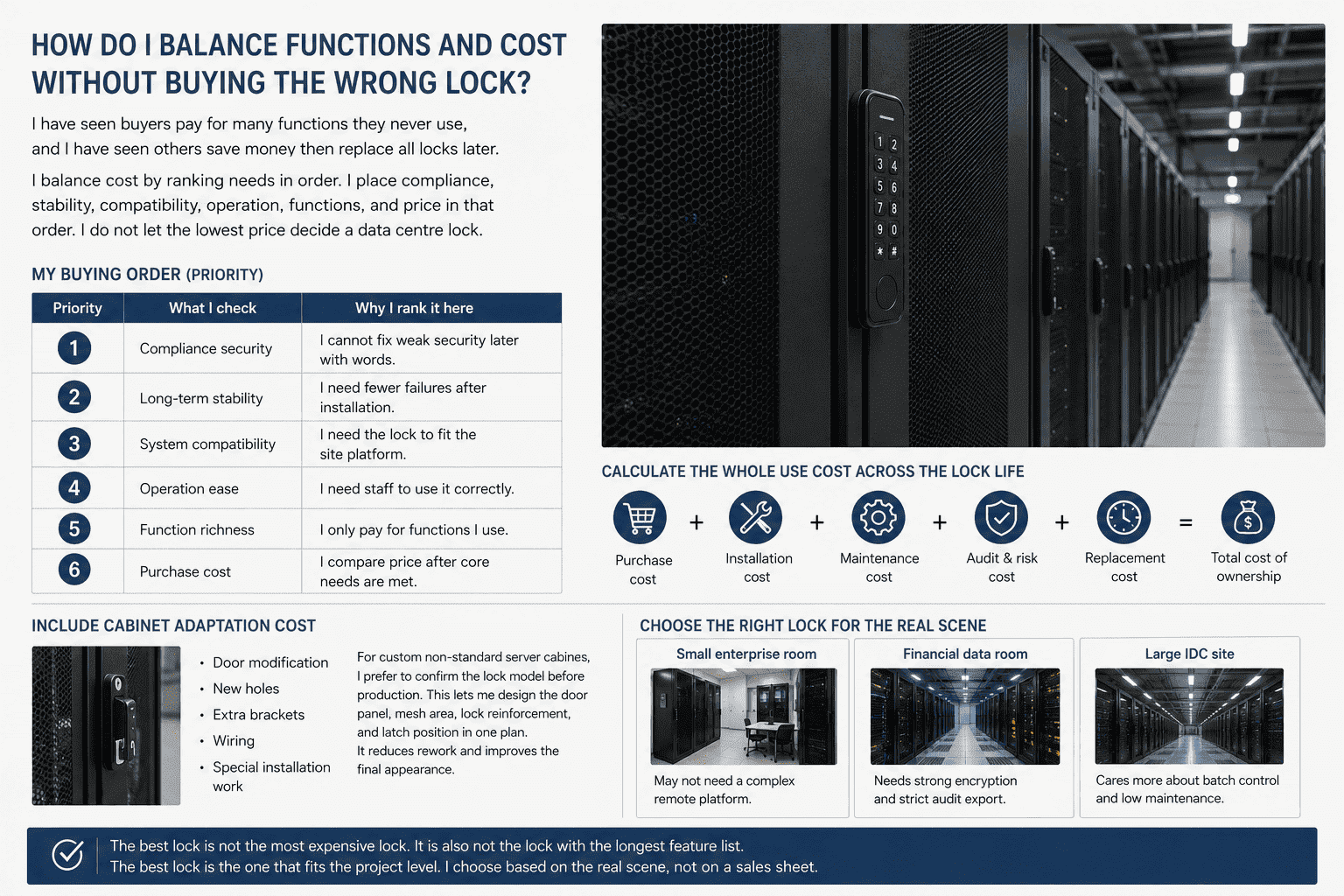
I know cost matters. I also know that a cabinet project has a budget. But I do not like to compare locks only by unit price. A cheaper lock can become expensive if it creates maintenance, audit gaps, door damage, or replacement work. I prefer to calculate the whole use cost across the lock life.
My buying order is simple:
| Priority | What I check | Why I rank it here |
|---|---|---|
| 1 | Compliance security | I cannot fix weak security later with words |
| 2 | Long-term stability | I need fewer failures after installation |
| 3 | System compatibility | I need the lock to fit the site platform |
| 4 | Operation ease | I need staff to use it correctly |
| 5 | Function richness | I only pay for functions I use |
| 6 | Purchase cost | I compare price after core needs are met |
I also include cabinet adaptation cost. A lock may look affordable, but it may need door modification, new holes, extra brackets, wiring, or special installation work. For custom non-standard server cabinets, I prefer to confirm the lock model before production. This lets me design the door panel, mesh area, lock reinforcement, and latch position in one plan. It reduces rework. It also improves the final appearance.
I have learned that the best lock is not the most expensive lock. It is also not the lock with the longest feature list. The best lock is the one that fits the project level. A small enterprise room may not need a complex remote platform. A financial data room may need strong encryption and strict audit export. A large IDC site may care more about batch control and low maintenance. I choose based on the real scene, not on a sales sheet.
What is my practical recommendation for data centre cabinet buyers?
I have seen many projects become smoother when the lock is selected together with the cabinet, not after the cabinet is finished.
I recommend that buyers define the data centre level first, then confirm access rules, audit needs, lock power mode, material strength, cabinet fit, and installation plan before placing the order.
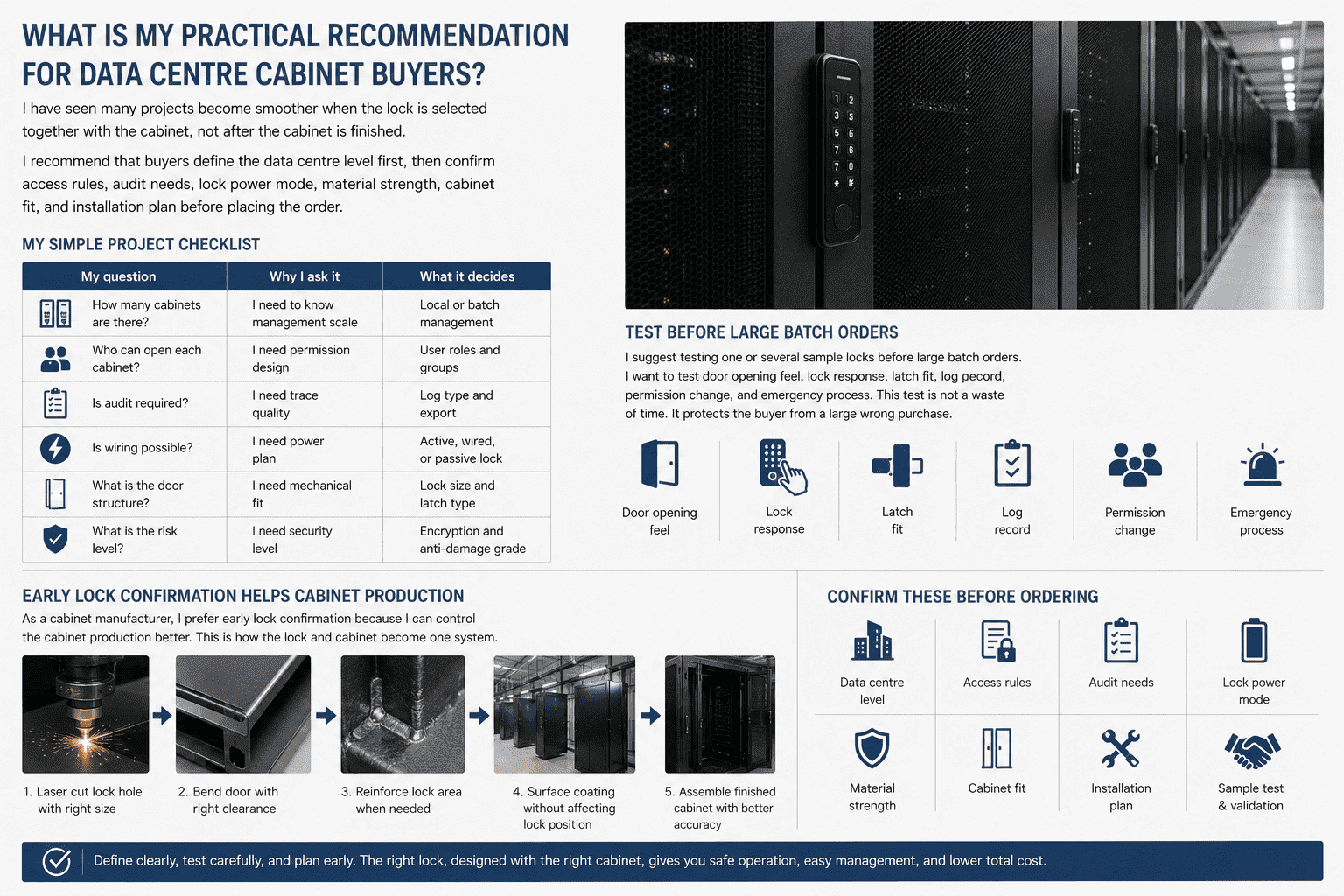
When a customer asks me for the best keyless cabinet lock, I do not answer with one model at once. I first ask about the cabinet and the room. I ask whether the cabinet is a standard 19-inch server cabinet or a custom non-standard cabinet. I ask whether the door is a mesh door, glass door, or solid steel door. I ask whether the cabinet needs high ventilation. I ask whether the lock will be installed on front doors, rear doors, or side panels. These details change the lock choice.
I use this simple project checklist:
| My question | Why I ask it | What it decides |
|---|---|---|
| How many cabinets are there? | I need to know management scale | Local or batch management |
| Who can open each cabinet? | I need permission design | User roles and groups |
| Is audit required? | I need trace quality | Log type and export |
| Is wiring possible? | I need power plan | Active, wired, or passive lock |
| What is the door structure? | I need mechanical fit | Lock size and latch type |
| What is the risk level? | I need security level | Encryption and anti-damage grade |
I also suggest testing one or several sample locks before large batch orders. I want to test door opening feel, lock response, latch fit, log record, permission change, and emergency process. This test is not a waste of time. It protects the buyer from a large wrong purchase.
As a cabinet manufacturer, I also prefer early lock confirmation because I can control the cabinet production better. I can cut the lock hole by laser with the right size. I can bend the door with the right clearance. I can weld or reinforce the lock area when needed. I can finish surface coating without damaging the lock position. I can assemble the finished cabinet with better accuracy. This is how the lock and cabinet become one system.
Conclusion
I choose the best keyless cabinet lock by matching security, stability, power mode, operation, and cabinet structure to the real data centre scene.
"Data center security - Wikipedia", https://en.wikipedia.org/wiki/Data_center_security. NIST physical and environmental protection guidance treats restricted physical access to information-system components as a required security control, supporting the view that rack or cabinet locks form part of a layered physical-security strategy. Evidence role: general_support; source type: government. Supports: The source should support that physical access controls, including restricted access to areas or enclosures containing information systems, are part of data centre security.. Scope note: This supports the principle of controlled physical access generally; it may not specifically rank the cabinet lock as the final security layer. ↩
"[PDF] NIST.SP.800-53r5.pdf", https://nvlpubs.nist.gov/nistpubs/specialpublications/NIST.SP.800-53r5.pdf. NIST SP 800-53 includes controls for monitoring, authorizing, and recording physical access to facilities and systems, supporting the use of cabinet-opening logs for accountability. Evidence role: general_support; source type: government. Supports: The source should support that physical access to protected areas or systems should be logged, monitored, or reviewed.. Scope note: The control language is broader than cabinet locks and applies to physical access management generally. ↩
"[PDF] Recommendation for Key Management: Part 1 - General", https://nvlpubs.nist.gov/nistpubs/specialpublications/nist.sp.800-57pt1r5.pdf. Government physical-security key-control guidance commonly requires controlled key issuance and restrictions on duplication, supporting the claim that copyable mechanical keys can weaken accountability. Evidence role: general_support; source type: government. Supports: The source should support that physical keys require controlled issuance, duplication control, and accountability because uncontrolled duplicates undermine access control.. Scope note: The source may address facility keys generally rather than server-cabinet keys specifically. ↩
"[PDF] Security Guidelines for Storage Infrastructure", https://nvlpubs.nist.gov/nistpubs/SpecialPublications/NIST.SP.800-209.pdf. Information-security frameworks such as ISO/IEC 27001 and PCI DSS require controls for secure areas and physical access accountability, supporting the need to evaluate cabinet locks against sector and audit requirements. Evidence role: general_support; source type: institution. Supports: The source should support that regulated or security-sensitive environments require controlled physical access and auditable access procedures.. Scope note: These frameworks establish general control expectations and do not prescribe a single cabinet-lock technology. ↩
"Role Based Access Control | CSRC", https://csrc.nist.gov/projects/role-based-access-control. NIST publications describe role-based access control and least privilege as established mechanisms for assigning permissions according to job function, supporting differentiated cabinet-access roles. Evidence role: expert_consensus; source type: government. Supports: The source should support role-based access control and least privilege as accepted methods for limiting user permissions.. Scope note: The cited RBAC principles are general access-control principles and may not be limited to physical cabinet locks. ↩
"[PDF] ACCESS CONTROL Quick link to Access Control summary table AC ...", https://csrc.nist.gov/files/pubs/sp/800/53/r5/ipd/docs/sp800-53r5-draft-controls-markup.pdf. NIST access-control guidance requires organizations to manage account lifecycle events, including disabling or removing access when it is no longer authorized, supporting rapid revocation of cabinet-lock permissions. Evidence role: general_support; source type: government. Supports: The source should support prompt revocation of access rights after termination, role change, or end of assignment.. Scope note: The guidance is written for access control broadly and must be applied by analogy to electronic cabinet-lock credentials. ↩
"Unleash the power of access control with wireless locks - Assa Abloy", https://www.assaabloy.com/it/en/stories/blog/wireless-access-control. Studies of battery-powered distributed devices identify battery monitoring and replacement as recurring operational tasks whose burden grows with the number of deployed devices, providing contextual support for maintenance concerns in battery-powered cabinet locks. Evidence role: general_support; source type: paper. Supports: The source should support that battery-powered distributed devices require ongoing battery monitoring and replacement, and that maintenance burden increases with deployment scale.. Scope note: The evidence may come from broader IoT or facilities-device deployments rather than data-centre cabinet locks specifically. ↩
"Guide to the Selection and Use of High Performance ...", https://www.nrc.gov/docs/ML0334/ML033490048.pdf. Engineering materials references describe stainless steels as corrosion-resistant structural alloys and zinc die-casting alloys as commonly used for durable hardware components, supporting their selection for robust lock bodies. Evidence role: general_support; source type: education. Supports: The source should support that stainless steel and zinc alloys have strength and durability properties relevant to hardware applications.. Scope note: Material-property data support suitability in principle but do not prove the performance of any specific lock design. ↩
"Accelerated Physical Endurance Test Procedure for Steel Doors | SDI", https://steeldoor.org/sdi-131/. Lock-hardware standards such as ANSI/BHMA and EN lock standards use cycle testing to classify mechanical durability, supporting the use of a stated opening-cycle rating as an endurance indicator. Evidence role: general_support; source type: institution. Supports: The source should support that lock and hardware standards use opening-cycle tests to evaluate durability, with cycle counts serving as a recognized endurance metric.. Scope note: The source may validate cycle testing as a method without specifying that 100,000 cycles is the required threshold for every data centre application. ↩
"Chapter 5-Protecting Your System: Physical Security, from ...", https://nces.ed.gov/pubs98/safetech/chapter5.asp. Physical-security guidance treats doors, frames, locks, and other barriers as an integrated protection system, supporting the claim that a strong lock cannot compensate for a structurally weak cabinet door. Evidence role: mechanism; source type: government. Supports: The source should support that effective physical security depends on the combined resistance of barriers, doors, frames, locks, and related components.. Scope note: The guidance is typically written for buildings or secure rooms and is applied here to cabinet construction by analogy. ↩
"[PDF] Security and Privacy Controls for Information Systems and ...", https://csrc.nist.gov/CSRC/media/Projects/risk-management/800-53%20Downloads/800-53r5/SP_800-53_v5_1-derived-OSCAL.pdf. NIST security-control guidance recognizes emergency access procedures and audit logging as complementary controls, supporting temporary emergency cabinet access when actions remain recorded and reviewable. Evidence role: general_support; source type: government. Supports: The source should support emergency or break-glass access procedures together with logging and later review.. Scope note: The source addresses information-system access broadly and may not specifically discuss cabinet-lock emergency opening. ↩
"User, Usage and Usability: Redefining Human Centric Cyber Security", https://pmc.ncbi.nlm.nih.gov/articles/PMC7968726/. Usable-security research shows that burdensome or poorly designed security controls can encourage users to adopt workarounds, supporting the warning that difficult lock systems may undermine intended access control. Evidence role: expert_consensus; source type: paper. Supports: The source should support that security mechanisms perceived as difficult or burdensome often lead to user workarounds or noncompliance.. Scope note: The evidence is usually drawn from broader cybersecurity or authentication contexts rather than cabinet-lock operation alone. ↩
