
Aperio KS100 Server Cabinet Lock: Is It A Practical Upgrade For Cabinet Security?
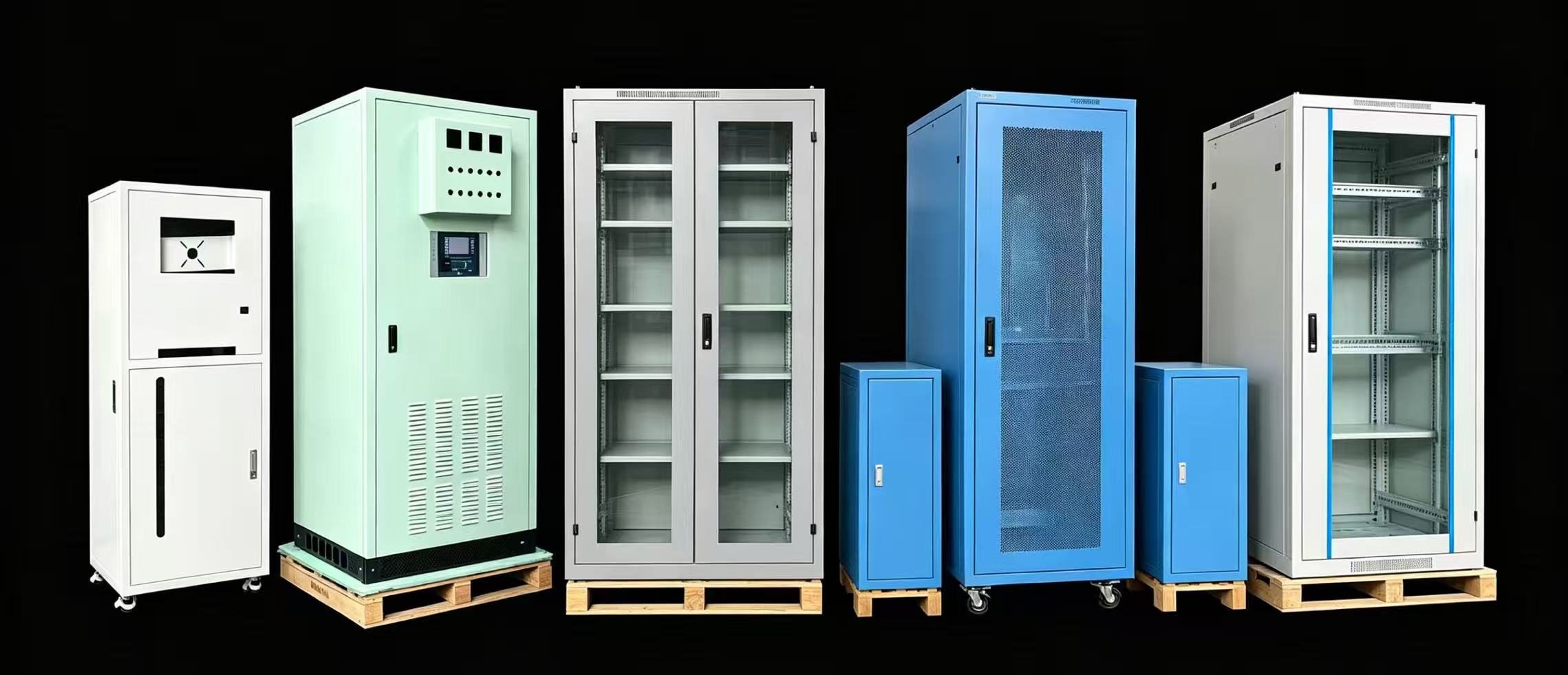
I often see teams protect the room door, but leave the cabinet door weak. One lost key can turn a secure room into a real risk.
-
Why does server cabinet lock security matter?
I see many server rooms look controlled from the outside, but the cabinet door still depends on a shared key. That small gap can create a big problem.
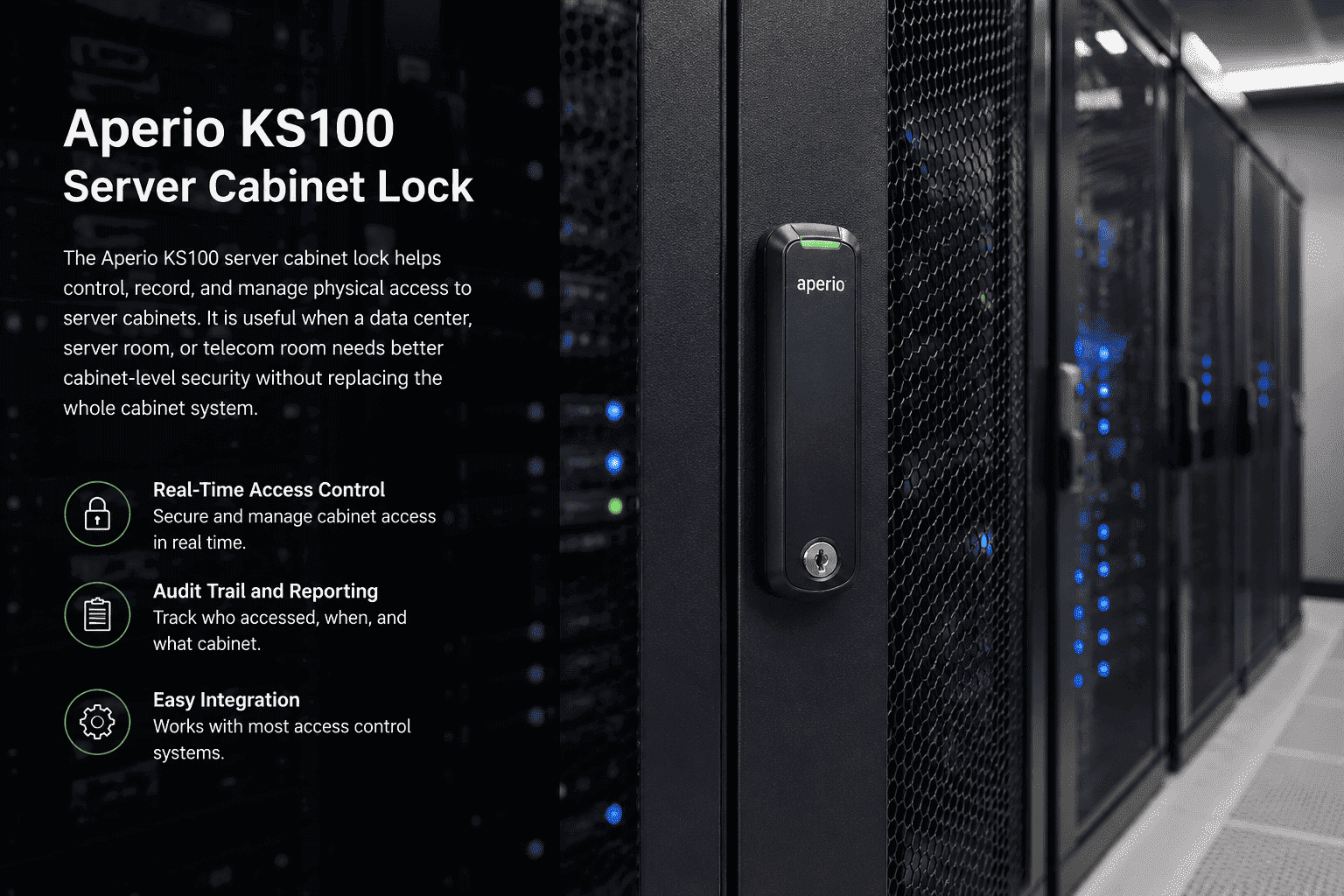
The server cabinet lock matters because it protects the final physical access point to IT equipment.1 A better lock can reduce unauthorized access, support access records, and help the operation team manage cabinet security in a more controlled way.2
The cabinet door is the last physical barrier
I see the cabinet as the final line between people and equipment. A data center, an operation room, a telecom room, or a computing room may have good room-level access control. The main door may use cards, passwords, guards, or cameras. But when a person is already inside the room, the cabinet door becomes the next control point.
A simple cabinet lock may look enough when the site is small. But it becomes weak when the number of cabinets, engineers, vendors, and maintenance events grows. I have seen projects where several people used the same key for many cabinets. I have also seen sites where keys were kept in a drawer. That is easy for daily work, but it is not easy for audit and trace.
| Risk point | What may happen | Why it matters |
|---|---|---|
| Shared key | Many people can open the cabinet | I cannot trace each action clearly |
| Lost key | The cabinet may stay exposed | I may need to replace many locks |
| No opening record | I do not know who opened the door | I cannot review incidents later |
| Manual checking only | Staff must inspect one by one | The team spends more time on basic control |
Cabinet access is not only about theft
I do not only worry about someone stealing equipment. I also worry about wrong operation. A person may pull the wrong cable. A vendor may open the wrong cabinet. A temporary worker may touch a power strip. These actions can stop a service, damage data, or create long downtime. A stronger cabinet lock cannot solve every problem. But it can make access more controlled, and it can make the team more careful before opening a cabinet.
What problems do traditional mechanical cabinet locks create?
I have used many mechanical locks on standard server cabinets. They are simple and low cost, but they do not answer modern management needs.
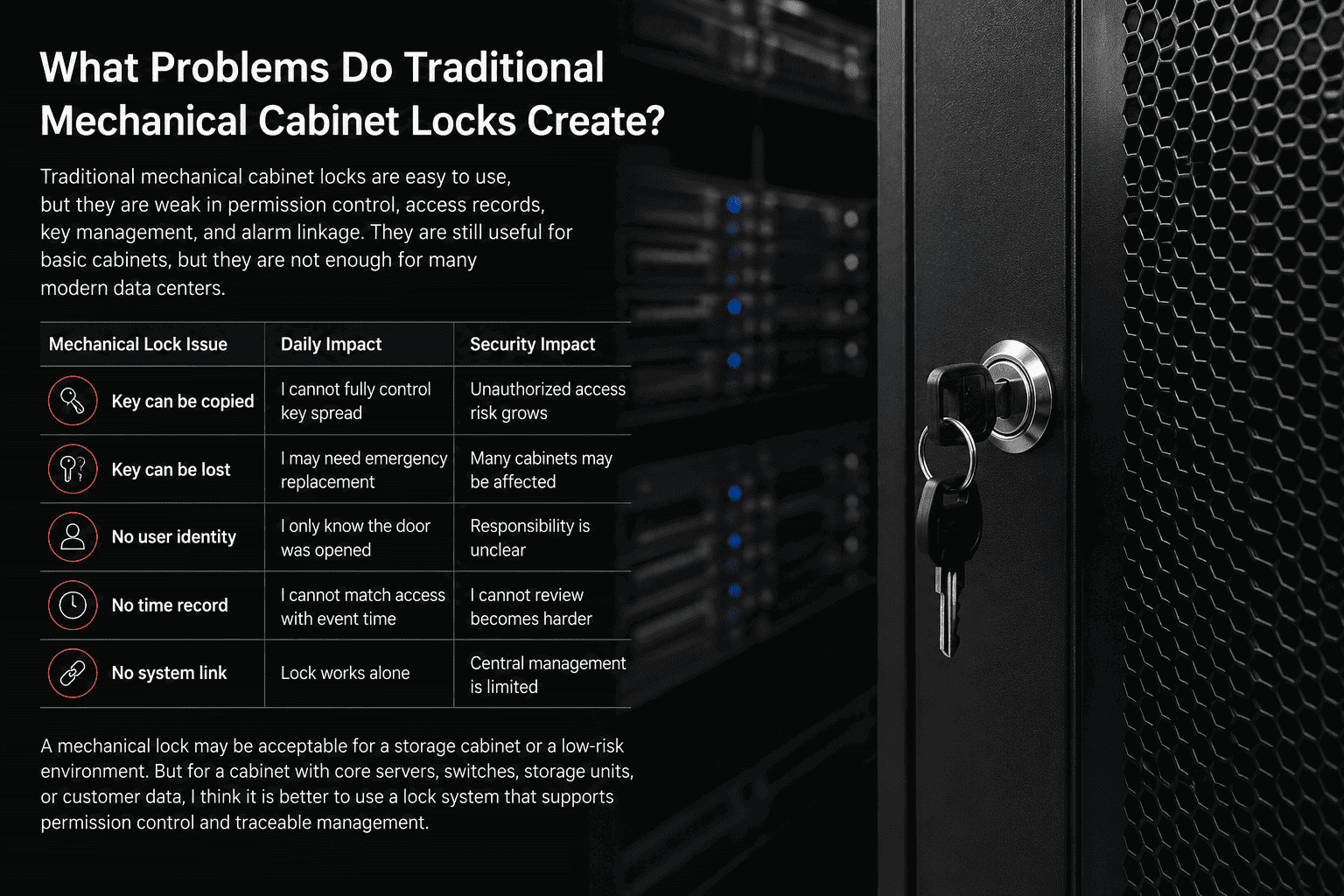
Traditional mechanical cabinet locks are easy to use, but they are weak in permission control, access records, key management, and alarm linkage. They are still useful for basic cabinets, but they are not enough for many modern data centers.
Mechanical keys are hard to manage at scale
I do not say mechanical locks are useless. They are still common in many standard cabinets. They are simple, cheap, and easy to replace. But when I look at a room with many cabinets, I see the same problems repeat. One key may open many locks.3 One technician may hold several keys. One copied key may stay outside the company. After a staff member leaves, the operation team may not know whether all keys were returned.
Mechanical locks also give no clear log.4 If a cabinet was opened at night, I cannot know from the lock itself. I may need to check cameras. I may need to ask people. I may need to compare maintenance tickets. This takes time, and it is not always accurate.
| Mechanical lock issue | Daily impact | Security impact |
|---|---|---|
| Key can be copied | I cannot fully control key spread | Unauthorized access risk grows |
| Key can be lost | I may need emergency replacement | Many cabinets may be affected |
| No user identity | I only know the door was opened | Responsibility is unclear |
| No time record | I cannot match access with event time | Incident review becomes harder |
| No system link | Lock works alone | Central management is limited |
Simple locks can hide serious weak points
I have seen cabinet doors with good steel structure, strong frame design, and proper ventilation. But the lock was still the lightest part of the whole access chain. This is not rare. Many customers focus on cabinet load capacity, cooling, cable management, and delivery time first. These are important. I also focus on them as a cabinet manufacturer. But security cannot stop at the cabinet shell. The locking system should match the value of the equipment inside the cabinet.
A mechanical lock may be acceptable for a storage cabinet or a low-risk environment. But for a cabinet with core servers, switches, storage units, or customer data, I think it is better to use a lock system that supports permission control and traceable management.
How does the Aperio KS100 fit modern cabinet security?
I do not see the Aperio KS100 as a magic product. I see it as a practical tool for cabinet-level access control.
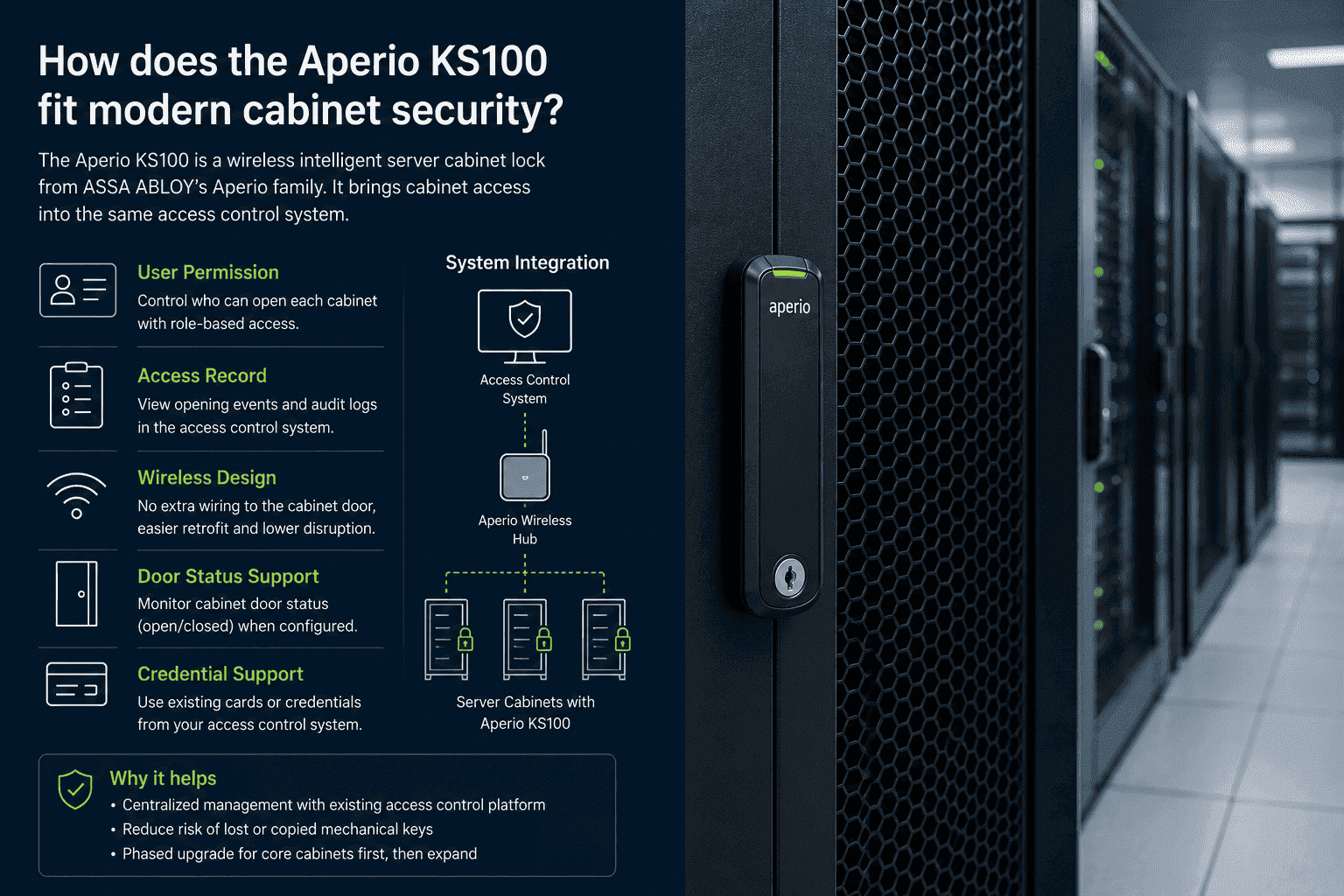
The Aperio KS100 is a wireless intelligent server cabinet lock from ASSA ABLOY’s Aperio family.5 It is designed for server cabinets and can help connect cabinet access with a wider access control system.6
It brings cabinet access into the same management system
The main value of the Aperio KS100 is not only the lock body. The value is the way it can bring cabinet access into a managed access control system. In many sites, the room door, office door, and sensitive area door already use cards or credentials. A cabinet lock that can work with the same kind of access control idea helps the team avoid a separate key system.
I like this direction because it reduces loose management. If the cabinet access can be planned with the same security rules as the room access, the operation team can give permission by user, by role, or by need. The team can also remove permission when a person changes role or leaves the project. This is more controllable than taking back a metal key.
| Function area | What I expect from a smart cabinet lock | Why it helps |
|---|---|---|
| User permission | I can control who may open each cabinet | Access becomes more precise |
| Access record | I can see opening events in the system | Audit work becomes easier |
| Wireless design | I reduce extra wiring work | Retrofit work can be lighter |
| Door status support | I can monitor cabinet door state when configured | Open-door risk becomes more visible |
| Credential support | I can use existing access control planning | Daily use becomes simpler |
Wireless access can reduce retrofit pressure
Many data centers and server rooms are already built. Pulling new wires to each cabinet is often difficult.7 It may affect layout, cable trays, cooling airflow, and operation schedules. A wireless cabinet lock can reduce this pressure. I still recommend careful planning before installation. Wireless does not mean “no planning.” The team should check signal coverage, gateway position, battery plan, system compatibility, and maintenance flow.8
Aperio KS100 is usually attractive for sites that want to improve cabinet security without rebuilding every cabinet. It can be part of a phased upgrade. The team may start with core cabinets first. Then it may expand to more cabinets based on budget and risk level.
What should I check before choosing the Aperio KS100?
I always tell customers not to buy a lock only because it looks advanced. The lock must fit the cabinet, the site, and the management process.
Before choosing the Aperio KS100, I should check cabinet compatibility, door structure, access control system support, installation space, user workflow, battery maintenance, and the real security level required by the site.
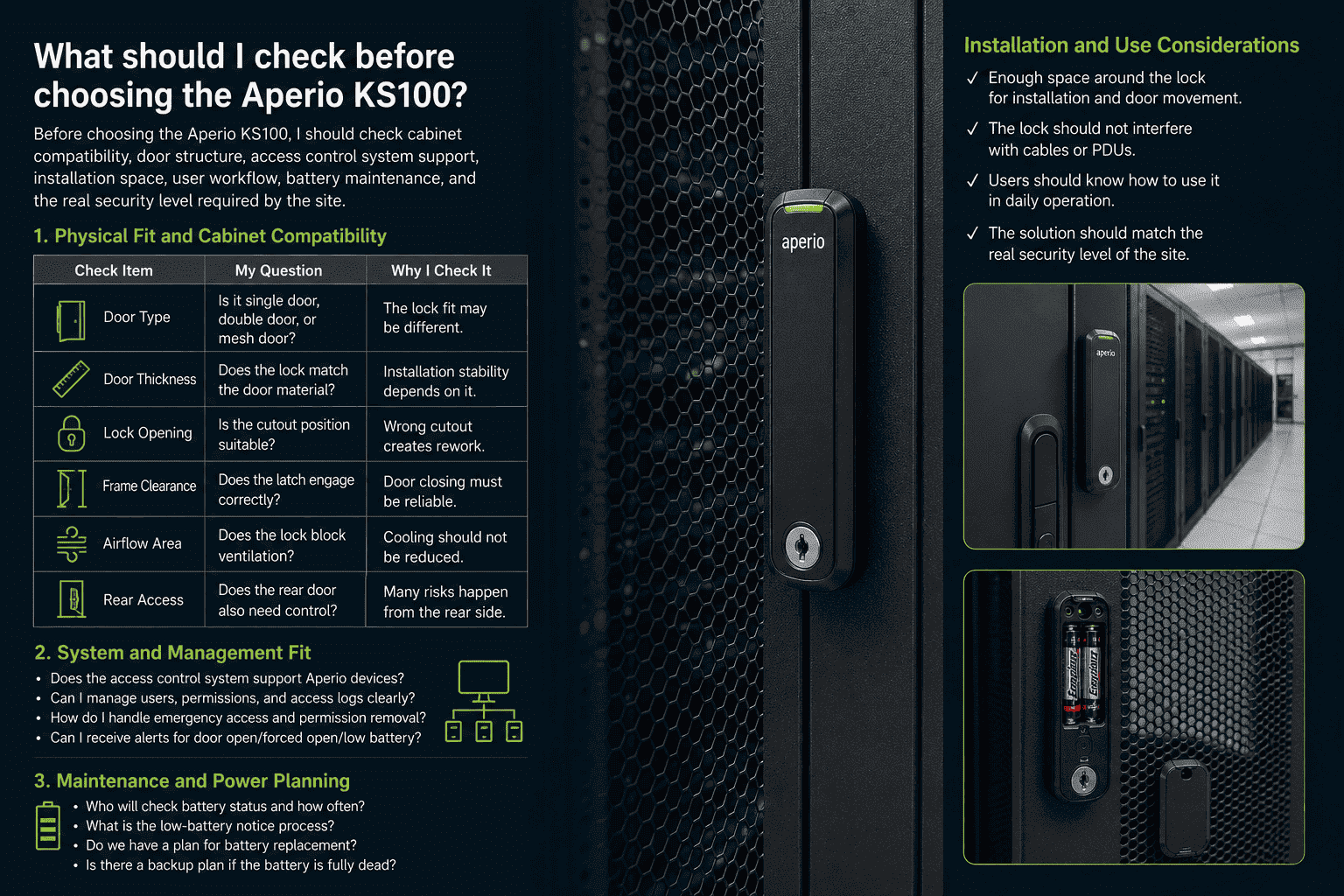
The lock must match the cabinet structure
As a cabinet manufacturer, I care a lot about the physical fit. A server cabinet is not just a box with a door. The door thickness, lock hole position, handle area, frame gap, hinge side, seal area, and mesh door design can all affect lock installation. Standard cabinets are easier to plan. Custom non-standard cabinets need more checking.
I also pay attention to the front and rear doors. Many server cabinets use perforated mesh doors for airflow. A lock upgrade should not block ventilation or reduce the door’s normal opening angle. If the cabinet has a special door structure, such as a reinforced door, split door, high-density mesh door, or special handle area, I prefer to check drawings before confirming the lock plan.
| Check item | My question | Why I check it |
|---|---|---|
| Door type | Is it single door, double door, or mesh door? | The lock fit may be different |
| Door thickness | Does the lock match the door material? | Installation stability depends on it |
| Lock opening | Is the cutout position suitable? | Wrong cutout creates rework |
| Frame clearance | Does the latch engage correctly? | Door closing must be reliable |
| Airflow area | Does the lock block ventilation? | Cooling should not be reduced |
| Rear access | Does the rear door also need control? | Many risks happen from the rear side |
The system must match the management goal
I do not suggest using a smart lock only as a better handle. If the access control system is not planned well, the value becomes limited. The team should define who can open which cabinet. The team should also define how to approve emergency access, how to remove permissions, how to review logs, and how to respond to abnormal door status.
Battery maintenance also needs a real process. Wireless products reduce wiring work, but they still need power planning. I would ask the operation team who checks battery status, how often they check it, and what happens when a low-power notice appears. A strong lock with a weak maintenance plan can still create trouble.
How can the Aperio KS100 support compliance and operation work?
I often see audits ask a simple question. Who had access to this system?9 A mechanical key does not answer that question well.
The Aperio KS100 can support compliance and operation work by adding user-based cabinet access control and access records. It can help teams review cabinet opening events and reduce unclear responsibility.
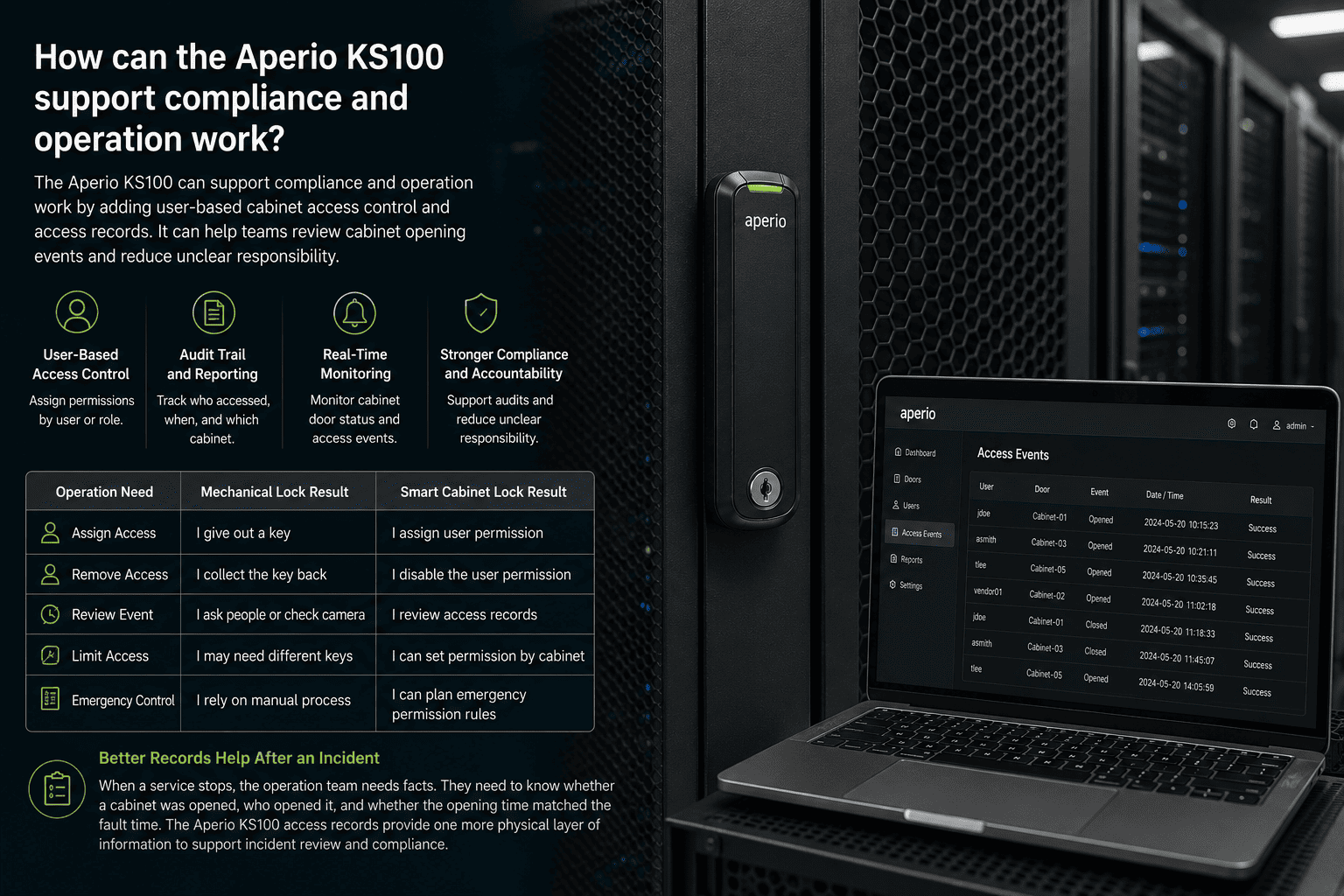
Traceability makes operation work cleaner
In real operation, many people may need cabinet access. Internal engineers, network staff, power maintenance staff, hardware vendors, and emergency support teams may all enter the room. If everyone uses the same mechanical key, the access story becomes unclear. I do not like unclear responsibility in a server room. Clear responsibility protects both the company and the technician.
With a managed cabinet lock, the team can build a more standard process. The user receives permission. The user opens the cabinet with an accepted credential. The system records the event. The team can later review the record if needed. This does not remove all risk. But it improves the quality of physical access management.
| Operation need | Mechanical lock result | Smart cabinet lock result |
|---|---|---|
| Assign access | I give out a key | I assign user permission |
| Remove access | I collect the key back | I disable the user permission |
| Review event | I ask people or check camera | I review access records |
| Limit access | I may need different keys | I can set permission by cabinet |
| Emergency control | I rely on manual process | I can plan emergency permission rules |
Better records help after an incident
When a service stops, the operation team needs facts. They need to know whether a cabinet was opened, who opened it, and whether the opening time matched the fault time. A smart lock record can support this review.10 It does not replace monitoring logs from servers, switches, or power systems. It adds one more physical layer of information.
This is important for data centers, telecom rooms, and computing centers. In these places, physical contact may create a digital problem. A pulled cable, a touched switch, or a changed device can lead to serious results. I think cabinet access records are useful because they connect human action with equipment events.
How should I think about cabinet manufacturing when using smart locks?
I cannot separate the lock from the cabinet body. A good smart lock still needs a reliable cabinet door, accurate sheet metal work, and stable assembly.
When I use a smart lock on a server cabinet, I should also check cabinet precision, door strength, latch alignment, surface treatment, and mesh door quality. The lock and the cabinet must work together.
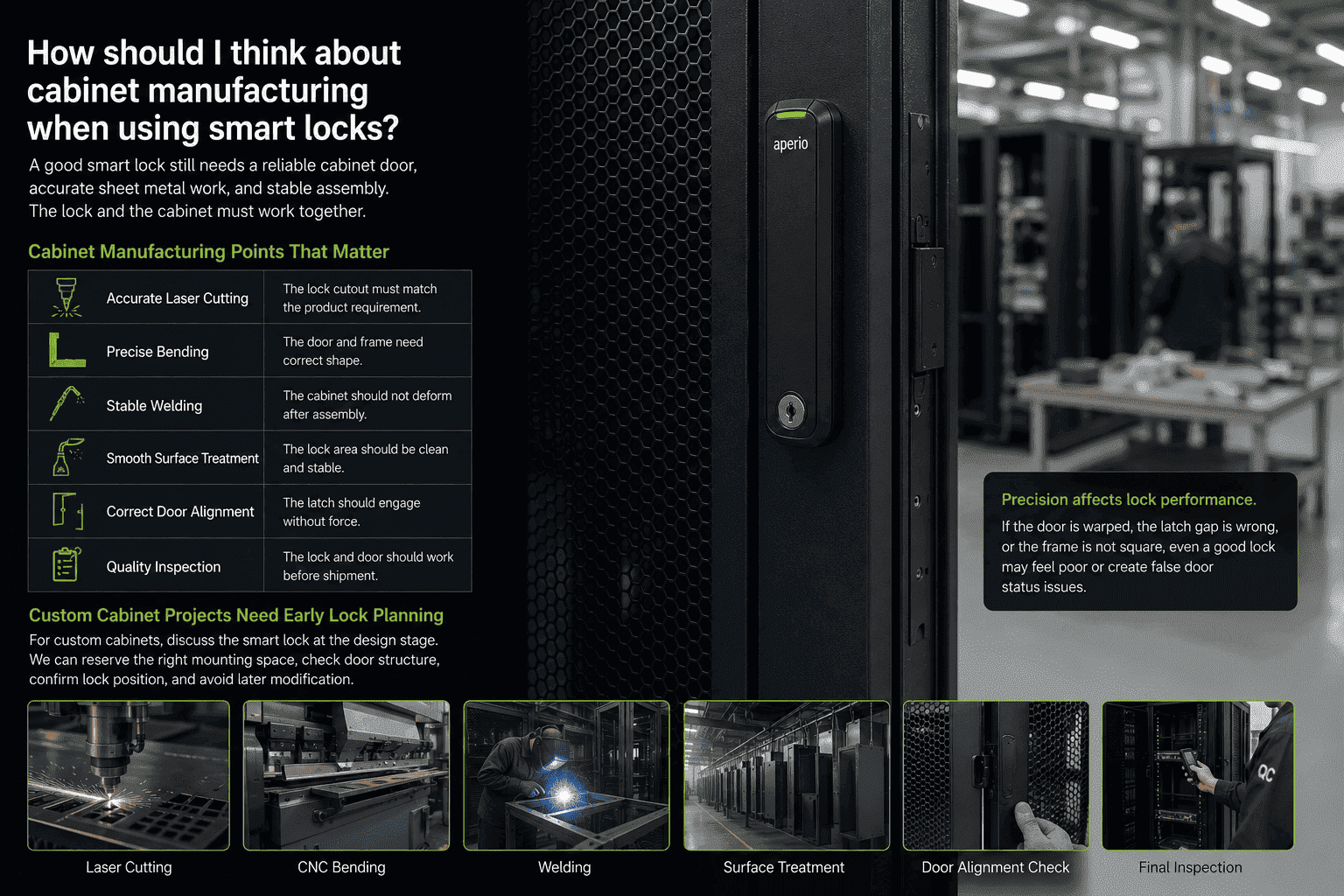
Precision affects lock performance
I manufacture standard network cabinets, server cabinets, custom non-standard cabinets, and custom mesh doors. From my own work, I know that a lock can only perform well when the cabinet structure is accurate. If the door is warped, the latch gap is wrong, or the frame is not square, even a good lock may feel poor. It may rub, fail to close smoothly, or create false door status issues.
This is why I care about raw material selection, laser cutting, precise bending, welding, polishing, acid cleaning, powder coating, and final assembly. These steps sound basic, but they decide the real cabinet quality. A server cabinet needs load capacity, cooling, cable space, and stable doors. A smart lock adds another requirement. It needs accurate installation points and repeatable door closing.
| Cabinet manufacturing point | Why it matters for smart lock use |
|---|---|
| Accurate laser cutting | The lock cutout must match the product requirement |
| Precise bending | The door and frame need correct shape |
| Stable welding | The cabinet should not deform after assembly |
| Smooth surface treatment | The lock area should be clean and stable |
| Correct door alignment | The latch should engage without force |
| Quality inspection | The lock and door should work before shipment |
Custom cabinet projects need early lock planning
For custom non-standard server cabinets, I prefer to discuss the lock at the design stage. If the customer wants Aperio KS100 or another smart lock, I want to know early. I can then reserve the right mounting space, check the door structure, confirm the lock position, and avoid later modification. This saves time and reduces risk.
Custom mesh doors need more attention. The perforation pattern, edge reinforcement, handle cutout, and latch area must be planned together. If the lock is added too late, the door may need redesign. I have learned this from real projects. A small lock decision can affect the door drawing, bending sequence, and assembly check. Early planning is simpler and safer.
Is the Aperio KS100 the right choice for every server cabinet?
I do not think one lock fits every project. I think the right choice depends on risk, budget, cabinet quantity, and management needs.
The Aperio KS100 is a good option when a site needs controlled cabinet access, user records, and system-based management. For low-risk cabinets, a high-quality mechanical lock may still be enough.
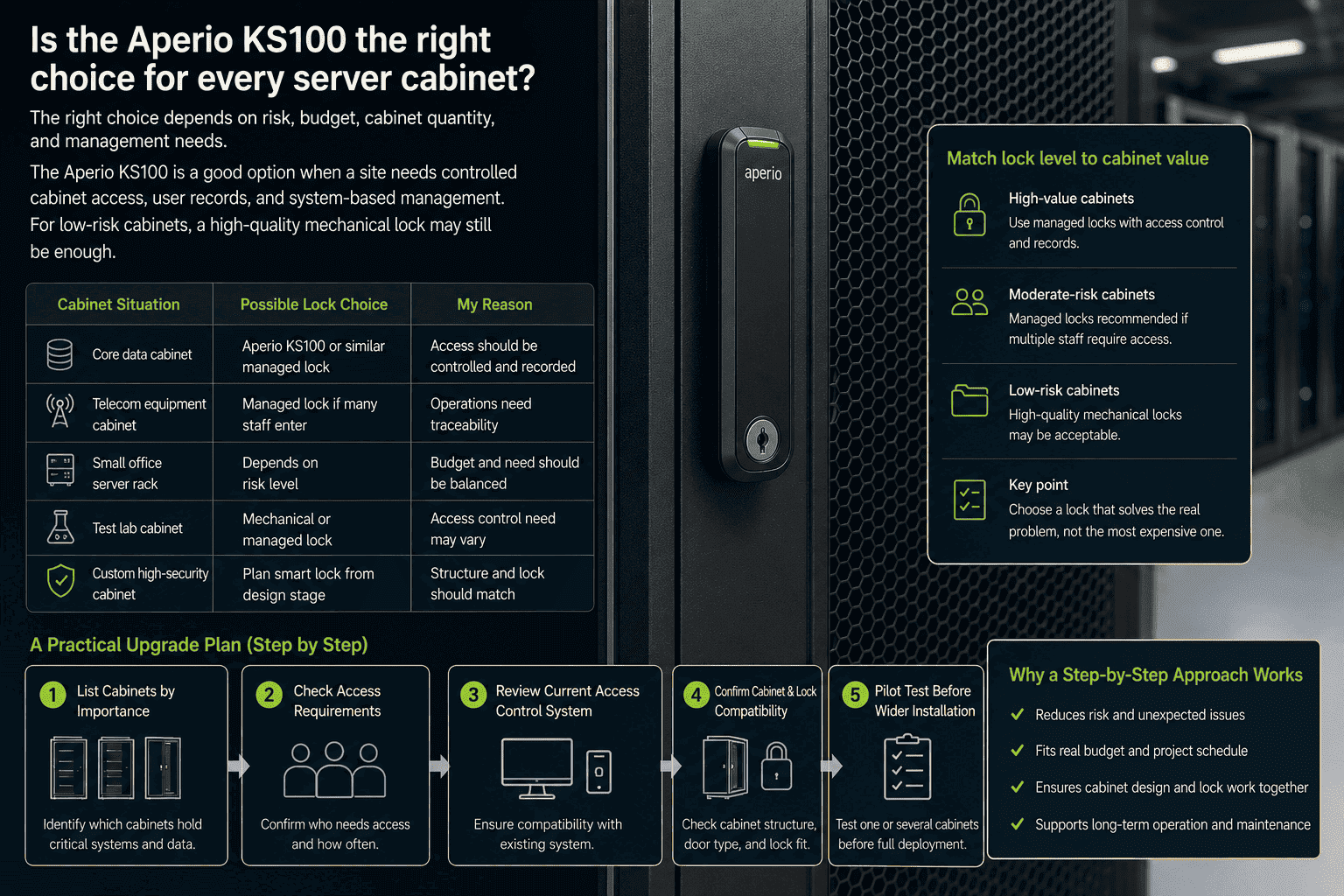
I match the lock level to the cabinet value
I do not recommend overbuilding every cabinet. Some cabinets hold low-risk test equipment. Some cabinets hold core systems and customer data. These two cases should not use the same thinking. A cabinet lock should match the risk level of the equipment, the number of people with access, and the audit requirement.11
For high-value cabinets, I prefer a system that supports access control and records. For simple storage or small internal use, a better mechanical lock may be acceptable. The key is not to choose the most expensive lock. The key is to choose a lock that solves the real problem.
| Cabinet situation | Possible lock choice | My reason |
|---|---|---|
| Core data cabinet | Aperio KS100 or similar managed lock | Access should be controlled and recorded |
| Telecom equipment cabinet | Managed lock if many staff enter | Operations need traceability |
| Small office server rack | Depends on risk level | Budget and need should be balanced |
| Test lab cabinet | Mechanical or managed lock | Access control need may vary |
| Custom high-security cabinet | Plan smart lock from design stage | Structure and lock should match |
A practical upgrade should be planned step by step
If a customer asks me how to start, I usually suggest a simple order. First, list the cabinets by importance. Second, check who needs access. Third, check the current access control system. Fourth, confirm cabinet structure and lock compatibility. Fifth, test one or several cabinets before wider installation. This method is more realistic than changing every lock at once.
Aperio KS100 can be a strong part of this plan. But it should work with clear rules, proper cabinet design, and daily maintenance. I believe this is the honest way to use smart cabinet locks. The product matters, but the process also matters.
Conclusion
I see the Aperio KS100 as a practical cabinet security upgrade when access control, traceability, and reliable cabinet structure are planned together.
"NIST.SP.800-53r5.pdf", https://nvlpubs.nist.gov/nistpubs/specialpublications/NIST.SP.800-53r5.pdf. NIST security-control guidance treats physical access control for facilities, systems, and equipment as a required component of information-system protection, providing contextual support for the role of a cabinet lock as a final physical access control. Evidence role: general_support; source type: government. Supports: The source should support that physical access to information systems and related equipment should be controlled as part of information security.. Scope note: The source supports the general security principle rather than evaluating any specific cabinet-lock product. ↩
"[PDF] NIST.SP.800-53r5.pdf", https://nvlpubs.nist.gov/nistpubs/specialpublications/NIST.SP.800-53r5.pdf. Government security-control guidance links physical access authorization and access-event monitoring with accountability, supporting the claim that controlled locks and access records improve cabinet-security management. Evidence role: expert_consensus; source type: government. Supports: The source should support the security value of authorizing physical access and maintaining records of access events.. Scope note: The guidance addresses physical access control broadly and does not quantify risk reduction for cabinet locks specifically. ↩
"Campus Master Key Control Policy University of Wisconsin ...", https://uwpd.wisc.edu/content/uploads/2014/01/Master_Key_Policy_Final.pdf. Institutional key-control guidance describes master-key systems as arrangements in which a single key can operate multiple locks, which explains why shared or hierarchical keys can complicate access accountability. Evidence role: mechanism; source type: education. Supports: The source should explain how master-key or shared-key arrangements can expand access and complicate key control.. Scope note: Such guidance explains the mechanism of key-control risk but may not address server cabinets specifically. ↩
"[PDF] Guide to Computer Security Log Management", https://nvlpubs.nist.gov/nistpubs/legacy/sp/nistspecialpublication800-92.pdf. Physical-access-control guidance explains that electronic access-control systems can generate audit records for access events, supporting the contrast with conventional mechanical locks that do not inherently identify users or record opening times. Evidence role: mechanism; source type: government. Supports: The source should support that electronic access-control systems can record access events, while conventional mechanical locks lack built-in electronic audit records.. Scope note: The source supports the technology distinction generally rather than documenting the specific locks used in the article's examples. ↩
"Aperio® KS100 Wireless Server Cabinet Lock", https://www.assaabloy.com/ae/en/documents/solutions/products/aperio/aperio-ks100-/assets/documents/brochure---product-datasheets/aperio_ks100_datasheet_2023.pdf. ASSA ABLOY product documentation identifies the Aperio KS100 as a wireless server-cabinet lock in the Aperio line, directly supporting the product-description claim. Evidence role: definition; source type: other. Supports: The source should verify the product name, manufacturer, wireless design, and intended cabinet-lock category.. Scope note: Because the likely source is manufacturer documentation, it verifies product characteristics but is not independent evidence of operational performance. ↩
"Aperio KS100 Server Cabinet Lock | ASSA ABLOY", https://www.assaabloy.com/pl/en/solutions/products/digital-access-solutions/aperio/aperio-ks100-server-cabinet-lock. Manufacturer technical documentation describes the KS100 as a server-cabinet lock intended for use with Aperio-enabled access-control infrastructure, supporting the claim that cabinet access can be linked to a wider access-control system. Evidence role: general_support; source type: other. Supports: The source should support that the KS100 is made for server cabinets and is designed to work with electronic access-control infrastructure.. Scope note: The documentation can confirm intended functionality, but actual integration depends on site configuration and compatible access-control components. ↩
"[PDF] Access Control Safety Upgrades - Western Washington University", https://fdo.wwu.edu/sites/fdo.wwu.edu/files/2024-09/Access%20Control%20final.pdf. Research and technical literature on wireless access-control deployment notes that wireless components can reduce cabling requirements in retrofit installations, providing contextual support for the claim that wiring every cabinet can be difficult. Evidence role: general_support; source type: research. Supports: The source should support that wireless access-control systems can reduce cabling requirements and installation disruption in retrofit environments.. Scope note: The support is contextual and may discuss doors or building access points rather than server-cabinet locks specifically. ↩
"NIST.SP.800-53r5.pdf", https://nvlpubs.nist.gov/nistpubs/specialpublications/NIST.SP.800-53r5.pdf. Government guidance on wireless and connected-device deployments emphasizes connectivity, configuration, power, and maintenance considerations, supporting the need to plan signal coverage, gateways, batteries, compatibility, and maintenance workflows for wireless cabinet locks. Evidence role: mechanism; source type: government. Supports: The source should support that wireless connected devices require planning for connectivity, power, compatibility, and ongoing maintenance.. Scope note: The guidance is not specific to the Aperio KS100 and should be used as general deployment context. ↩
"SP 800-53 Rev. 5, Security and Privacy Controls ... - NIST CSRC", https://csrc.nist.gov/pubs/sp/800/53/r5/upd1/final. Security-control frameworks require organizations to manage and review access authorizations, supporting the audit relevance of asking which individuals had access to a system or protected area. Evidence role: expert_consensus; source type: government. Supports: The source should support that access rights and access events are subject to review or audit in information-security programs.. Scope note: The source supports the general audit principle and may not phrase the audit question in the same informal terms. ↩
"[PDF] Guide to Computer Security Log Management", https://nvlpubs.nist.gov/nistpubs/legacy/sp/nistspecialpublication800-92.pdf. NIST incident-response guidance describes logs and other records as important inputs for incident analysis, supporting the claim that cabinet-access records can assist post-incident review. Evidence role: mechanism; source type: government. Supports: The source should support that logs and audit records are used during incident analysis and post-incident review.. Scope note: The guidance discusses logs broadly and does not prove that a smart-lock record alone can determine the cause of an outage. ↩
"Risk Management Framework for Information Systems and ...", https://nvlpubs.nist.gov/nistpubs/SpecialPublications/NIST.SP.800-37r2.pdf. NIST risk-management guidance states that security controls should be selected and tailored according to assessed organizational risk, supporting a cabinet-lock choice based on equipment criticality, access exposure, and audit needs. Evidence role: expert_consensus; source type: government. Supports: The source should support selecting security controls according to risk, asset importance, and organizational requirements.. Scope note: The source supports the risk-based decision method generally and does not prescribe a specific cabinet-lock type. ↩
