
How Should I Purchase Custom Industrial Enclosures?
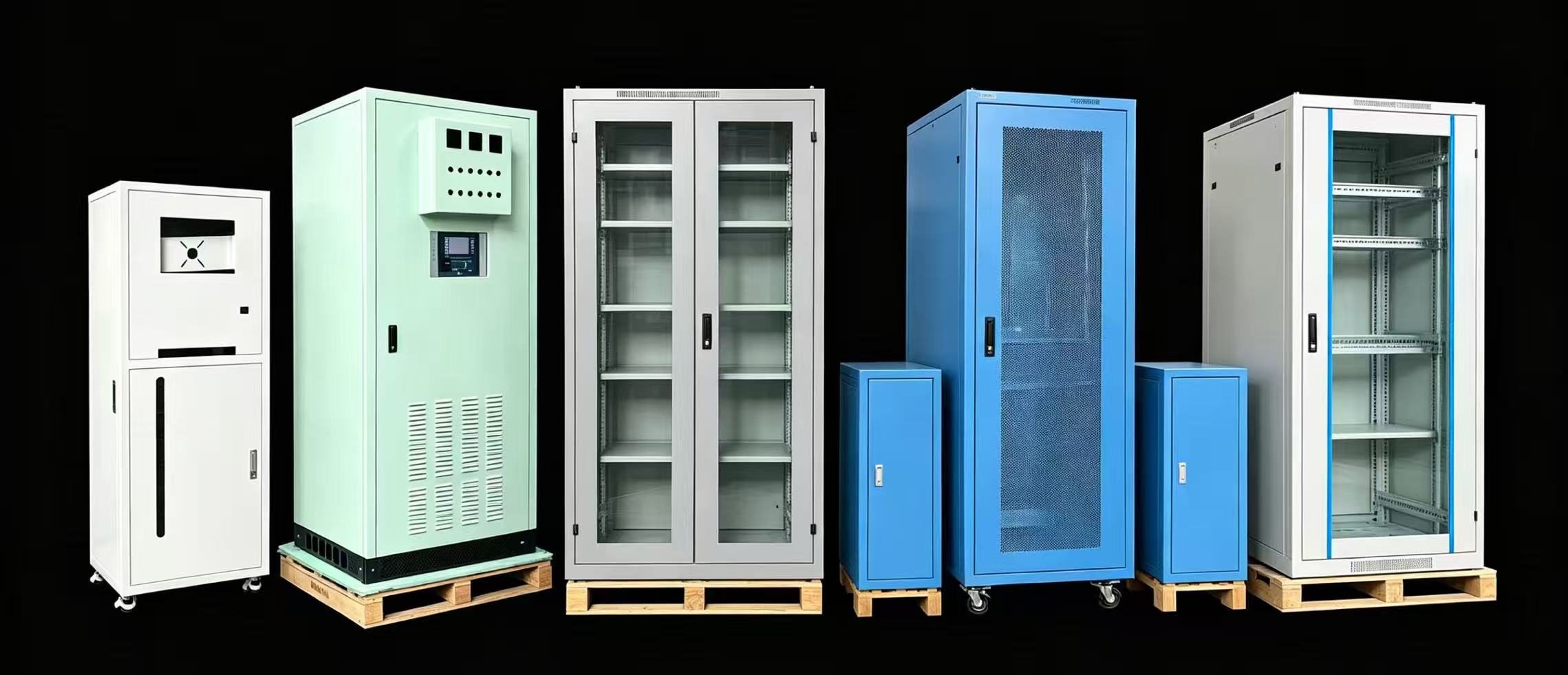
A wrong enclosure can slow installation, damage equipment, and raise service costs. I have seen small size mistakes become expensive site problems.
I purchase custom industrial enclosures by first confirming the installed equipment, size, weight, quantity, site environment, mounting method, cooling need, wiring path, and service access. Then I move through requirement review, drawing confirmation, production, inspection, and delivery.
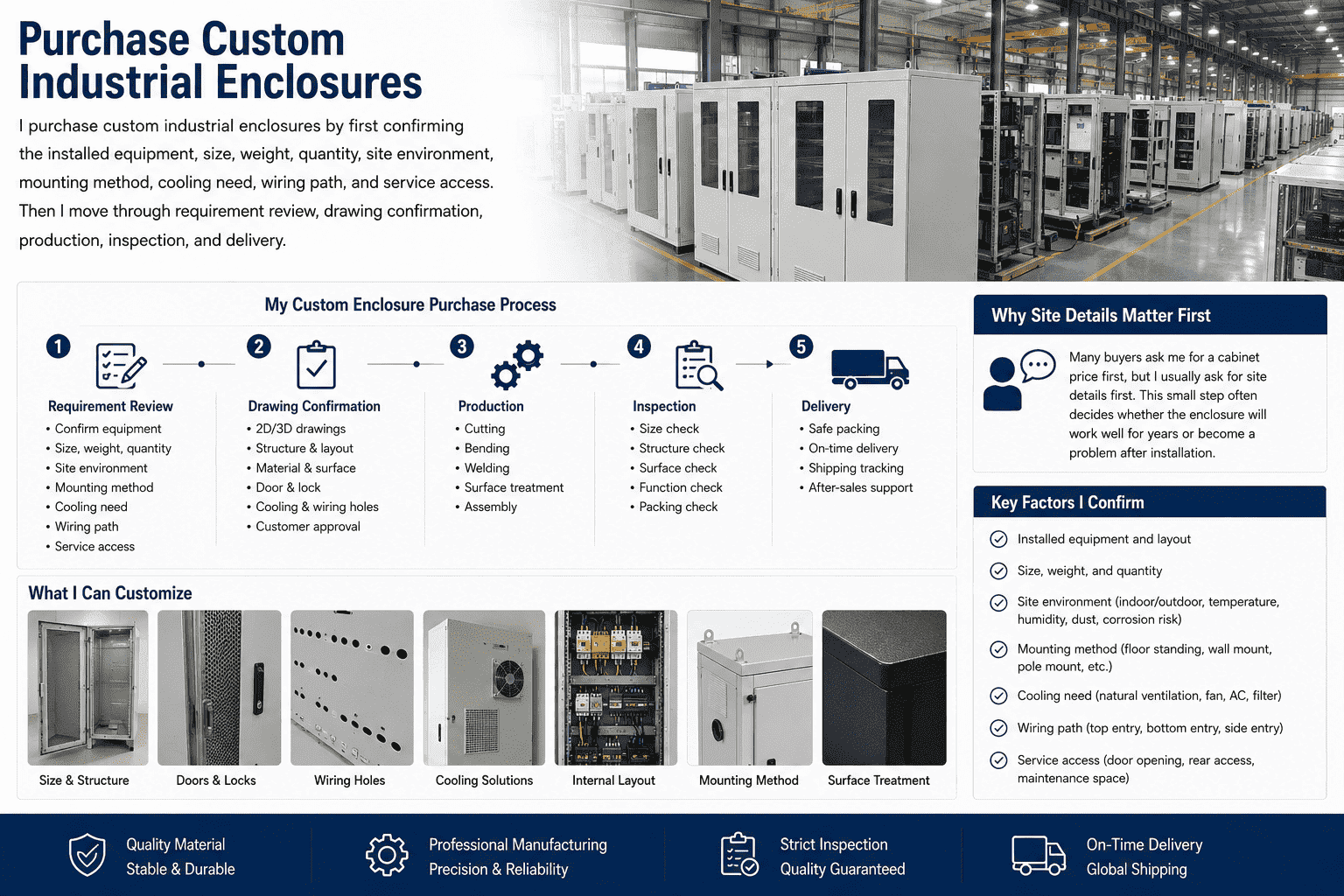
Many buyers ask me for a cabinet price first, but I usually ask for site details first. This small step often decides whether the enclosure will work well for years or become a problem after installation.
Why Do I Need A Custom Industrial Enclosure Instead Of A Standard Cabinet?
A standard cabinet looks simple to buy, but it can fail when the site is not simple1. I have seen this happen many times.
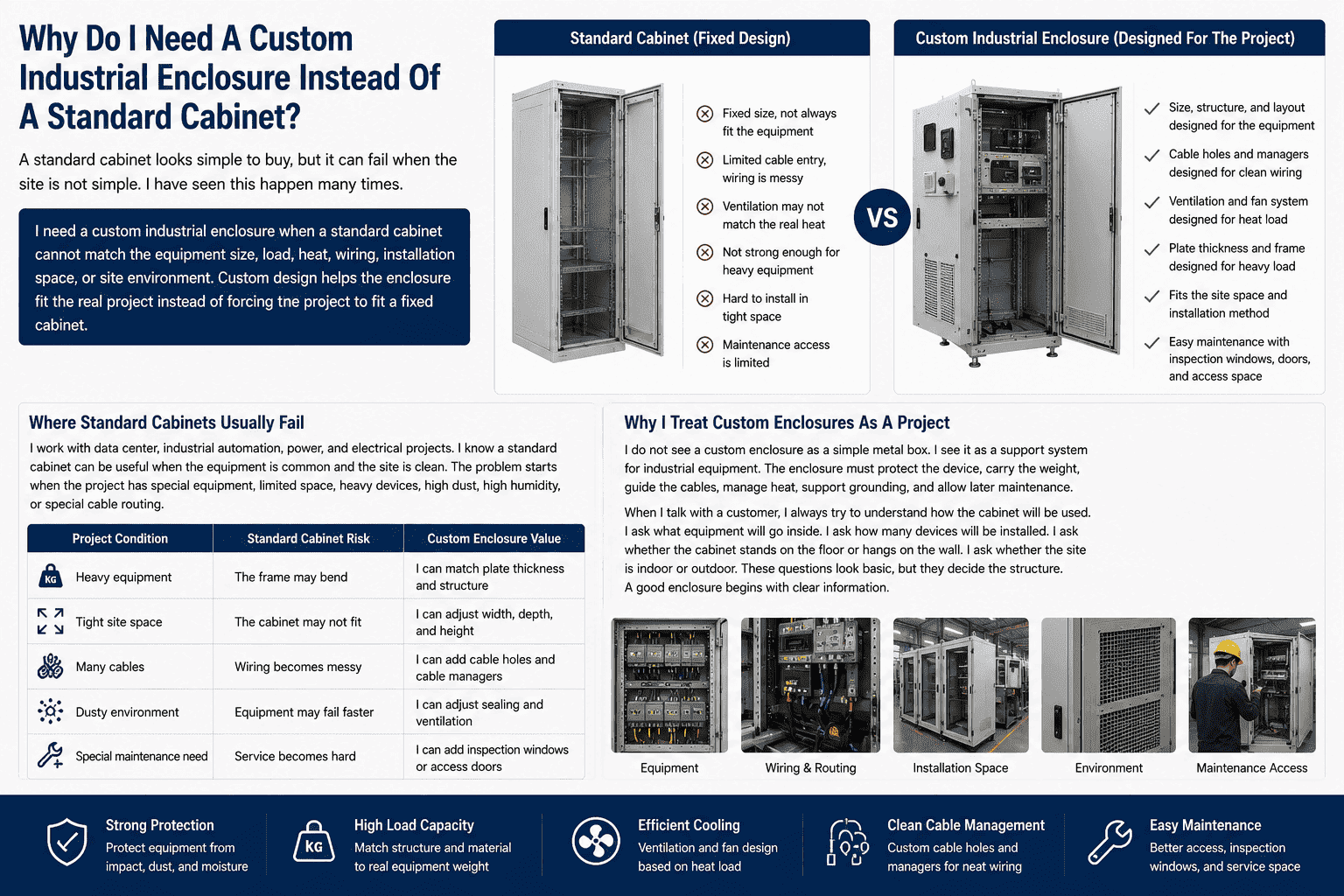
I need a custom industrial enclosure when a standard cabinet cannot match the equipment size, load, heat, wiring, installation space, or site environment.2 Custom design helps the enclosure fit the real project instead of forcing the project to fit a fixed cabinet.
Where Standard Cabinets Usually Fail
I work with data center, industrial automation, power, and electrical projects. I know a standard cabinet can be useful when the equipment is common and the site is clean. The problem starts when the project has special equipment, limited space, heavy devices, high dust, high humidity, or special cable routing.
A standard enclosure gives me fixed height, width, depth, door style, panel thickness, hole position, and mounting layout. This is not always enough. A custom enclosure lets me start from the real site. I can design the cabinet around the equipment, not around a catalog model.
| Project condition | Standard cabinet risk | Custom enclosure value |
|---|---|---|
| Heavy equipment | The frame may bend | I can match plate thickness and structure |
| Tight site space | The cabinet may not fit | I can adjust width, depth, and height |
| Many cables | Wiring becomes messy | I can add cable holes and cable managers |
| Dusty environment | Equipment may fail faster | I can adjust sealing and ventilation |
| Special maintenance need | Service becomes hard | I can add inspection windows or access doors |
Why I Treat Custom Enclosures As A Project
I do not see a custom enclosure as a simple metal box. I see it as a support system for industrial equipment. The enclosure must protect the device, carry the weight, guide the cables, manage heat, support grounding, and allow later maintenance.3
When I talk with a customer, I always try to understand how the cabinet will be used. I ask what equipment will go inside. I ask how many devices will be installed. I ask whether the cabinet stands on the floor or hangs on the wall. I ask whether the site is indoor or outdoor. These questions look basic, but they decide the structure. A good enclosure begins with clear information.
What Information Should I Prepare Before Buying A Custom Industrial Enclosure?
A vague request usually creates a vague cabinet. I have learned that unclear details can cause delays, redesigns, and wrong production.
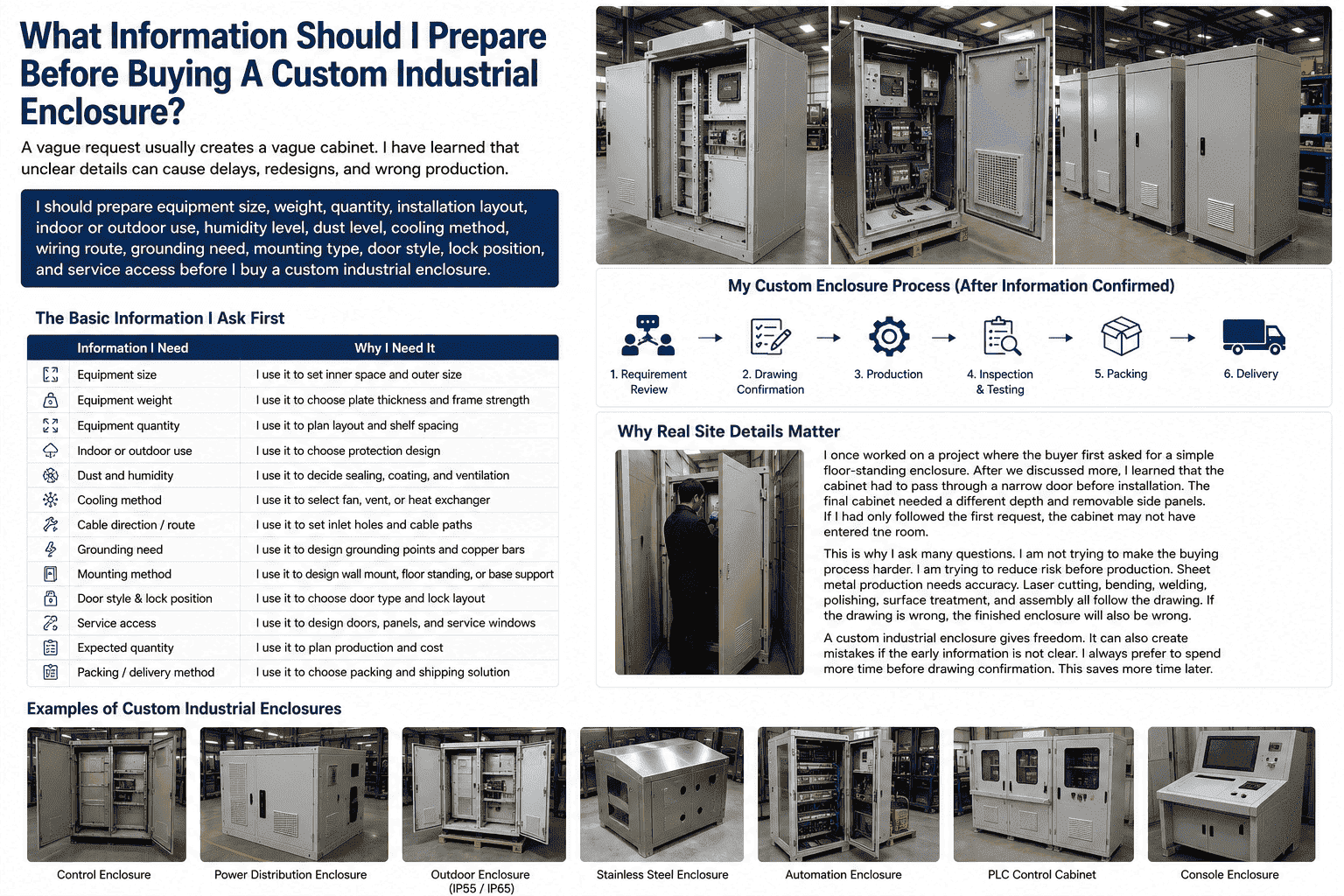
I should prepare equipment size, weight, quantity, installation layout, indoor or outdoor use, humidity level, dust level, cooling method, wiring route, grounding need, mounting type, door style, lock position, and service access before I buy a custom industrial enclosure.4
The Basic Information I Ask First
When I start a custom enclosure case, I do not rush to cut sheet metal. I first collect details. I ask for the equipment list. I ask for drawings if the customer has them. I ask for photos of the site if possible. I also ask for the expected delivery quantity and packing method, especially for overseas projects.
The size of the installed devices is one key point. The weight is another key point. A light control module and a heavy power unit need different support. The quantity also matters. One device may need a simple shelf. Many devices may need rails, beams, layers, and cable separation.
| Information I need | Why I need it |
|---|---|
| Equipment size | I use it to set inner space and outer size |
| Equipment weight | I use it to choose plate thickness and frame strength |
| Equipment quantity | I use it to plan layout and shelf spacing |
| Indoor or outdoor use | I use it to choose protection design |
| Dust and humidity | I use it to decide sealing, coating, and ventilation |
| Mounting method | I use it to design wall mount, floor standing, or base support |
| Cable direction | I use it to set inlet holes and cable paths |
| Maintenance method | I use it to design doors, panels, and service windows |
Why Real Site Details Matter
I once worked on a project where the buyer first asked for a simple floor-standing enclosure. After we discussed more, I learned that the cabinet had to pass through a narrow door before installation. The final cabinet needed a different depth and removable side panels. If I had only followed the first request, the cabinet may not have entered the room.
This is why I ask many questions. I am not trying to make the buying process harder. I am trying to reduce risk before production. Sheet metal production needs accuracy.5 Laser cutting, bending, welding, polishing, surface treatment, and assembly all follow the drawing. If the drawing is wrong, the finished enclosure will also be wrong.
A custom industrial enclosure gives freedom. It can also create mistakes if the early information is not clear. I always prefer to spend more time before drawing confirmation. This saves more time later.
How Does A Reliable Custom Industrial Enclosure Process Work?
A poor process can make a good idea fail. I have seen projects lose time because the cabinet drawing was not confirmed clearly.
A reliable custom industrial enclosure process usually includes requirement communication, solution design, drawing confirmation, material preparation, sheet metal production, surface treatment, assembly, quality inspection, packing, and delivery.6 Each step should be checked before the next step starts.
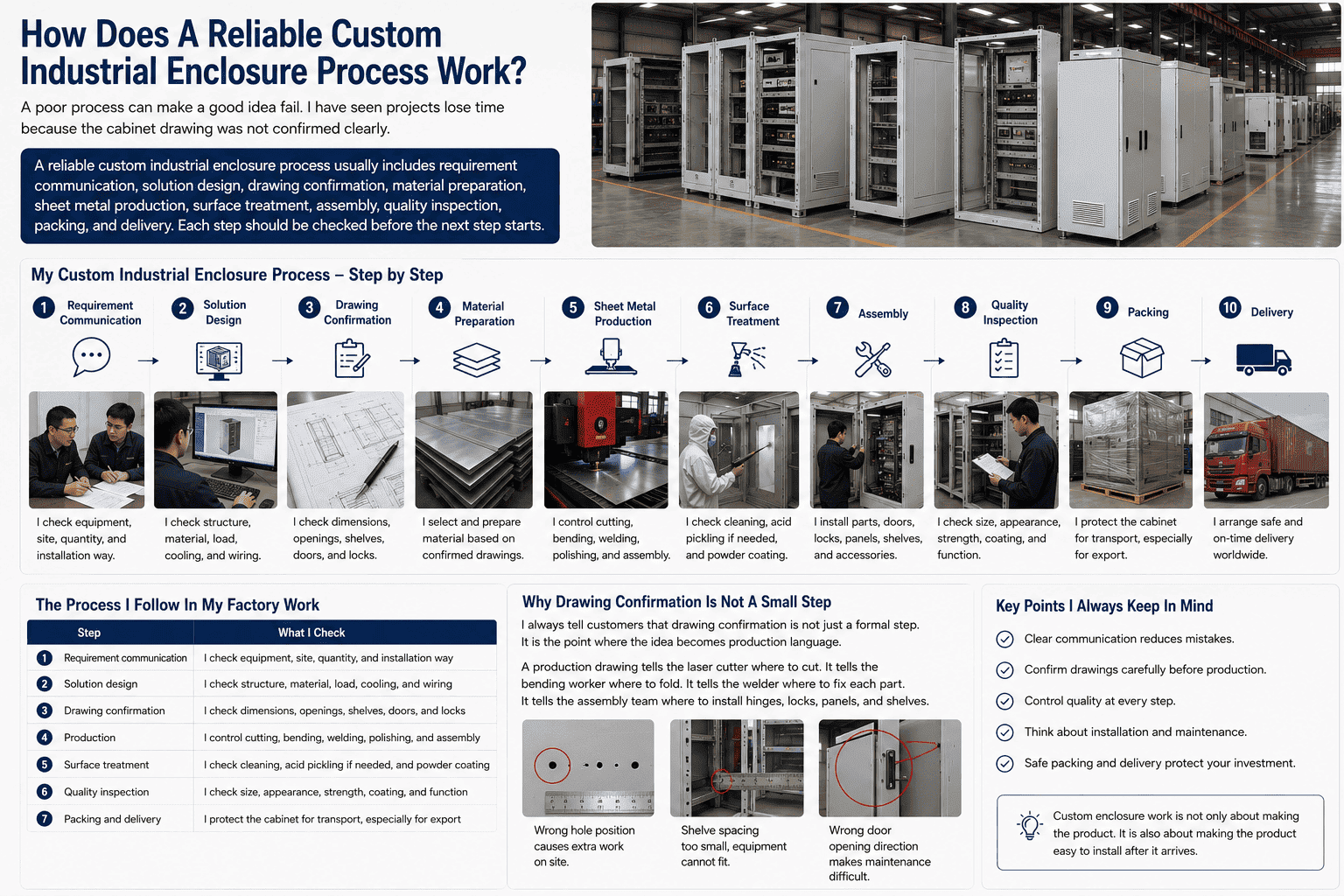
The Process I Follow In My Factory Work
I use a step-by-step process because custom production has many details. I do not want the buyer to feel lost. I also do not want my production team to guess. A confirmed drawing is the center of the process.
The first step is requirement communication. I listen to the equipment and site conditions. The second step is solution design. I turn the requirement into a structure. The third step is drawing confirmation. This is very important. I need the buyer to check size, layout, holes, doors, shelves, locks, and cable positions. After that, production can start.
| Step | What I check |
|---|---|
| Requirement communication | I check equipment, site, quantity, and installation way |
| Solution design | I check structure, material, load, cooling, and wiring |
| Drawing confirmation | I check dimensions, openings, shelves, doors, and locks |
| Production | I control cutting, bending, welding, polishing, and assembly |
| Surface treatment | I check cleaning, acid pickling if needed, and powder coating |
| Quality inspection | I check size, appearance, strength, coating, and function |
| Packing and delivery | I protect the cabinet for transport, especially for export |
Why Drawing Confirmation Is Not A Small Step
I always tell customers that drawing confirmation is not just a formal step. It is the point where the idea becomes production language. A production drawing tells the laser cutter where to cut. It tells the bending worker where to fold. It tells the welder where to fix each part. It tells the assembly team where to install hinges, locks, panels, and shelves.
If the cable hole is 30 mm away from the needed position, the installer may need to cut the cabinet again on site. If the shelf spacing is too small, the equipment may not fit. If the door opening direction is wrong, maintenance may become difficult. These problems are avoidable.
For this reason, I prefer clear drawing review. I mark the important sizes. I ask the customer to check the equipment again. I also check whether the cabinet can be packed and shipped safely. Custom enclosure work is not only about making the product. It is also about making the product easy to install after it arrives.
How Can I Customize The Structure, Material, And Layout?
A cabinet can look correct from outside but still fail inside. I care more about the inside layout because that is where the equipment works.
I can customize the enclosure size, plate thickness, frame structure, shelves, beams, rails, cable holes, grounding points, ventilation areas, lock holes, inspection windows, and strong-current and weak-current separation based on the equipment and site need.
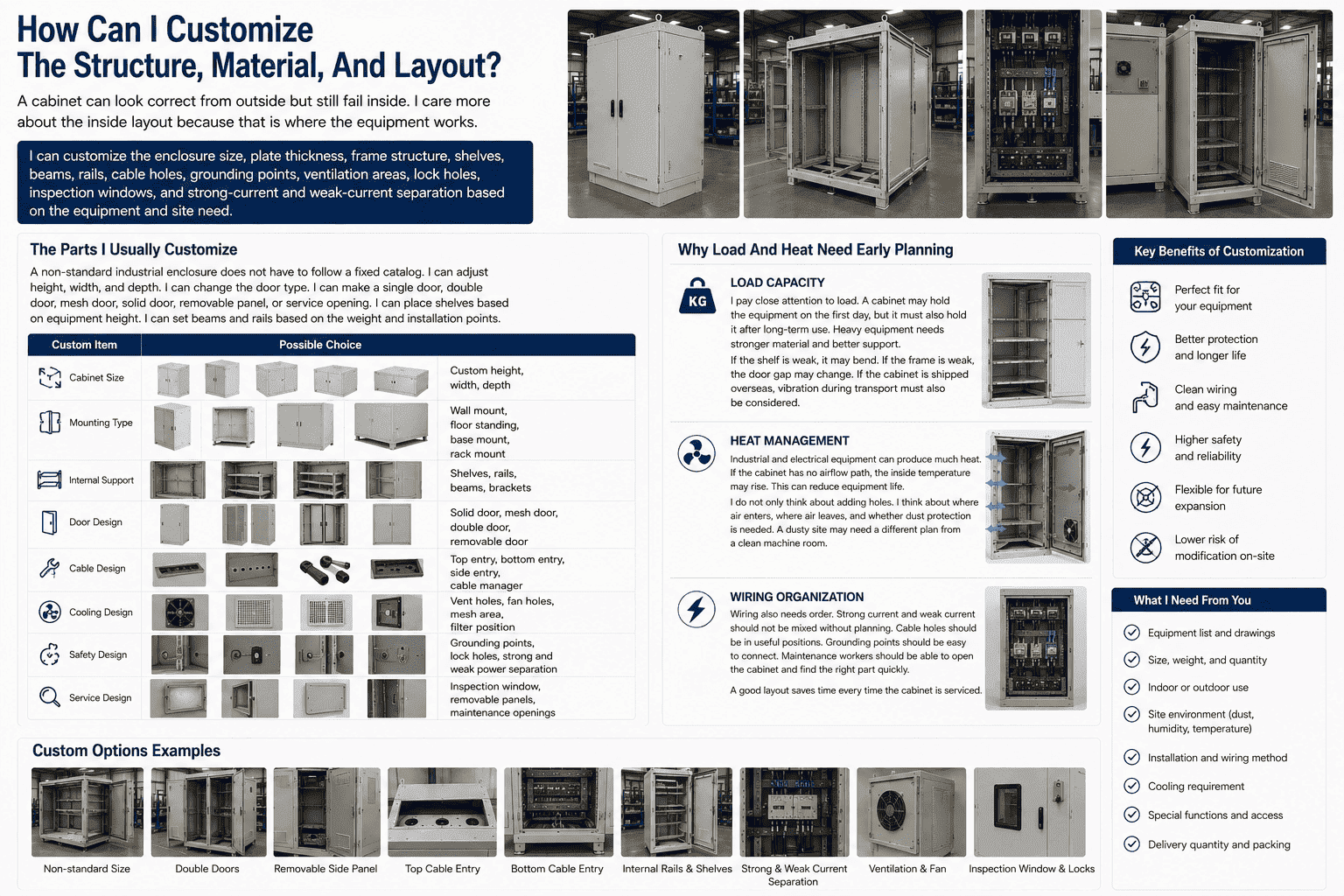
The Parts I Usually Customize
A non-standard industrial enclosure does not have to follow a fixed catalog. I can adjust height, width, and depth. I can change the door type. I can make a single door, double door, mesh door, solid door, removable panel, or service opening. I can place shelves based on equipment height. I can set beams and rails based on the weight and installation points.
The material also matters. Some projects need a stronger structure. Some projects need better corrosion resistance. Some projects need a clean powder coating finish. Some projects need special cutouts for switches, meters, screens, fans, filters, connectors, or cable glands.
| Custom item | Possible choice |
|---|---|
| Cabinet size | Custom height, width, depth |
| Mounting type | Wall mount, floor standing, base mount, rack mount |
| Internal support | Shelves, rails, beams, brackets |
| Door design | Solid door, mesh door, double door, removable door |
| Cable design | Top entry, bottom entry, side entry, cable manager |
| Cooling design | Vent holes, fan holes, mesh area, filter position |
| Safety design | Grounding points, lock holes, strong and weak power separation |
| Service design | Inspection window, removable panels, maintenance openings |
Why Load And Heat Need Early Planning
I pay close attention to load. A cabinet may hold the equipment on the first day, but it must also hold it after long-term use. Heavy equipment needs stronger material and better support.7 If the shelf is weak, it may bend. If the frame is weak, the door gap may change. If the cabinet is shipped overseas, vibration during transport must also be considered.
Heat is another practical issue. Industrial and electrical equipment can produce much heat. If the cabinet has no airflow path, the inside temperature may rise. This can reduce equipment life. I do not only think about adding holes. I think about where air enters, where air leaves, and whether dust protection is needed. A dusty site may need a different plan from a clean machine room.8
Wiring also needs order. Strong current and weak current should not be mixed without planning.9 Cable holes should be in useful positions. Grounding points should be easy to connect. Maintenance workers should be able to open the cabinet and find the right part quickly. A good layout saves time every time the cabinet is serviced.
Can I Order Only One Custom Industrial Enclosure?
Some buyers think custom production must start with a large quantity. I understand this concern because many factories only want batch orders.
Yes, I can order one custom industrial enclosure if the manufacturer supports non-standard sheet metal customization. One piece can be produced according to the required size, structure, material, mounting method, and site condition.
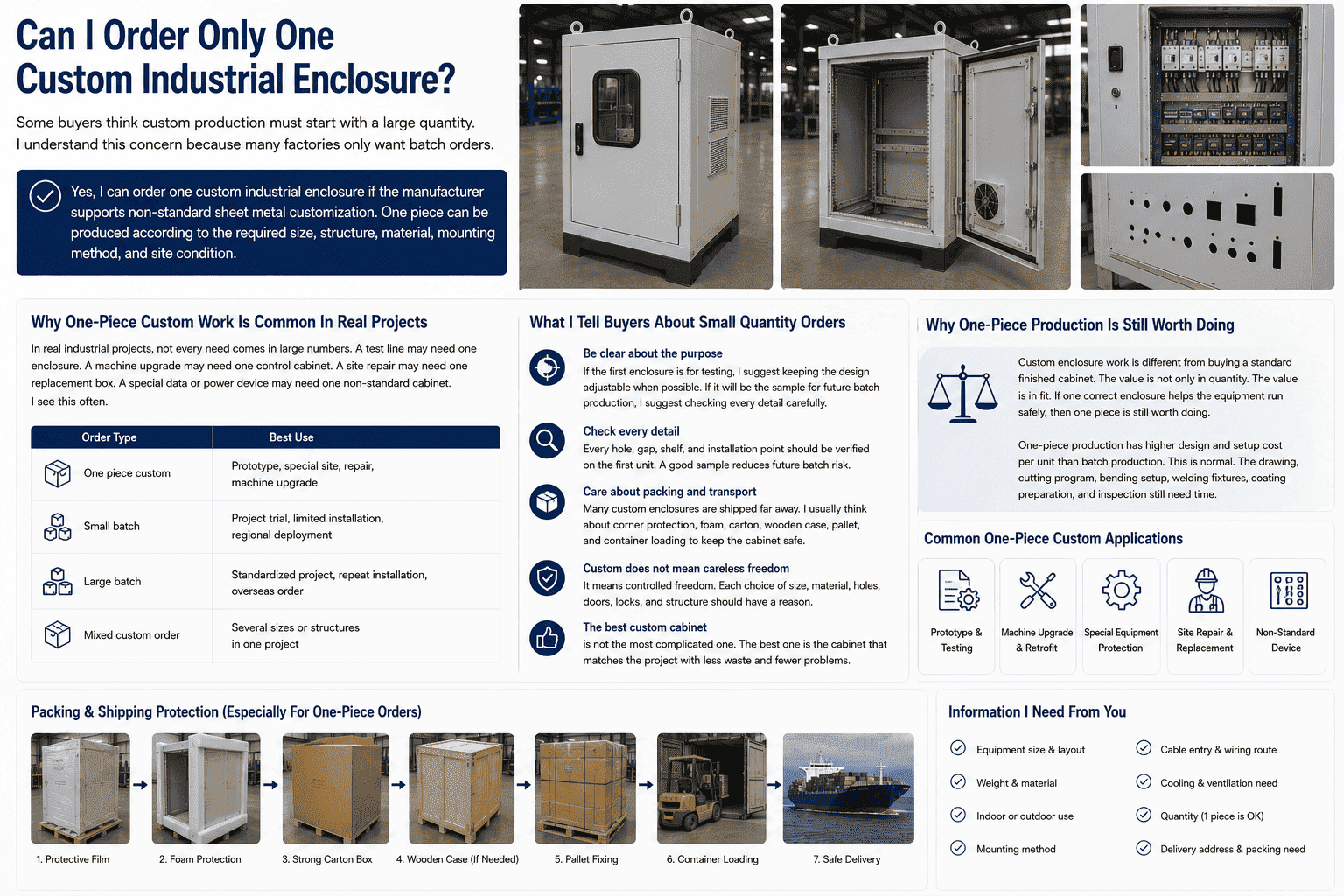
Why One-Piece Custom Work Is Common In Real Projects
In real industrial projects, not every need comes in large numbers. A test line may need one enclosure. A machine upgrade may need one control cabinet. A site repair may need one replacement box. A special data or power device may need one non-standard cabinet. I see this often.
Custom enclosure work is different from buying a standard finished cabinet. The value is not only in quantity. The value is in fit. If one correct enclosure helps the equipment run safely, then one piece is still worth doing. Of course, one-piece production has higher design and setup cost per unit than batch production. This is normal. The drawing, cutting program, bending setup, welding fixtures, coating preparation, and inspection still need time.
| Order type | Best use |
|---|---|
| One piece custom | Prototype, special site, repair, machine upgrade |
| Small batch | Project trial, limited installation, regional deployment |
| Large batch | Standardized project, repeat installation, overseas order |
| Mixed custom order | Several sizes or structures in one project |
What I Tell Buyers About Small Quantity Orders
I tell buyers to be clear about purpose. If the first enclosure is for testing, I suggest keeping the design adjustable when possible. If the first unit will become the sample for future batch production, I suggest checking every hole, gap, shelf, and installation point carefully. A good sample can reduce future batch risk.
For one-piece production, I also care about packing. Many custom enclosures are shipped far away. A single cabinet can still get damaged if the packing is weak. I usually think about corner protection, foam, carton, wooden case, pallet, and container loading. A cabinet is not finished when it leaves the assembly line. It is finished when it reaches the site in good condition.
I also remind buyers that custom does not mean careless freedom. It means controlled freedom. I can customize size, material, holes, doors, locks, and structure, but each choice should have a reason. The best custom cabinet is not the most complicated one. The best one is the cabinet that matches the project with less waste and fewer problems.
What Future Trends Should I Consider When Buying Custom Industrial Enclosures?
Industrial systems are changing fast. I now see more buyers asking for cabinets that support automation, data, and long-term service.
I should consider modular design, smart monitoring, energy saving, better cooling, cleaner wiring, recyclable material, and integrated installation when buying custom industrial enclosures for future industrial projects.
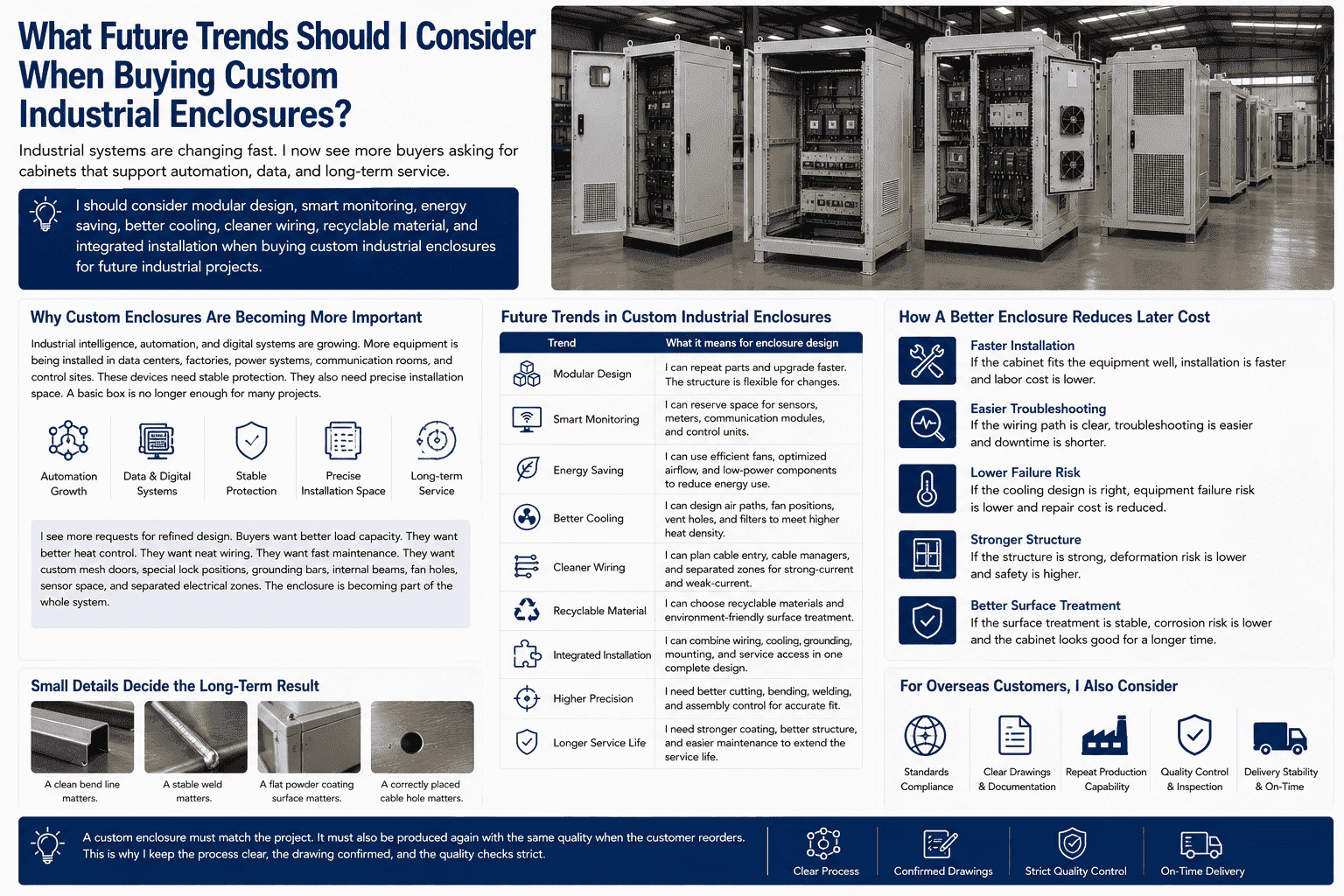
Why Custom Enclosures Are Becoming More Important
Industrial intelligence, automation, and digital systems are growing. More equipment is being installed in data centers, factories, power systems, communication rooms, and control sites. These devices need stable protection. They also need precise installation space. A basic box is no longer enough for many projects.
I see more requests for refined design. Buyers want better load capacity. They want better heat control. They want neat wiring. They want fast maintenance. They want custom mesh doors, special lock positions, grounding bars, internal beams, fan holes, sensor space, and separated electrical zones. The enclosure is becoming part of the whole system.
| Trend | What it means for enclosure design |
|---|---|
| Modular design | I can repeat parts and upgrade faster |
| Smart monitoring | I can reserve space for sensors and control units |
| Green production | I can reduce waste and choose suitable material |
| Integrated layout | I can combine wiring, cooling, grounding, and service access |
| Higher precision | I need better cutting, bending, welding, and assembly control |
| Longer service life | I need stronger coating, better structure, and easier maintenance |
How A Better Enclosure Reduces Later Cost
A good custom enclosure costs more attention at the beginning, but it can reduce later cost. If the cabinet fits the equipment well, installation is faster. If the wiring path is clear, troubleshooting is easier. If the cooling design is right, equipment failure risk is lower. If the structure is strong, deformation risk is lower. If the surface treatment is stable, corrosion risk is lower.
I have worked in sheet metal cabinet manufacturing for many years. I believe the small details decide the long-term result. A clean bend line matters. A stable weld matters. A flat powder coating surface matters. A correctly placed cable hole matters. These details may not look exciting in a sales picture, but they matter when the cabinet is installed and used every day.
For overseas customers, I also think about standards, drawings, repeat production, and delivery stability. A custom enclosure must match the project. It must also be produced again with the same quality when the customer reorders. This is why I keep the process clear, the drawing confirmed, and the quality checks strict.
Conclusion
I buy custom industrial enclosures by matching the cabinet to the real equipment, site, load, wiring, cooling, and service needs before production starts.
"NEMA enclosure types - Wikipedia", https://en.wikipedia.org/wiki/NEMA_enclosure_types. IEC 60529 and NEMA 250 classify enclosures by environmental protection characteristics, indicating that enclosure suitability depends on site exposure rather than cabinet dimensions alone. Evidence role: definition; source type: institution. Supports: Environmental conditions such as dust, water, corrosion, and location affect enclosure suitability.. Scope note: These standards support the general principle of site-dependent suitability, not a specific failure rate for standard cabinets. ↩
"A comprehensive guide on industrial panel design", https://uk.farnell.com/technical-resources/guides/comprehensive-on-industrial-panel-design. Industrial control panel and enclosure guidance treats mechanical fit, environmental rating, heat dissipation, and wiring access as design inputs, supporting the use of a custom enclosure when standard products cannot satisfy those conditions. Evidence role: expert_consensus; source type: institution. Supports: Enclosure choice should account for equipment fit, load, heat dissipation, wiring, installation, and environmental protection.. Scope note: The source would substantiate the selection criteria, while the decision to customize remains project-specific. ↩
"1926.404 - Wiring design and protection.", http://www.osha.gov/laws-regs/regulations/standardnumber/1926/1926.404. Electrical equipment and enclosure standards identify protection, bonding or grounding, access, and environmental suitability as enclosure-related design concerns, supporting the article's description of the enclosure as more than a simple box. Evidence role: general_support; source type: institution. Supports: Industrial enclosures serve protective, mechanical support, cable routing, thermal management, grounding, and maintenance-access functions.. Scope note: The support is contextual because different standards emphasize different functions depending on equipment type and jurisdiction. ↩
"Systems Engineering for ITS - Design and Specifications", https://ops.fhwa.dot.gov/seits/sections/section3/3_3_7.html. Systems engineering and product design literature emphasizes early definition of functional, environmental, interface, and maintenance requirements, supporting the need to collect detailed enclosure requirements before fabrication. Evidence role: expert_consensus; source type: research. Supports: Clear design inputs and requirements are needed before custom engineering and production.. Scope note: This supports the requirements-management principle broadly rather than validating every individual item in the author's checklist. ↩
"Precision Sheet Metal Fabrication: Achieving High Accuracy - Geomiq", https://geomiq.com/blog/precision-sheet-metal-fabrication/. Manufacturing engineering references on sheet-metal fabrication describe cutting, bending, and assembly as tolerance-controlled processes based on engineering drawings, supporting the claim that production accuracy is critical. Evidence role: general_support; source type: education. Supports: Sheet-metal fabrication relies on dimensional tolerances, accurate drawings, and process-specific manufacturing information.. Scope note: The source would explain the manufacturing principle, not assess the accuracy of any particular factory process. ↩
"Manufacturing and Quality | www.waru.edu", https://www.waru.edu/tools/dau-systems-engineering-brainbook/design-considerations/manufacturing-quality. ISO 9001 quality-management principles require control of design, production, inspection, and externally provided outputs, providing a standards-based context for a staged custom-enclosure manufacturing process. Evidence role: expert_consensus; source type: institution. Supports: Quality-managed manufacturing commonly separates requirements review, design confirmation, production control, inspection, and delivery activities.. Scope note: ISO 9001 supports the process-control logic generally; it does not prescribe this exact enclosure-specific sequence. ↩
"[PDF] Wood Handbook, Chapter 09: Structural Analysis Equations", https://research.fs.usda.gov/download/treesearch/37423.pdf. Engineering mechanics texts show that applied load affects stress and deflection in structural members, supporting the need for stronger material or support when an enclosure carries heavier equipment. Evidence role: mechanism; source type: education. Supports: Higher loads increase structural stress and deflection, which can require stronger materials, thicker members, or added supports.. ↩
"Ingress Protection (IP) ratings - IEC", https://www.iec.ch/ip-ratings. IEC ingress-protection ratings and NEMA enclosure types classify degrees of protection against dust and other environmental exposures, supporting the claim that dusty sites may require different enclosure designs than clean rooms. Evidence role: definition; source type: institution. Supports: Dust exposure is an environmental condition addressed through enclosure protection ratings and design choices.. Scope note: The standards classify protection levels but do not determine the best design for a particular site without project-specific exposure data. ↩
"[PDF] Task 5—Technical Basis for Electromagnetic Compatibility ... - INFO", https://info.ornl.gov/sites/publications/files/Pub61858.pdf. Electromagnetic-compatibility installation guidance identifies cable routing and separation of power and signal circuits as methods for reducing interference, supporting the need to plan strong-current and weak-current wiring paths. Evidence role: expert_consensus; source type: institution. Supports: Cable routing and separation between power and signal circuits are recognized practices for safety and electromagnetic compatibility.. Scope note: Specific separation distances and routing requirements vary by standard, voltage, cable type, and installation environment. ↩
