
What does an AWS datacenter look like?
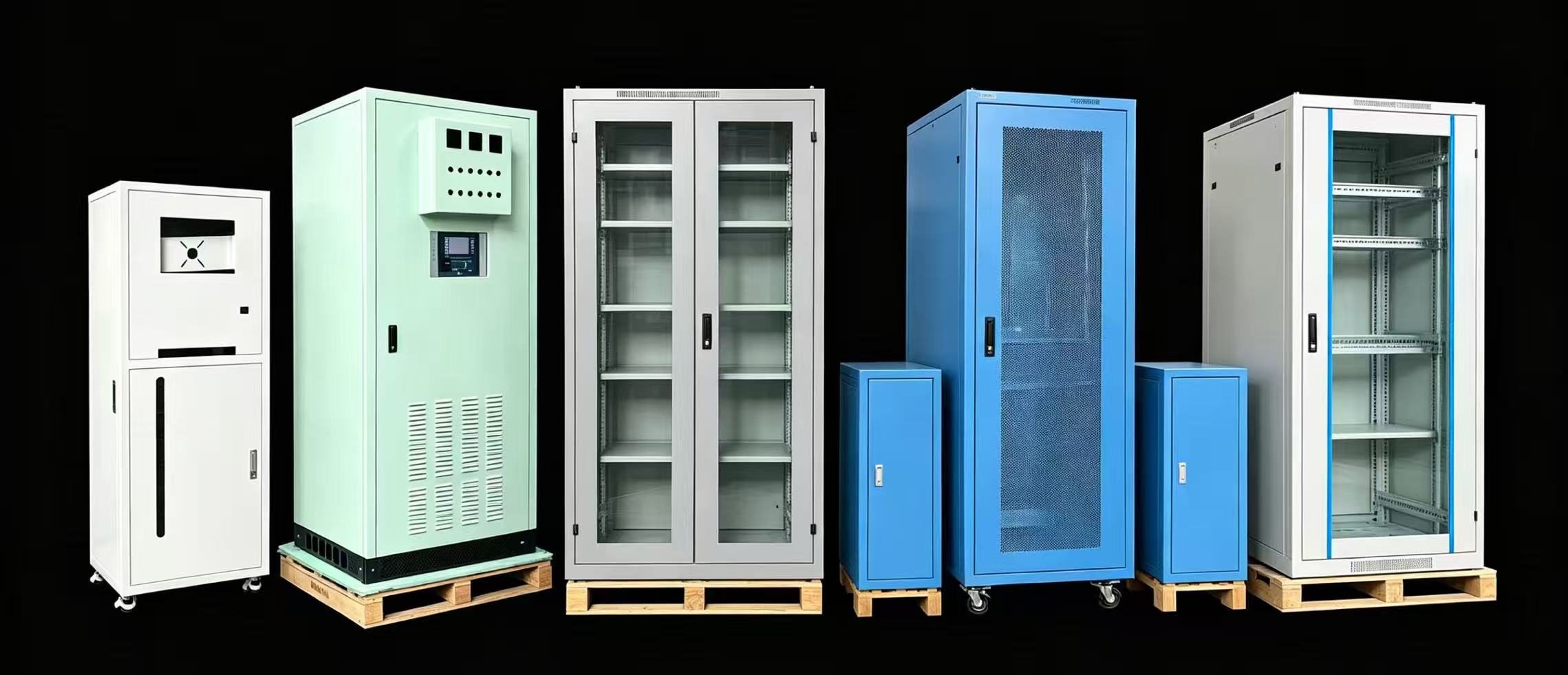
I see many people imagine a cloud as something light and hidden. This idea is risky, because real cloud power needs heavy buildings, strict control, and precise hardware.1
An AWS datacenter usually looks like a large, secure, industrial campus2 with one or more massive low-rise buildings, strong perimeter control, separated functional zones, standardized server halls, dense cabinet rows, cooling systems, power systems, and fully managed operations for cloud and AI workloads.
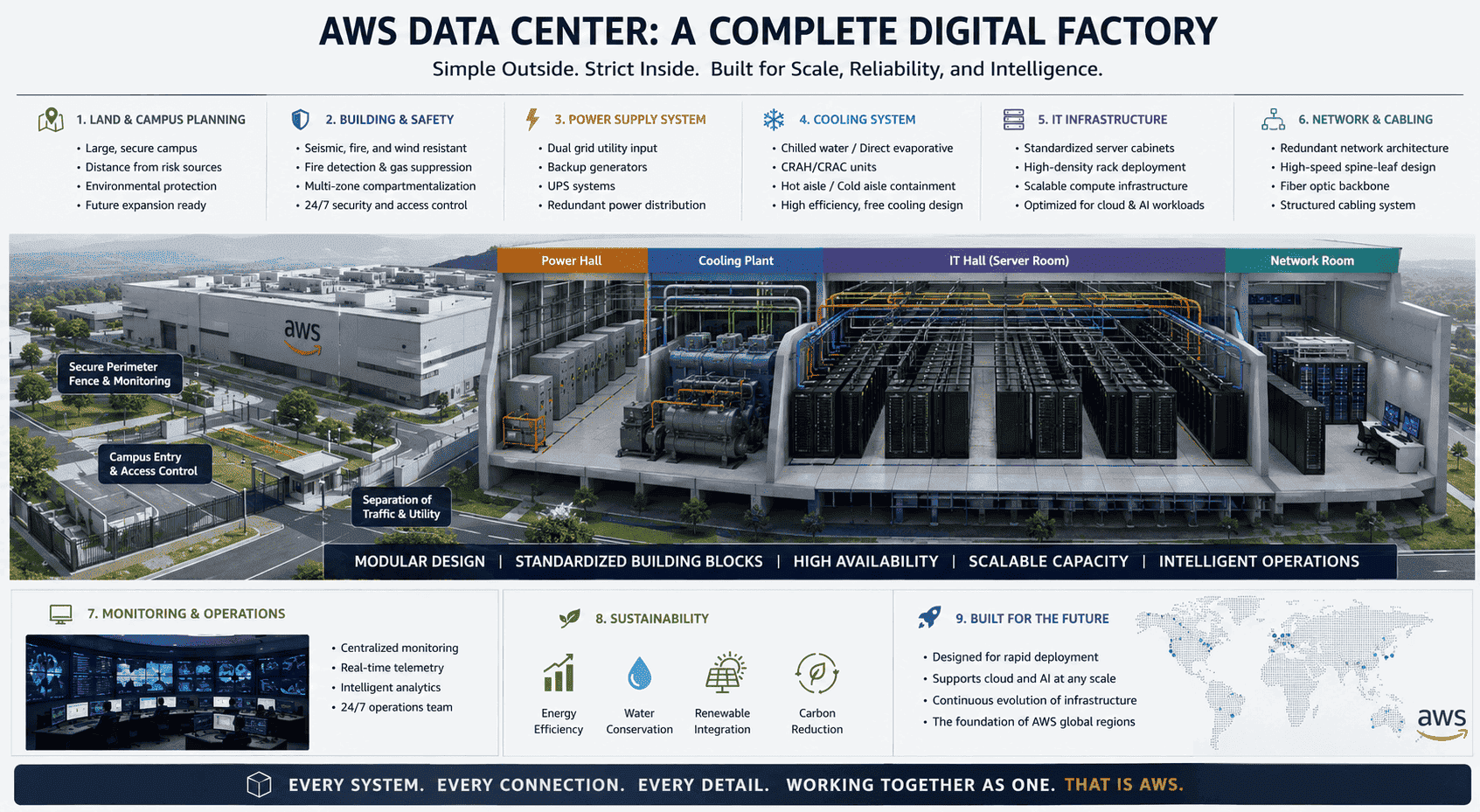
When I look at an AWS datacenter from the view of a cabinet manufacturer, I do not only see a building. I see a complete digital factory. I see land planning, building safety, power supply, cooling, cabling, server cabinets, network racks, and monitoring rooms working as one system. AWS does not treat a datacenter as a normal computer room. AWS builds it as a modular, standard, and smart infrastructure base. That is why its outside shape looks simple, but its inside logic is very strict.
Why does an AWS datacenter look like a secure industrial campus?
Many people expect a datacenter to look like an office building. This view causes confusion, because a real cloud facility must protect power, cooling, servers, data, and people.
An AWS datacenter often looks like a closed industrial campus because it needs safety, disaster resistance, energy control, and stable operation. I usually see this type of facility as a group of large buildings with walls, green buffer zones, private roads, and separated access points.
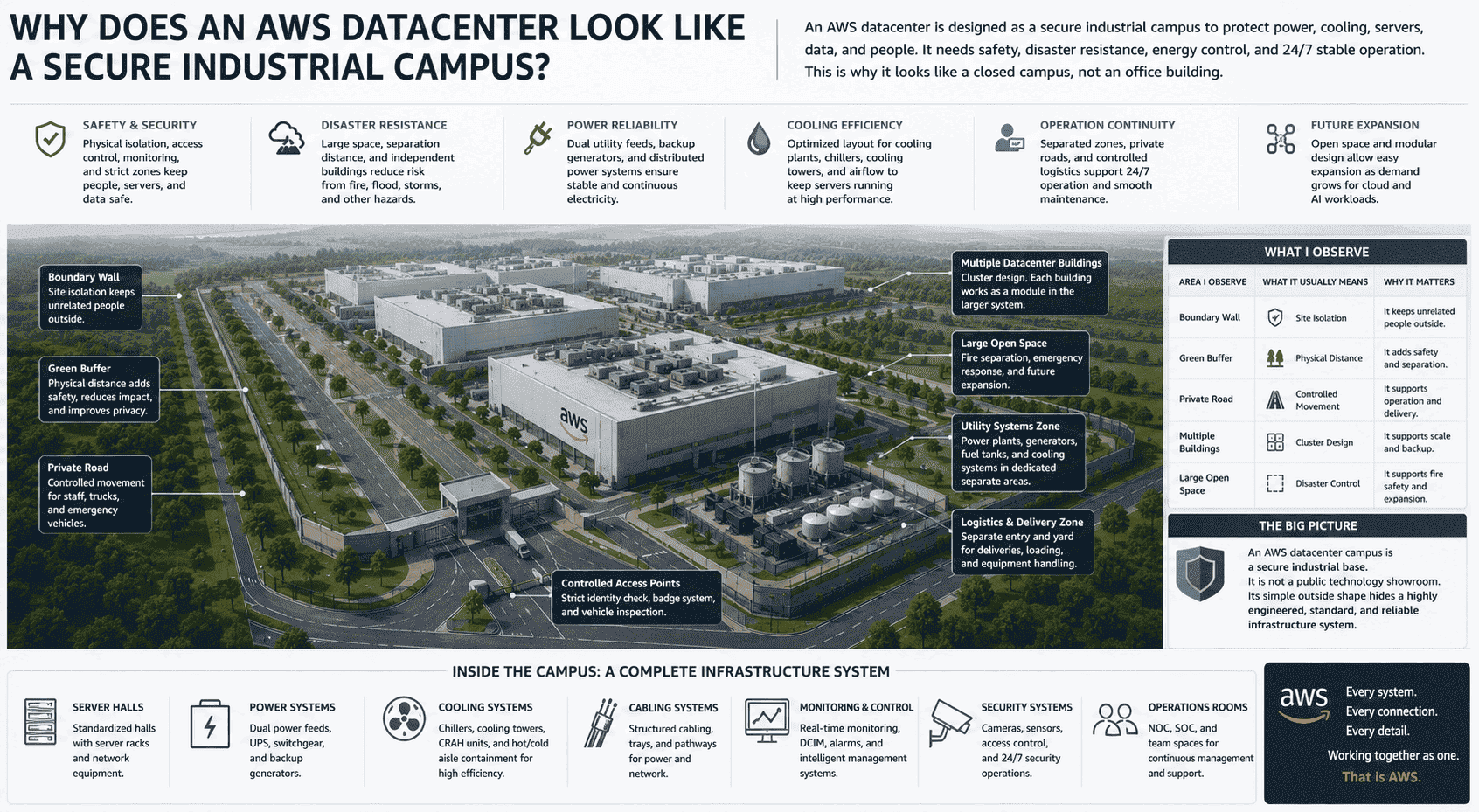
When I study large cloud datacenters, I always start from the outside. The first thing I notice is the campus layout. The whole site is usually open, clean, and separated from public areas. I often see a dedicated boundary wall, controlled entrances, inner roads, and enough space between buildings. This space is not wasted. It helps fire separation, security control, truck access, cooling layout, and future expansion.
AWS datacenters often use a cluster layout. One campus may have several independent datacenter buildings.3 Each building can work as a module in a larger system. This method makes the campus easier to expand. It also reduces risk, because one building does not need to carry the full load of the whole region.
From my factory experience, I know that the most stable industrial systems always look simple from far away. The real value is in repeated standards.
| Area I observe | What it usually means | Why it matters |
|---|---|---|
| Boundary wall | Site isolation | It keeps unrelated people outside |
| Green buffer | Physical distance | It adds safety and separation |
| Private road | Controlled movement | It supports operation and delivery |
| Multiple buildings | Cluster design | It supports scale and backup |
| Large open space | Disaster control | It supports fire safety and expansion |
I see the AWS datacenter campus as a secure industrial base, not as a public technology showroom.
What does the outside building of an AWS datacenter usually look like?
Some people think a cloud building should look futuristic. I think this idea misses the point, because AWS buildings are designed first for function, safety, and long-term operation.
An AWS datacenter building usually looks like a large square or rectangular industrial structure. It often has high floors, thick walls, fire-rated insulated panels, limited windows, gray exterior colors, and a very practical shape.
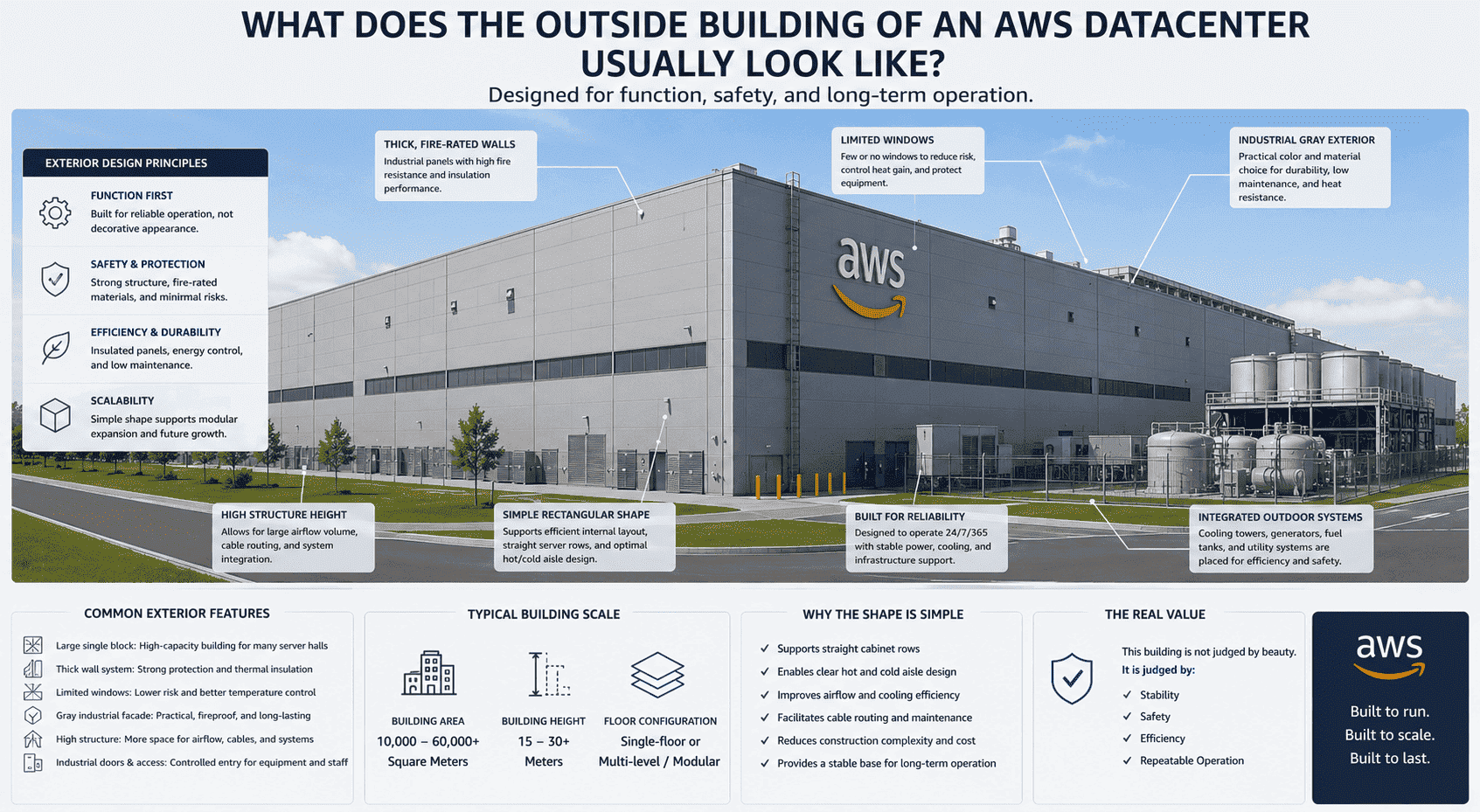
When I see the outside form of a hyperscale datacenter, I usually find that the design is not decorative. The building form is direct. The walls are strong. The height is larger than many normal workshops. The building area can reach thousands or even tens of thousands of square meters.4 Some buildings are single-floor structures. Some buildings use double-floor or modular layers, based on land, power, cooling, and local construction rules.
I pay special attention to the wall system. Many such buildings use industrial gray fireproof and insulated panels. This choice is practical. The wall must help temperature control. It must also support fire safety. It must resist weather. It must reduce maintenance cost. The outer face may look plain, but it serves many serious needs.
The square or rectangular shape also has clear value. It makes internal layout easier. It supports straight cabinet rows. It supports clear hot and cold aisle design. It supports cable routing and equipment movement. I have learned this same rule in cabinet production. A simple shape is often the best base for high precision.
| Outside feature | My simple reading | Operational value |
|---|---|---|
| Large single block | High capacity | It supports many server halls |
| Thick wall | Strong protection | It improves safety and insulation |
| Limited windows | Lower risk | It protects equipment and heat control |
| Gray industrial face | Practical design | It fits fireproof building panels |
| High structure | Better space | It supports airflow, cable, and systems |
I do not judge this building by beauty. I judge it by stability, safety, and repeatable operation.
How are the internal zones of an AWS datacenter arranged?
A datacenter may look like one large room from imagination. This idea is wrong, because real cloud operation needs many separated zones with clear functions.
An AWS datacenter is usually divided into server room areas, power and auxiliary areas, network and cable areas, cooling areas, security areas, and monitoring rooms.5 Each zone has a clear role, and each movement path is controlled.
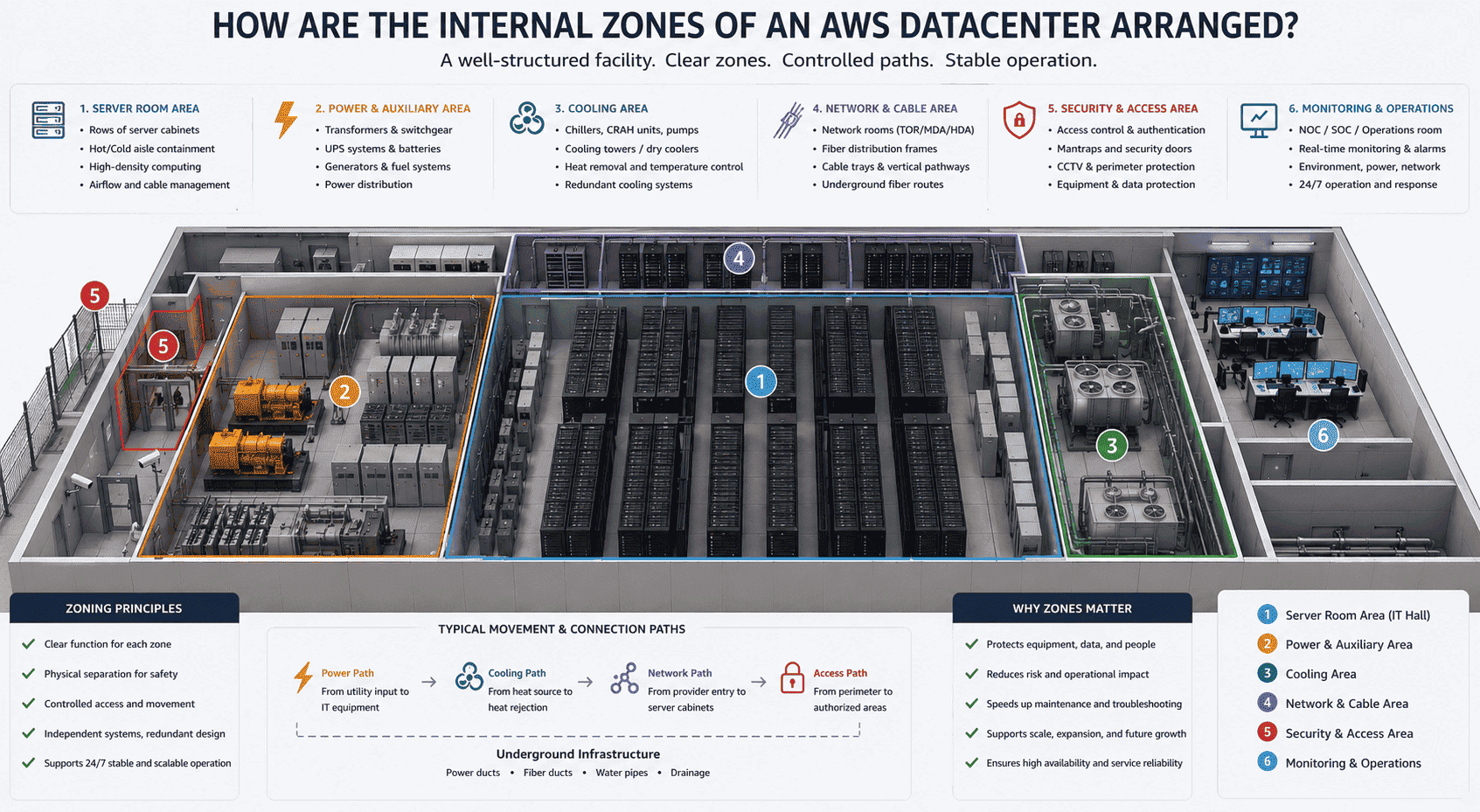
Inside a large cloud datacenter, I expect strong zoning. I do not expect random placement. The equipment room area is the main heart. It holds rows of server cabinets and network cabinets. The power auxiliary area supports the load with transformers, UPS systems, switchgear, generators, and distribution systems6. The cooling area handles heat removal. The monitoring room watches security, environment, power, network, and alarms.
Cabling is also a key part of the internal structure. Many campuses use underground cable routes and fiber routes to connect buildings. Inside the building, cables need fixed paths, marked routes, and protected channels.7 This is not only for neatness. It is also for safety, repair speed, and fault control.
As a cabinet factory, I care about how zoning affects cabinet design. A cabinet in a cloud datacenter is not an empty metal box. It must match the room airflow, floor load, cable entry, grounding, static control, and maintenance space. If the zone plan is wrong, even a good cabinet cannot work well.
| Internal zone | What I usually expect | What the zone protects |
|---|---|---|
| Server hall | Dense cabinet rows | Computing and storage capacity |
| Power area | Stable energy flow | Uptime and load safety |
| Cooling area | Heat removal systems | Temperature and hardware life |
| Cable area | Fiber and power routing | Network stability and repair speed |
| Monitoring room | Real-time control | Security and fast response |
I see the internal zoning as the skeleton of the whole datacenter. The cabinets, cables, and servers are placed on this skeleton.
What do the server rooms and cabinet rows look like inside?
Some buyers only ask about servers. I always remind them that servers cannot work well without correct cabinet rows, airflow, grounding, and floor design.
Inside an AWS-style server hall, I expect long rows of unified cabinets. The cabinets often face each other in cold aisles and back each other in hot aisles.8 The room uses strict spacing, anti-static flooring, controlled airflow, and clear cable routes.
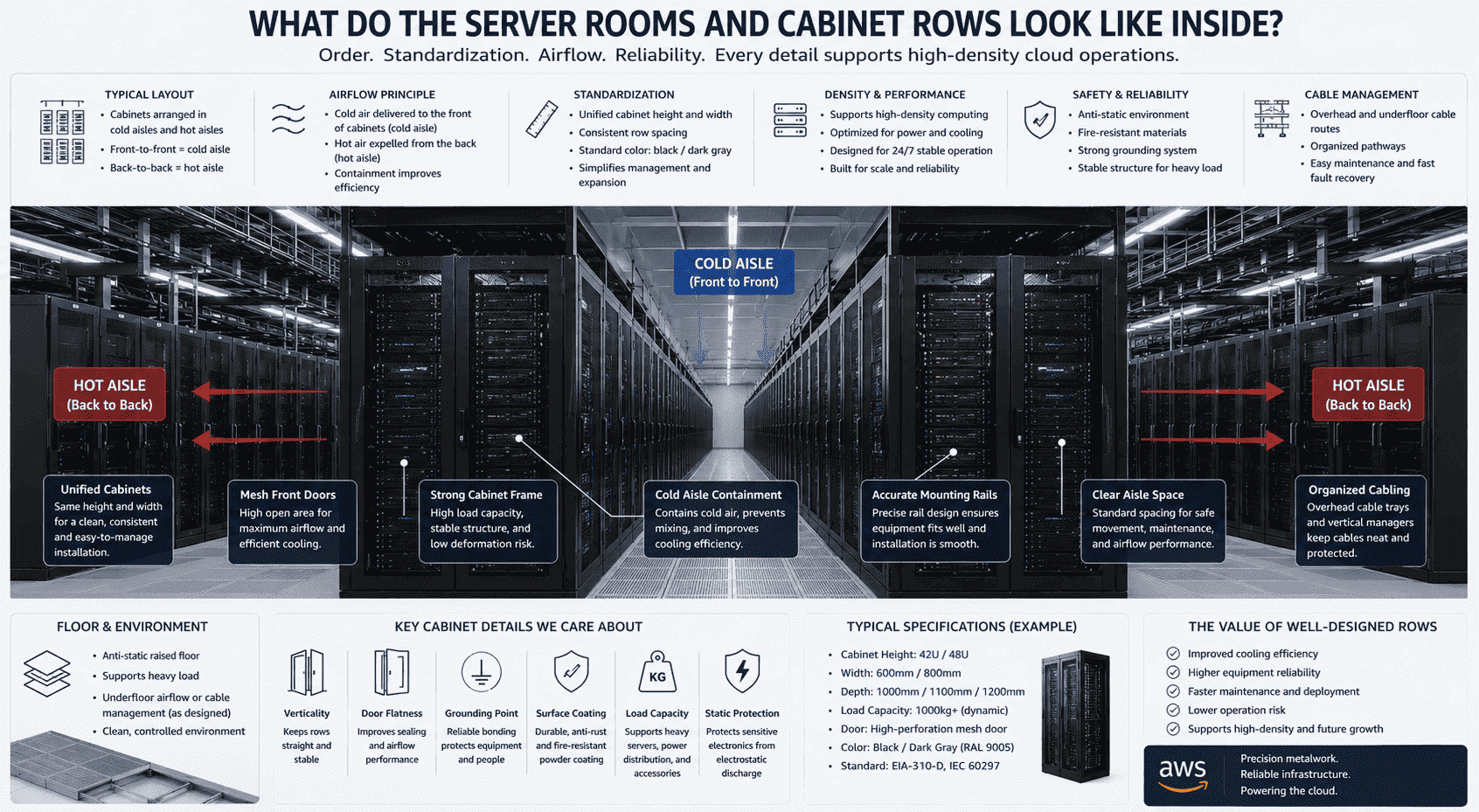
The most direct visual feature inside a hyperscale server room is order. Cabinet height is unified. Cabinet color is often black or dark gray. Rows are straight. The aisles are clear. The front of one cabinet row faces the front of another row. This creates a cold aisle. The back of one row faces the back of another row. This creates a hot aisle. The layout helps cooling air move in a controlled way.
I have produced many network cabinets and server cabinets for global customers. I know that small differences can become big problems in a high-density room. Cabinet verticality, door flatness, frame strength, rail accuracy, grounding point, mesh door open area, and surface coating all affect the final use. In a normal office server room, people may accept small variation. In a hyperscale cloud datacenter, standardization must be much stricter.
Anti-static flooring is also very important.9 The floor must support equipment movement and load. It must help cable or air management when the design needs it. The cabinet base must align with the floor plan. The cabinet must support heavy servers. It must resist dust. It must support electromagnetic protection needs. It must meet fire safety expectations.
| Cabinet detail | Why I care | Result in the server hall |
|---|---|---|
| Unified height | It keeps rows consistent | It improves airflow and management |
| Mesh doors | They support air movement | They help high-density cooling |
| Strong frame | It carries heavy servers | It reduces deformation risk |
| Accurate rails | They fit equipment well | They reduce installation trouble |
| Static protection | It protects electronics | It reduces hidden damage |
| Fire-resistant surface | It improves safety | It supports long-term use |
When I look at these cabinet rows, I see precision metalwork supporting invisible cloud services.
Why does AWS use so much standardization in hardware and layout?
Some projects fail because every room uses a different design. I have seen this problem often, and I know it makes delivery, repair, and expansion harder.
AWS uses high standardization because cloud infrastructure must scale fast and operate safely. Standard cabinets, server layouts, network equipment, cooling patterns, and operation rules reduce mistakes, improve repair speed, and support massive computing growth.
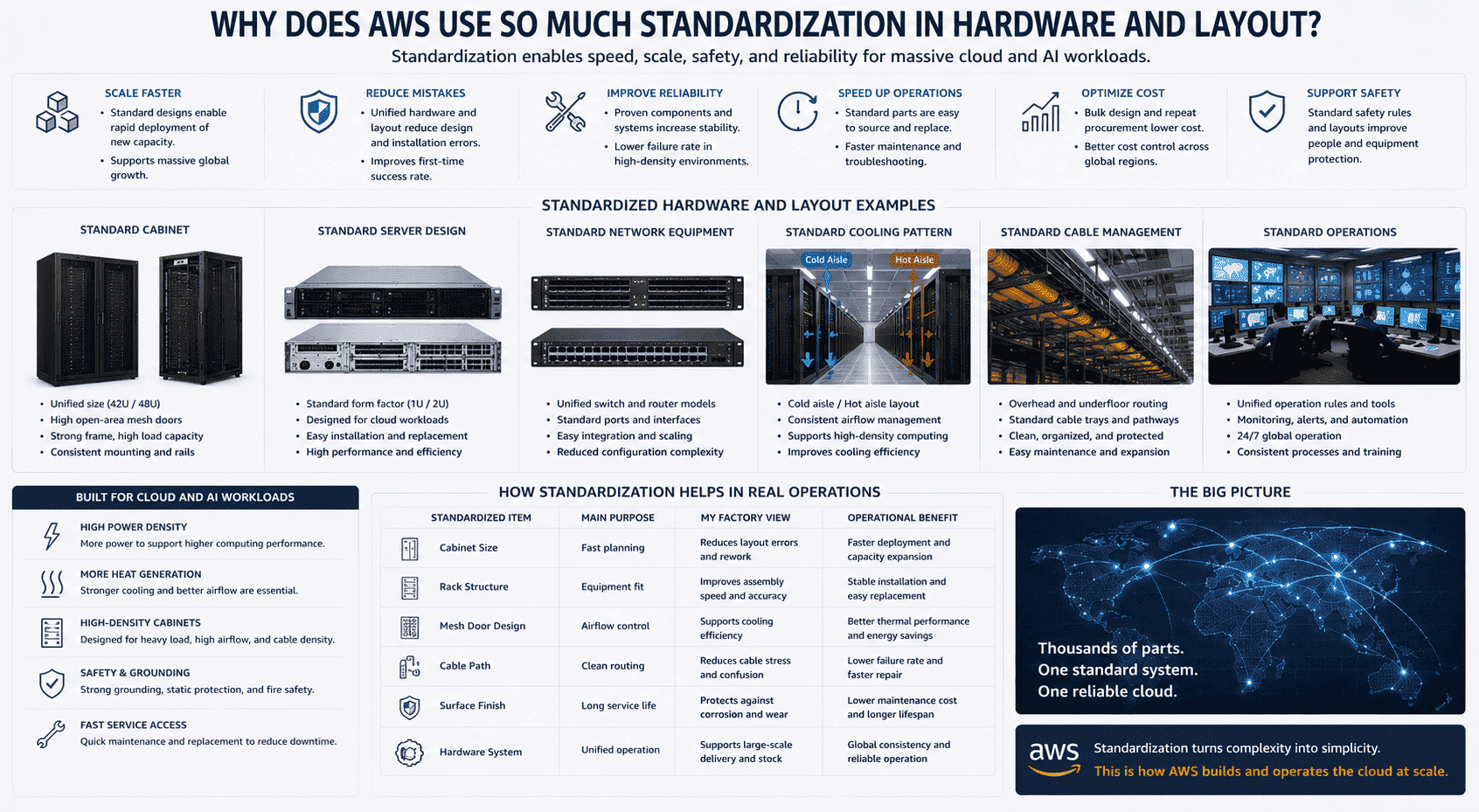
AWS is known for deep control over its infrastructure.10 Its datacenter hardware is not only bought and placed. It is designed, tested, and improved for cloud workloads. The cabinets, servers, network equipment, and internal systems must fit the same operating logic. This level of standardization supports huge scale.
I understand this clearly because my factory also works with standard and non-standard cabinet orders. Standard products give speed and stable cost. Custom products solve special problems. A hyperscale datacenter needs both ideas, but it must still keep a unified system. Even when the hardware is customized, the final form must still support repeat production.
Cloud and AI workloads increase power density.11 More power means more heat. More heat means stronger cooling and better airflow. A cabinet for this environment must not only look strong. It must be strong in load-bearing. It must have high open-area mesh doors. It must support cable density. It must support grounding and safety. It must allow service teams to work quickly.
| Standardized item | Main purpose | My factory view |
|---|---|---|
| Cabinet size | Fast planning | It reduces layout errors |
| Rack structure | Equipment fit | It improves assembly speed |
| Mesh door design | Airflow control | It supports cooling efficiency |
| Cable path | Clean routing | It reduces repair time |
| Surface finish | Long service life | It protects against corrosion |
| Hardware system | Unified operation | It supports large-scale delivery |
I see AWS standardization as a way to turn thousands of parts into one reliable system.
How does cooling shape the look of an AWS datacenter?
Many people only see the building and the cabinets. I see heat first, because heat decides the space, airflow, aisle layout, and many hardware details.
Cooling shapes an AWS datacenter through hot and cold aisle design, large air handling systems, controlled airflow paths, sealed zones, and cabinet door structures. The whole room layout is built to remove heat from dense server equipment.
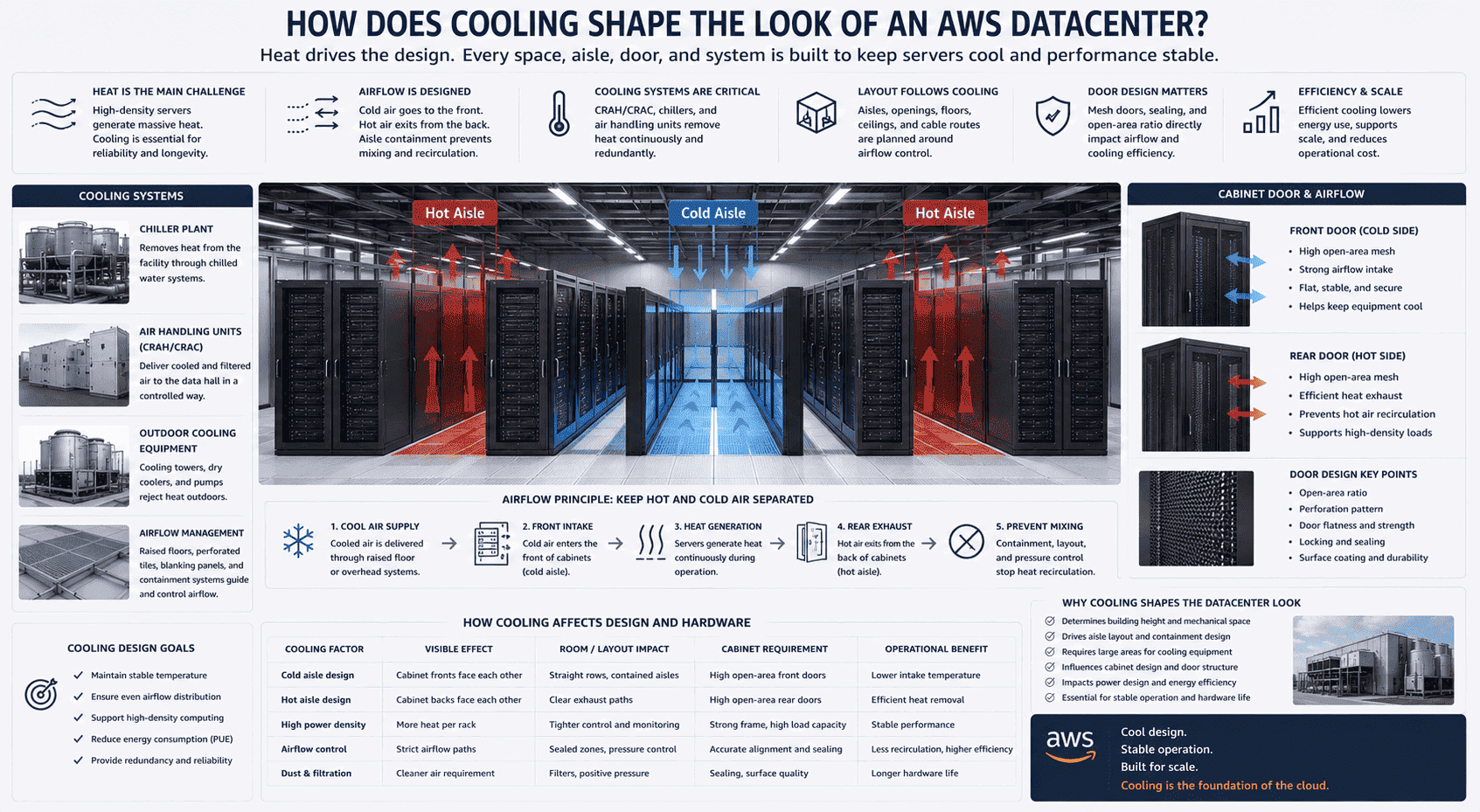
Cloud computing creates heat every second. AI computing creates even more heat. A datacenter must move this heat away in a stable way. This is why the room layout looks so strict. The cabinet fronts face cold air. The cabinet backs release hot air. The room must stop hot air and cold air from mixing too much. If hot air returns to the server intake, equipment temperature rises.12 If airflow is blocked, hardware life becomes shorter.
The cabinet door design matters more than many people think. A high-quality mesh door allows enough airflow. The perforation pattern, open area ratio, flatness, strength, and locking design all matter. If the mesh is weak, the door may deform. If the open area is too low, airflow suffers. If the surface coating is poor, corrosion and dust become long-term risks.
Cooling also affects building shape. High floors can help air movement and equipment routing. Large mechanical zones are needed for cooling equipment. Outdoor equipment may also need space. This is why AWS-style campuses look large, open, and industrial.
| Cooling factor | Visible effect | Cabinet requirement |
|---|---|---|
| Cold aisle | Cabinet fronts face each other | Front doors must pass air well |
| Hot aisle | Cabinet backs face each other | Rear doors must release heat |
| High power density | More heat per rack | Frame must carry heavy equipment |
| Air control | Strict room layout | Cabinets must align accurately |
| Dust control | Closed management | Surface and sealing must be stable |
I often say that a datacenter is not only a server room. It is also a heat control machine.
What makes an AWS datacenter different from a normal server room?
A normal server room may support one company. An AWS datacenter supports massive cloud services, so the scale, discipline, and engineering depth are very different.
An AWS datacenter differs from a normal server room in scale, security, power design, cooling design, hardware standardization, automation, cabinet density, and operation rules. It is a complete digital infrastructure system, not just a room with racks.
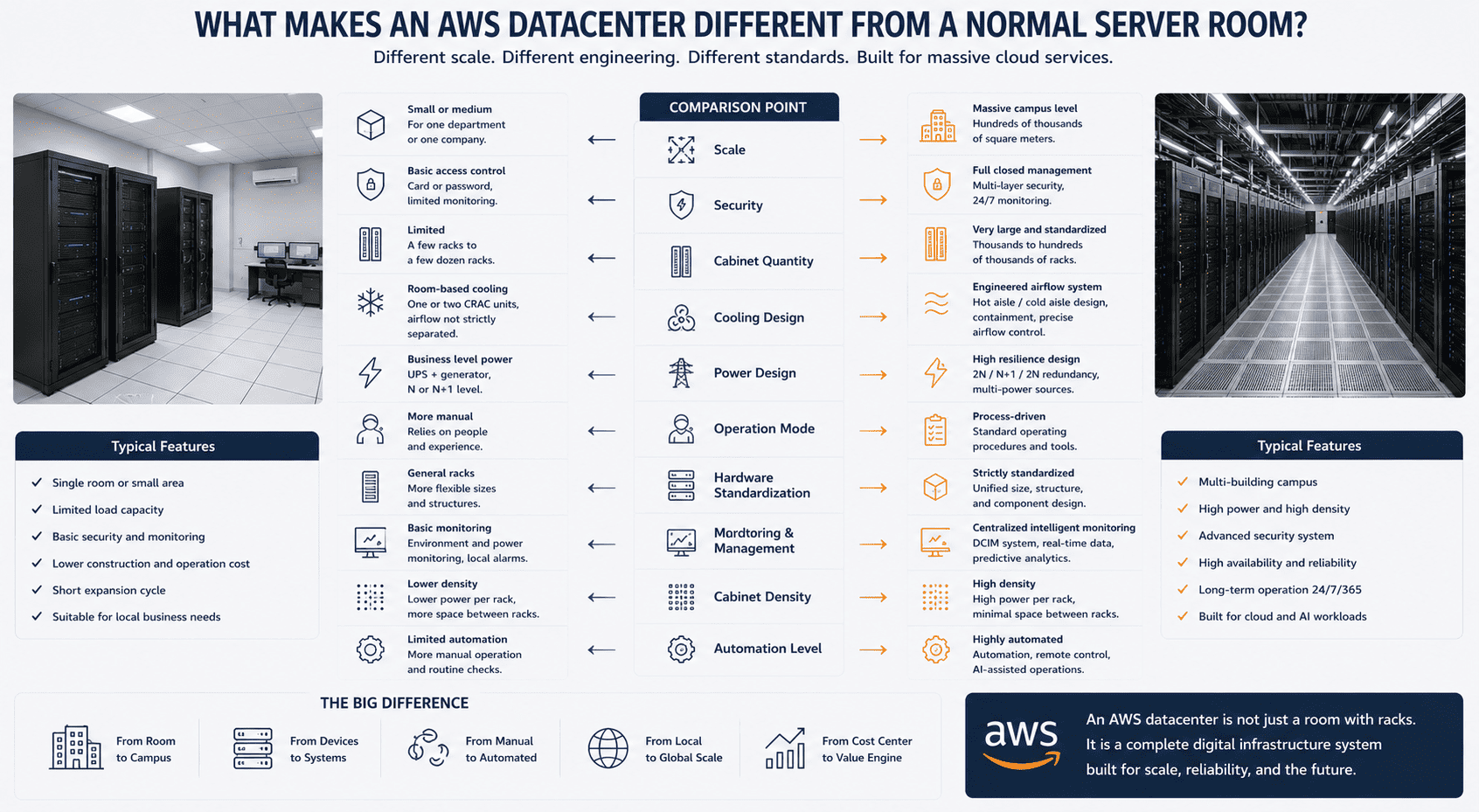
I have seen many customers compare cloud datacenters with ordinary equipment rooms. I always explain the gap in simple terms. A normal server room may use several cabinets, one cooling system, one access door, and basic monitoring. A hyperscale datacenter uses campus planning, high-power systems, full security layers, modular rooms, large cooling design, strict cabinet standards, and nonstop operation.
The difference also appears in management. A normal room may allow many manual decisions. A hyperscale facility needs fixed process. Every cable path, cabinet position, airflow direction, and maintenance route must have a reason. The staff cannot rely only on personal experience. The whole system must guide the operation.
From a manufacturing view, the difference is also clear. A normal rack can be more flexible. A hyperscale rack must be repeatable, strong, and precise. A small batch can tolerate more adjustment. A large batch cannot. If one dimension is wrong, hundreds or thousands of cabinets may face the same issue. This is why source quality control is so important.
| Comparison point | Normal server room | AWS-style datacenter |
|---|---|---|
| Scale | Small or medium | Massive campus level |
| Security | Basic access control | Full closed management |
| Cabinet quantity | Limited | Very large and standardized |
| Cooling | Room-based | Engineered airflow system |
| Power | Business level | High resilience design |
| Operation | More manual | Process-driven and monitored |
I think this difference explains why AWS datacenters look plain but feel powerful.
Why should cabinet buyers care about AWS datacenter design?
Some buyers think AWS design is too large to learn from. I disagree, because even small projects can copy its useful logic.
Cabinet buyers should care because AWS datacenter design shows the value of standard size, strong structure, airflow planning, cable management, static protection, fire safety, and controlled production. These rules also help normal data rooms and custom cabinet projects.
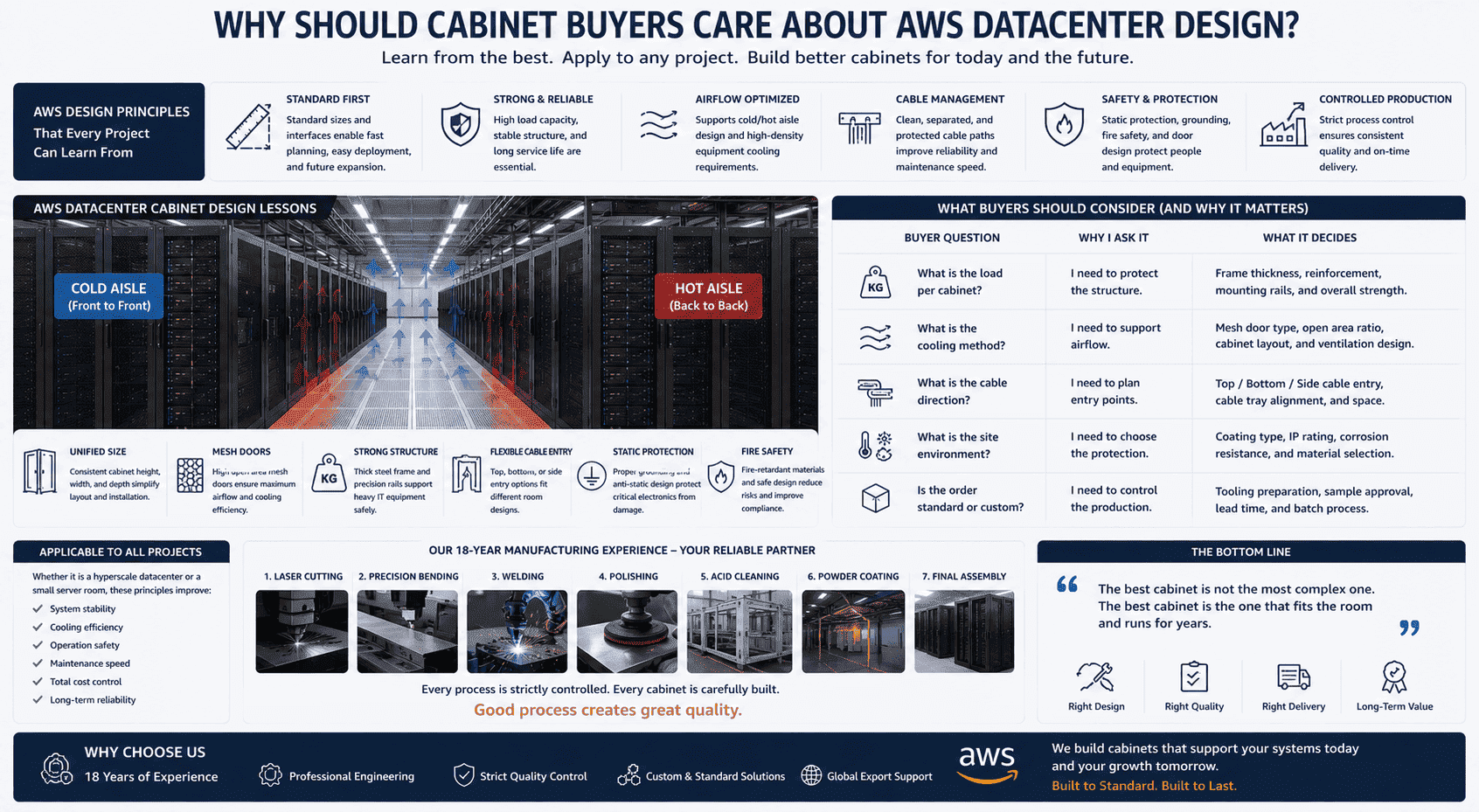
I use AWS-style datacenter thinking when I discuss cabinet projects with overseas customers. I ask about load first. I ask about cooling next. I ask about cable entry, grounding, door type, surface finish, installation site, and delivery quantity. These questions are not formal questions. They decide whether the final cabinet will work in the real room.
A good cabinet must match the environment. If the room uses cold and hot aisles, the door open area must support airflow. If the equipment is heavy, the frame and mounting rails must carry the load. If the room has strict safety rules, the coating, grounding, and material choice must be controlled. If the project is custom, the drawing and sample must be checked carefully before batch production.
My factory has 18 years of sheet metal cabinet manufacturing experience. I trust process control because I have seen what happens when process control is weak. Laser cutting, precise bending, welding, polishing, acid cleaning, powder coating, and final assembly must connect smoothly. One weak step can damage the whole cabinet.
| Buyer question | Why I ask it | What it decides |
|---|---|---|
| What is the load per cabinet? | I need to protect structure | Frame thickness and reinforcement |
| What is the cooling method? | I need to support airflow | Mesh door and layout design |
| What is the cable direction? | I need to plan entry points | Top, bottom, or side cable paths |
| What is the site environment? | I need to choose protection | Coating, sealing, and material |
| Is the order standard or custom? | I need to control production | Tooling, sample, and batch process |
I believe that the best cabinet is not the most complex one. The best cabinet is the one that fits the room and runs for years.
Conclusion
I see an AWS datacenter as an industrial, standardized, secure, and intelligent digital base, where buildings, power, cooling, cabinets, and operations work as one system.
"[PDF] The NIST Definition of Cloud Computing", https://nvlpubs.nist.gov/nistpubs/legacy/sp/nistspecialpublication800-145.pdf. Government or national-laboratory guidance on data centers supports the point that cloud services depend on physical facilities with engineered power, cooling, hardware, and operational controls; this contextual evidence does not verify the specific configuration of any individual AWS site. Evidence role: general_support; source type: government. Supports: A neutral government or national-lab source should support that cloud services run on physical data centers requiring power, cooling, hardware, and operational controls.. Scope note: Contextual support for cloud data centers generally, not direct proof of one AWS facility. ↩
"AWS Data Center Security: The Ultimate Guide to Protecting Your ...", https://imba.missouri.edu/aws-data-center-security-0954737863.html. AWS documentation on data-center physical and environmental controls supports the claim that its facilities use layered physical security and controlled access; because the source is from AWS, it is direct but not independent evidence of the facilities’ external appearance. Evidence role: case_reference; source type: institution. Supports: An AWS infrastructure or security source should support that AWS data centers use layered physical security and controlled facility access.. Scope note: Direct AWS source, but not an independent visual survey. ↩
"Availability Zones - AWS Fault Isolation Boundaries", https://docs.aws.amazon.com/whitepapers/latest/aws-fault-isolation-boundaries/availability-zones.html. AWS documentation states that an Availability Zone consists of one or more discrete data centers with independent power, networking, and connectivity, which supports the article’s discussion of grouped but separated AWS data-center infrastructure; it does not prove that every AWS campus has the same building arrangement. Evidence role: case_reference; source type: institution. Supports: AWS documentation should support that Availability Zones consist of one or more discrete data centers with independent infrastructure.. Scope note: Supports AWS infrastructure grouping, not the layout of every campus. ↩
"Data Centers and Their Energy Consumption - Congress.gov", https://www.congress.gov/crs-product/R48646. Research or institutional reporting on hyperscale data centers can document that large facilities may occupy thousands to tens of thousands of square meters, supporting the scale estimate; the evidence is contextual unless it reports measurements for the specific AWS facility being described. Evidence role: statistic; source type: research. Supports: A research or institutional source should document typical size ranges or examples of hyperscale data center floor areas.. Scope note: Contextual size evidence for hyperscale data centers, not necessarily AWS-specific. ↩
"Data Center and Server Room Standards", https://services.ku.edu/TDClient/818/Portal/KB/ArticleDet?ID=21009. Data-center design standards such as TIA-942 or BICSI guidance describe distinct functional spaces for IT equipment, power, cooling, cabling, and operations, supporting the zoning concept; such standards provide a general design framework rather than a verified AWS floor plan. Evidence role: definition; source type: institution. Supports: A recognized data center design standard should support the idea that data centers are organized into distinct equipment, power, cooling, cabling, and operations areas.. Scope note: General standards support zoning; they do not disclose AWS internal layouts. ↩
"[PDF] 2024 United States Data Center Energy Usage Report", https://eta-publications.lbl.gov/sites/default/files/2024-12/lbnl-2024-united-states-data-center-energy-usage-report.pdf?utm_source=substack&utm_medium=email. Engineering guidance from a government or national-laboratory source supports that data centers commonly use transformers, UPS equipment, switchgear, generators, and distribution systems to deliver and maintain electrical power; this is general infrastructure evidence rather than confirmation of a specific AWS equipment list. Evidence role: mechanism; source type: government. Supports: A government or national-lab engineering source should explain the role of UPS, generators, switchgear, transformers, and distribution in data center power continuity.. Scope note: General data center power-system support, not site-specific AWS disclosure. ↩
"Cabling a Data Center to TIA-942 Standard - Fosco Connect", https://www.fiberoptics4sale.com/blogs/archive-posts/95047686-cabling-a-data-center-to-tia-942-standard?srsltid=AfmBOopEG7tbvmGkMbtzYzznANL4abEw1AikuBdoVKUVexpm_wtBr5NV. Telecommunications and data-center cabling standards support the use of planned pathways, labeling, and protected routing for maintainability and risk reduction; the evidence is normative guidance and does not prove that every AWS building uses the exact routing described. Evidence role: expert_consensus; source type: institution. Supports: A cabling or data center standard should support planned pathways, labeling, and cable protection as accepted infrastructure practices.. Scope note: Standards-based support, not an AWS-specific installation record. ↩
"Move to a Hot Aisle/Cold Aisle Layout | ENERGY STAR", https://www.energystar.gov/products/data_center_equipment/16-more-ways-cut-energy-waste-data-center/move-hot-aislecold-aisle-layout. Data-center best-practice guidance from Lawrence Berkeley National Laboratory and related engineering sources describes hot-aisle/cold-aisle rack orientation as a standard airflow-management method, supporting the layout explanation; this does not demonstrate that a particular AWS room uses that exact arrangement. Evidence role: mechanism; source type: government. Supports: A government or engineering source should support that alternating rack fronts and backs creates cold and hot aisles for airflow management.. Scope note: General thermal-management support, not a confirmed AWS room plan. ↩
"[PDF] JSC-66552BASELINE.pdf - NASA Standards", https://standards.nasa.gov/sites/default/files/standards/JSC/Baseline/0/JSC-66552BASELINE.pdf. Electrostatic-discharge standards and technical guidance support that static-control measures help protect sensitive electronic equipment from ESD-related damage; the evidence supports the general need for static control but not the specific flooring specification of an AWS facility. Evidence role: mechanism; source type: institution. Supports: An ESD standards organization or government source should support that electrostatic discharge can damage electronics and that static-control measures reduce risk.. Scope note: General ESD mechanism, not AWS-specific flooring evidence. ↩
"AWS Nitro System", https://aws.amazon.com/ec2/nitro/. AWS technical documentation on systems such as Nitro and custom infrastructure supports the claim that AWS controls significant parts of its cloud infrastructure design and operation; because the evidence is primarily self-published, it should be treated as direct but not independent support. Evidence role: case_reference; source type: institution. Supports: A source should support that AWS designs or controls major parts of its infrastructure stack, such as custom hardware, networking, or virtualization systems.. Scope note: Direct AWS evidence, but self-published and not independently audited in the article. ↩
"Electricity Demand and Grid Impacts of AI Data Centers", https://arxiv.org/html/2509.07218v3. International energy and data-center research reports document that AI and other high-performance computing workloads can increase rack power density and cooling requirements, supporting the article’s trend claim; the evidence is sector-level and does not quantify power density for a specific AWS hall. Evidence role: statistic; source type: institution. Supports: An international energy institution or research source should support that AI and high-performance cloud workloads raise rack power density and cooling demand.. Scope note: Sector-level trend evidence, not AWS-specific measurement. ↩
"Raise the Temperature - Data Center Equipment - Energy Star", https://www.energystar.gov/products/data_center_equipment/5-simple-ways-avoid-energy-waste-your-data-center/raise-temperature. Data-center thermal-management research supports that recirculation of hot exhaust air into equipment inlets raises server intake temperatures and can reduce cooling effectiveness; this evidence explains the mechanism generally rather than proving conditions inside a specific AWS facility. Evidence role: mechanism; source type: research. Supports: A data center thermal-management source should support that exhaust-air recirculation increases server inlet temperature.. Scope note: General thermal mechanism, not a site-specific AWS measurement. ↩
