
What Does a High-Density Data Center Mean Today?
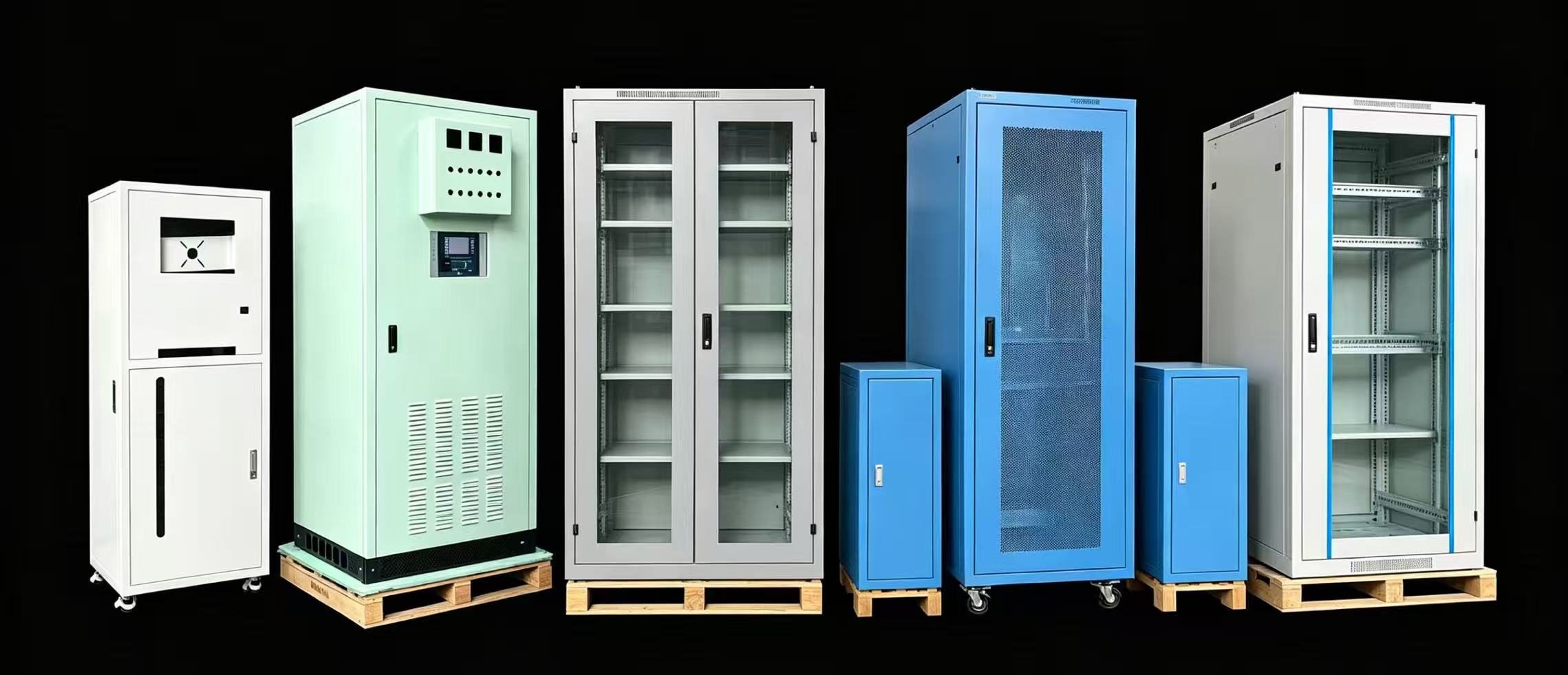
Many data centers look crowded, hot, and hard to control. I see wasted space become a risk when computing demand rises faster than infrastructure.
A high-density data center places more computing power, power load, and heat output into each rack space.1 I treat it as a precise system, where racks, airflow, power, load capacity, and safety standards must work together.
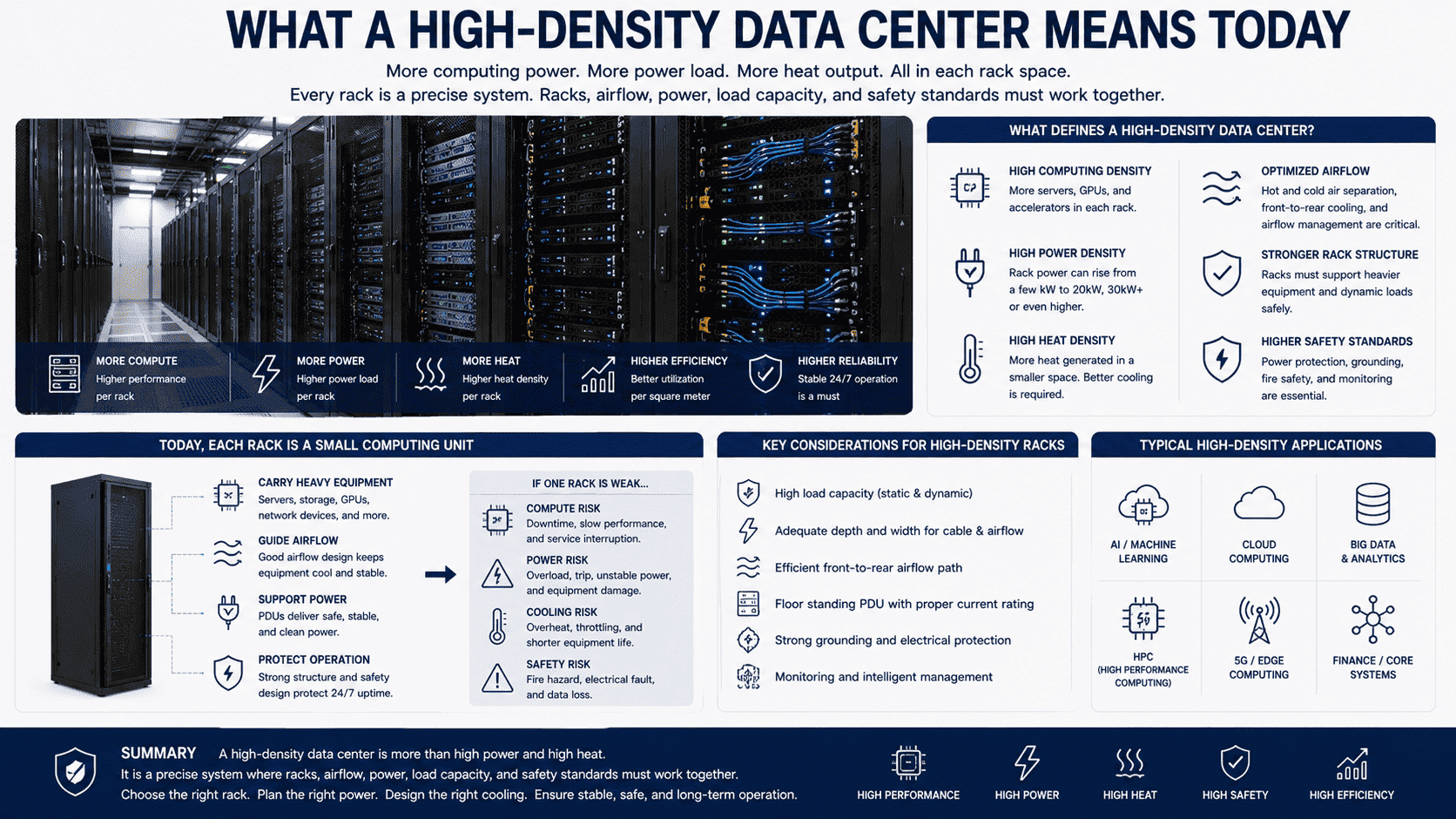
I used to see data center racks as metal frames for servers. I do not see them that way now. I see each rack as a small computing unit. It carries heavy equipment. It guides air. It supports power. It protects stable operation. If one rack is weak, the whole room feels the pressure.
Why Has Rack Density Become So Important?
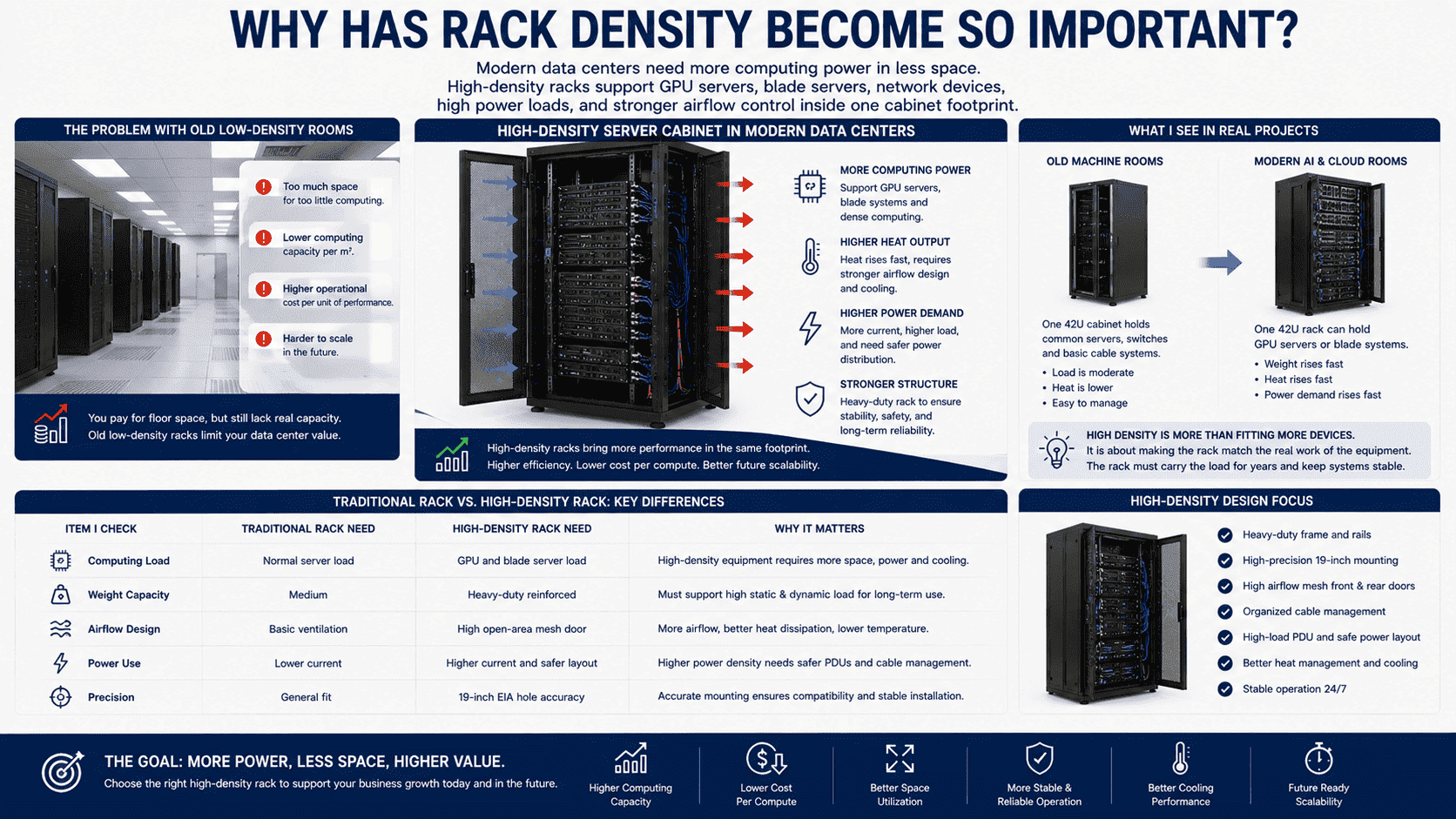
Old rooms lose value when they use too much space for too little computing. I have seen customers pay for floor area but still lack real capacity.
Rack density matters because modern data centers need more computing power in less space.2 I use high-density racks to support GPU servers, blade servers, network devices, high power loads, and stronger airflow control inside one cabinet footprint.
What I See in Real Projects
In older machine rooms, one 42U cabinet may hold common servers, switches, and basic cable systems. The load is not light, but it is still easy to manage. In modern AI rooms and cloud data centers, one 42U rack can hold GPU servers or blade systems. The weight rises fast. The heat rises fast. The power demand also rises fast.3 I have seen customers move from ordinary server racks to heavy-duty racks because their old cabinets started to shake, bend, or block airflow.
High density is not only about putting more devices into one rack. It is about making the rack match the real work of the equipment. The rack must carry the load for years. The mounting holes must line up with server rails. The front and rear doors must allow air to pass.4 The frame must stay square after shipping, installation, and long use.
| Item I Check | Traditional Rack Need | High-Density Rack Need |
|---|---|---|
| Computing load | Normal server load | GPU and blade server load |
| Weight capacity | Medium | Heavy-duty reinforced |
| Airflow | Basic ventilation | High open-area mesh door |
| Power use | Lower current | Higher current and safer layout |
| Precision | General fit | 19-inch EIA hole accuracy |
What Makes Heat Control So Hard in High-Density Rooms?
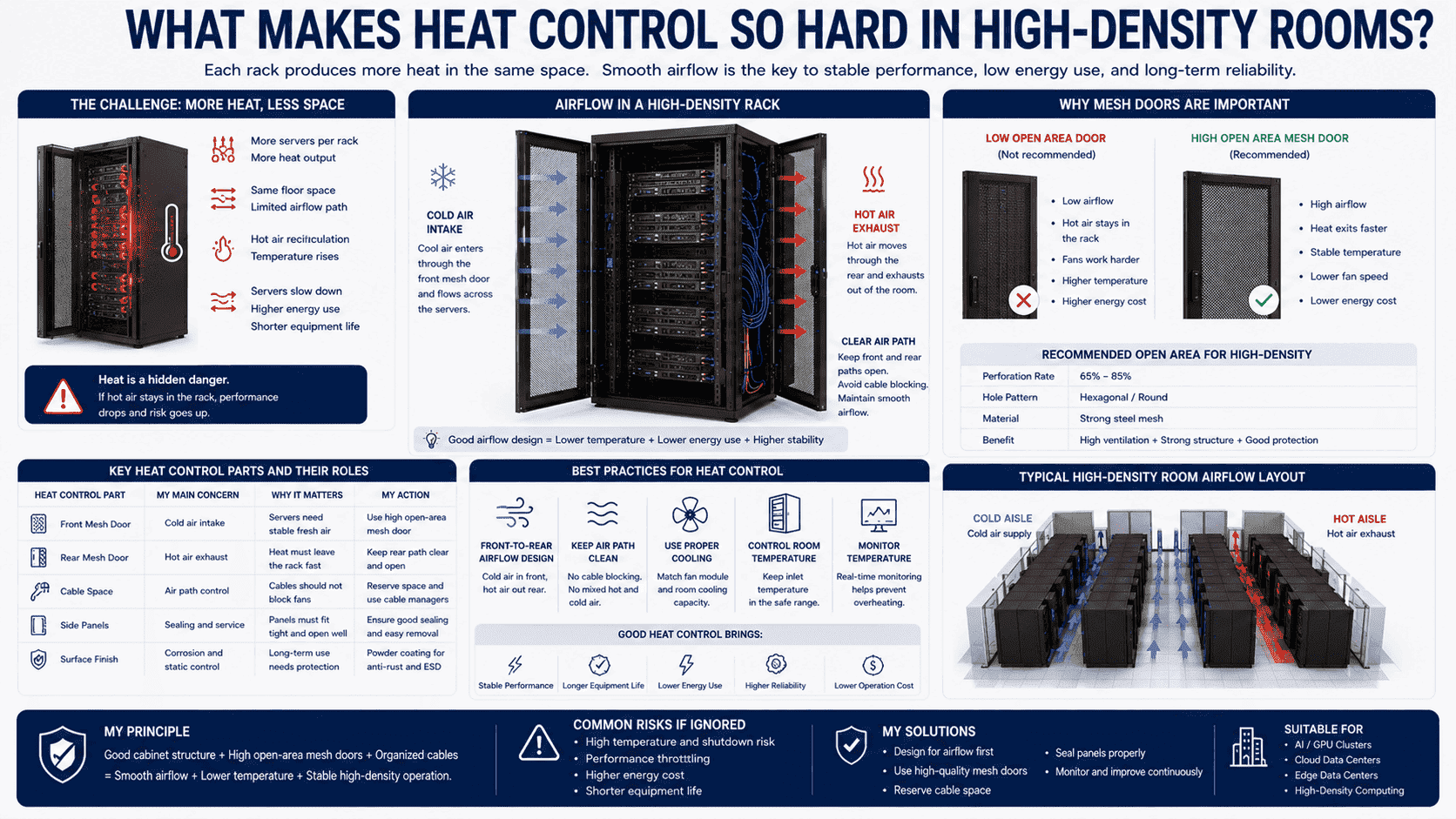
Heat becomes a hidden danger when the rack looks full but airflow is weak. I have seen powerful servers slow down because hot air stayed inside.
Heat control is hard because each rack produces more heat in the same space.5 I need the cabinet structure, mesh doors, cable layout, and room airflow to support smooth cold air intake and hot air exhaust.
Why I Pay Attention to Mesh Doors
When I produce network cabinets and server cabinets, I look at the door first if the project is high density. A closed or low-open-rate door can make a strong server rack behave like a hot box.6 The server fans try to pull air. The door blocks part of the air. The equipment becomes louder. The temperature rises. The energy use also rises because the cooling system works harder.
For high-density data centers, I prefer high-ventilation mesh front and rear doors. The mesh pattern must be strong enough to protect the cabinet. It also must offer enough open area for airflow. This sounds simple, but it is a detailed sheet metal process. If the hole pattern is weak, the door may bend. If the door is too heavy, daily operation becomes hard. If the surface treatment is poor, corrosion may appear in humid environments.
| Heat Control Part | My Main Concern | Why It Matters |
|---|---|---|
| Front mesh door | Cold air intake | Servers need stable fresh air |
| Rear mesh door | Hot air exhaust | Heat must leave the rack fast |
| Cable space | Air path control | Cables should not block fans |
| Side panels | Sealing and service | Panels must fit tight and open well |
| Surface finish | Corrosion and static control | Long-term use needs protection |
Why Is Rack Strength No Longer a Small Detail?
A weak rack may look fine when it is empty. I have seen real problems appear only after heavy servers were installed and moved.
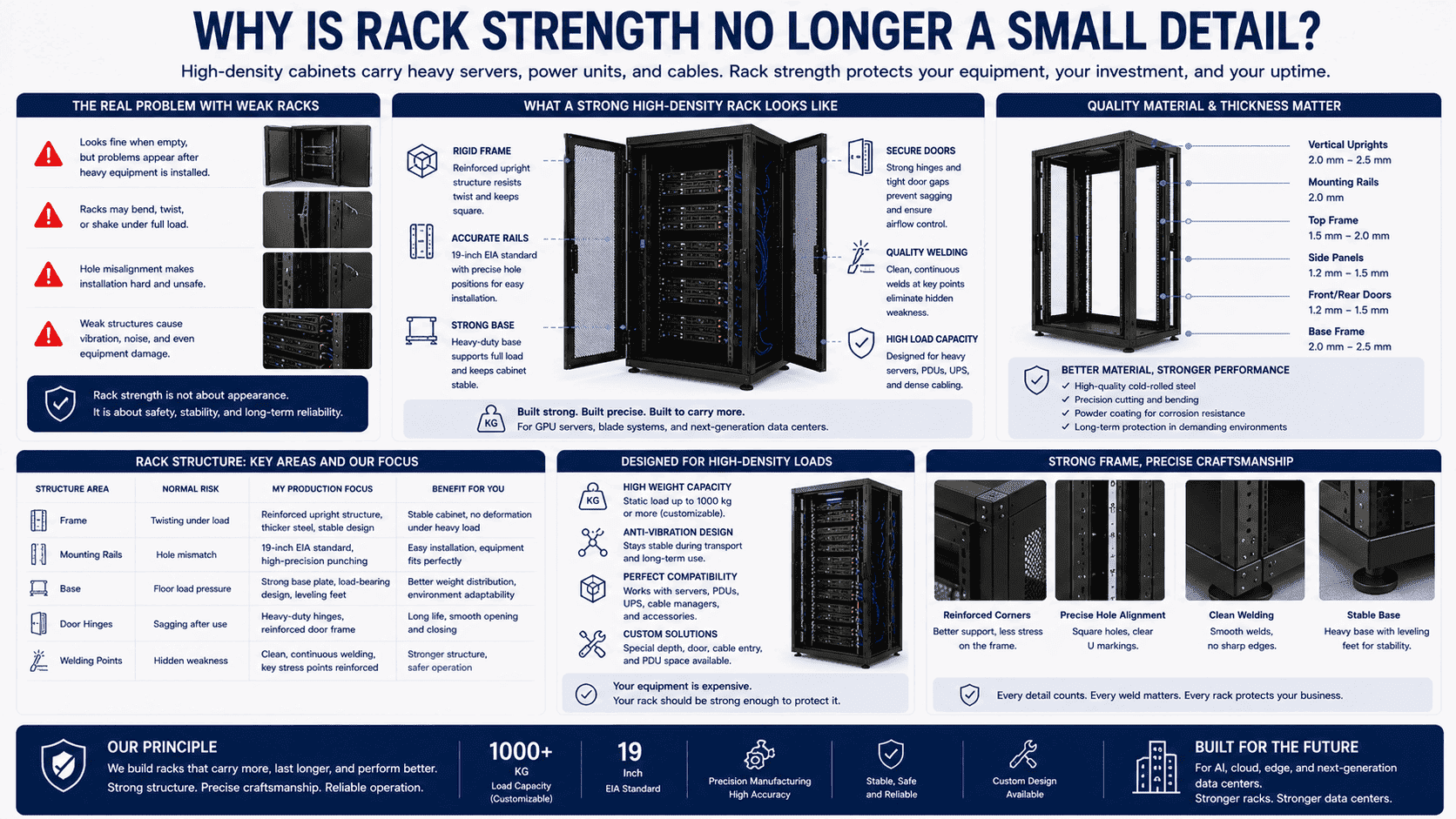
Rack strength matters because high-density cabinets carry heavy computing equipment, power units, and cables.7 I use reinforced frames, precise bending, stable welding, and proper material thickness to protect the full load.
How I Think About Load
I never judge a cabinet only by its appearance. A high-density data center cabinet must be tested by structure, not by paint. The cabinet frame should be rigid. The vertical mounting rails should be accurate. The base should support the full load. The top and bottom should not twist during transport. The cabinet should still keep its shape after many servers are mounted.
In my factory, I often explain this point to customers who buy custom cabinets. A non-standard cabinet may need special depth, special door design, special cable entry, or special PDU space. These changes can affect strength. A deeper cabinet may need stronger side support. A cabinet with large mesh doors may need a better hinge design. A cabinet for GPU servers may need heavier mounting rails and stronger corner posts.
| Structure Area | Normal Risk | My Production Focus |
|---|---|---|
| Frame | Twisting under load | Reinforced upright structure |
| Mounting rails | Hole mismatch | Precise 19-inch EIA positions |
| Base | Floor load pressure | Strong base and stable leveling |
| Door hinges | Sagging after use | Strong hinge and stable door gap |
| Welding points | Hidden weakness | Clean and controlled welding |
What Role Does Power Distribution Play in High-Density Cabinets?
Power becomes a serious limit when computing demand grows. I have seen racks that had space left, but no safe power capacity left.
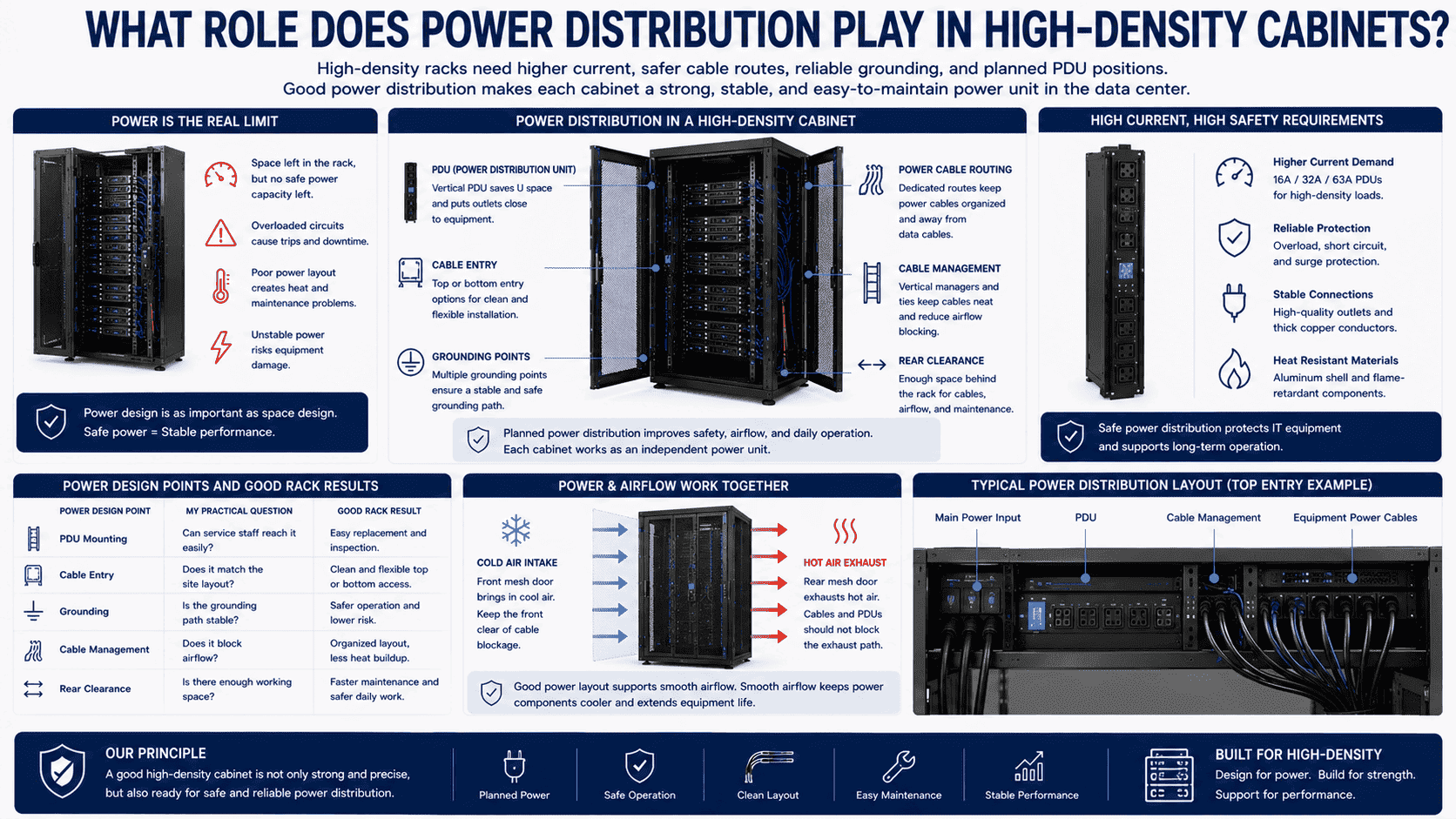
Power distribution matters because high-density racks need higher current, safer cable routes, reliable grounding, and planned PDU positions. I see each cabinet as an independent power unit inside the data center.
Why I Treat Power Space as Cabinet Space
A high-density cabinet is not useful if it only fits servers. It must also fit the power system that supports those servers. I always ask about PDU position, cable entry, grounding points, rear space, and service access. If these details are ignored, the rack becomes hard to maintain. A technician may need to reach behind hot servers. Power cables may block exhaust air.8 The cabinet may look clean at first, but daily operation becomes messy.
In modern data centers, one cabinet may carry a much higher electrical load than before. This means the rack structure must help the power system stay organized. Cable managers should separate power cables and data cables where possible. Grounding must be stable.9 The cabinet must not deform near PDU mounting positions. The surface coating should also help reduce static risk.
| Power Design Point | My Practical Question | Good Rack Result |
|---|---|---|
| PDU mounting | Can service staff reach it? | Easy replacement and inspection |
| Cable entry | Does it match site layout? | Clean top or bottom access |
| Grounding | Is the path stable? | Safer operation |
| Cable management | Does it block airflow? | Less heat buildup |
| Rear clearance | Is there enough working space? | Faster maintenance |
Why Does Precision Matter More Than Before?
A small hole error can become a big site delay. I have seen racks fail inspection because equipment rails did not fit smoothly.
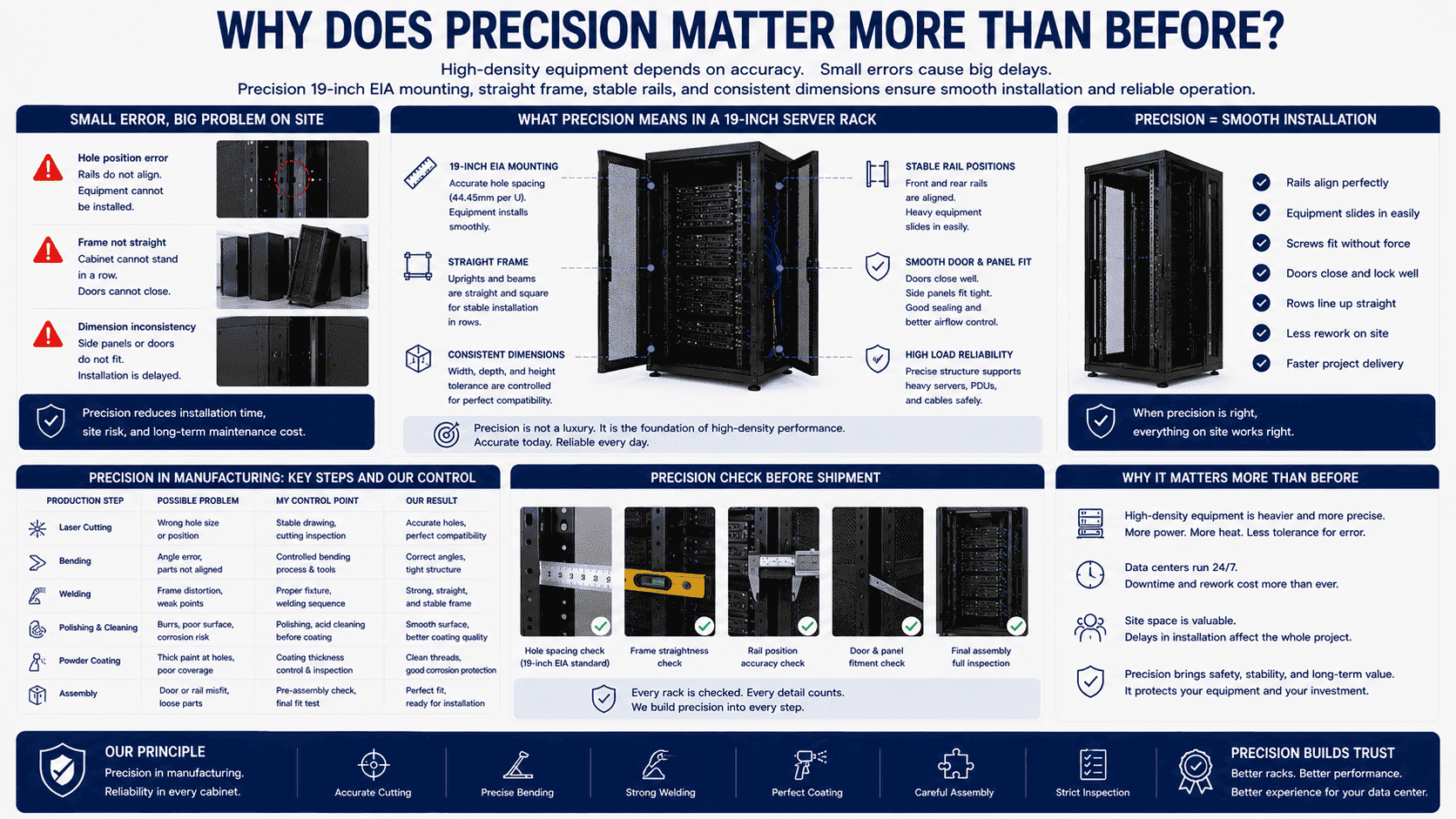
Precision matters because high-density equipment depends on accurate 19-inch EIA mounting10, straight frames, stable rail positions, and consistent cabinet dimensions. I use precise cutting, bending, welding, and assembly control to reduce installation risk.
What Precision Means in Daily Manufacturing
Precision sounds like a factory word, but it becomes a site word very fast. When the cabinet reaches the data center, technicians expect equipment to slide in and lock without force. They expect rails to align. They expect doors to close. They expect side panels to fit. They expect the cabinet to stand straight in rows. If the rack is inaccurate, the data center loses time during installation.
I pay close attention to laser cutting, bending angles, welding control, polishing, acid cleaning, powder coating, and final assembly. Each step affects the final cabinet. If the bending angle is wrong, the frame may not align. If welding pulls the metal, the door gap may change. If coating is too thick near mounting holes, the equipment screws may not fit well. Real high-density production is not only about stronger steel. It is also about repeatable accuracy.
| Production Step | Possible Problem | My Control Point |
|---|---|---|
| Laser cutting | Wrong hole size | Stable drawing and cutting check |
| Bending | Angle error | Controlled bending process |
| Welding | Frame distortion | Proper fixture and sequence |
| Powder coating | Thick paint at holes | Coating control and inspection |
| Assembly | Door or rail misfit | Final fit test before packing |
How Does High Density Change the Meaning of Custom Cabinets?
Standard cabinets cannot solve every site problem. I have seen overseas customers ask for special depth, special doors, and special load designs.
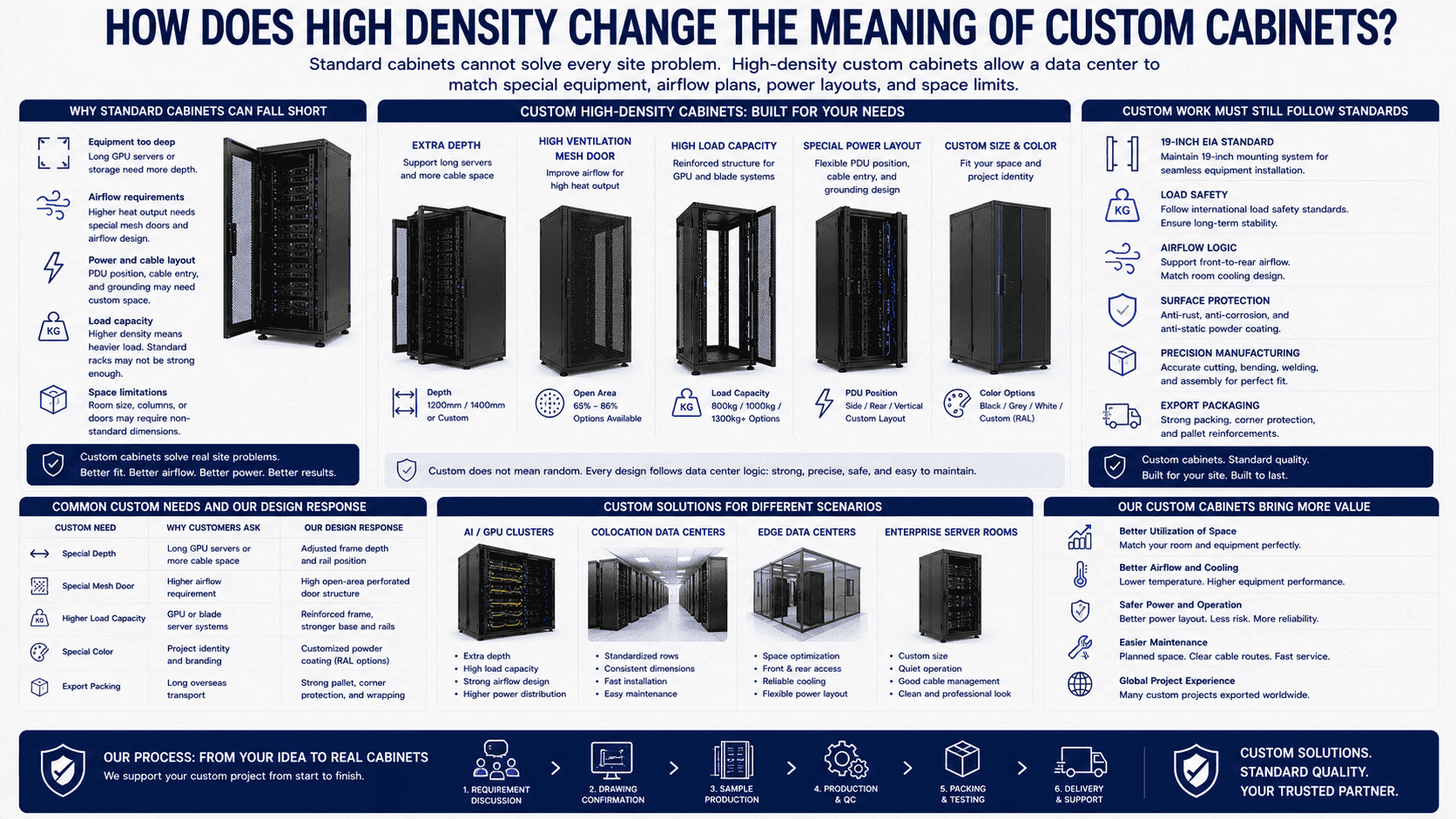
High-density custom cabinets allow a data center to match special equipment, airflow plans, power layouts, and space limits. I build non-standard cabinets when standard racks cannot meet load, cooling, size, or installation needs.
Why Custom Work Must Still Follow Standards
Custom does not mean random. This is one lesson I have learned from many non-standard cabinet projects. A custom high-density cabinet still needs clear standards. It still needs a 19-inch equipment mounting system if it supports rack servers. It still needs load safety. It still needs airflow logic. It still needs surface protection. It still needs packaging that protects the cabinet during long overseas shipping.
Some customers need special mesh doors for better ventilation. Some need extra depth for long GPU servers. Some need a wider cable channel. Some need stronger pallets and corner protection for export. Some need cabinet rows that match a colocation room layout. I can adjust these designs, but I always keep the basic data center logic. The cabinet must be strong, precise, safe, and easy to maintain.
| Custom Need | Why Customers Ask | My Design Response |
|---|---|---|
| Special depth | Long servers or cable space | Adjusted frame and rail position |
| Special mesh door | Higher airflow need | Strong perforated door structure |
| Higher load | GPU or blade systems | Reinforced frame and base |
| Special color | Project identity | Controlled powder coating |
| Export packing | Long transport | Strong packing and protection |
Why Is High Density Also About Energy Saving?
More power does not always mean better design. I have seen energy waste come from poor airflow and weak cabinet planning.
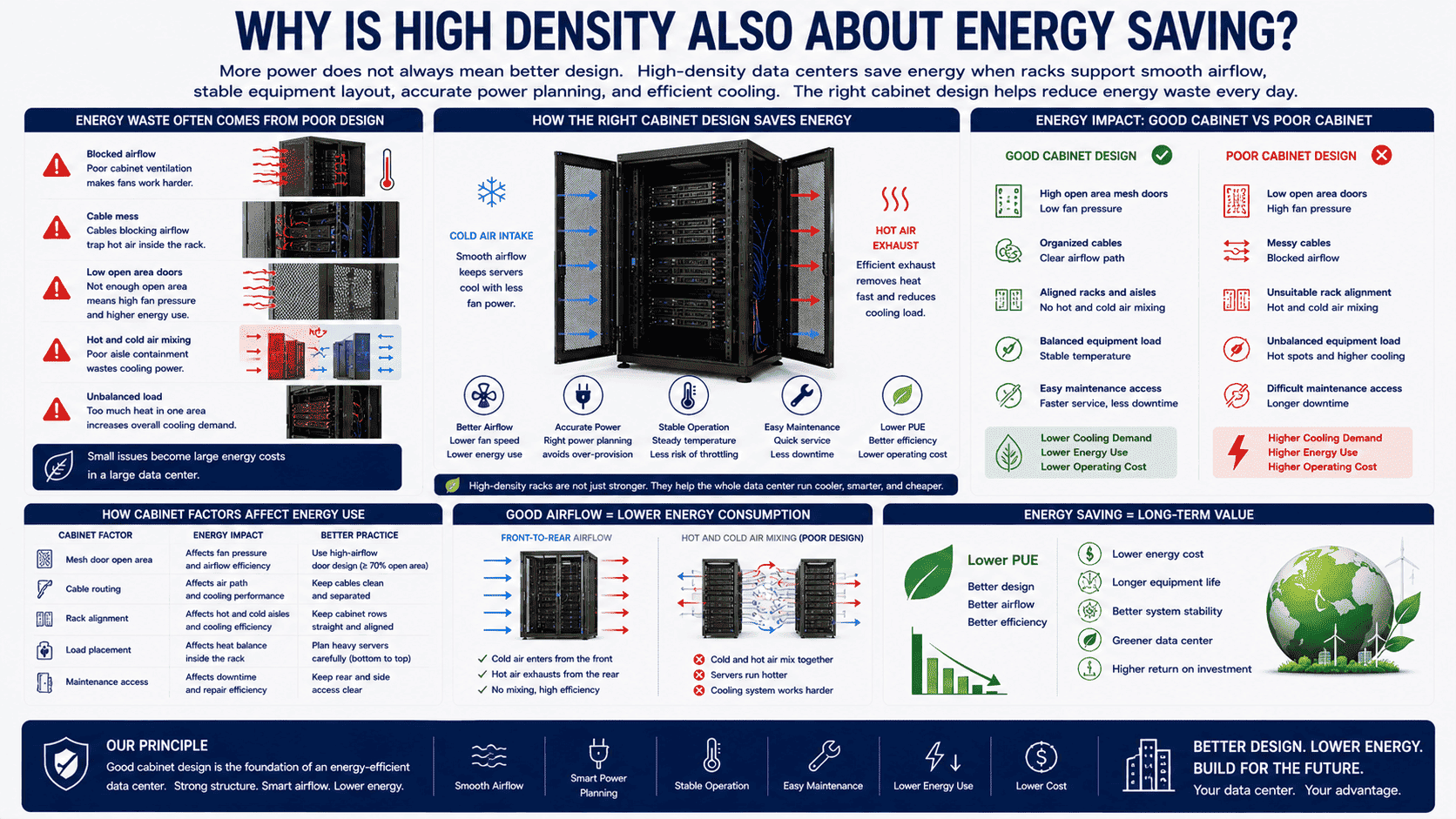
High-density data centers save energy when racks support smooth airflow, stable equipment layout, accurate power planning, and efficient cooling.11 I see the cabinet as a basic tool for lower energy waste.
How the Cabinet Affects Energy Use
The cabinet is not the cooling system, but it can help or hurt the cooling system. If the rack blocks air, the room must use more cooling power. If the cables block exhaust, the hot air stays longer. If doors do not have enough open area, server fans work harder. If cabinet rows are not aligned well, hot and cold air can mix.12 These small issues can become large energy costs in a large data center.
I think modern high-density construction pushes cabinets into a new role. The rack is no longer a passive frame. It supports the room’s energy plan. It helps control air direction. It helps keep equipment stable. It helps maintenance staff work faster. It helps reduce hidden failure points. This is why I believe high-density data centers replace the old idea of rough machine room construction.
| Cabinet Factor | Energy Impact | Better Practice |
|---|---|---|
| Mesh door open area | Affects fan pressure | Use high-airflow door design |
| Cable routing | Affects air path | Keep cables clean and separated |
| Rack alignment | Affects hot and cold aisles | Keep cabinet rows straight |
| Load placement | Affects heat balance | Plan heavy servers carefully |
| Maintenance access | Affects downtime and repair | Keep rear and side access clear |
Conclusion
I see a high-density data center as a precise computing system, where each cabinet must support stronger load, airflow, power, safety, and long-term stability.
"Best Practices Guide for Energy-Efficient Data Center Design", https://www.energy.gov/sites/default/files/2024-07/best-practice-guide-data-center-design_0.pdf. Institutional guidance on data-center thermal management defines high-density environments in terms of increased rack power density and the corresponding heat that must be removed from the same rack footprint. Evidence role: definition; source type: institution. Supports: A high-density data center can be defined by elevated rack-level power density and the associated thermal load.. Scope note: This supports the technical framing of high density but does not establish a universal threshold for every facility. ↩
"Overview of the AI supply chain: Competition in artificial intelligence ...", https://www.oecd.org/en/publications/competition-in-artificial-intelligence-infrastructure_623d1874-en/full-report/component-5.html. Institutional reports on data-center growth document rising demand for compute capacity from cloud services and artificial intelligence, providing context for the shift toward denser data-center infrastructure. Evidence role: general_support; source type: institution. Supports: Growth in cloud, AI, and digital services is increasing demand for data-center computing capacity and encouraging denser infrastructure.. Scope note: The source would support the general demand trend, not the specific space constraints of any individual site. ↩
"Generating Datacenter Configurations (including IT, Power, Cooling)", https://arxiv.org/html/2604.09616v1. Research on high-performance and accelerated data-center systems reports that dense server configurations increase rack-level electrical demand and heat output, supporting the need to account for weight, cooling, and power together. Evidence role: general_support; source type: paper. Supports: GPU-accelerated and blade-server deployments tend to increase rack-level power density and thermal load compared with lower-density server arrangements.. Scope note: The evidence is contextual because exact weight and power increases depend on the server model and rack configuration. ↩
"Install In-rack or In-row Cooling - Energy Star", https://www.energystar.gov/products/data_center_equipment/16-more-ways-cut-energy-waste-data-center/install-rack-or-row. Data-center thermal-management guidance explains that rack enclosures should not impede equipment air intake or exhaust, supporting the use of ventilated front and rear doors in high-density racks. Evidence role: mechanism; source type: institution. Supports: Sufficient front and rear rack-door ventilation helps maintain cold-air intake and hot-air exhaust paths for IT equipment.. Scope note: The guidance supports the airflow principle but does not specify the exact mesh design required for this cabinet. ↩
"Rice researchers turn wasted data center heat into clean power", https://news.rice.edu/news/2025/rice-researchers-turn-wasted-data-center-heat-clean-power. Engineering explanations of data-center cooling note that nearly all electrical power consumed by IT equipment is ultimately dissipated as heat, so increasing rack power density increases heat load in the same footprint. Evidence role: mechanism; source type: education. Supports: Higher electrical power consumption by rack-mounted IT equipment results in greater heat that must be removed from the same space.. Scope note: This supports the physical mechanism but not a specific measured heat load for the article's example. ↩
"quantifying air flow rate through a server in an operational ...", https://mavmatrix.uta.edu/context/mechaerospace_theses/article/1223/type/native/viewcontent. Experimental and modeling studies of rack airflow show that enclosure restrictions such as low-open-area doors can increase pressure drop and impair cooling, which may raise server inlet temperatures. Evidence role: mechanism; source type: paper. Supports: Reduced rack-door open area can increase airflow impedance and raise server inlet or enclosure temperatures.. Scope note: The evidence supports the mechanism; the phrase 'hot box' is rhetorical rather than a measured technical category. ↩
"EN IEC 61587-1:2022 - Mechanical Structures Test ...", https://standards.iteh.ai/catalog/standards/clc/24a2d15d-bd70-49ff-8c10-8143e33b8519/en-iec-61587-1-2022?srsltid=AfmBOoptL0HyhjY7hJmD9TD0RquzfzKukfDx1xFutJeLJ7jBY_XYDNxJ. Mechanical-structure standards for electronic equipment enclosures specify load and stability tests for racks and cabinets, supporting the need to design high-density cabinets for combined equipment and accessory loads. Evidence role: expert_consensus; source type: institution. Supports: Rack and cabinet designs for IT equipment are evaluated against mechanical load and structural integrity requirements.. Scope note: Such standards establish testing principles and classes, while the required load rating still depends on the actual cabinet design and equipment inventory. ↩
"[PDF] Data Center Airflow Management Retrofit", https://datacenters.lbl.gov/sites/default/files/airflow-doe-femp.pdf. Government data-center airflow-management guidance identifies cable congestion and unmanaged openings as factors that can obstruct air paths and reduce cooling efficiency, supporting the concern that power cables may block exhaust air. Evidence role: mechanism; source type: government. Supports: Cable congestion in racks can obstruct airflow paths and reduce cooling effectiveness.. Scope note: The guidance supports the general airflow effect, while the severity depends on the rack layout and cable volume. ↩
"section 270526 - Grounding and Bonding - Caltech IMSS", https://www.its.caltech.edu/~jemonaly/work/vdn/Spec/270526.html. Telecommunications bonding and grounding standards specify reliable bonding pathways for racks, cabinets, and equipment, supporting the article's statement that grounding must be stable. Evidence role: expert_consensus; source type: institution. Supports: Data-center racks and telecommunications equipment require reliable bonding and grounding paths for safety and equipment protection.. Scope note: The standard supports the safety principle but does not evaluate the grounding design of any specific cabinet. ↩
"19-inch rack - Wikipedia", https://en.wikipedia.org/wiki/19-inch_rack. The EIA-310 rack standard defines the 19-inch equipment mounting interface and associated dimensional requirements, supporting the article's emphasis on accurate 19-inch rack mounting. Evidence role: definition; source type: institution. Supports: The 19-inch rack format and mounting-hole dimensions are standardized by EIA-310 and related rack standards.. ↩
"Cooling & Air Management", https://datacenters.lbl.gov/cooling-air-management. Government energy-efficiency guidance for data centers reports that airflow management, equipment layout, and coordinated cooling practices can reduce cooling waste, supporting the article's claim that rack design contributes to energy savings. Evidence role: general_support; source type: government. Supports: Improved rack airflow management and cooling coordination can reduce waste and improve data-center energy efficiency.. Scope note: The source would support the general efficiency relationship, not quantify savings for the specific cabinet designs described. ↩
"Move to a Hot Aisle/Cold Aisle Layout | ENERGY STAR", https://www.energystar.gov/products/data_center_equipment/16-more-ways-cut-energy-waste-data-center/move-hot-aislecold-aisle-layout. Data-center thermal-management guidance describes hot-aisle/cold-aisle layouts as a method for limiting recirculation and mixing between hot exhaust air and cold supply air, supporting the article's concern about row alignment. Evidence role: mechanism; source type: institution. Supports: Hot-aisle/cold-aisle airflow organization is used to reduce mixing of hot exhaust air with cold supply air and improve cooling performance.. Scope note: The evidence supports the airflow-management principle, while actual mixing depends on containment, perforated tiles, rack gaps, and room design. ↩
