
What Cabinet & Floor Standing PDU Solutions Should I Choose?
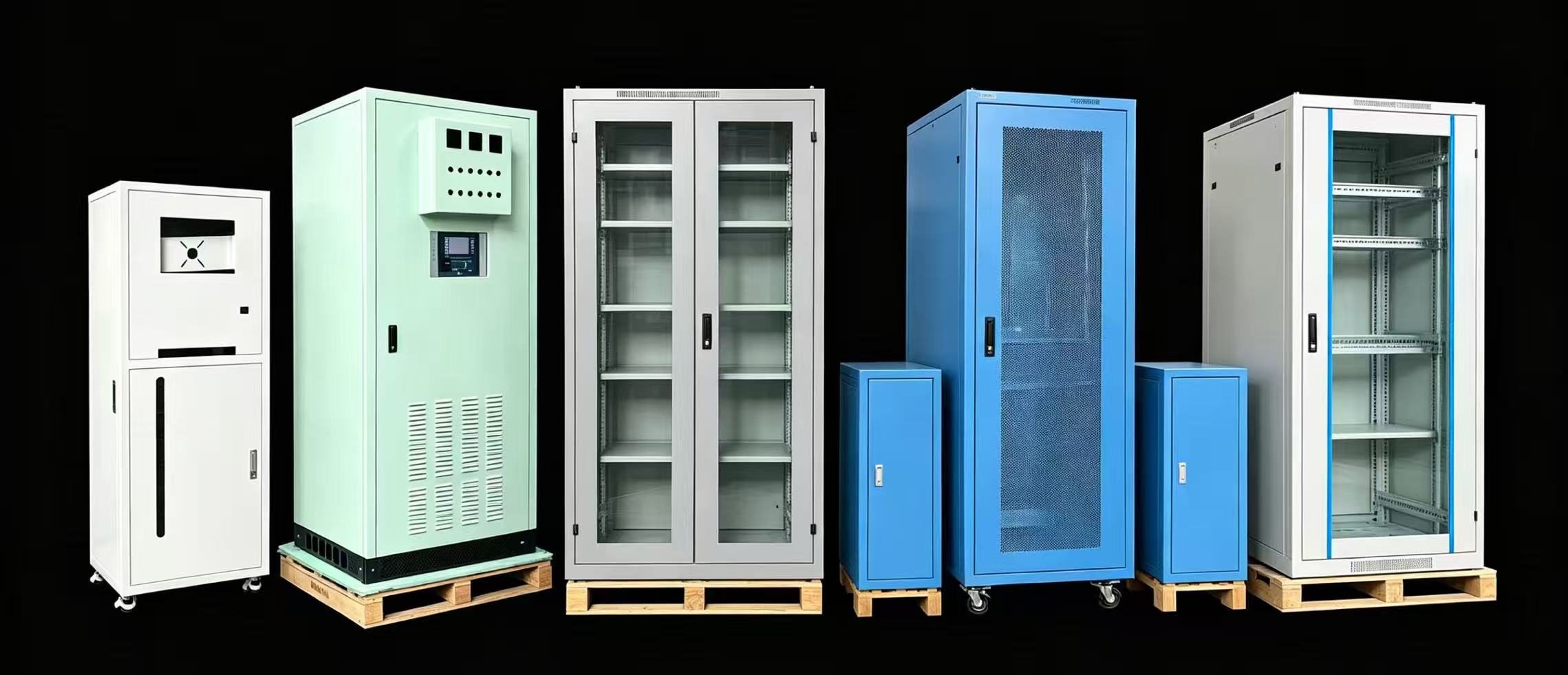
I see many cabinet projects fail from weak power planning. The cabinet looks strong, but poor PDU selection can cause heat, trips, and downtime1.
I choose cabinet and floor standing PDU solutions by matching load current, cabinet height, outlet type, protection level, and remote control needs. A good floor standing PDU saves rack U space, improves cable order, protects IT equipment, and supports stable long-term operation in data centers and network rooms.2
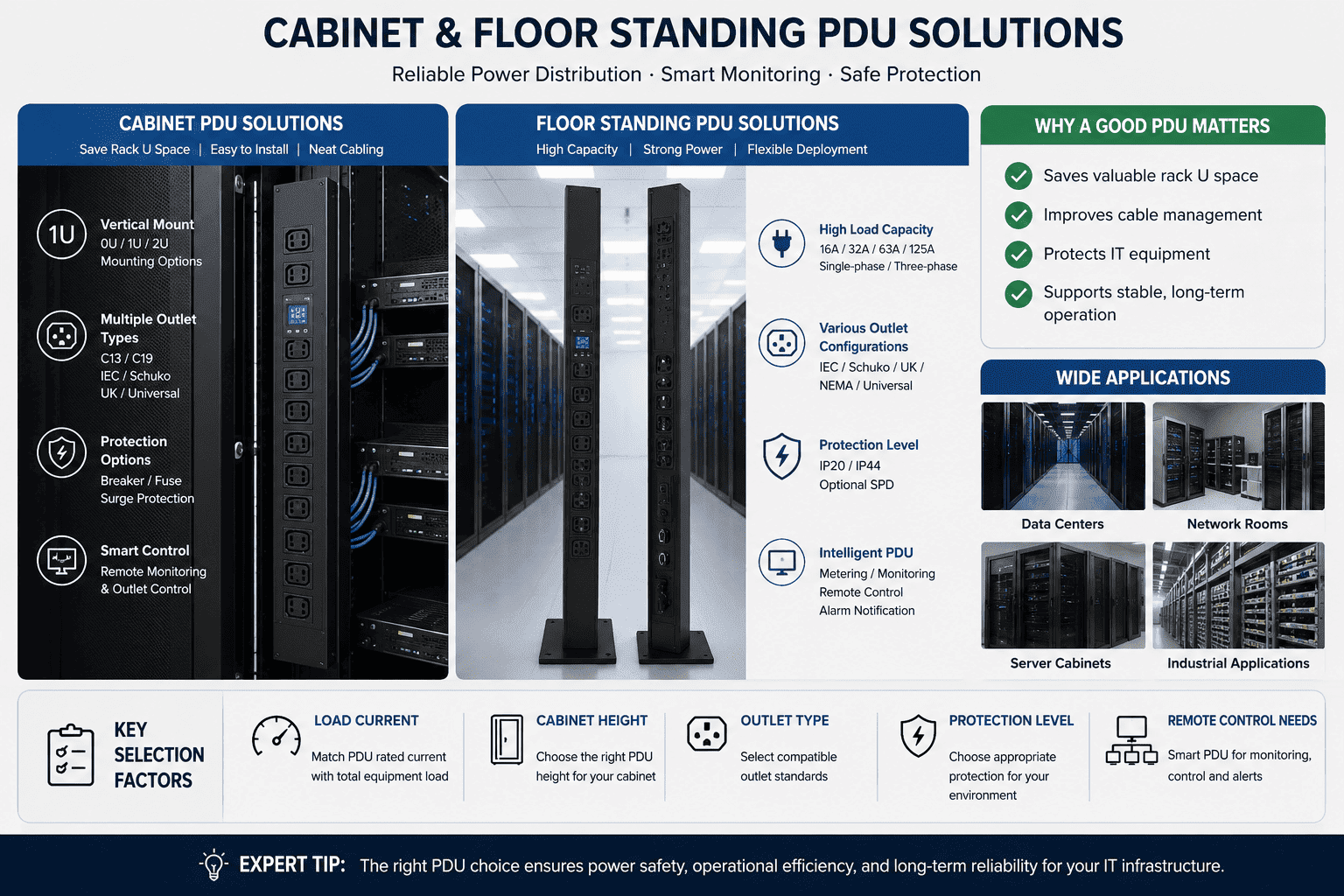
I have worked with many overseas cabinet orders, and I have seen one clear fact. A server cabinet is not only a metal frame. It carries equipment, airflow, cables, and power safety at the same time. The PDU inside the cabinet is like the heart of the power system. If I select the wrong PDU, the cabinet may still stand well, but the whole system may run with hidden risk. I will break down the real choices that I use in cabinet and floor standing PDU projects.
Why Does A Floor Standing PDU Matter Inside A Server Cabinet?
I see many buyers focus on cabinet thickness first. That is important, but I also check power distribution early because the PDU affects every device inside.
I use a floor standing PDU when I need vertical power distribution inside a 19-inch server cabinet or network cabinet. It mounts along the cabinet upright, saves equipment U space, keeps airflow open, and supports safer high-density operation.3
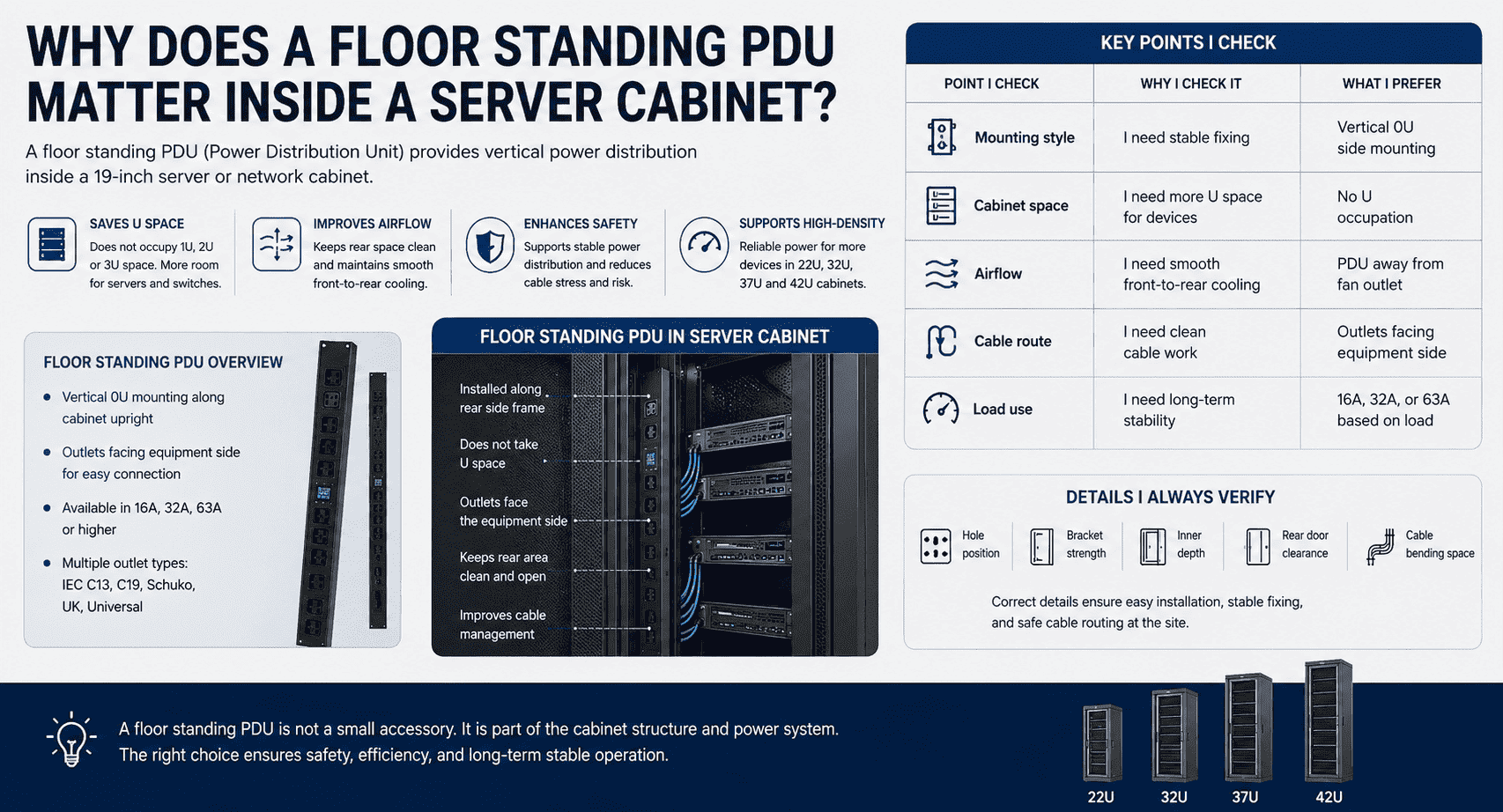
A floor standing PDU is also called a vertical mounted power distribution unit. I normally install it along the rear side of the cabinet frame. It follows the cabinet height. It does not take the 1U, 2U, or 3U space that servers and switches need. This is very useful in 22U, 32U, 37U, and 42U cabinets, because every U position has value.
I also care about heat. When I place a PDU in the wrong position, the power cable bundle may block the rear exhaust path4. A vertical PDU helps me keep the rear space cleaner. It also helps the customer manage power cords from top to bottom.
| Point I Check | Why I Check It | What I Prefer |
|---|---|---|
| Mounting style | I need stable fixing | Vertical 0U side mounting |
| Cabinet space | I need more U space for devices | No U occupation |
| Airflow | I need smooth front-to-rear cooling | PDU away from fan outlet |
| Cable route | I need clean cable work | Outlets facing the equipment side |
| Load use | I need long-term stability | 16A, 32A, or 63A based on load |
In my factory work, I do not treat the PDU as a small accessory. I treat it as part of the cabinet structure. I check the hole position, bracket strength, inner depth, rear door clearance, and cable bending space. If these details are wrong, the buyer may face loose fixing, hard installation, or bad cable pressure after the cabinet reaches the site.
Which Floor Standing PDU Type Should I Use For My Project?
I see different projects need different PDU levels. I do not push the highest type every time, because a simple network room may not need full remote control.
I select the PDU type by the risk level, load size, monitoring need, and operation method. Basic, overload protection, metered, intelligent remote, and dual redundant PDUs each fit a different cabinet project.
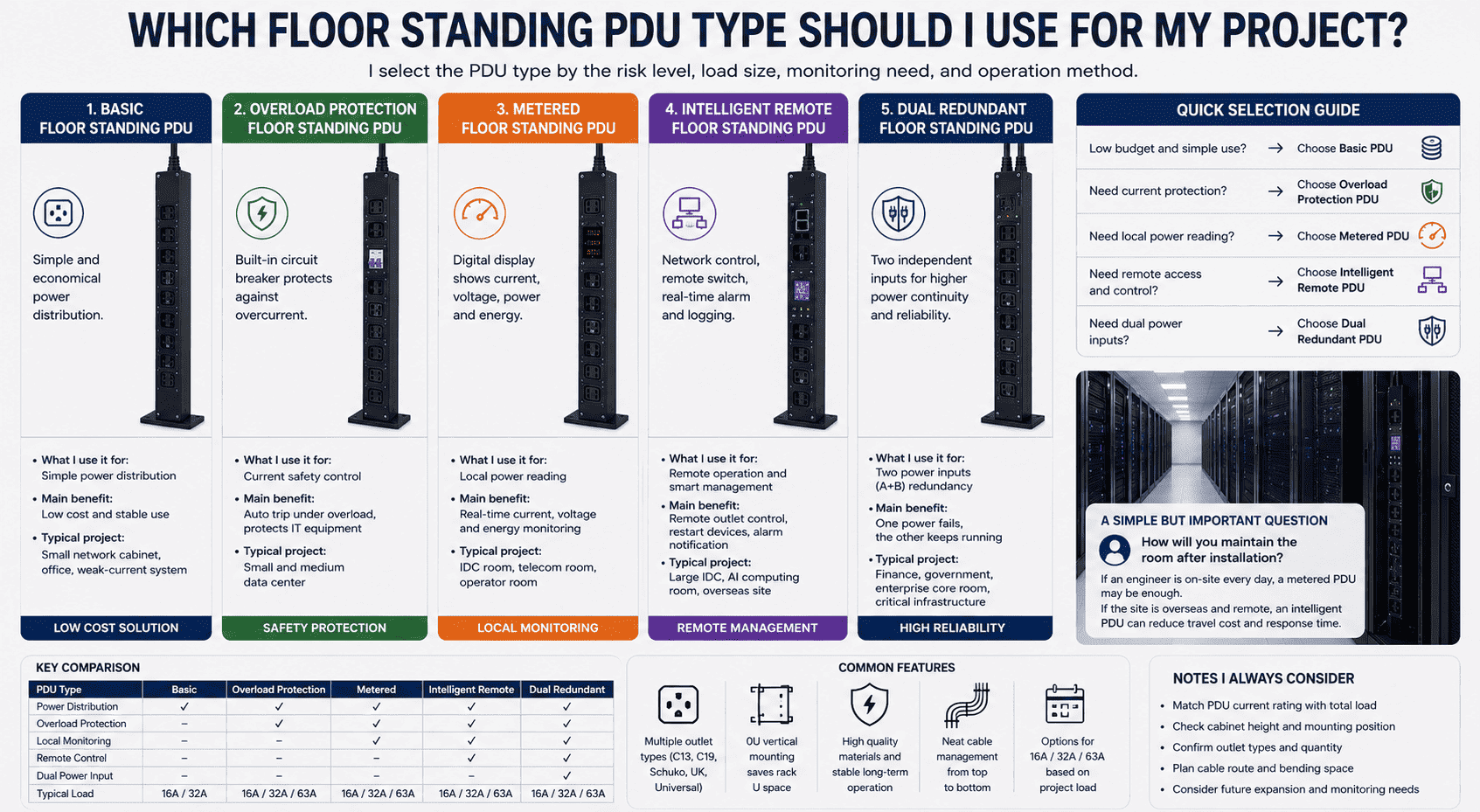
I usually divide floor standing PDUs into several real project levels. A basic PDU only gives power distribution. It has a simple structure. It has a lower cost. It works well for small network cabinets, office weak-current systems, and projects with low management demand.
An overload protection PDU adds a main or branch circuit breaker. I use it when the customer wants automatic trip protection under overcurrent. This is common in small and medium data centers. It can help protect IT devices when the current goes beyond the safe range.5
A metered PDU has a digital display. I use it when the operator wants to see current, voltage, power, and energy use. This is useful in IDC rooms and telecom rooms. The manager can understand cabinet energy use without guessing.6
An intelligent remote PDU has a network port. I use it for higher-level rooms. The customer can log in remotely, control outlets, restart single devices, and receive overload warnings.7 This is useful for overseas IDC projects, AI computing rooms, and sites with limited local staff.
A dual redundant floor standing PDU has two independent inputs. I use it with two UPS power sources. If one line fails, the system can keep running through another line.8 I see this design often in finance, government, enterprise core rooms, and important international projects.
| PDU Type | What I Use It For | Main Benefit | Typical Project |
|---|---|---|---|
| Basic floor standing PDU | Simple power distribution | Low cost and stable use | Small network cabinet |
| Overload protection PDU | Current safety control | Auto trip under overload | Small and medium data center |
| Metered PDU | Local power reading | Real-time current and voltage | IDC and operator room |
| Intelligent remote PDU | Remote operation | Remote switch and alarm | Large IDC and computing room |
| Dual redundant PDU | Two power inputs | Better power continuity | Finance and core machine room |
I always ask the customer one simple question before quoting. I ask how they will maintain the room after installation. If they have an engineer on site every day, a metered PDU may be enough. If the site is overseas and remote, an intelligent PDU may reduce travel cost. This question makes the selection more real.
How Do I Match A Floor Standing PDU With A 19-Inch Cabinet?
I cannot match a PDU by outlet count only. I must check the cabinet structure first, because a good PDU still fails when the fixing position is wrong.
I match a floor standing PDU with a 19-inch cabinet by checking cabinet height, rear space, upright hole position, mounting bracket, door clearance, cable path, plug standard, and current rating.
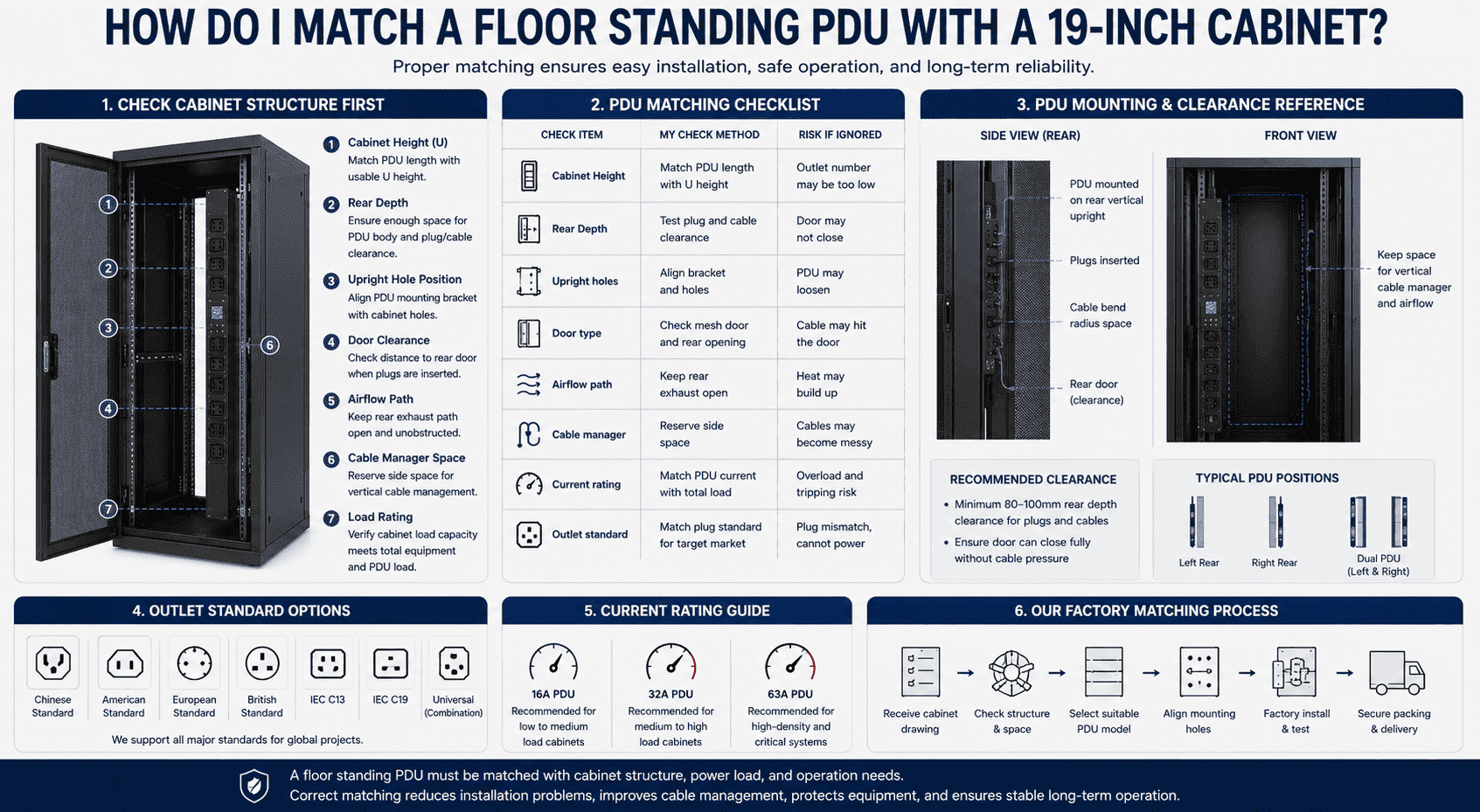
In our factory, I always start with the cabinet drawing. I check the 19-inch mounting profile, the rear upright, the vertical side space, and the distance to the rear door. A floor standing PDU needs enough room for the body and the inserted plugs. If the cabinet is too shallow, the cable may press against the rear door.9 This is a common problem in low-cost cabinets.
I also check cabinet height. A 22U cabinet may use a shorter vertical PDU. A 42U cabinet can use a longer PDU with more outlets. I do not believe one PDU length fits every cabinet. I prefer one-to-one matching, especially for overseas projects where site rework is expensive.
Our standard server cabinets and network cabinets can be matched with floor standing PDUs at the factory. I match the PDU holes with the cabinet holes. I make sure the PDU is fixed firmly. I do not want shaking after transport. I also check if the PDU position blocks cable managers, fans, shelves, or rear vertical rails.
| Cabinet Detail | My Check Method | Risk If Ignored |
|---|---|---|
| Cabinet height | I match PDU length with U height | Outlet number may be too low |
| Rear depth | I test plug and cable clearance | Door may not close |
| Upright holes | I align bracket and holes | PDU may loosen |
| Door type | I check mesh door and rear opening | Cable may hit the door |
| Airflow path | I keep rear exhaust open | Heat may build up |
| Cable manager | I reserve side space | Cables may become messy |
I also match outlet standards based on the destination market. I support Chinese standard, American standard, European standard, British standard, C13, and C19 universal interfaces. I treat this part carefully because plug mismatch is a very real problem. A cabinet may be strong and well painted, but the user cannot power the equipment if the outlet standard is wrong.
What Safety Details Should I Check Before Ordering A Floor Standing PDU?
I have seen buyers compare only price, and I understand that pressure. But power parts need safety checks because one failure can damage many devices.
I check conductor material, shell material, current capacity, overload protection, short circuit protection, surge protection, flame resistance, and certification needs before I confirm a cabinet PDU order.
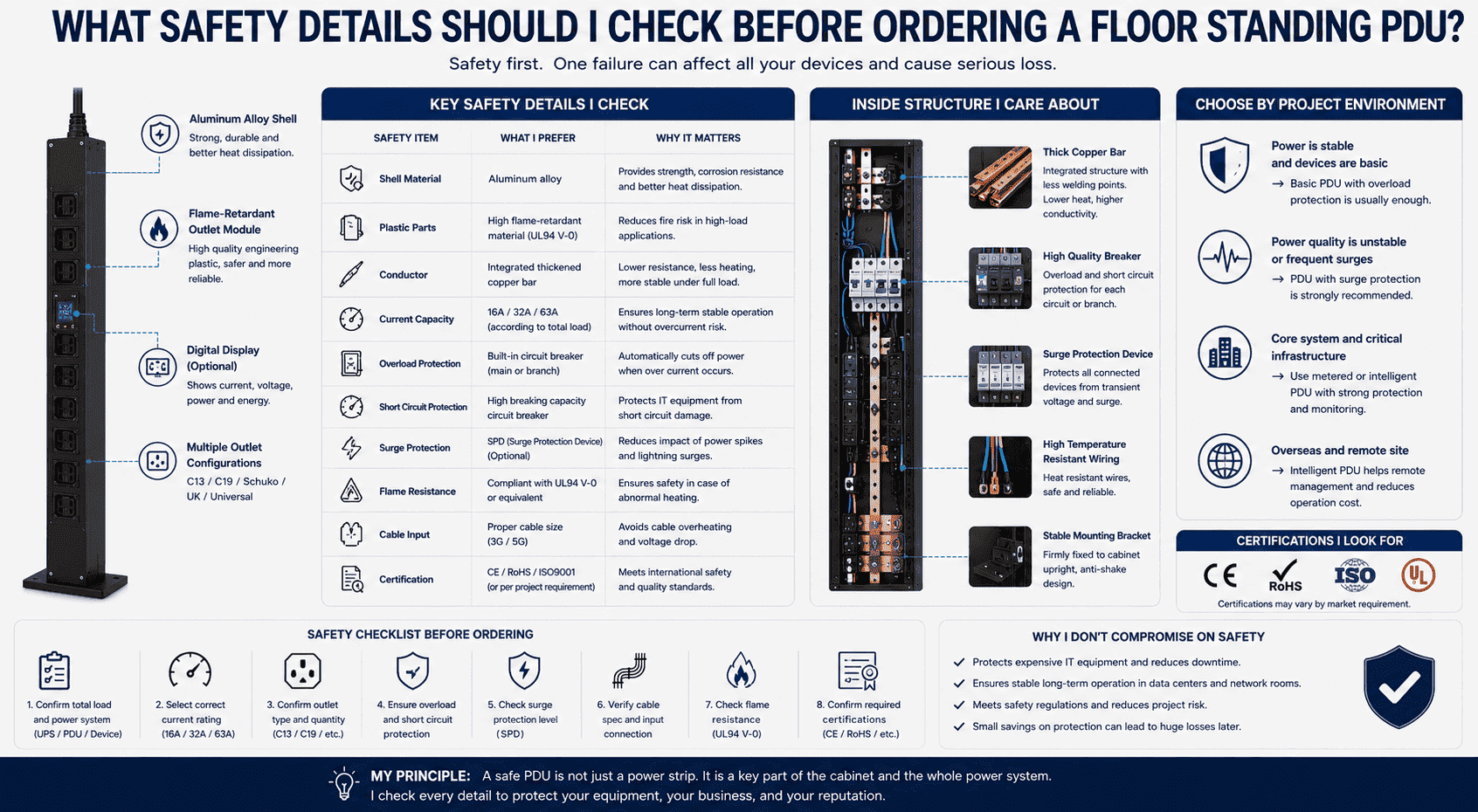
A real industrial floor standing PDU should be built for long running time. I prefer an aluminum alloy shell because it is strong and has better heat behavior. I also use high flame-retardant engineering plastic in the outlet module area. I do not want weak plastic near high-load use.
The conductor is very important. I prefer an integrated thickened copper bar structure. I do not like too many welding points inside a high-load PDU. Welding points can become heat points when the PDU runs at full load for a long time.10 A better copper bar gives more stable conduction and lower heating risk.11
I check current rating very carefully. A 16A PDU may be enough for a small cabinet. A 32A PDU is common in higher-load server cabinets. A 63A PDU may be used in high-density rooms. I never select current by guesswork. I ask for device power, UPS design, input voltage, and reserve load.
| Safety Item | What I Prefer | Why It Matters |
|---|---|---|
| Shell | Aluminum alloy | It gives strength and better heat resistance |
| Plastic parts | Flame-retardant material | It reduces fire risk |
| Conductor | Thick copper bar | It lowers heat under load |
| Protection | Overload and short circuit | It protects IT devices |
| Surge function | [Surge and lightning protection | It reduces power spike damage](https://www.nist.gov/document/enduserpdf)%%%FOOTNOTE_REF_12%%% |
| Breaker design | Main or branch breaker | It gives controlled cut-off |
| Cable input | Proper cable size | It avoids cable heating |
I also check the project environment. If the room has unstable power, surge protection becomes more important. If the cabinet serves core devices, I suggest stronger protection and monitoring. If the project is for a basic weak-current room, I still keep short circuit and overload safety as the bottom line. I do not remove key safety functions only to reduce a small cost.
Why Should I Buy The Cabinet And PDU As One Integrated Solution?
I see many customers buy cabinets from one supplier and PDUs from another supplier. This can work, but it can also create small problems that become big on site.
I prefer an integrated cabinet and floor standing PDU solution because the structure, holes, grounding, cable route, airflow, outlet standard, and safety functions can be checked together before shipment.
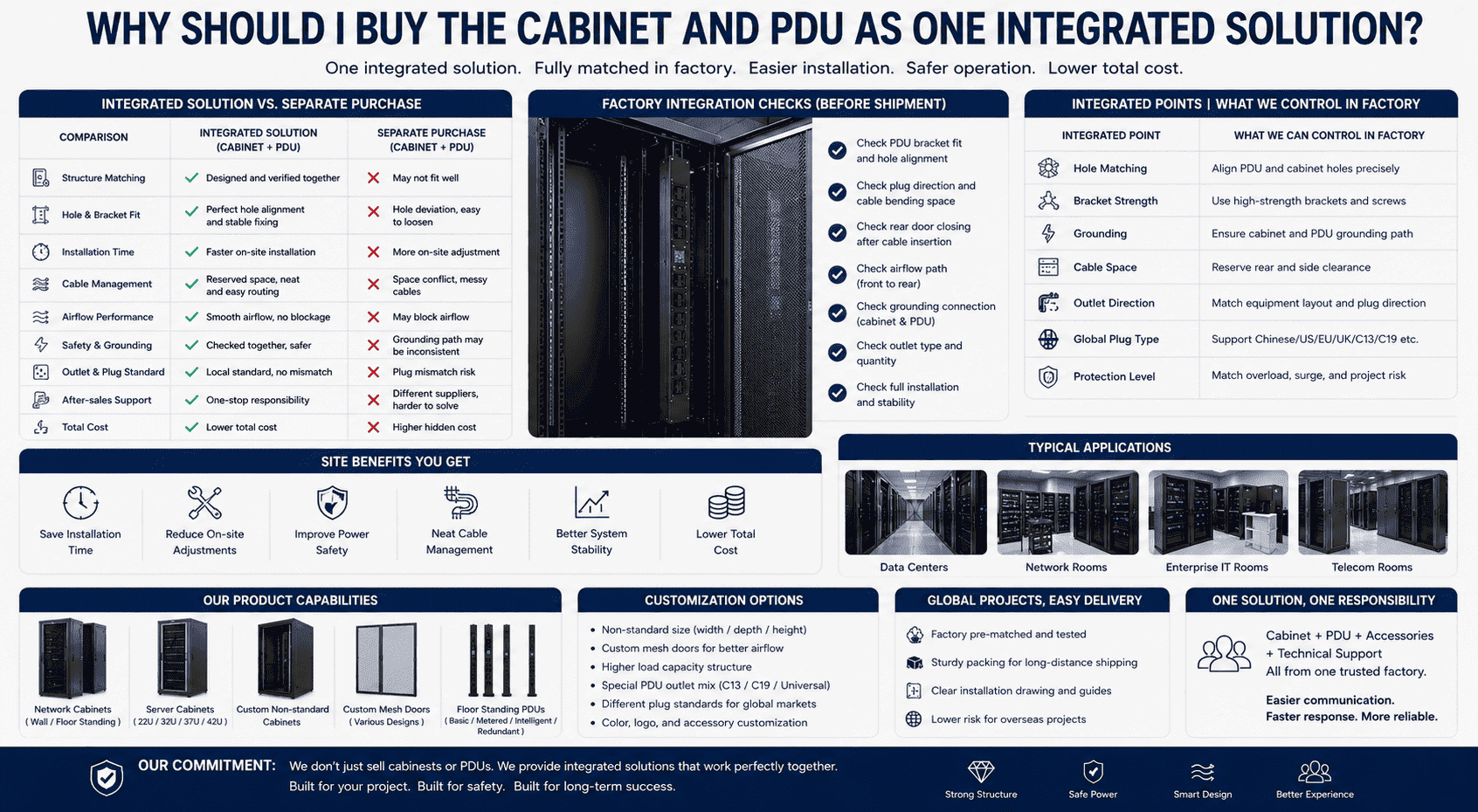
When I build a cabinet and PDU solution together, I can check the full installation before packing. I can test whether the PDU bracket fits the rear upright. I can check whether the plug direction is comfortable for the equipment layout. I can check whether the rear mesh door closes after cables are inserted. These checks sound small, but they save real time on site.
Our factory has many years of sheet metal cabinet experience. We produce network cabinets, server cabinets, custom non-standard cabinets, custom non-standard server cabinets, and custom mesh doors. Because of this, I do not only look at the PDU as an electrical part. I also look at it from the cabinet structure side. I check load bearing, bending accuracy, welding strength, powder coating thickness, and grounding points.
| Integrated Point | What I Can Control In Factory | Site Benefit |
|---|---|---|
| Hole matching | I align PDU and cabinet holes | Faster installation |
| Bracket strength | I use stable fixing parts | Less shaking during use |
| Grounding | I check cabinet and PDU grounding path | Better safety |
| Cable space | I reserve rear and side clearance | Easier cable management |
| Outlet direction | I match device layout | Cleaner power connection |
| Global plug type | I choose local standard | No plug mismatch |
| Protection level | I match project risk | Lower operation risk |
For overseas projects, I think this is even more important. The customer may not have a full technical team on site. The cabinet may travel a long distance by sea. The installer may follow the drawing only. If the cabinet and PDU are already matched in the factory, the final site work becomes easier.
I also support standard stock cabinet orders and non-standard custom cabinet orders. Some customers need special mesh doors for airflow. Some need wider cabinets for cable space. Some need higher load capacity. Some need a special PDU outlet mix with C13 and C19. I can match the cabinet and PDU based on that real need instead of forcing one standard design into every project.
How Do Cabinet Structure, Cooling, And Power Work Together?
I do not separate cabinet design from power design. A cabinet with poor airflow can make a good PDU work in a hotter space than it should.
I plan cabinet structure, cooling, and PDU layout together by keeping equipment space clear, rear airflow open, cable paths organized, and power components fixed away from heat concentration areas.
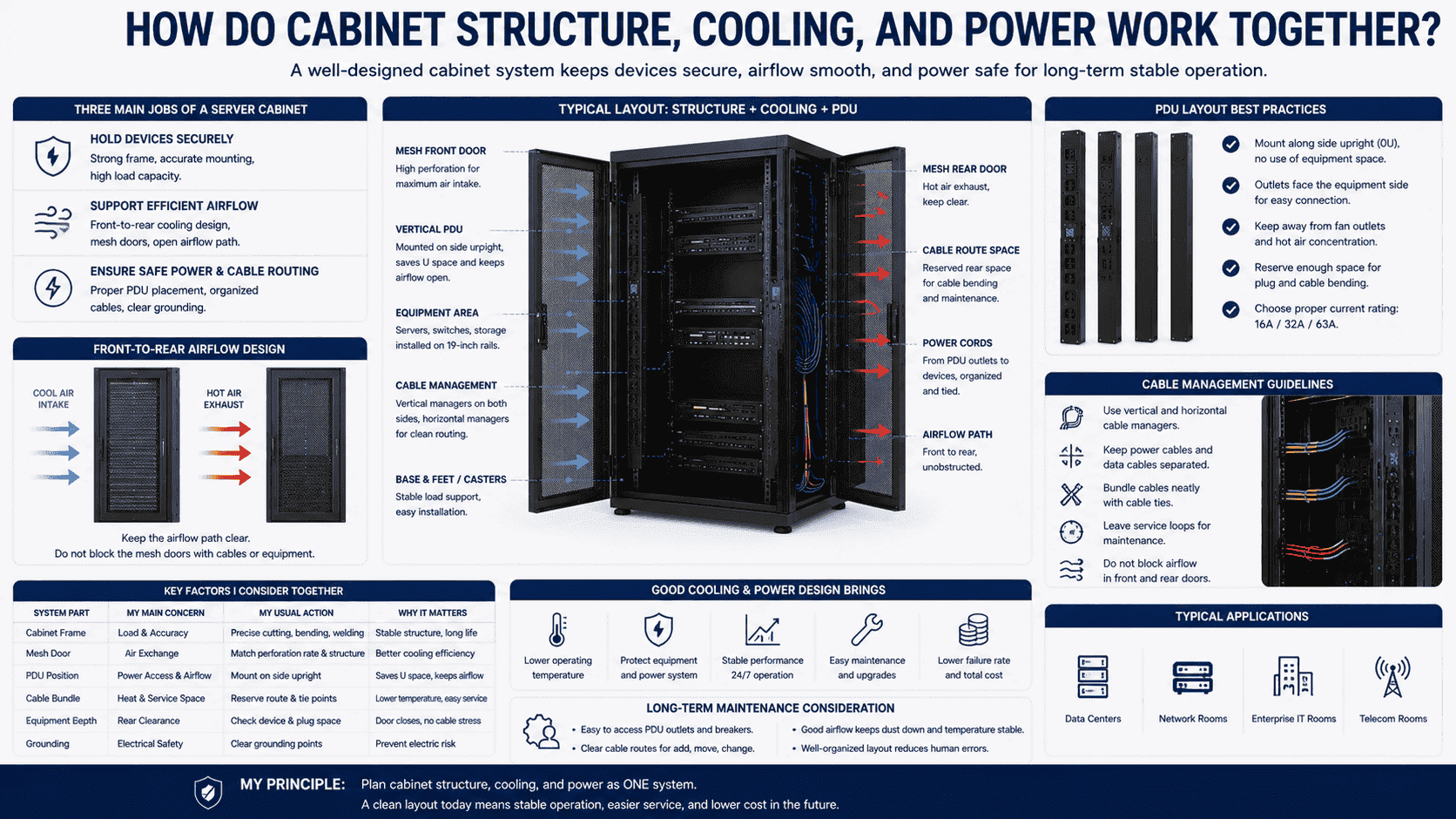
A server cabinet has three main jobs. It must hold devices. It must help air move. It must support safe power and cable routing. If one job is weak, the full cabinet system becomes less stable. I learned this from real orders where customers asked for very high-density installation. The cabinet looked normal from outside, but inside it needed more cable space, better rear door opening, and a better PDU position.
A mesh door helps airflow. I produce standard and custom mesh doors because different rooms have different cooling needs. If the rear cable bundle blocks the mesh door area, the mesh door cannot do its job well. This is why I place the vertical PDU near the side and guide the cables in a clean line.
| System Part | My Main Concern | My Usual Action |
|---|---|---|
| Cabinet frame | Load and accuracy | I use precise cutting and bending |
| Mesh door | Air exchange | I match perforation and structure |
| PDU position | Power access and airflow | I place it along side upright |
| Cable bundle | Heat and service space | I reserve route and tie points |
| Equipment depth | Rear clearance | I check device and plug space |
| Grounding | Electrical safety | I keep clear grounding points |
I also consider long-term maintenance. A data center does not stop after installation. Engineers will replace servers, add switches, trace cables, and reset power. If the PDU is hard to reach, every small task becomes harder. If the outlets are blocked, the engineer may pull cables at a bad angle. So I prefer a layout that looks simple and works well after months of use.
What Plug Standards And Outlet Choices Should I Confirm?
I never assume that one plug standard fits all countries. A wrong outlet type can delay a project even when the cabinet quality is good.
I confirm plug standards by the project country, equipment power cord, UPS output, current level, and future expansion plan. I often use C13, C19, Chinese, American, European, or British outlets.
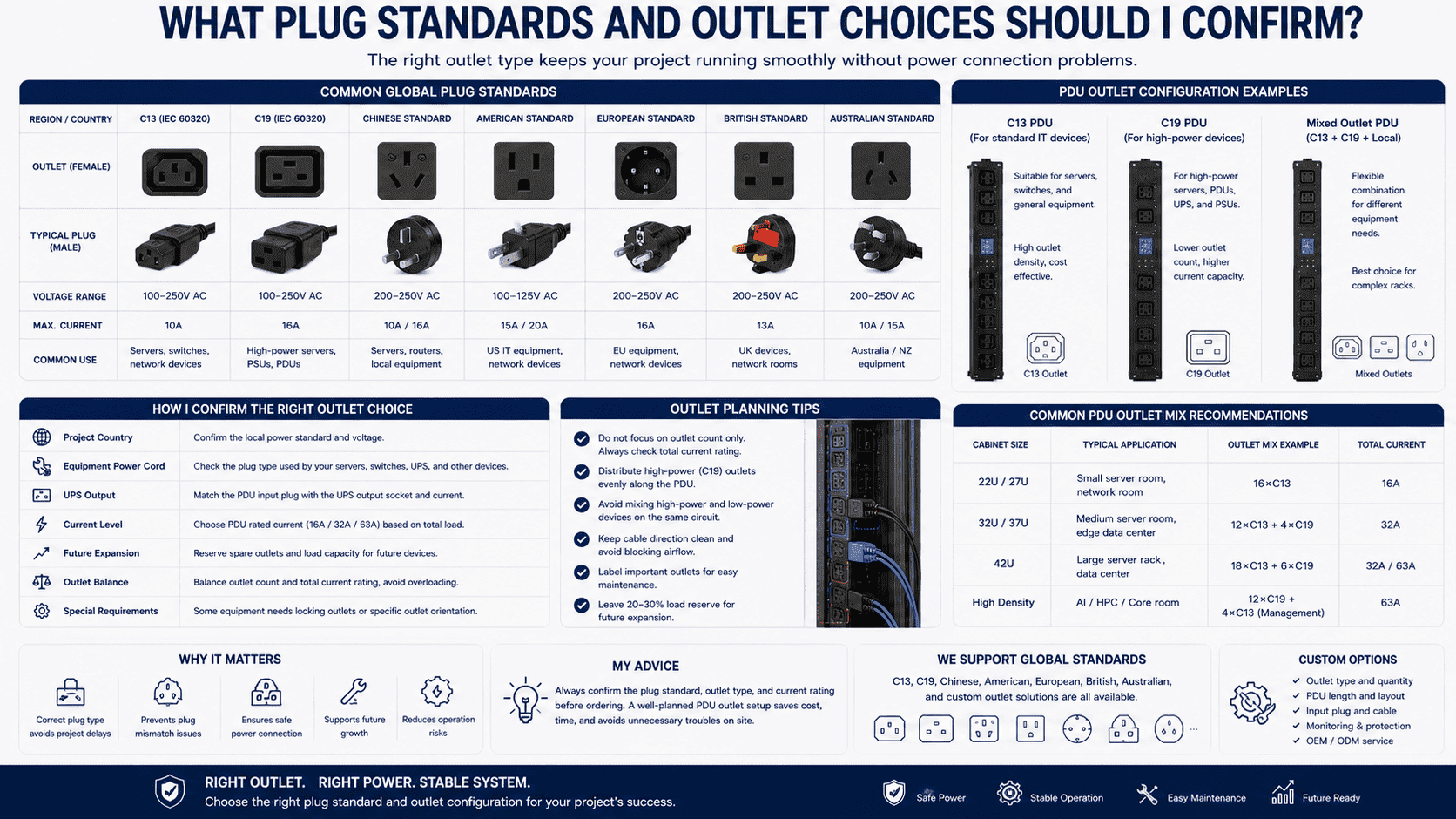
International cabinet projects need careful outlet planning. Some customers use C13 for common servers. Some use C19 for higher-power equipment. Some sites ask for national socket types because local devices already use those power cords. I ask for the equipment list before I finish the PDU layout.
I also check the balance between outlet count and current capacity. More outlets do not always mean more usable power. If the total current rating is limited, the user cannot load every outlet at full power. I explain this clearly because it avoids wrong expectations.
| Outlet Choice | Where I Use It | My Reminder |
|---|---|---|
| C13 | Standard servers and switches | I check total load |
| C19 | Higher-power IT equipment | I check cable and breaker size |
| Chinese standard | China-based projects | I match local power cords |
| American standard | US-related projects | I check voltage and plug type |
| European standard | EU projects | I check local socket rules |
| British standard | UK and related markets | I check fuse and plug needs |
| Mixed outlets | Complex equipment racks | I plan outlet sequence |
I also think about future changes. A cabinet may start with a small load, then receive more servers later. If the PDU has no spare outlets or no load reserve, the operator may add unsafe extension strips. I do not like that. I prefer a proper outlet count and a safe current margin from the start.
Conclusion
I choose cabinet and floor standing PDU solutions as one system, because strong structure, safe power, clean airflow, and correct standards protect the whole project.
"[PDF] Best Practices Guide for Energy-Efficient Data Center Design", https://www.energy.gov/sites/default/files/2024-07/best-practice-guide-data-center-design_0.pdf. Data-center thermal and reliability guidance identifies electrical distribution design and airflow management as factors affecting equipment temperature and service continuity, supporting the claim that unsuitable PDU selection can contribute to heat, trips, and downtime; this is contextual support rather than evidence about any specific cabinet installation. Evidence role: general_support; source type: institution. Supports: A neutral data-center or engineering source should support that poor electrical distribution design and obstructed airflow are recognized contributors to overheating, protective trips, and downtime risk.. Scope note: The support is general engineering guidance and would not prove that every PDU mismatch causes downtime. ↩
"Vertical PDUs vs. Horizontal PDUs", https://www.enconnex.com/vertical-pdus-vs-horizontal-pdus/. Reference descriptions of rack power distribution units note that vertical or 0U PDUs distribute power within racks while avoiding occupation of equipment rack units, which supports the article's space-saving claim; claims about long-term stability remain contextual and depend on installation quality and load design. Evidence role: definition; source type: encyclopedia. Supports: A neutral reference should define rack PDUs and explain that vertical or 0U PDUs are mounted outside the equipment U space and used for rack-level power distribution.. Scope note: A definition source can support the form factor and function, but it cannot independently verify reliability improvements for this article's specific solution. ↩
"Best Practices Guide for Energy-Efficient Data Center Design", https://www.energy.gov/sites/default/files/2024-07/best-practice-guide-data-center-design_0.pdf. Data-center rack design guidance describes vertical 0U power distribution as a method of distributing power without occupying equipment rack units and emphasizes unobstructed airflow paths for cooling, supporting the stated mechanism; the source would not directly measure the safety of this exact layout. Evidence role: mechanism; source type: institution. Supports: A data-center infrastructure source should explain how vertical mounting outside the equipment mounting plane preserves rack units and how cable placement affects airflow.. Scope note: The evidence would support the design rationale, not prove that a particular installed PDU is safer. ↩
"Data Center Airflow Management Retrofit", https://datacenters.lbl.gov/sites/default/files/airflow-doe-femp.pdf. Energy-efficiency and data-center cooling guidance recognizes cable congestion and blocked exhaust paths as airflow-management problems in server racks, supporting the claim that rear cable bundles may obstruct exhaust airflow; this is a general thermal-management principle rather than a site-specific airflow test. Evidence role: mechanism; source type: government. Supports: A government or research source should support that cable congestion can impede airflow in server racks and affect cooling performance.. Scope note: The degree of obstruction depends on rack geometry, fan direction, cable density, and cooling design. ↩
"Electrical Testing Study Material - Article 240", https://arlweb.msha.gov/District/DIST_09/Electrical%20test%20materials/ART240.pdf. Electrical safety standards describe overcurrent protective devices as mechanisms that interrupt excessive current to protect conductors and equipment from damage or fire risk, supporting the article's statement about overload protection; the source would not verify the performance of a particular PDU unless that model is certified and tested. Evidence role: mechanism; source type: institution. Supports: An electrical standard or safety reference should explain that overcurrent protective devices interrupt excessive current to reduce damage and fire risk.. Scope note: Protection effectiveness depends on correct rating, installation, coordination, and certification. ↩
"PUE™: A COMPREHENSIVE EXAMINATION OF THE METRIC", https://datacenters.lbl.gov/sites/default/files/WP49-PUE%20A%20Comprehensive%20Examination%20of%20the%20Metric_v6.pdf. Data-center energy-management literature describes rack-level metering, including metered PDUs, as a way to measure electrical load and energy use at the cabinet or rack level, supporting the claim that operators can assess cabinet energy use directly; it does not show that all metered PDUs provide the same measurement accuracy. Evidence role: general_support; source type: research. Supports: A data-center energy-management source should support that metered rack PDUs provide measurements such as current, voltage, power, or energy for rack-level monitoring.. Scope note: Measurement parameters and accuracy vary by device design and calibration. ↩
"APC Switched Rack PDUs", https://www.apcguard.com/Switched-Rack-PDU.asp. Technical literature on networked power distribution units identifies remote monitoring, outlet-level switching, reboot functions, and alarm notification as common capabilities of intelligent PDUs, supporting the article's feature description; feature availability is product-specific and cannot be assumed for every intelligent PDU. Evidence role: general_support; source type: research. Supports: A neutral technical source should support that networked or intelligent PDUs can include remote monitoring, outlet switching, reboot, and alarm functions.. Scope note: The source would support common capabilities, not certify that any particular unit includes all listed functions. ↩
"What is Data Center Redundancy? N, N+1, 2N, 2N+1", https://www.coresite.com/blog/data-center-redundancy-n-1-vs-2n-1. Data-center redundancy guidance describes independent A and B power distribution paths as a means of maintaining service through a single power-path failure, supporting the article's statement about dual redundant PDU use; this assumes compatible equipment and properly designed upstream power systems. Evidence role: mechanism; source type: institution. Supports: A data-center standard or reliability reference should explain that independent A/B power paths support continued operation when one path fails, assuming dual-corded equipment or transfer capability.. Scope note: The claim is only valid where loads can receive power from the remaining path, such as through dual power supplies or an appropriate transfer mechanism. ↩
"271116i.docx", https://www.cfm.va.gov/TIL/spec/271116i.docx. Rack installation and cabling guidance emphasizes maintaining adequate rear clearance for connectors, cable routing, and bend radius, supporting the warning that shallow cabinets can cause cables to press against rear doors; the exact clearance requirement depends on equipment depth and connector type. Evidence role: general_support; source type: institution. Supports: A rack installation or cabling standard should support the need for adequate rear clearance for connectors, bend radius, and door closure.. Scope note: The source would provide general clearance principles rather than a universal minimum for every cabinet and PDU combination. ↩
"Analysing the Pressure Effect on the Contact Resistance of ...", https://upcommons.upc.edu/bitstreams/a8d772bb-2e41-40a8-81db-beb191c9467d/download. Electrical engineering studies of busbar joints and contact resistance show that resistive losses at connections can produce localized temperature rise under high current, supporting the article's concern about weld or joint heat points; this does not prove that all welded PDU conductors are unsafe. Evidence role: mechanism; source type: paper. Supports: A peer-reviewed or engineering paper should explain that increased resistance at electrical joints can cause localized temperature rise under current load.. Scope note: Actual heating depends on joint quality, material, current, enclosure temperature, and test certification. ↩
"Busbar Sizing by Current and Temperature Rise", https://payapress.com/busbar-sizing/. Engineering references on conductor materials describe copper as a high-conductivity material and explain that lower resistance reduces resistive heating for a given current, supporting the article's rationale for copper busbars; the source would not by itself compare specific PDU manufacturing designs. Evidence role: mechanism; source type: education. Supports: An educational or engineering reference should support copper's high electrical conductivity and the relationship between conductor resistance, current, and heat generation.. Scope note: Thermal performance also depends on conductor cross-section, enclosure ventilation, connection quality, and load profile. ↩
"Surge protection of end-user equipment", https://www.nist.gov/document/enduserpdf. Electrical safety guidance describes surge protective devices as limiting transient overvoltages from events such as switching surges or lightning, supporting the claim that surge protection can reduce power-spike damage; protection is risk reduction, not a guarantee against all surge events. Evidence role: mechanism; source type: government. Supports: A government or standards-based source should explain that surge protective devices limit transient overvoltages to reduce the likelihood of equipment damage.. Scope note: Effectiveness depends on surge magnitude, grounding, device rating, installation, and coordination with upstream protection. ↩
