
Tripp Lite: Racks & Cooling?
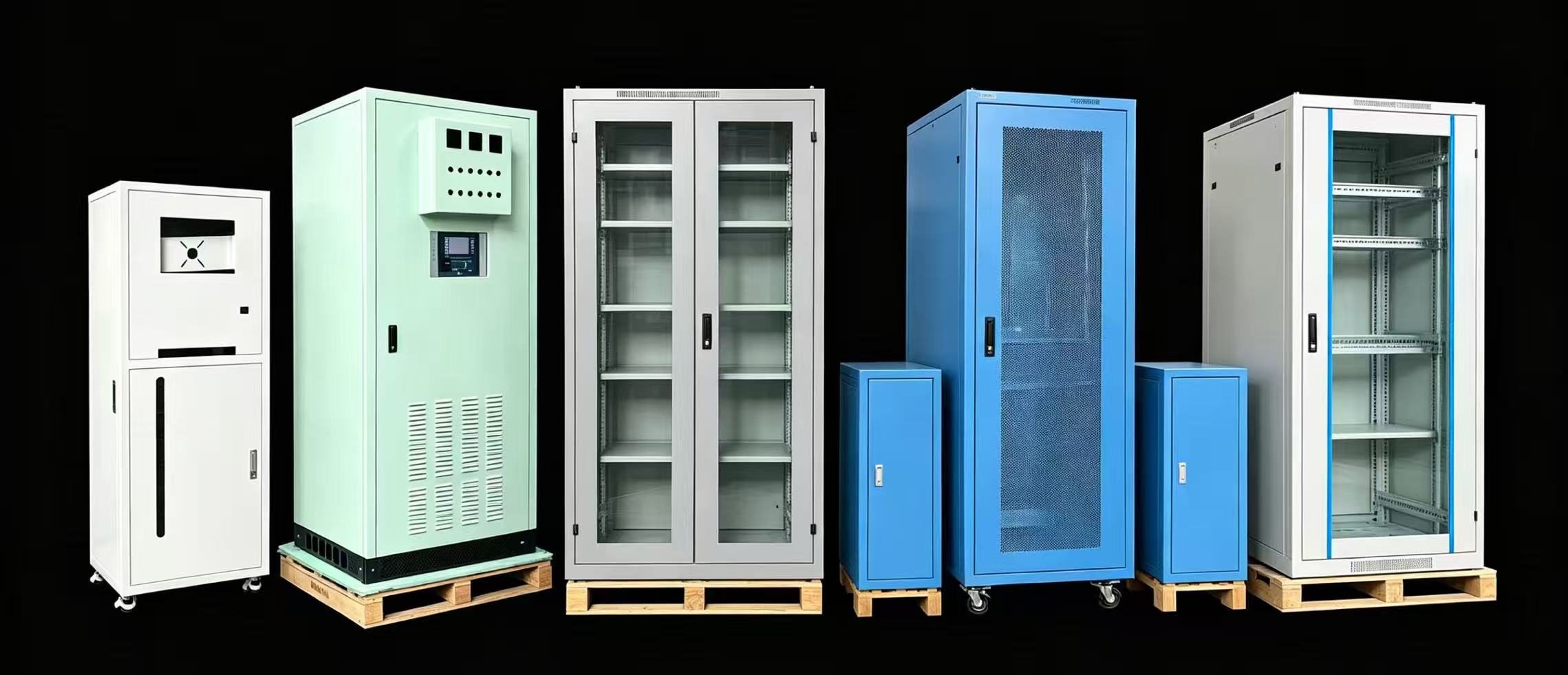
A weak rack can hide a serious risk. Heat builds up slowly.1 I believe the right rack and cooling design can protect uptime.
Tripp Lite racks and cooling solutions matter because they treat the cabinet as part of the whole IT system. I see the best rack design as a mix of load strength, airflow, cable space, physical protection, and clear heat control for servers, switches, storage, and UPS equipment.
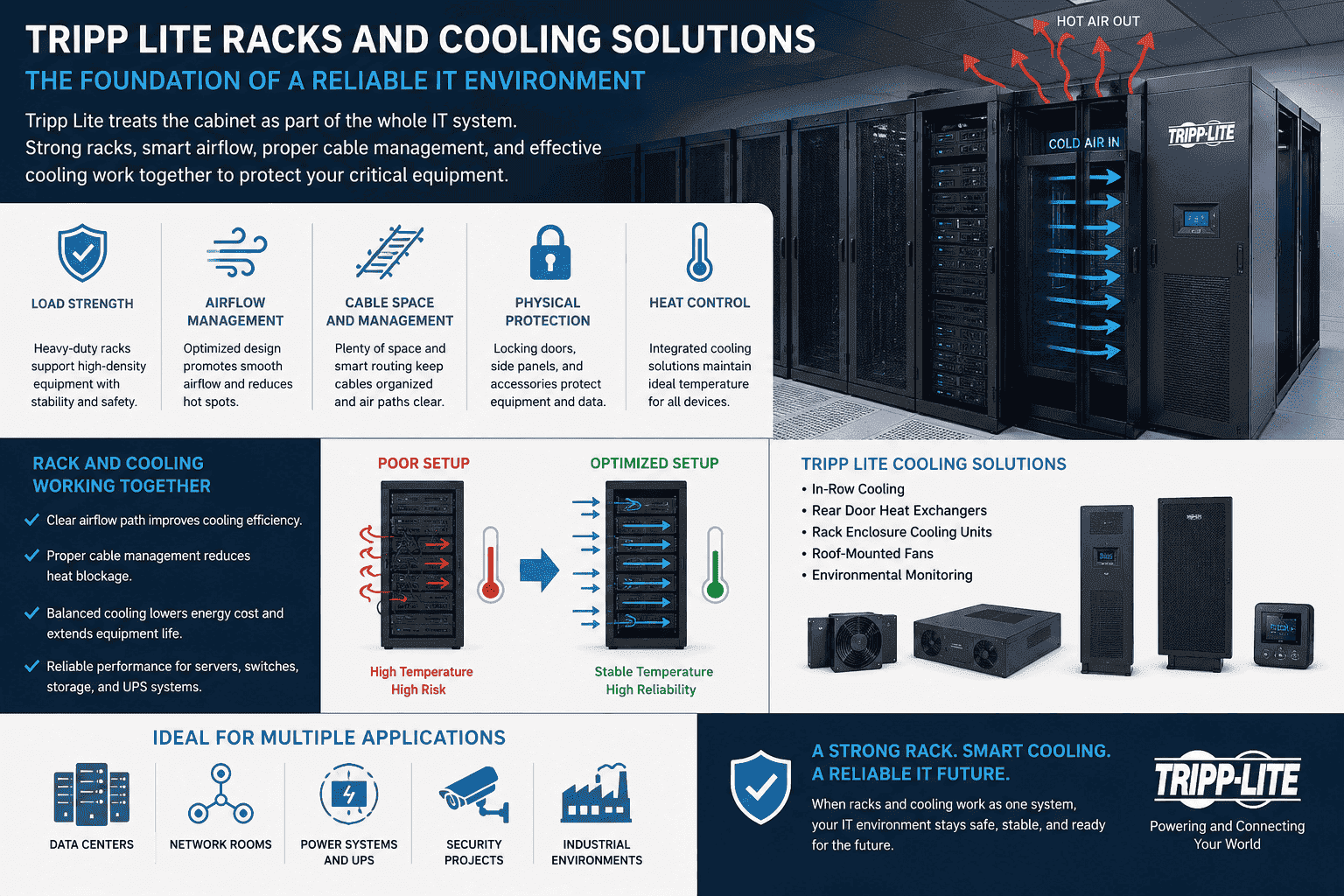
I have worked with many network cabinet and server cabinet projects. I no longer see a cabinet as only a steel box. I see it as the base of the whole IT room. When a rack is weak, the equipment is at risk. When airflow is poor, the heat stays inside.2 When cables block the air path, even a good cooling system works harder than it should. Tripp Lite gives a useful example of how racks and cooling should work together. I use this idea when I design or customize cabinets for data centers, network rooms, power systems, security projects, and industrial sites.
Why Is a Rack More Than a Metal Cabinet?
A cheap cabinet may look fine at first. The problem starts when heat, weight, dust, and cable mess appear together. I solve this from the structure.
A rack is more than a metal cabinet because it carries equipment, guides airflow, protects hardware, organizes cables, and supports future maintenance.3 I treat the rack as a working part of the IT system, not as simple storage.
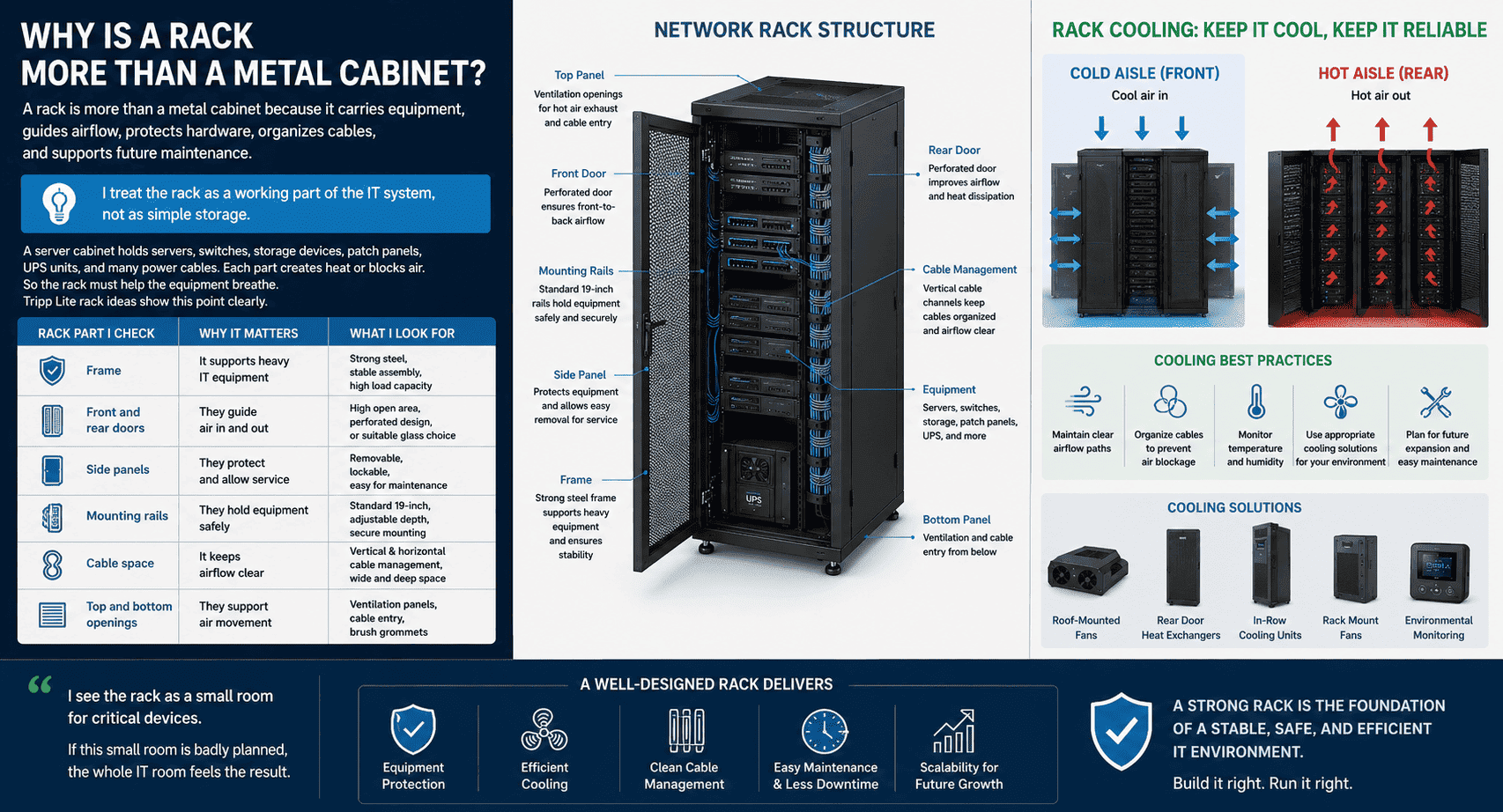
I have seen customers focus only on size and price. I understand that budget matters. But I also know that a rack must support real operation. A server cabinet holds servers, switches, storage devices, patch panels, UPS units, and many power cables. Each part creates heat or blocks air. So the rack must help the equipment breathe. Tripp Lite rack ideas show this point clearly. The cabinet body, doors, rails, side panels, and cable paths all affect cooling. I use the same thinking in custom cabinet work. I check the full use case before I suggest a structure.
| Rack Part I Check | Why It Matters | What I Look For |
|---|---|---|
| Frame | It supports heavy IT equipment | Strong steel and stable assembly |
| Front and rear doors | They guide air in and out | High open area or suitable glass choice |
| Side panels | They protect and allow service | Removable design |
| Mounting rails | They hold equipment safely | Standard 19-inch layout |
| Cable space | It keeps airflow clear | Vertical and horizontal cable management |
| Top and bottom openings | They support air movement | Proper ventilation and cable entry |
I see the rack as a small room for critical devices. If this small room is badly planned, the whole IT room feels the result.
How Do Tripp Lite Style Racks Support Better Cooling?
Heat does not wait for anyone. It rises, spreads, and shortens equipment life. I reduce this risk by designing airflow before installation.
Tripp Lite style racks support better cooling through perforated doors, top and bottom ventilation, clean cable paths, strong frame design, and space for airflow control. I see these details as the base of stable server operation.
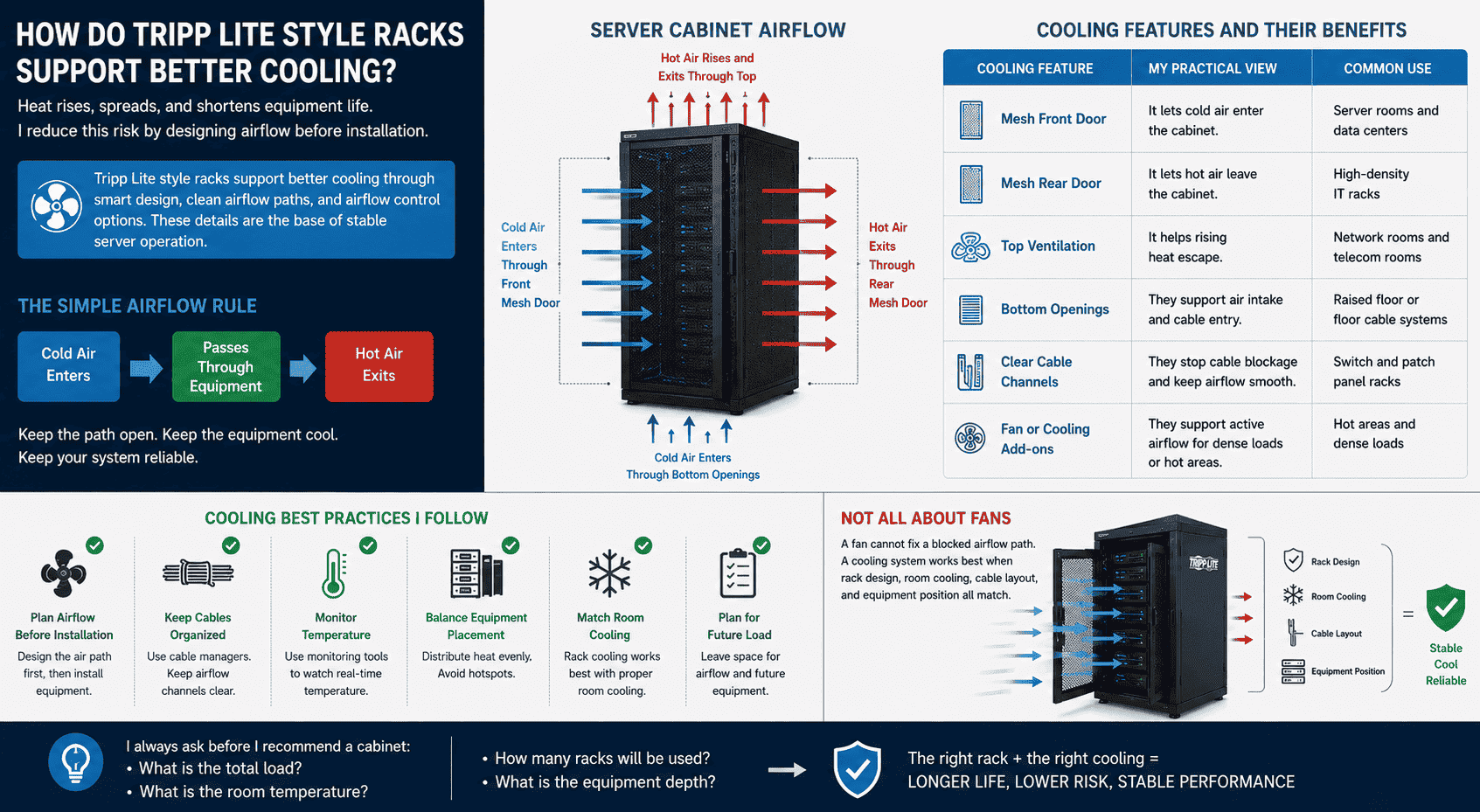
I often explain cooling in a simple way. Cold air must enter the rack. Hot air must leave the rack. The path between these two points must stay open. A cabinet with high-density mesh front and rear doors can help air move through the equipment.4 Many Tripp Lite rack designs use perforated doors with high open area, often more than 75%5. This helps cold air from the room enter the cabinet. It also helps hot air leave from the rear side. I use similar logic when I make custom mesh doors for server cabinets and network cabinets.
| Cooling Feature | My Practical View | Common Use |
|---|---|---|
| Mesh front door | It lets cold air enter | Server rooms and data centers |
| Mesh rear door | It lets hot air leave | High-density IT racks |
| Top ventilation | It helps rising heat escape | Network rooms and telecom rooms |
| Bottom openings | They support air intake and cable entry | Raised floor or floor cable systems |
| Clear cable channels | They stop cable blockage | Switch and patch panel racks |
| Fan or cooling add-ons | They support active airflow | Hot areas and dense loads |
I also remind customers that adding fans is not the whole answer. A fan cannot fix a blocked airflow path.6 A cooling system works best when the rack, room cooling, cable layout, and equipment position all match. This is why I ask about load, room temperature, rack quantity, and equipment depth before I recommend a cabinet.
What Rack Specifications Matter for Heavy IT Loads?
A heavy rack failure can damage equipment and stop service. I take load capacity seriously because servers and UPS modules are not light.
Important rack specifications include steel thickness, frame strength, load capacity, 19-inch mounting standard, cabinet height, depth, door type, coating quality, and cable management space. I check these points before I confirm any rack solution.
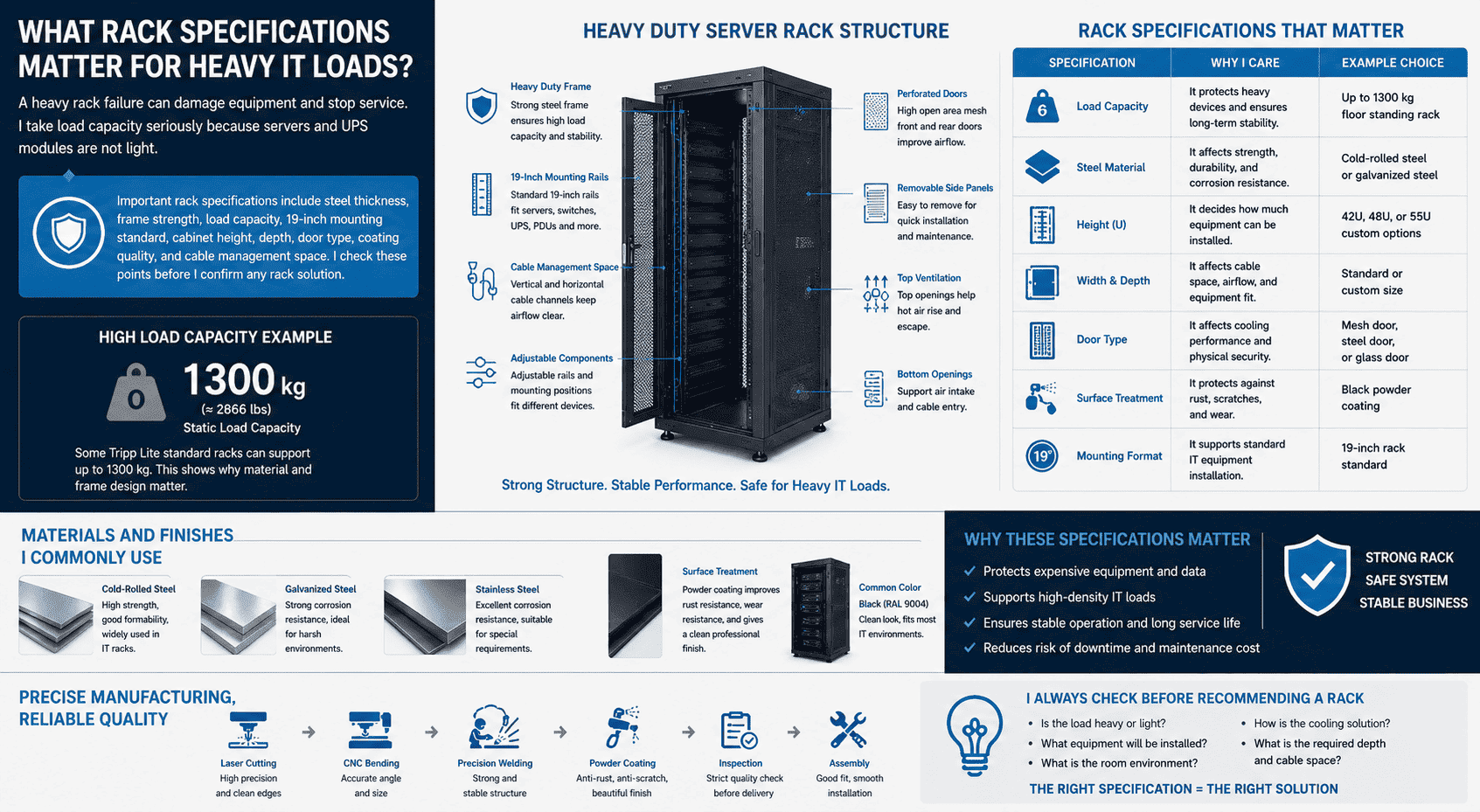
I see many high-density projects where the cabinet must carry much more than switches. It may need to hold servers, storage arrays, UPS power modules, PDUs, and battery-related parts. Tripp Lite standard cabinets are known for heavy-duty structure, and some standard racks can support around 1300 kg. This kind of load capacity shows why material and frame design matter. I use cold-rolled steel, stainless steel, or galvanized steel based on the project need. I also use powder coating to improve rust resistance and wear resistance7. A black powder finish is common because it looks clean and works well in many IT rooms.
| Specification | Why I Care | Example Choice |
|---|---|---|
| Load capacity | It protects heavy devices | High-load floor standing rack |
| Steel material | It affects strength and life | Cold-rolled steel or galvanized steel |
| Height | It decides equipment capacity | 42U, 48U, or 55U custom |
| Width and depth | It affects cable and airflow space | Standard or custom size |
| Door type | It affects cooling and security | Mesh, steel, or glass door |
| Surface treatment | It protects against rust and scratches | Powder coating |
| Mounting format | It supports standard equipment | 19-inch rack standard8 |
I also pay attention to assembly. A cabinet can have good material but poor fit. That still creates problems. Doors may not close well. Rails may not align. Side panels may shake. So I check cutting, bending, welding, coating, and final assembly. In my own production work, I use laser cutting, CNC bending, precision welding, powder coating, and inspection to keep cabinet size and structure stable.
How Should Airflow and Cable Management Work Together?
Good cooling can fail when cables block the air. I have seen neat cable planning reduce heat problems faster than adding more fans.
Airflow and cable management should work together by keeping front-to-back air paths open, separating power and data cables9, using vertical channels, using horizontal managers, and avoiding cable bundles near hot exhaust areas.
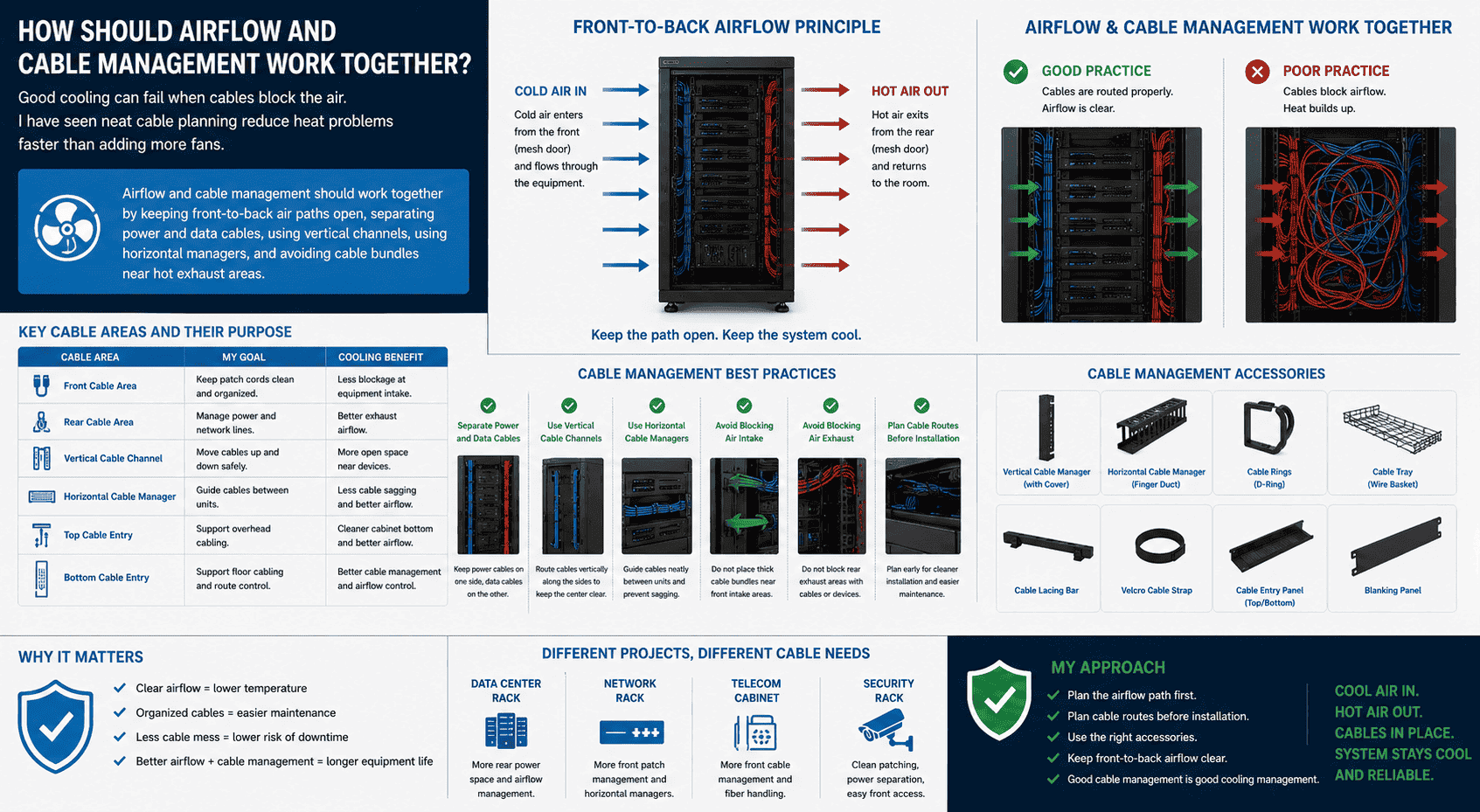
I always look inside the rack before I judge the cooling result. A cabinet may have mesh doors and good room cooling, but thick cable bundles can still block cold air. Network projects often have many patch cords, fiber cables, power cords, and grounding wires. If the cabinet has no vertical cable tray or horizontal cable manager, the installer may tie cables in the wrong place. This can reduce airflow and make later maintenance slow. Tripp Lite rack systems often give attention to cable space and accessory layout. I think this detail is not small. It affects daily work.
| Cable Area | My Goal | Cooling Benefit |
|---|---|---|
| Front cable area | Keep patch cords clean | Less blockage at equipment intake |
| Rear cable area | Manage power and network lines | Better exhaust airflow |
| Vertical cable channel | Move cables up and down safely | More open space near devices |
| Horizontal cable manager | Guide cables between units | Less cable sagging |
| Top cable entry | Support overhead cabling | Cleaner cabinet bottom |
| Bottom cable entry | Support floor cabling | Better route control |
I also tell customers to plan cable routes before they buy the cabinet. A 42U rack full of switches needs different cable space than a rack with several servers. A telecom cabinet may need more front cable management. A data center rack may need more rear power space. A security monitoring project may need clean patching and easy front access. I see cable management as cooling management. The two tasks should not be separated.
Which Rack Types Fit Different Project Sites?
One rack cannot fit every site. I ask about the room, wall, weather, load, and service style before I suggest a model.
Different sites need different racks. I use floor standing racks for data centers, wall-mounted cabinets for small network points, outdoor waterproof cabinets for exposed areas, and custom cabinets for special industrial or power projects.
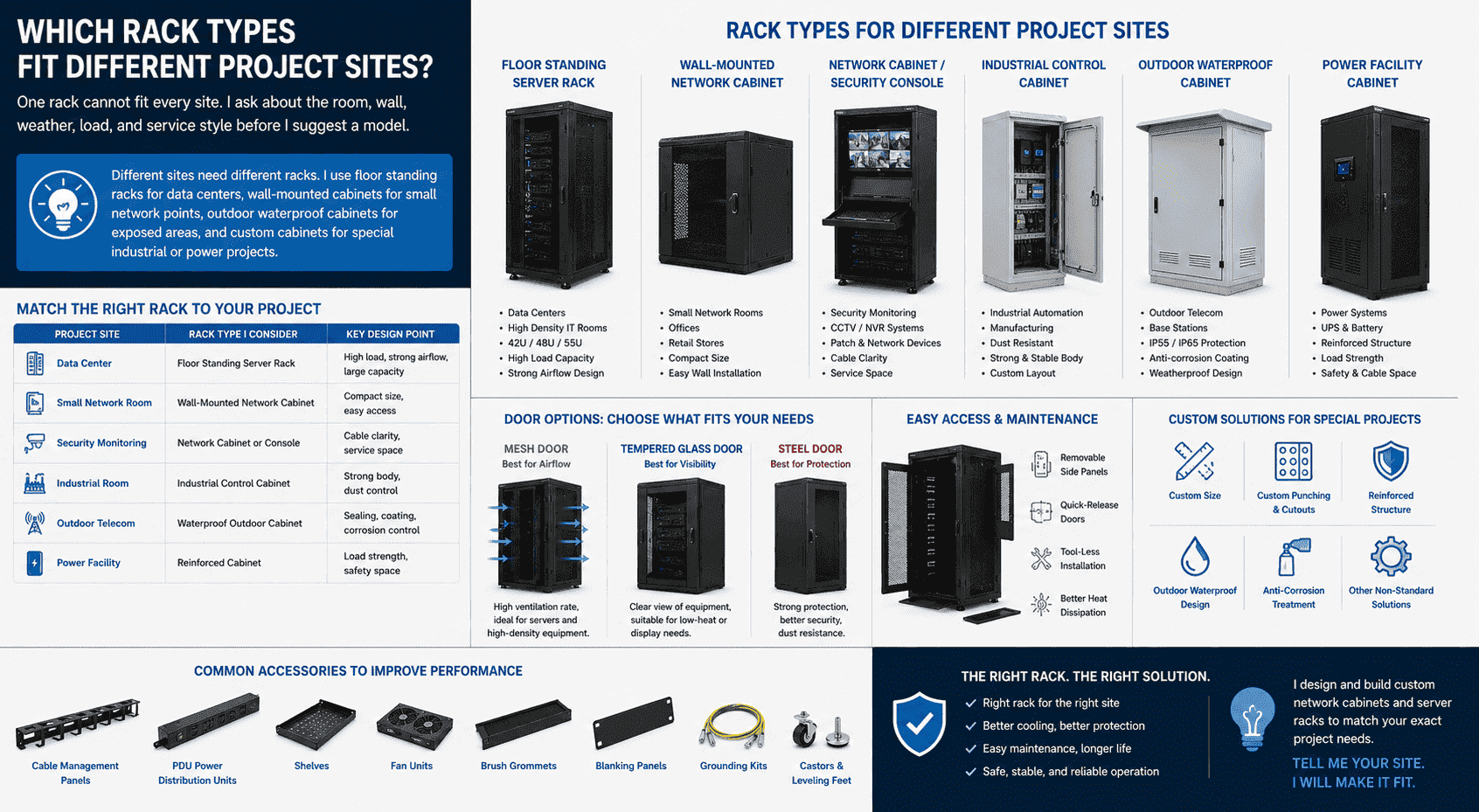
I see Tripp Lite as a strong example because its rack range covers many use cases. A data center may need 42U or 48U floor standing racks. A high-capacity room may even need a 55U ultra-high cabinet. A small office or security point may need a wall-mounted cabinet. A telecom or outdoor power project may need waterproof, anti-rust, and dust-resistant design10. I use the same project-based thinking in my custom work. I do not push one model for every buyer. I ask what the cabinet must hold, where it will stand, and how often people need to open it.
| Project Site | Rack Type I Consider | Key Design Point |
|---|---|---|
| Data center | Floor standing server rack | High load and strong airflow |
| Small network room | Wall-mounted network cabinet | Compact size and easy access |
| Security monitoring | Network cabinet or console | Cable clarity and service space |
| Industrial room | Industrial control cabinet | Strong body and dust control |
| Outdoor telecom | Waterproof outdoor cabinet | Sealing, coating, and corrosion control |
| Power facility | Reinforced cabinet | Load strength and safety space |
I also care about door choice. A mesh door is usually better for airflow. A tempered glass door gives clear visibility and can work for low-heat or display needs. A steel door gives stronger protection. Removable side panels help fast maintenance. I make custom size, custom punching, reinforced structure, outdoor waterproof design, anti-corrosion treatment, and other non-standard solutions when the standard model does not fit the site.
Why Will AI Make Rack Cooling Requirements Stricter?
AI equipment uses more power. More power means more heat.11 I believe rack cooling will become a bigger buying decision, not a small detail.
AI will make rack cooling stricter because high-power servers create higher heat density. I expect future racks to need stronger airflow control, better structure, smarter monitoring, and more careful cable and power planning.
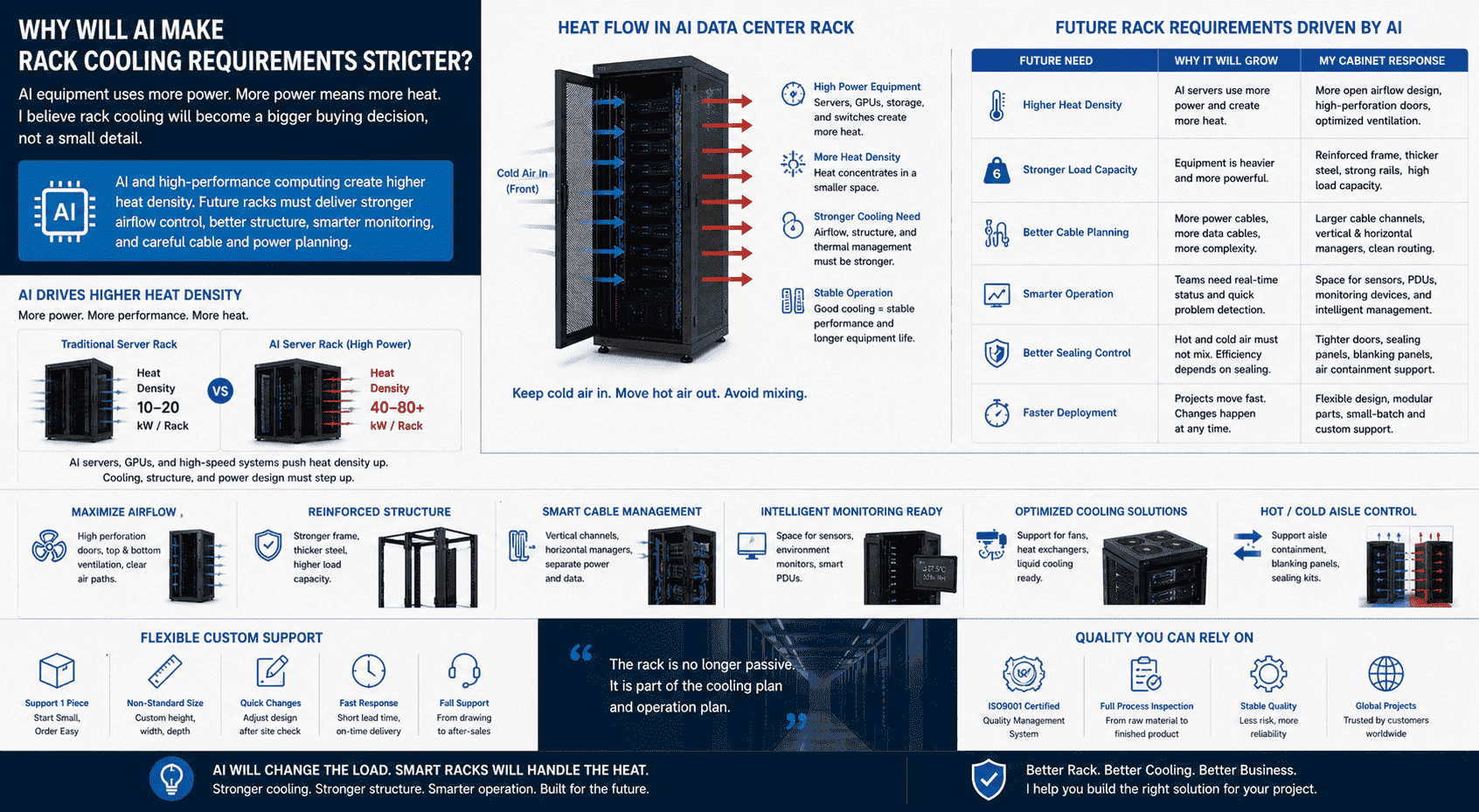
I watch the IT market closely because cabinet demand changes with equipment demand. AI computing, cloud platforms, edge data centers, and high-speed network systems all push more power into each rack. This means the old idea of “just add some fans” will not be enough. A cabinet must support stable airflow, high load, clean cable routes, strong power layout, and possible sensor or monitoring systems. Tripp Lite’s focus on rack and cooling systems gives a useful direction. It shows that the rack is no longer passive. It is part of the cooling plan and operation plan.
| Future Need | Why It Will Grow | My Cabinet Response |
|---|---|---|
| Higher heat density | AI servers use more power | More open airflow design |
| Stronger load capacity | Equipment is heavier | Reinforced frame and rails |
| Better cable planning | More power and data lines appear | Larger cable channels |
| Smarter operation | Teams need fast status checks | Space for sensors and PDUs |
| Better sealing control | Hot and cold air must not mix | Better panel and door fit |
| Faster deployment | Projects move quickly | Small-batch and custom support |
I believe rack makers must become more flexible. Customers may need one sample cabinet first. They may need a non-standard size. They may need fast changes after site measurement. In my business, I support small orders starting from one piece because many overseas projects need this flexibility. I also follow ISO9001 quality control and full-process inspection, because future cooling and load demands will leave less room for careless manufacturing.
Conclusion
I see racks and cooling as one system. A strong, well-ventilated, well-organized cabinet protects equipment, uptime, and future IT growth.
"NREL Joins $40 Million Effort To Advance Data Center Cooling ...", https://www.nlr.gov/news/detail/program/2023/nrel-joins-effort-to-advance-data-center-cooling-efficiency. ASHRAE thermal guidance for data processing environments identifies control of intake-air temperature and rack-level airflow as central to maintaining acceptable IT equipment operating conditions. Evidence role: general_support; source type: institution. Supports: Data-center thermal guidance recognizes heat management around IT equipment as a reliability and operational concern.. Scope note: This supports the general thermal-risk context rather than proving that heat always builds slowly in every rack. ↩
"Cooling & Air Management", https://datacenters.lbl.gov/cooling-air-management. Research and best-practice guidance on data-center airflow management describe inadequate separation and movement of supply and exhaust air as causes of hot-air recirculation and elevated rack inlet temperatures. Evidence role: mechanism; source type: research. Supports: Poor airflow management can allow hot exhaust air to recirculate or remain near equipment intakes, increasing equipment inlet temperatures.. ↩
"Data Center Server Rack: The Ultimate Guide [2025]", https://encoradvisors.com/data-center-server-rack/. Data-center infrastructure guidance characterizes server racks as physical support systems for standardized equipment mounting, airflow management, cable organization, equipment access, and protection. Evidence role: definition; source type: institution. Supports: Equipment racks are commonly described as infrastructure that supports standardized mounting, airflow, cable routing, access, and protection of IT equipment.. Scope note: This is definitional support and may not cover every rack design or installation context. ↩
"Manage Airflow for Cooling Efficiency - Energy Star", https://www.energystar.gov/products/data_center_equipment/16-more-ways-cut-energy-waste-data-center/manage-airflow-cooling-efficiency. Data-center airflow-management literature notes that perforated front and rear rack doors support the common front-to-back cooling path by reducing door-related airflow resistance. Evidence role: mechanism; source type: research. Supports: Perforated or mesh rack doors reduce obstruction to front-to-back airflow used by many rack-mounted servers.. Scope note: The effect depends on the door open area, equipment fan design, cable obstruction, and room-level cooling layout. ↩
"Wall-Mount Rack Cabinets - Tripp Lite - Eaton", https://tripplite.eaton.com/video/rack-enclosure-wall-mount/64790. Manufacturer specifications for selected Eaton Tripp Lite SmartRack cabinets describe perforated front and rear doors with high open area, supporting the claim that some Tripp Lite rack designs use doors intended to reduce airflow restriction. Evidence role: case_reference; source type: other. Supports: Selected Tripp Lite or Eaton Tripp Lite SmartRack specifications state that rack doors are perforated and have a high percentage of open area, commonly around or above 75%.. Scope note: This supports specific Tripp Lite models and should not be generalized to every Tripp Lite rack without checking the relevant model datasheet. ↩
"[PDF] Data Center Airflow Management Retrofit", https://datacenters.lbl.gov/sites/default/files/airflow-doe-femp.pdf. Data-center airflow-management studies explain that obstruction, bypass airflow, and exhaust recirculation can reduce cooling effectiveness; fan capacity alone does not ensure adequate equipment inlet conditions. Evidence role: mechanism; source type: research. Supports: Airflow obstructions and poor separation of hot and cold air can undermine cooling effectiveness even when mechanical airflow is present.. ↩
"Graphene-reinforced epoxy powder coating to achieve high ...", https://www.sciencedirect.com/science/article/pii/S2238785422013898. Materials and coatings literature describes powder coating as a protective polymer finish for metals that can improve corrosion resistance and abrasion or wear performance when properly applied and cured. Evidence role: mechanism; source type: research. Supports: Powder coatings are used as protective finishes that can improve corrosion resistance and surface durability on metal substrates.. Scope note: Performance depends on coating chemistry, pretreatment, thickness, curing quality, and the service environment. ↩
"19-inch rack - Wikipedia", https://en.wikipedia.org/wiki/19-inch_rack. Reference sources on the 19-inch rack describe it as a standardized mounting system for electronic equipment, with dimensions governed by standards including EIA-310 and IEC 60297. Evidence role: definition; source type: encyclopedia. Supports: The 19-inch rack is a standardized frame format for mounting electronic equipment, associated with standards such as EIA-310 and IEC 60297.. Scope note: An encyclopedia source is suitable for basic definition and historical context; formal compliance claims should cite the actual standard. ↩
"Cabling a Data Center to TIA-942 Standard - Fosco Connect", https://www.fiberoptics4sale.com/blogs/archive-posts/95047686-cabling-a-data-center-to-tia-942-standard?srsltid=AfmBOoqnvQZkFwvtgI0deSUjyu5YXxodL0NT1z4qQkNeD_opX16Ht8FM. Structured-cabling guidance from standards and professional bodies recommends planned separation and routing of power and communications cabling to reduce interference risk and improve maintainability. Evidence role: expert_consensus; source type: institution. Supports: Structured cabling guidance commonly recommends managing power and communications cabling to reduce interference risk, maintain organization, and support serviceability.. Scope note: Required separation distances vary by cable type, shielding, voltage, jurisdiction, and applicable standard. ↩
"IP code", https://en.wikipedia.org/wiki/IP_code. Enclosure-rating systems such as IEC 60529 IP codes and NEMA enclosure types define levels of protection against dust and water ingress, providing a standards basis for outdoor cabinet requirements. Evidence role: definition; source type: institution. Supports: Outdoor electrical and telecom enclosures are commonly evaluated for ingress protection against dust and water, and may also require corrosion-resistant materials or finishes.. Scope note: Ingress-protection ratings address dust and water entry; corrosion resistance may require additional material or coating specifications. ↩
"How Researchers Are Driving Advances for Data Centers", https://eta.lbl.gov/news/how-researchers-are-driving-advances-data-centers. Institutional analyses of data-center energy use report that AI workloads are increasing demand for high-power computing infrastructure, while data-center thermal principles require nearly all IT electrical power consumed in servers to be removed as heat. Evidence role: mechanism; source type: institution. Supports: Higher IT electrical power use increases heat that must be rejected by the cooling system, and AI workloads are associated with growing data-center power-density demands.. Scope note: This supports the general power-to-heat relationship and AI-related demand trend, not the exact heat output of a specific AI server or rack. ↩
