
Soundproof Quiet Server Racks & Cabinets: Where Do They Really Matter?
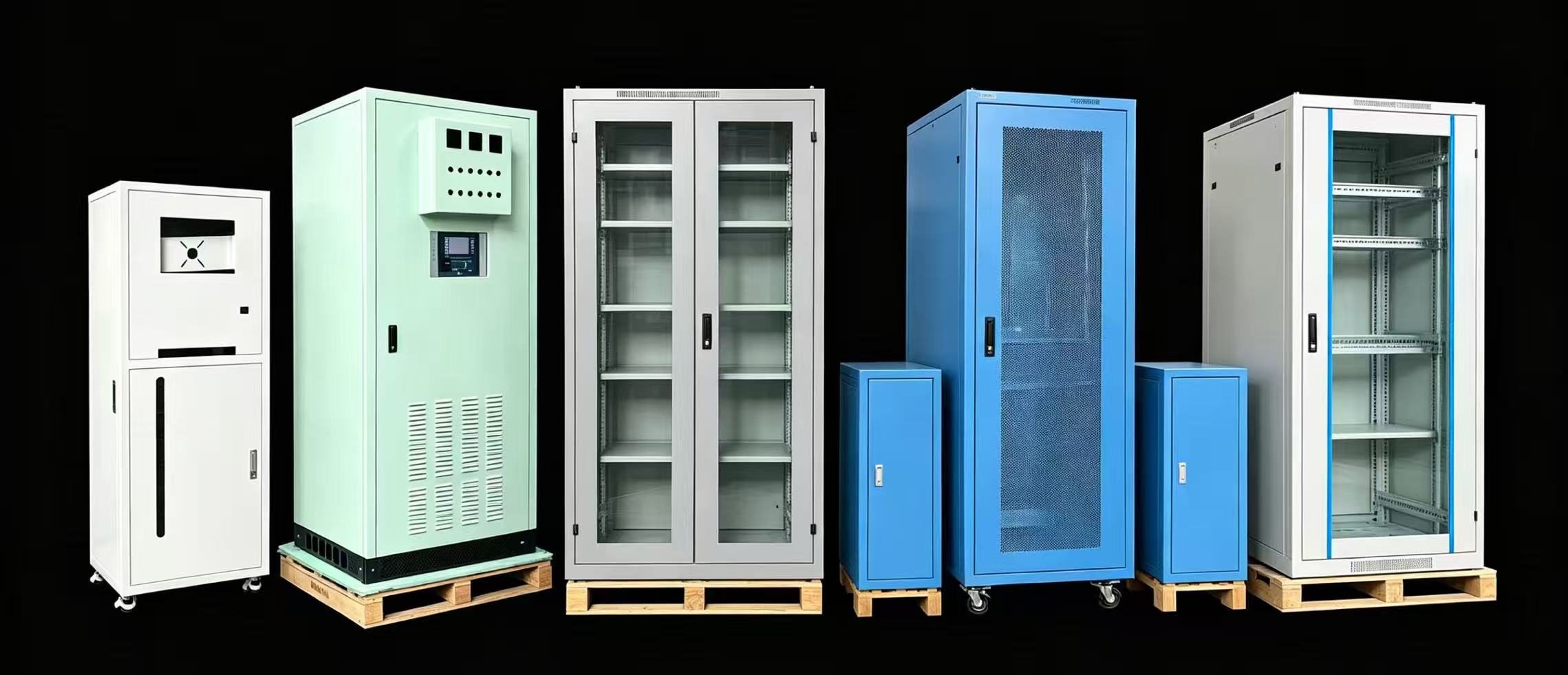
Server noise can break focus fast. I see small offices buy standard racks, then struggle with fan noise, hard drive vibration, and open mesh doors.
Soundproof quiet server racks and cabinets reduce equipment noise while keeping standard 19-inch installation and safe cooling. I use them in offices, labs, research rooms, and small server areas where normal network cabinets cannot control sound. A proper design can lower noise by about 15–36 dB(A)1.
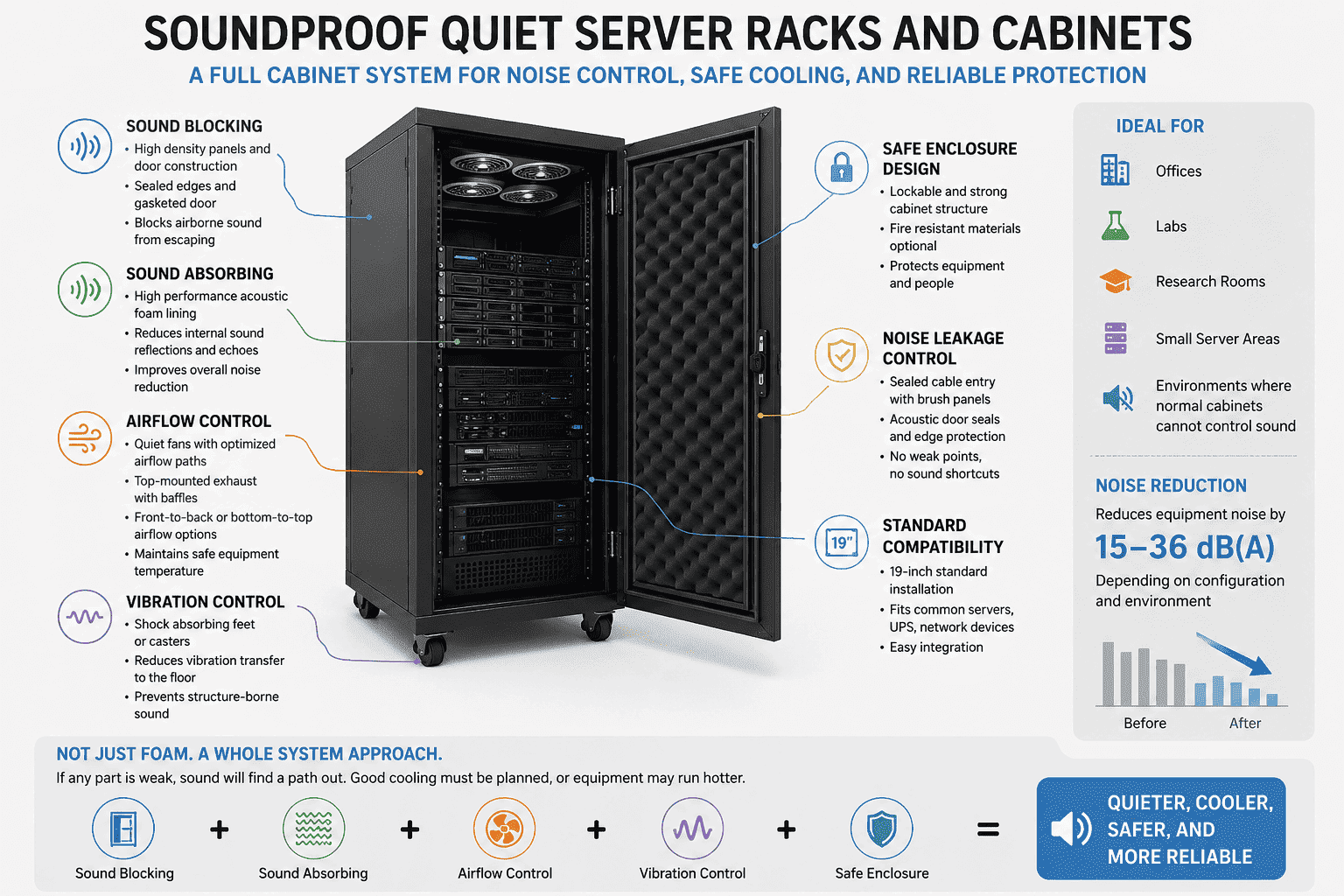
I do not see a quiet server cabinet as a normal cabinet with foam added inside. I see it as a full cabinet system. It needs sound blocking, sound absorbing, airflow control, vibration control, and safe enclosure design. If one part is weak, the sound will find a path out. If cooling is not planned, the equipment may run hotter. This is why I always look at the whole structure first, not only the outside size.
Why Do Offices And Labs Need Soundproof Quiet Server Cabinets?
Noise is not only annoying. I have seen it reduce work focus, disturb meetings, and make a small network room feel stressful.
Soundproof quiet server cabinets are needed in offices, office buildings, research institutes, medical labs, and small server rooms. These places need servers, switches, and computing devices near people. A quiet cabinet reduces fan, disk, and vibration noise while keeping the equipment safe and organized.
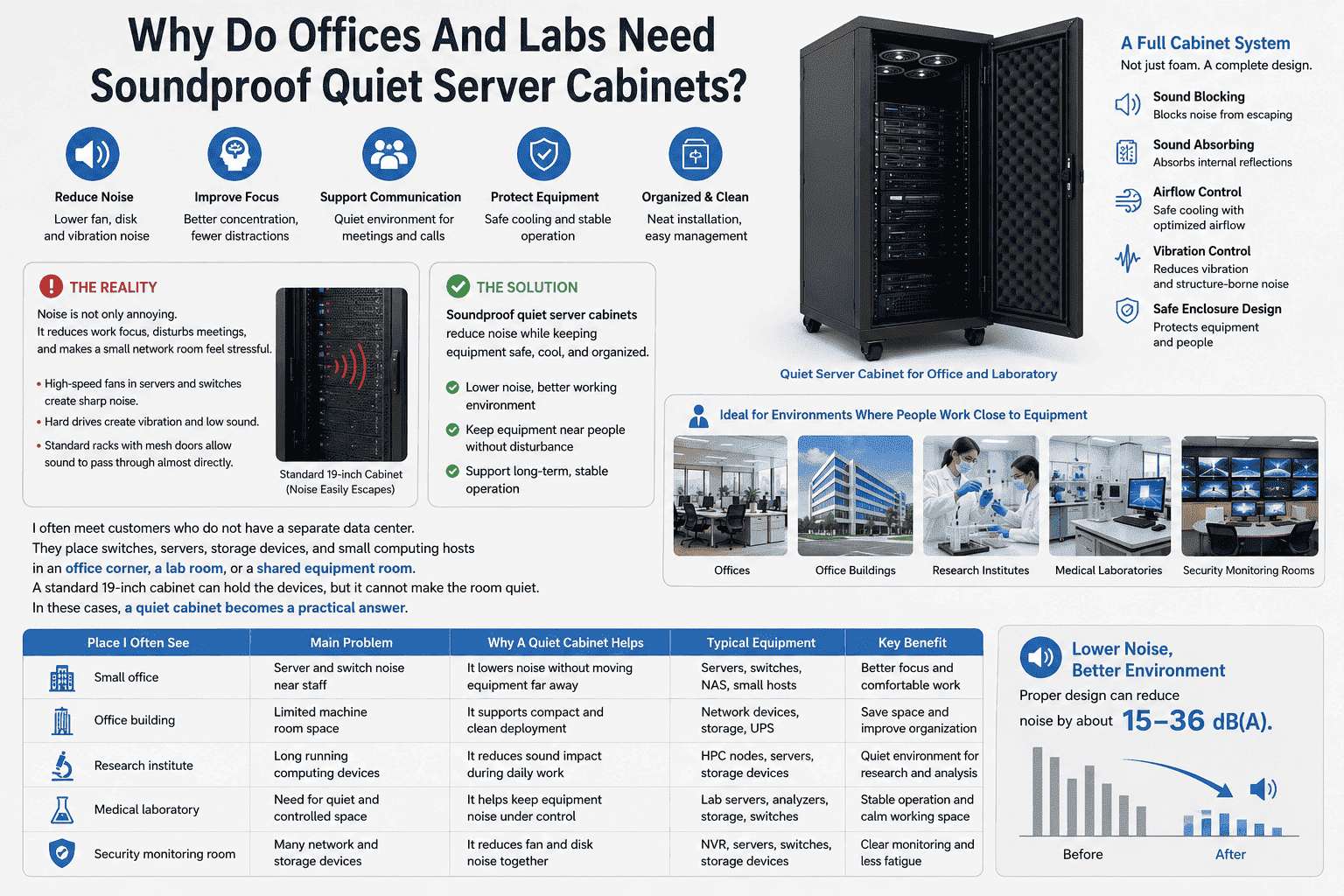
I often meet customers who do not have a separate data center. They place switches, servers, storage devices, and small computing hosts in an office corner, a lab room, or a shared equipment room. A standard 19-inch cabinet2 can hold the devices, but it cannot make the room quiet. Most standard racks use mesh front and rear doors. These doors are good for airflow, but they allow sound to pass through almost directly3. The high-speed fans in switches and servers create sharp noise.4 Hard drives create vibration and low sound. These sounds mix together and spread through the room.
I see the need more clearly in places where people must think, test, and talk. A medical lab needs stable equipment, but it also needs a calm working space. A research institute may run computing tasks for long hours, but staff may sit close to the equipment. A small company may not want to rent a separate machine room. In these cases, a quiet cabinet becomes a practical answer.
| Place I Often See | Main Problem | Why A Quiet Cabinet Helps |
|---|---|---|
| Small office | Server and switch noise near staff | It lowers noise without moving equipment far away |
| Office building | Limited machine room space | It supports compact and clean deployment |
| Research institute | Long running computing devices | It reduces sound impact during daily work |
| Medical laboratory | Need for quiet and controlled space | It helps keep equipment noise under control |
| Security monitoring room | Many network and storage devices | It reduces fan and disk noise together |
How Is A Quiet Server Cabinet Different From A Standard 19-Inch Cabinet?
A normal cabinet holds equipment. A quiet cabinet holds equipment and controls sound, airflow, vibration, and enclosure safety at the same time.
A soundproof quiet server cabinet is different because it uses a closed acoustic system. It has layered sound absorption, solid composite doors, sealing strips, controlled ventilation paths, vibration reduction, and a standard 19-inch internal mounting structure for servers and network devices.
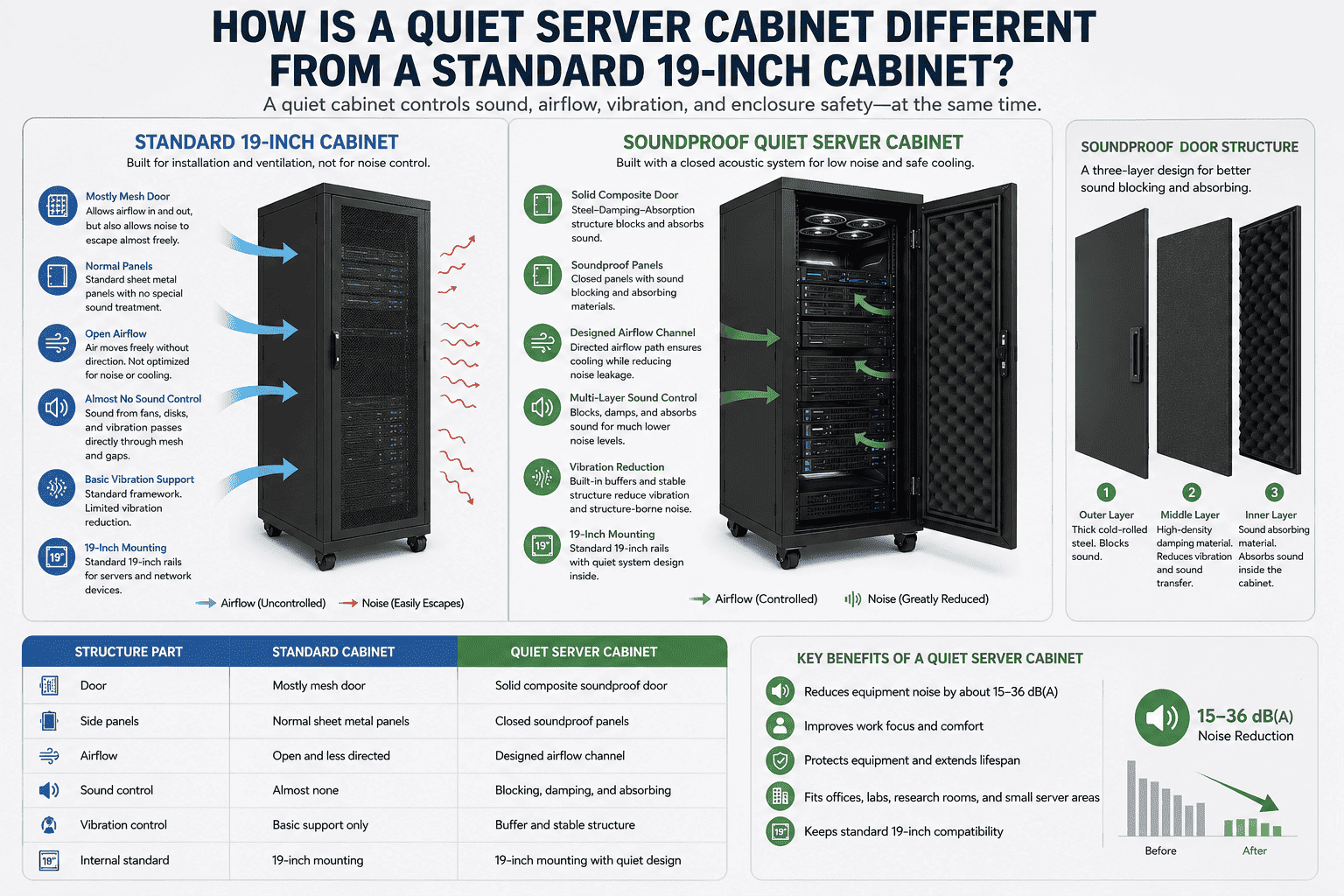
I always explain this difference in a simple way. A standard cabinet is mainly a frame, panels, doors, and rails. It is built for installation, wiring, and ventilation. It usually has mesh doors. It often allows free airflow. It also allows free noise movement. A quiet server cabinet is built with a different goal. It must stop sound from leaking out, but it still needs to keep equipment cool. This needs more careful design.
The cabinet door is a key part. In my quiet cabinet design, the door can use a solid double-layer composite sheet metal structure. The outside layer can be thick cold-rolled steel. This layer helps block sound. The middle layer can use high-density soundproof damping material. This layer reduces vibration and sound transfer. The inner layer can use sound absorbing material. This layer absorbs sound inside the cabinet. These three layers form a steel, damping, and absorption structure.
The side panels, top cover, and base also need closed soundproof treatment. The door edges need sealing strips. The cabinet body should be stable and tight. If a gap remains, sound can leak out. This is why I do not treat quiet cabinets as simple foam-lined racks.
| Structure Part | Standard Cabinet | Quiet Server Cabinet |
|---|---|---|
| Door | Mostly mesh door | Solid composite soundproof door |
| Side panels | Normal sheet metal panels | Closed soundproof panels |
| Airflow | Open and less directed | Designed airflow channel |
| Sound control | Almost none | Blocking, damping, and absorbing |
| Vibration control | Basic support only | Buffer and stable structure |
| Internal standard | 19-inch mounting | 19-inch mounting with quiet design |
What Noise Sources Does A Soundproof Server Rack Control?
I first identify the noise source. If I do not know where the sound comes from, I cannot design the right cabinet.
A soundproof server rack controls fan noise, hard drive vibration, airflow noise, and cabinet resonance. It reduces sound by using sealed doors, layered acoustic materials, damping layers, vibration buffering, and a welded or reinforced cabinet body that limits sound leakage and panel shaking.
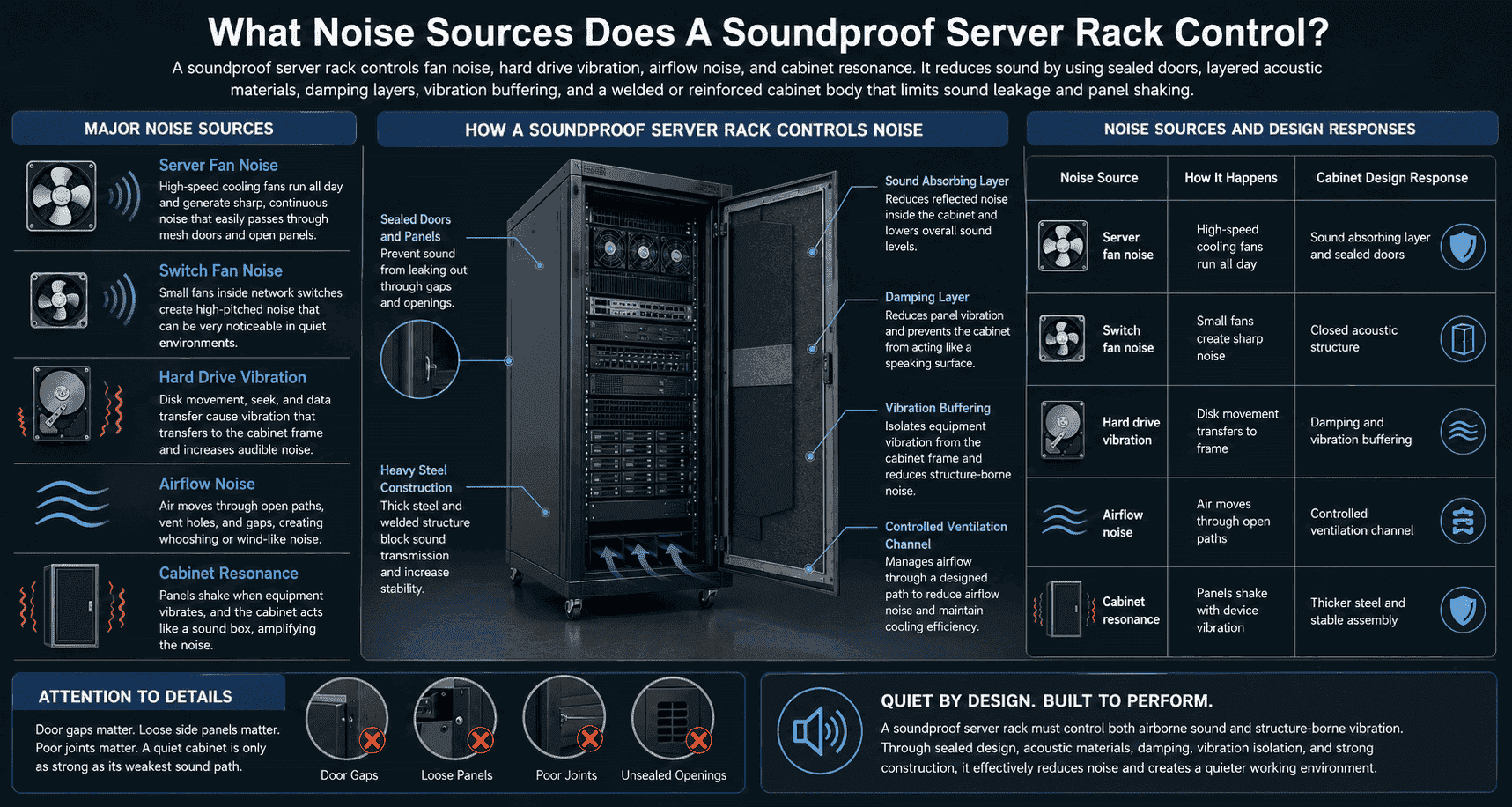
The loudest noise usually comes from cooling fans. Servers and switches use high-speed fans because they need stable heat removal. These fans can produce sharp, continuous sound. The sound passes through mesh doors and open panels very easily. Storage devices can also create vibration. Hard drives spin, seek, and transfer small movements into the cabinet frame.5 If the cabinet is thin or loose, the cabinet may act like a sound box. It can make the vibration easier to hear.
A quiet cabinet must control both airborne sound and structure-borne vibration. Airborne sound moves through openings and thin panels. Structure-borne vibration moves through rails, frames, and panels.6 I use closed panels, sealing design, damping material, and stable cabinet construction to deal with these two paths. The internal sound absorbing layer helps reduce reflected noise inside the cabinet.7 The damping layer helps reduce panel vibration.8 The thick outer steel layer helps block sound from leaving the cabinet.
I also pay attention to small details. Door gaps matter. Loose side panels matter. Poor joints matter. A quiet cabinet is only as strong as its weakest sound path.
| Noise Source | How It Happens | Cabinet Design Response |
|---|---|---|
| Server fan noise | High-speed cooling fans run all day | Sound absorbing layer and sealed doors |
| Switch fan noise | Small fans create sharp noise | Closed acoustic structure |
| Hard drive vibration | Disk movement transfers to frame | Damping and vibration buffering |
| Airflow noise | Air moves through open paths | Controlled ventilation channel |
| Cabinet resonance | Panels shake with device vibration | Thicker steel and stable assembly |
How Can A Quiet Cabinet Reduce Noise Without Hurting Cooling?
I cannot only close the cabinet and hope it stays safe. Heat is as important as noise.
A quiet server cabinet reduces noise without hurting cooling by using controlled air channels. It guides inlet and outlet airflow instead of leaving airflow random.9 This design lowers sound leakage while helping servers, switches, and network devices keep stable operating temperatures.
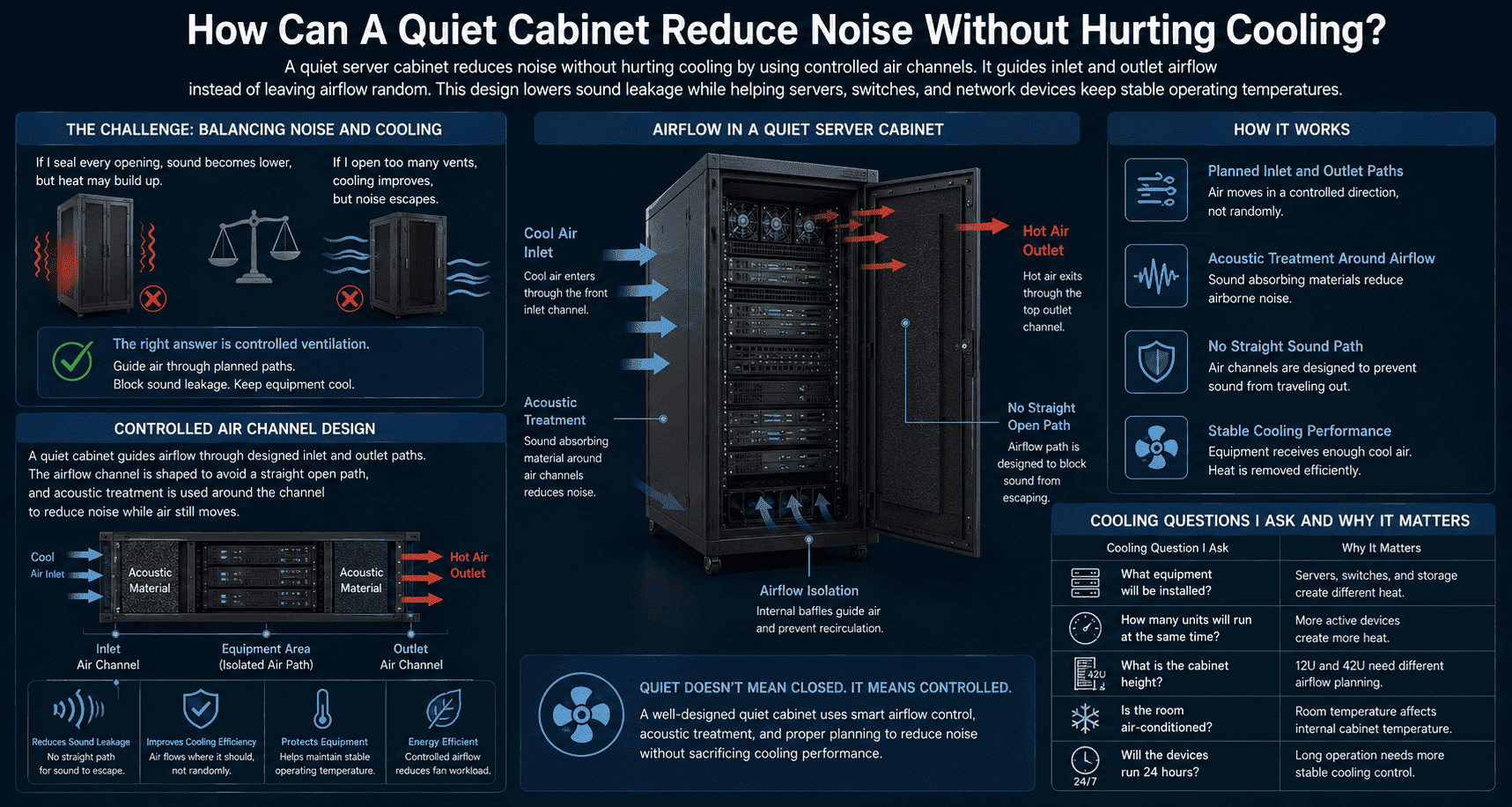
Cooling is one of the hardest parts of a soundproof cabinet. If I seal every opening, sound becomes lower, but heat may build up.10 If I open too many vents, cooling improves, but noise escapes. The right answer is not full closure or full opening. The right answer is controlled ventilation.
A normal mesh cabinet lets air move in many directions. This can create random airflow. It may also send hot air back into the equipment area. A quiet cabinet should guide air through planned inlet and outlet paths. The airflow channel should be shaped so sound does not have a straight open path out of the cabinet. The cabinet can use internal acoustic treatment around the airflow path. This helps reduce noise while air still moves.
I also consider the heat load. A small switch cabinet does not need the same cooling design as a 42U server cabinet. A lab computing rack with heavy servers needs stronger airflow planning. This is why I ask customers about device type, heat output, rack height, room temperature, and working hours before I design or recommend a quiet cabinet.
| Cooling Question I Ask | Why It Matters |
|---|---|
| What equipment will be installed? | Servers, switches, and storage create different heat |
| How many units will run at the same time? | More active devices create more heat |
| What is the cabinet height? | 12U and 42U need different airflow planning |
| Is the room air-conditioned? | Room temperature affects internal cabinet temperature |
| Will the devices run 24 hours? | Long operation needs more stable cooling control |
What Materials And Structures Make The Cabinet Truly Quiet?
Material quality decides if the quiet design works for years. I do not choose materials only by appearance.
A truly quiet cabinet uses cold-rolled steel, high-density damping material, layered sound absorbing material, sealing rubber strips, and a stable welded or reinforced body. The materials should be flame-retardant, eco-friendly, odor-free, and suitable for safety checks in offices, labs, and project sites.11
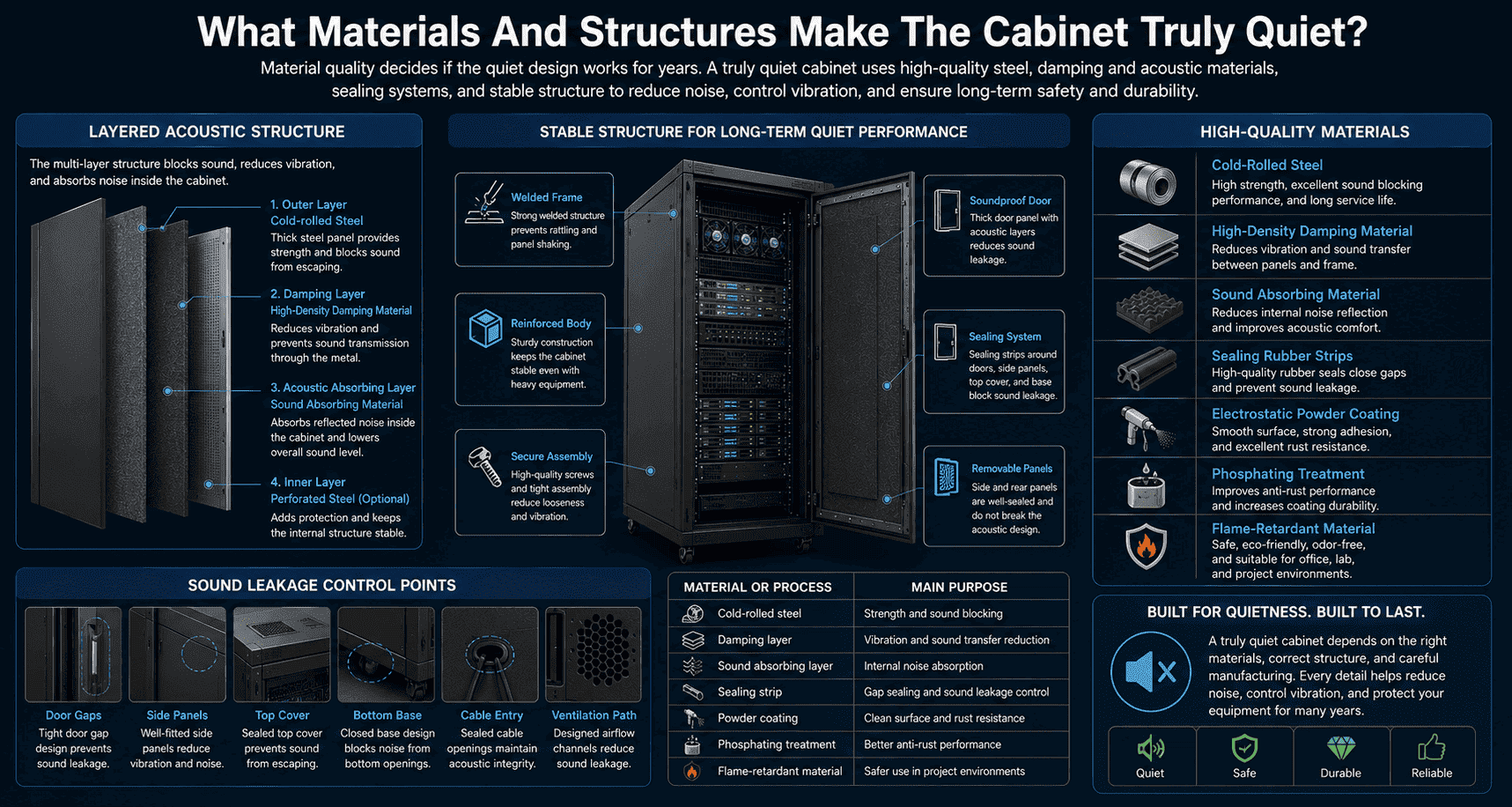
The door structure is usually the most visible part, but the full cabinet matters. I prefer a thick cold-rolled steel outer layer because it gives strength and sound blocking. I use damping material in the middle because it reduces sound transmission and panel vibration. I use an inner sound absorbing layer because it reduces reflected noise inside the cabinet. This layered structure is more reliable than a single soft layer added inside.
The sealing system also matters. A door with good material still leaks sound if the edge has gaps. I use soundproof sealing strips on the door area. I also pay attention to the side panels, top cover, and bottom base. These parts should not be open in ways that break the acoustic design. The cabinet body needs stable welding and good assembly. A loose cabinet can rattle after equipment starts running.
Surface treatment is also important. I use electrostatic powder coating because it gives a clean finish and strong protection. Phosphating before coating helps improve rust resistance. For some projects, I also use stainless steel or galvanized steel depending on the environment. In all cases, I want the cabinet to be quiet, safe, and durable.
| Material Or Process | Main Purpose |
|---|---|
| Cold-rolled steel | Strength and sound blocking |
| Damping layer | Vibration and sound transfer reduction |
| Sound absorbing layer | Internal noise absorption |
| Sealing strip | Gap sealing and sound leakage control |
| Powder coating | Clean surface and rust resistance |
| Phosphating treatment | Better anti-rust performance |
| Flame-retardant material | Safer use in project environments |
Which Sizes And Custom Options Should I Consider First?
A quiet cabinet must fit the room, the devices, and the service plan. I always check these points before production.
Common quiet server cabinet sizes include 12U, 15U, 18U, 22U, 32U, and 42U. I can customize height, width, depth, door type, load structure, airflow design, waterproof level, anti-rust treatment, and internal 19-inch mounting layout based on the project.
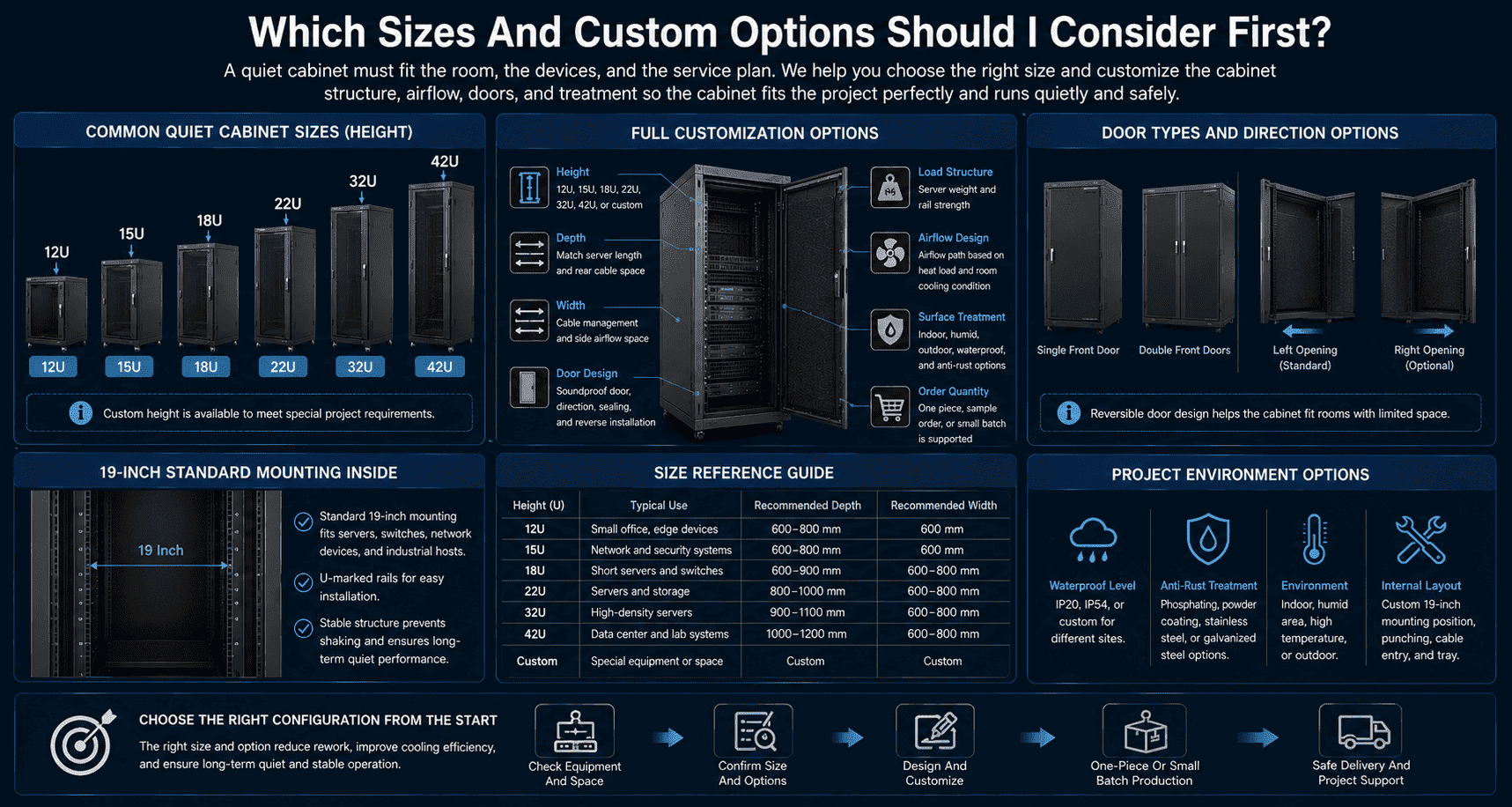
I see many buyers start with rack height only. Height is important, but it is not enough. I also check depth because servers can be long. I check width because cable space and side airflow may matter. I check load capacity because heavy servers need reinforced mounting rails and a stronger base. I also check door direction because some rooms have limited opening space. In some designs, the door can be reverse installed, which helps the cabinet fit the site better.
The inside still follows the 19-inch standard. This point is important. A quiet cabinet should not become a special box that makes installation difficult. It should support standard servers, switches, network devices, industrial control hosts, and other 19-inch equipment. The rack posts should be stable. The installed equipment should not shake.
I also support non-standard customization because different projects have different limits. Some customers need a small office quiet rack from one unit. Some customers need a lab cabinet with special punching. Some customers need outdoor waterproof and anti-corrosion treatment. I can support small orders and one-piece customization because many overseas projects do not need a large batch at the beginning.
| Option | What I Check |
|---|---|
| Cabinet height | 12U, 15U, 18U, 22U, 32U, 42U, or custom |
| Depth | Server length and rear cable space |
| Width | Cable management and airflow space |
| Door design | Soundproof solid door, direction, sealing |
| Load structure | Server weight and rail strength |
| Airflow path | Heat load and room cooling condition |
| Surface treatment | Indoor, humid, or outdoor environment |
| Order quantity | One piece, sample order, or small batch |
How Do I Control Quality For Quiet Server Cabinets?
A quiet cabinet needs stable quality, not only a good drawing. I check production and inspection step by step.
I control quiet server cabinet quality through raw material checks, laser cutting, CNC bending, welding, powder coating, assembly inspection, dimensional checks, coating checks, load checks, and protection level checks. I also follow ISO9001 quality management to keep each production step stable.
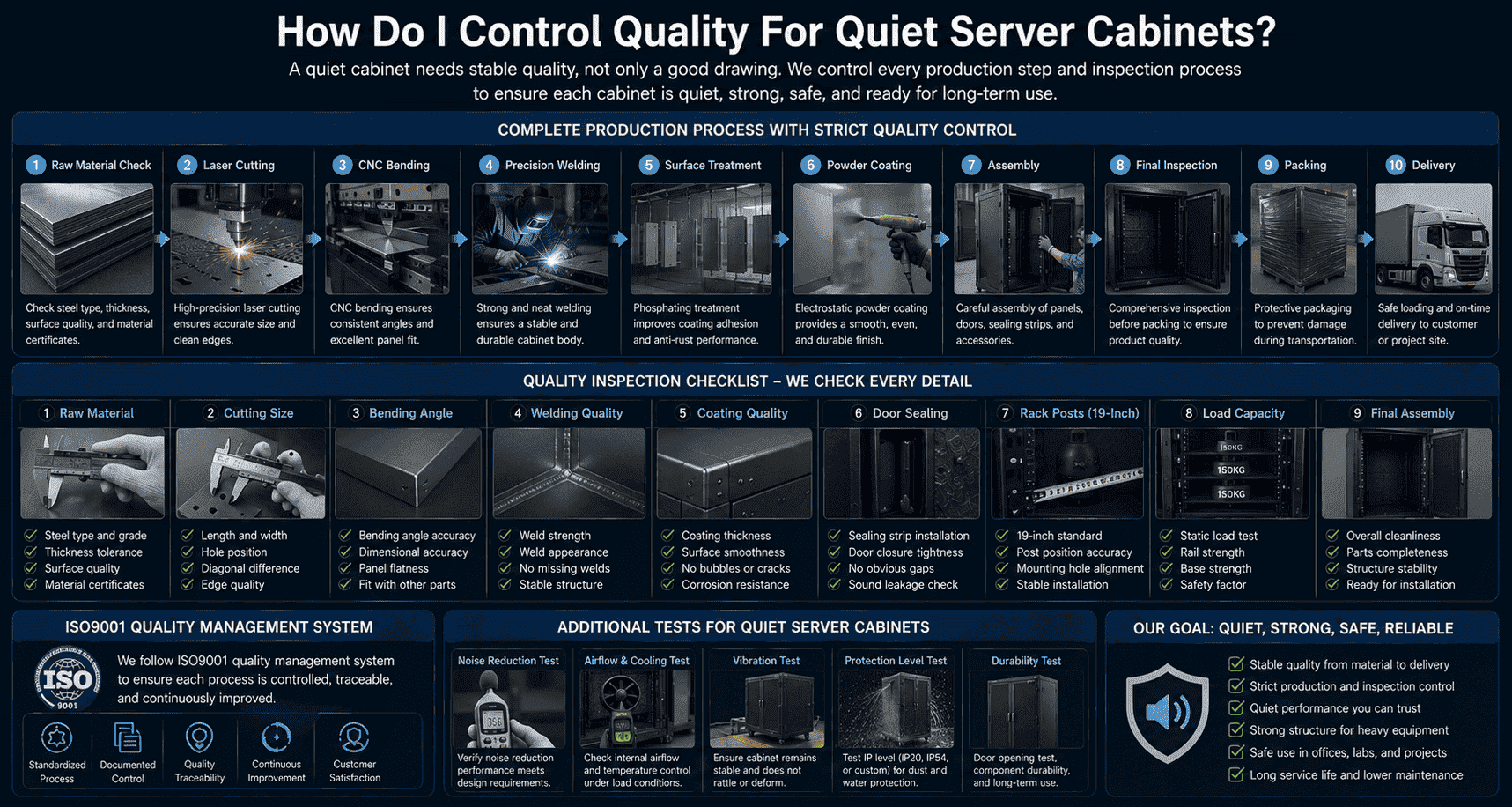
I have learned that quiet cabinet quality depends on small production details. If the bending angle is not accurate, the door may not seal well. If welding is weak, the body may not stay stable. If the coating is poor, the surface may rust or peel. If the acoustic material is uneven, the noise reduction effect may become unstable. This is why I take production control seriously.
I use a complete sheet metal production line. The process can include laser cutting, CNC bending, precision welding, electrostatic powder coating, and final assembly. Advanced equipment helps keep size and structure accurate. I also check raw materials before production. I prefer high-quality cold-rolled steel, stainless steel, or galvanized sheet based on the use case. I check semi-finished products during production. I check finished cabinets before delivery.
For quiet cabinets, I pay special attention to sealing, door closure, panel fit, internal rack post position, and surface finish. I also check whether the cabinet can support the expected load. A quiet cabinet must be quiet, but it must also be strong, safe, and easy to install.
| Inspection Point | What I Want To Confirm |
|---|---|
| Raw material | Correct steel type and thickness |
| Cutting size | Accurate part dimensions |
| Bending angle | Good panel fit and sealing |
| Welding | Stable cabinet body |
| Coating | Smooth surface and rust protection |
| Door sealing | No obvious sound leakage path |
| Rack posts | Standard 19-inch installation |
| Load capacity | Safe support for installed equipment |
| Final assembly | Clean, stable, and ready for use |
Conclusion
I use soundproof quiet server cabinets when equipment must stay close to people, but noise, heat, safety, and installation must still be controlled.
"[PDF] Effect of opening size on the effectiveness of a noise enclosure on ...", https://researchrepository.wvu.edu/cgi/viewcontent.cgi?article=2600&context=etd. Measured studies of acoustic enclosures report insertion-loss values in the tens of decibels when mass, sealing, absorption, and ventilation paths are jointly designed, supporting the plausibility of a 15–36 dB(A) reduction range for comparable enclosed equipment. Evidence role: statistic; source type: research. Supports: Independent acoustic enclosure measurements or research showing that enclosed, lined equipment cabinets can achieve noise reductions in the approximate 15–36 dB(A) range under specified test conditions.. Scope note: The source would support the general magnitude of reduction for acoustic enclosures, not verify the performance of this specific cabinet design. ↩
"Rack unit", https://en.wikipedia.org/wiki/Rack_unit. The 19-inch rack format is standardized in rack specifications such as EIA/ECA-310 and IEC 60297 and is widely used for mounting electronic, telecommunications, and server equipment. Evidence role: definition; source type: institution. Supports: The 19-inch rack as a standardized mounting system for electronic, network, and server equipment.. ↩
"Sound transmission measurements through porous screens", https://physics.byu.edu/docs/publication/3023. Architectural and engineering acoustics texts describe openings and ventilation paths as common weak points in sound isolation, because they permit airborne sound transmission even when they improve air movement. Evidence role: mechanism; source type: education. Supports: Openings and perforated or mesh surfaces reduce acoustic isolation because airborne sound travels through gaps, while also permitting airflow.. Scope note: The source would explain the physical principle; the actual attenuation of a specific mesh door depends on its open area, geometry, and surrounding enclosure. ↩
"Communities Are Raising Noise Pollution Concerns About ...", https://www.eesi.org/articles/view/communities-are-raising-noise-pollution-concernsabout-data-centers. Research on electronic-equipment acoustics identifies cooling fans as a dominant source of server and network-device noise, with blade-passing and airflow effects contributing to tonal and high-frequency sound components. Evidence role: mechanism; source type: paper. Supports: Cooling fans in servers and network equipment are important contributors to equipment noise and can produce prominent tonal or high-frequency components.. Scope note: The source would support the noise mechanism generally, not the sound level of any particular switch or server model. ↩
"Hard Drive Disk Vibration | UW Department of Mechanical Engineering", https://www.me.washington.edu/research/faculty/ishen/hdd_vibration. Studies of hard-disk-drive acoustics and vibration describe spindle rotation and actuator seek motion as sources of mechanical vibration and airborne noise that can couple into the drive chassis and supporting structure. Evidence role: mechanism; source type: paper. Supports: Rotating disks and actuator seek movements in hard drives can generate vibration and acoustic noise that may couple into surrounding chassis structures.. Scope note: The source would support the mechanism for HDD-based systems; it would be less applicable to all-solid-state storage configurations. ↩
"Airborne vs Structure-Borne Noise", https://commercial-acoustics.com/sound-advice/airborne-vs-structure-borne-noise/. Acoustics references distinguish airborne sound, transmitted through air and openings, from structure-borne sound, transmitted as vibration through connected solid elements such as frames, rails, and panels. Evidence role: definition; source type: education. Supports: The distinction between airborne sound transmission through air paths and structure-borne sound transmission through solid mechanical connections.. ↩
"Providing an optimal porous absorbent pattern to reduce mid to low ...", https://pmc.ncbi.nlm.nih.gov/articles/PMC6277340/. Acoustic absorption theory shows that porous or fibrous lining materials convert part of incident sound energy into heat, thereby reducing reflected sound energy and reverberant buildup inside an enclosure. Evidence role: mechanism; source type: education. Supports: Absorptive lining reduces reflected sound energy and reverberation inside an enclosure.. Scope note: The degree of reduction depends on material thickness, flow resistivity, placement, and the frequency spectrum of the equipment noise. ↩
"Evaluation of Vibration Damping Enhancement in Laminated ... - PMC", https://pmc.ncbi.nlm.nih.gov/articles/PMC11396767/. Vibration-control literature shows that viscoelastic and constrained-layer damping treatments dissipate vibrational energy in metal panels, reducing resonance amplitudes and the sound radiated by vibrating structures. Evidence role: mechanism; source type: paper. Supports: Damping materials applied to panels can reduce resonant vibration and associated radiated noise.. Scope note: The source would support the damping mechanism; performance in a cabinet depends on panel geometry, bonding quality, damping material properties, and excitation frequency. ↩
"Cooling & Air Management", https://datacenters.lbl.gov/cooling-air-management. ASHRAE data-center thermal guidance emphasizes managing equipment intake and exhaust airflow to limit hot-air recirculation and maintain acceptable inlet temperatures, supporting the use of planned airflow paths in enclosed racks. Evidence role: expert_consensus; source type: institution. Supports: Data-center thermal guidance emphasizing controlled airflow, separation of intake and exhaust air, and avoidance of hot-air recirculation.. Scope note: The guidance is primarily written for data centers and server rooms; applying it to a soundproof office cabinet requires cabinet-specific thermal validation. ↩
"Best Practices for Acoustic Enclosures in HVAC Systems | DECIBEL", https://www.decibelinternational.com/blog/acoustic-enclosures-for-hvac-systems-best-practices-17/. Engineering guidance on acoustic and electronic enclosures notes that reducing openings can improve sound isolation, but restricted ventilation lowers convective heat removal and can raise internal equipment temperatures. Evidence role: mechanism; source type: research. Supports: Closed or poorly ventilated enclosures can improve sound isolation while restricting heat removal from electronic equipment.. Scope note: The source would support the general heat-noise tradeoff; actual temperature rise depends on equipment heat load, airflow rate, ambient temperature, and cabinet geometry. ↩
"[PDF] Electrical Appliance Enclosures - CPSC", https://www.cpsc.gov/s3fs-public/electric.pdf. Electrical-equipment safety standards such as UL 94 and IEC 62368-1 address flammability and fire-safety considerations for materials used in or near electronic equipment enclosures. Evidence role: expert_consensus; source type: institution. Supports: Electrical and information-technology equipment standards address fire-safety characteristics of enclosure and internal materials.. Scope note: Such standards support the relevance of flame-retardant material selection; they do not establish that any particular cabinet material is eco-friendly or odor-free without product-specific testing. ↩
