
A Guide to Server Rack Sizes for Data Centers?
Server rack sizes are based on 19-inch mounting width and U height. I use 1U as 44.45 mm. Common data center racks are 42U high, 600 or 800 mm wide, and 800, 1000, or 1200 mm deep.
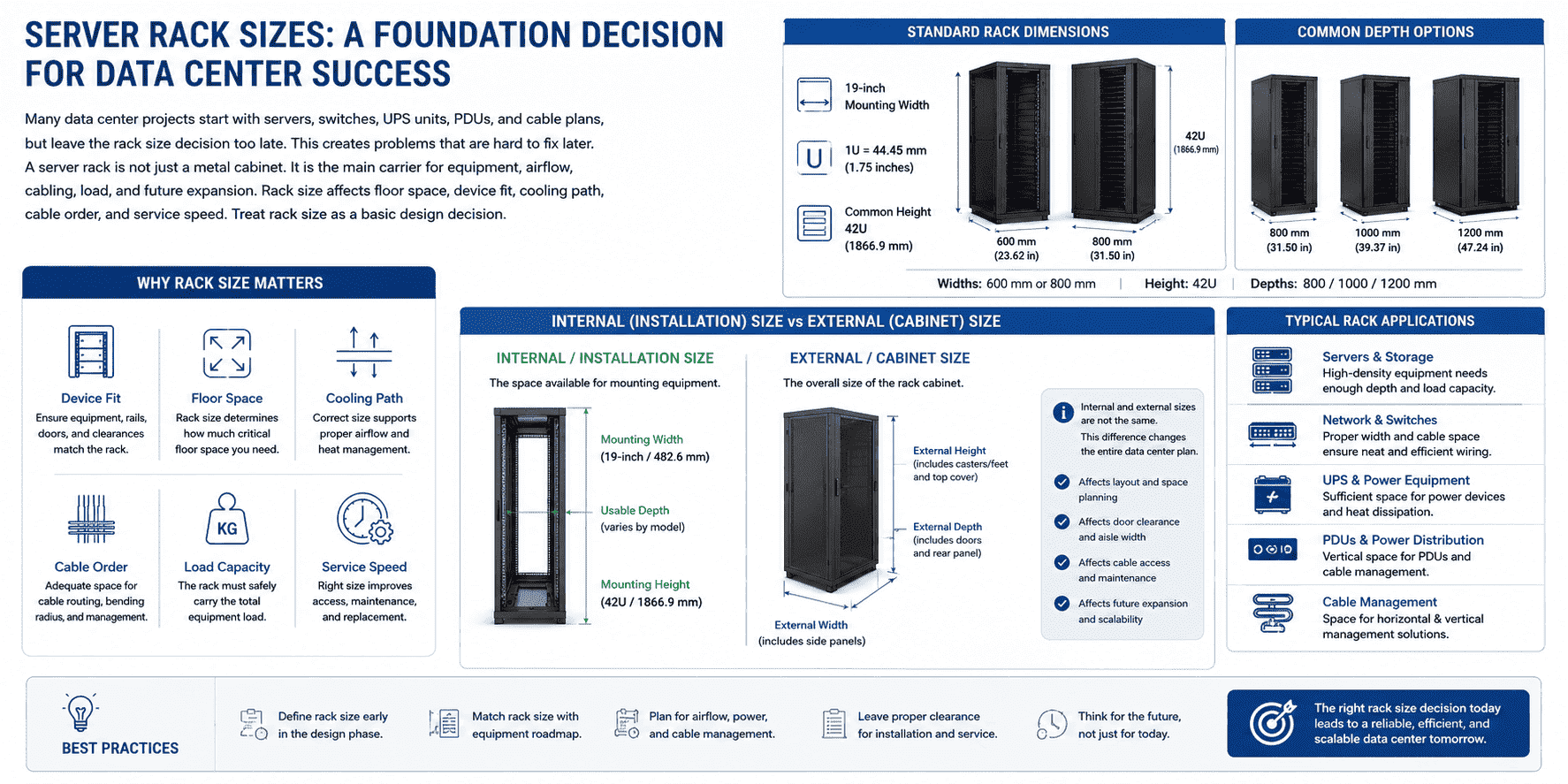
I have seen many data center projects start with servers, switches, UPS units, PDUs, and cable plans. I have also seen many teams leave the rack size decision too late. That creates problems that are hard to fix later. A server rack is not only a metal cabinet. It is the main carrier for equipment, airflow, cabling, load, and future expansion. I treat rack size as a basic design decision. It affects floor space, device fit, cooling path, cable order, and service speed. When I design or manufacture a rack, I always separate the internal installation size from the external cabinet size. These two sizes do not mean the same thing. This small difference changes the whole data center plan.
What Does U Mean in Server Rack Size?
Many buyers only look at total rack height. That mistake causes wrong capacity planning, wrong device count, and poor installation results. I start with U size.
U is the standard height unit for rack-mounted IT equipment. I use 1U as 44.45 mm.1 A 42U rack gives 42 units of usable mounting height for servers, switches, routers, UPS units, PDUs, and patch panels.2
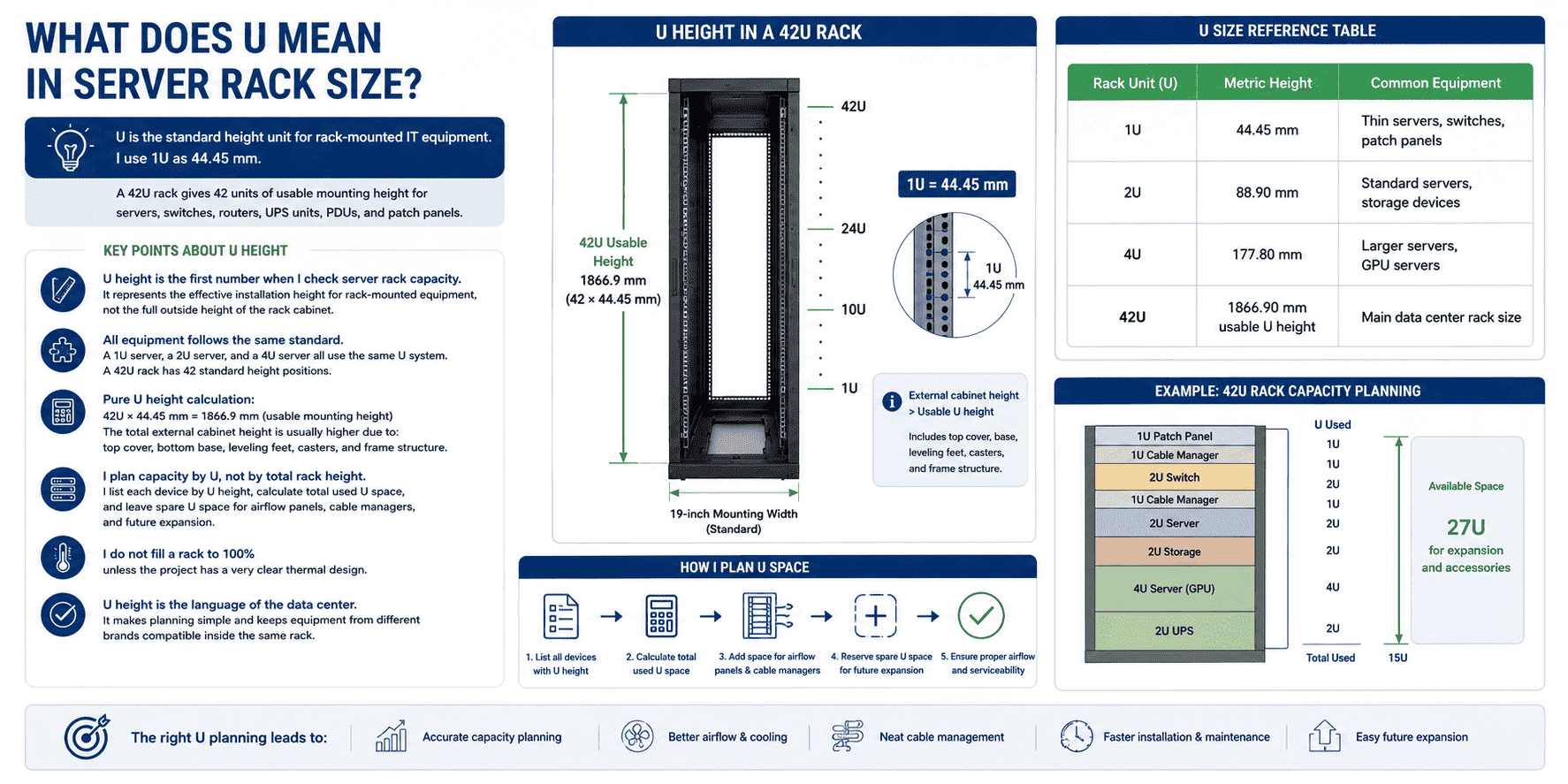
I use U height as the first number when I check server rack capacity. The U number does not describe the full outside height of the rack shell. It describes the effective installation height for rack-mounted equipment. This point is important. A 1U server, a 2U server, and a 4U server all follow the same standard. A 42U rack has 42 standard height positions. The pure U height is 42 × 44.45 mm, which equals 1866.9 mm. The total external cabinet height may be higher because the rack has a top cover, bottom base, leveling feet, casters, and frame structure.
I often explain this to customers during early drawings. I ask them to list each device by U height. I then calculate the total used U space. I also leave spare U space for airflow panels, cable managers, and future expansion. I do not fill a rack to 100% unless the project has a very clear thermal design.
| Rack Unit | Metric Height | Common Equipment |
|---|---|---|
| 1U | 44.45 mm | Thin servers, switches, patch panels |
| 2U | 88.90 mm | Standard servers, storage devices |
| 4U | 177.80 mm | Larger servers, GPU servers |
| 42U | 1866.90 mm usable U height | Main data center rack size |
I treat U height as the language of the data center. It makes planning simple. It also keeps equipment from different brands compatible inside the same rack.
Why Is 19-Inch Width the Standard for Server Racks?
A rack can look wide from the outside, but the real equipment mounting width follows another rule. I use the 19-inch standard to avoid fit problems.
The standard internal mounting width of a server rack is 19 inches, or 482.6 mm.3 Most rack servers, switches, routers, UPS units, PDUs, patch panels, and cable managers are designed for this mounting width.4
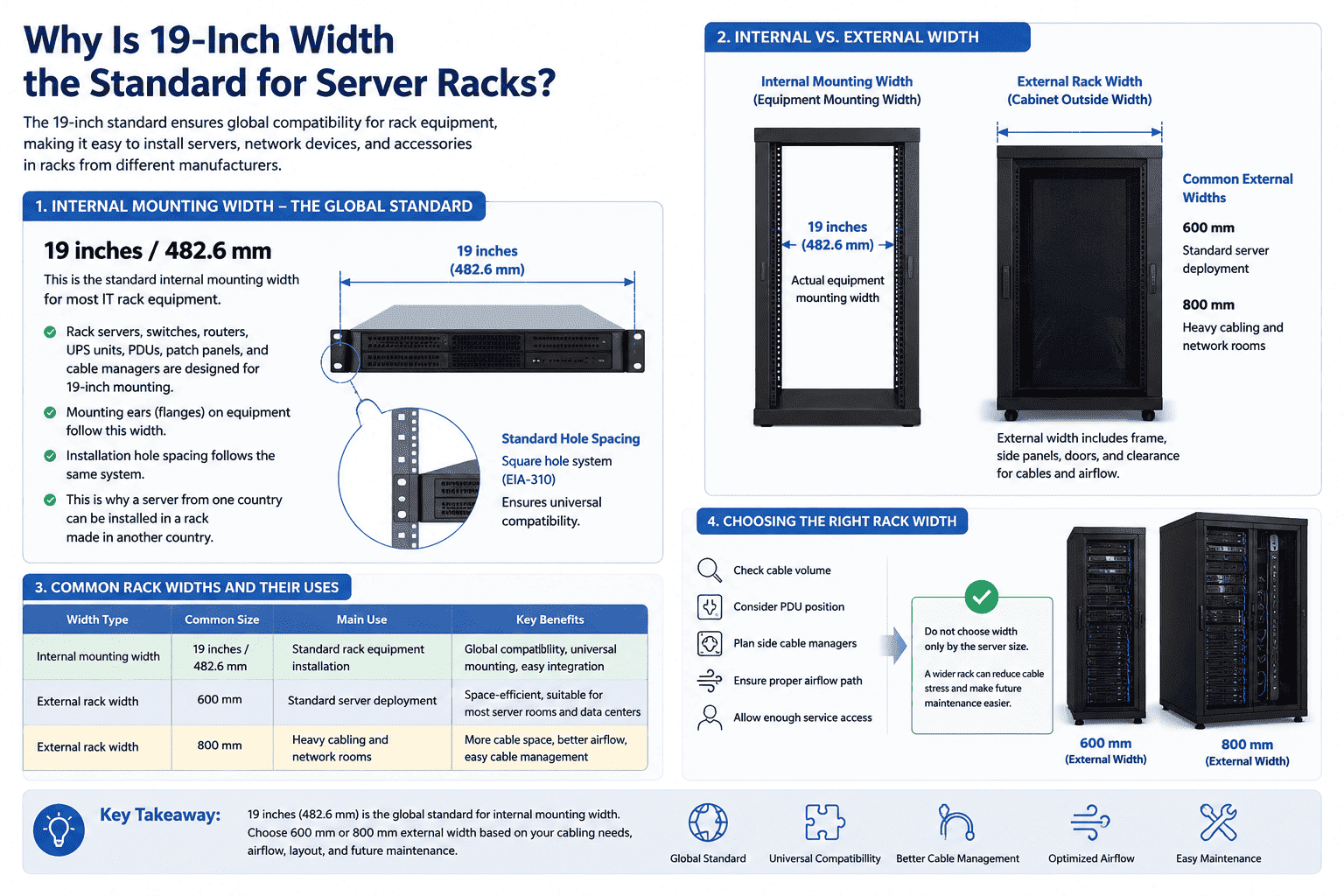
I always make a clear difference between internal mounting width and external cabinet width. The internal mounting width is 19 inches. This is the global standard for most IT rack equipment. The mounting ears on servers and network devices follow this width. The installation hole spacing also follows this system.5 This is why a server from one country can be installed in a rack made in another country.6
The external width is different. A common rack outside width is 600 mm. This size works well for standard server rooms and many data centers. It gives enough width for the 19-inch mounting rails, side frame, and basic cable space. I use 600 mm wide racks when equipment cabling is not too heavy and the layout needs higher space efficiency.
I use 800 mm wide racks when cabling needs more space. These racks are common in structured cabling rooms, weak current rooms, telecom rooms, and data centers with many network cables. The extra side space helps cable bending, vertical cable management, and airflow order.
| Width Type | Common Size | Main Use |
|---|---|---|
| Internal mounting width | 19 inches / 482.6 mm | Standard rack equipment installation |
| External rack width | 600 mm | Standard server deployment |
| External rack width | 800 mm | Heavy cabling and network rooms |
I do not choose width only by the server size. I also check cable volume, PDU position, side cable managers, airflow path, and service access. A wider rack can reduce cable stress. It can also make later maintenance easier.
How Deep Should a Data Center Server Rack Be?
A rack that is too shallow blocks server installation. A rack that is too deep wastes floor space. I match rack depth to equipment depth.
Common server rack depths are 600 mm, 800 mm, 1000 mm, and 1200 mm.7 I choose depth by checking the real device depth, rear cable space, airflow space, rail travel, and maintenance access.
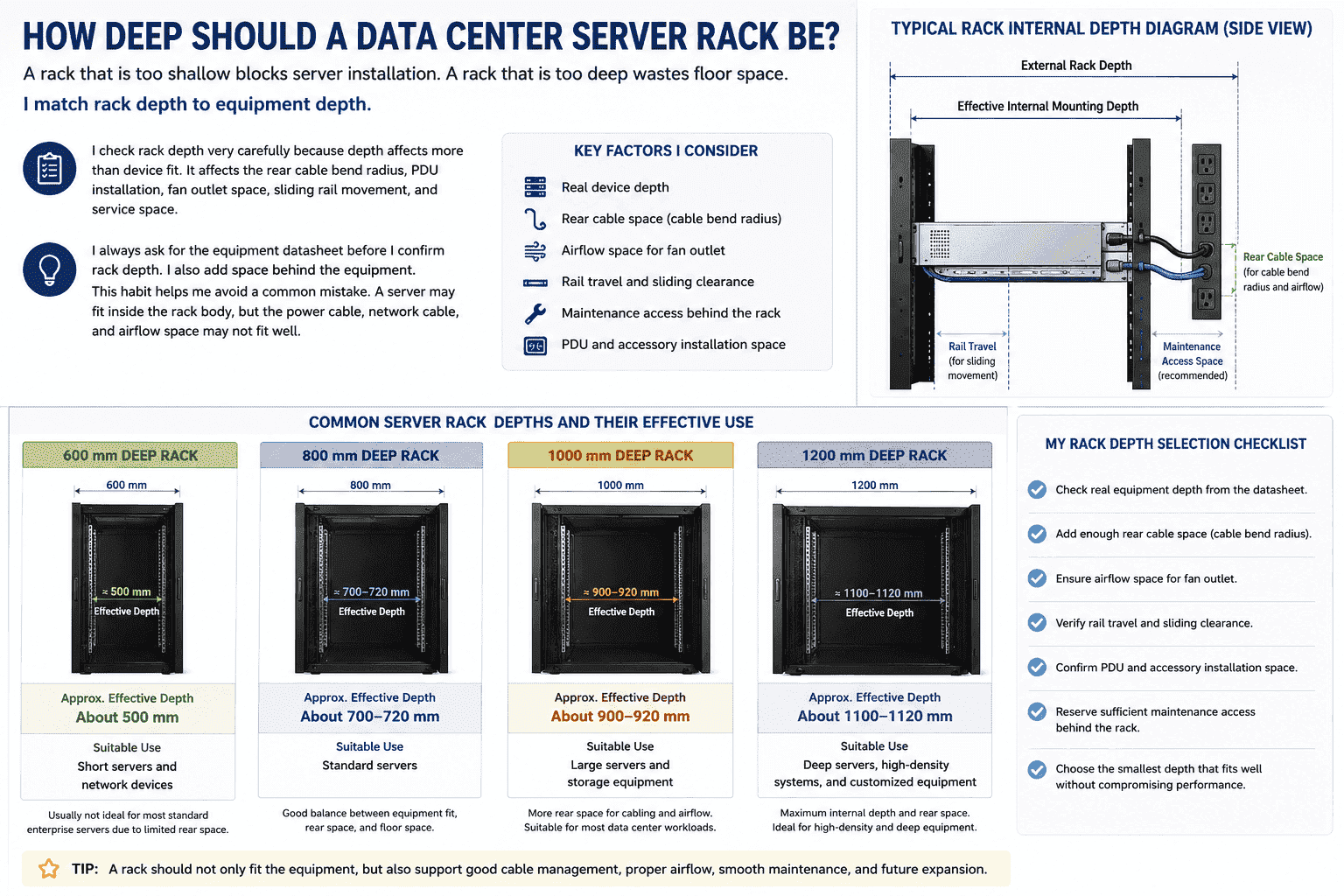
I check rack depth very carefully because depth affects more than device fit. It affects the rear cable bend radius, PDU installation, fan outlet space, sliding rail movement, and service space. A 600 mm deep rack usually has about 500 mm of effective internal mounting depth. I use it for shorter network equipment, small servers, and light IT rooms. I do not use it for many standard enterprise servers because rear cable space may become tight.
An 800 mm deep rack usually has about 700 to 720 mm of effective internal depth. I use this depth for many standard server cases. It gives better rear space than a 600 mm rack. A 1000 mm deep rack usually has about 900 to 920 mm of effective internal depth. I choose this size for larger servers, storage equipment, and data center workloads with more rear cabling. A 1200 mm deep rack usually has about 1100 to 1120 mm of effective internal depth. I use it for deep servers, high-density systems, and some large customized equipment.
| External Depth | Approx. Effective Depth | Suitable Use |
|---|---|---|
| 600 mm | About 500 mm | Short servers and network devices |
| 800 mm | About 700–720 mm | Standard servers |
| 1000 mm | About 900–920 mm | Large servers and storage |
| 1200 mm | About 1100–1120 mm | Deep servers and high-density systems |
I always ask for the equipment datasheet before I confirm rack depth. I also add space behind the equipment. This habit helps me avoid a common mistake. A server may fit inside the rack body, but the power cable, network cable, and airflow space may not fit well.8
Why Do Internal and External Rack Sizes Matter?
Many projects confuse cabinet outside dimensions with usable mounting dimensions. This confusion causes layout mistakes and installation delays. I separate both sizes from the beginning.
Internal rack size decides equipment fit. External rack size decides room layout. I use internal width, U height, and usable depth for device planning. I use outside width, depth, and height for floor layout and aisle planning.9
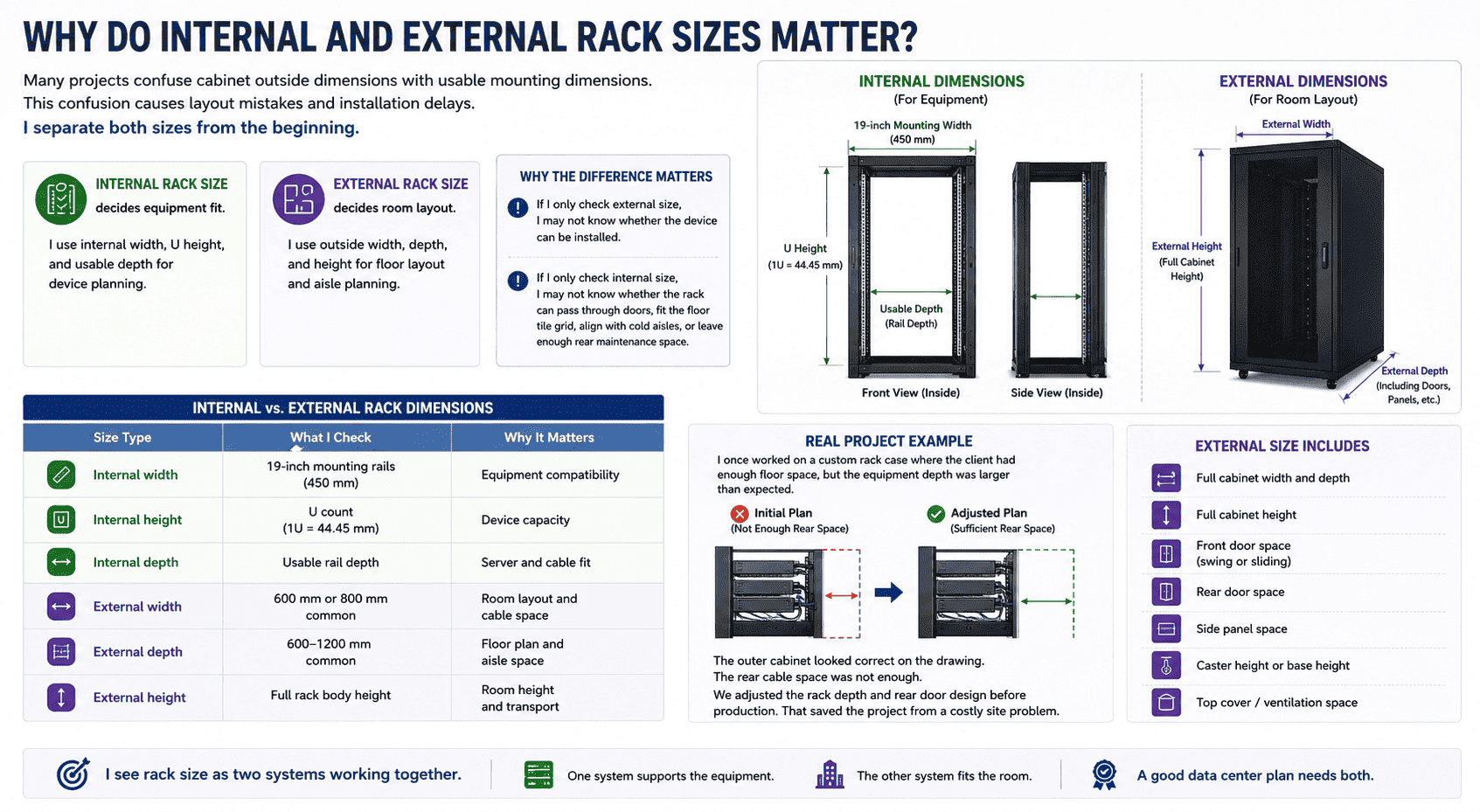
I never use only one dimension when I discuss a server rack. The rack has internal dimensions and external dimensions. The internal mounting space is for the equipment. It includes the 19-inch mounting width, U height, rail spacing, and usable depth. The external size is for the room. It includes the full cabinet width, depth, height, door space, side panel space, caster height, base height, and top cover.
This difference becomes important in data center layout. If I only check external size, I may not know whether the device can be installed. If I only check internal size, I may not know whether the rack can pass through doors, fit the floor tile grid, align with cold aisles, or leave enough rear maintenance space.
I once worked on a custom rack case where the client had enough floor space, but the equipment depth was larger than expected. The outer cabinet looked correct on the drawing. The rear cable space was not enough. We adjusted the rack depth and rear door design before production. That saved the project from a costly site problem.
| Size Type | What I Check | Why It Matters |
|---|---|---|
| Internal width | 19-inch mounting rails | Equipment compatibility |
| Internal height | U count | Device capacity |
| Internal depth | Usable rail depth | Server and cable fit |
| External width | 600 mm or 800 mm common | Room layout and cable space |
| External depth | 600–1200 mm common | Floor plan and aisle space |
| External height | Full rack body height | Room height and transport |
I see rack size as two systems working together. One system supports the equipment. The other system fits the room. A good data center plan needs both.
How Does Rack Size Affect Cooling and Cable Management?
A wrong rack size can trap heat and crowd cables. I use rack size to support clean airflow and clean cabling.
Rack size affects cooling because it controls equipment spacing, door airflow, cable room, and hot aisle or cold aisle fit. I prefer mesh front and rear doors for data center racks because they support better airflow.10
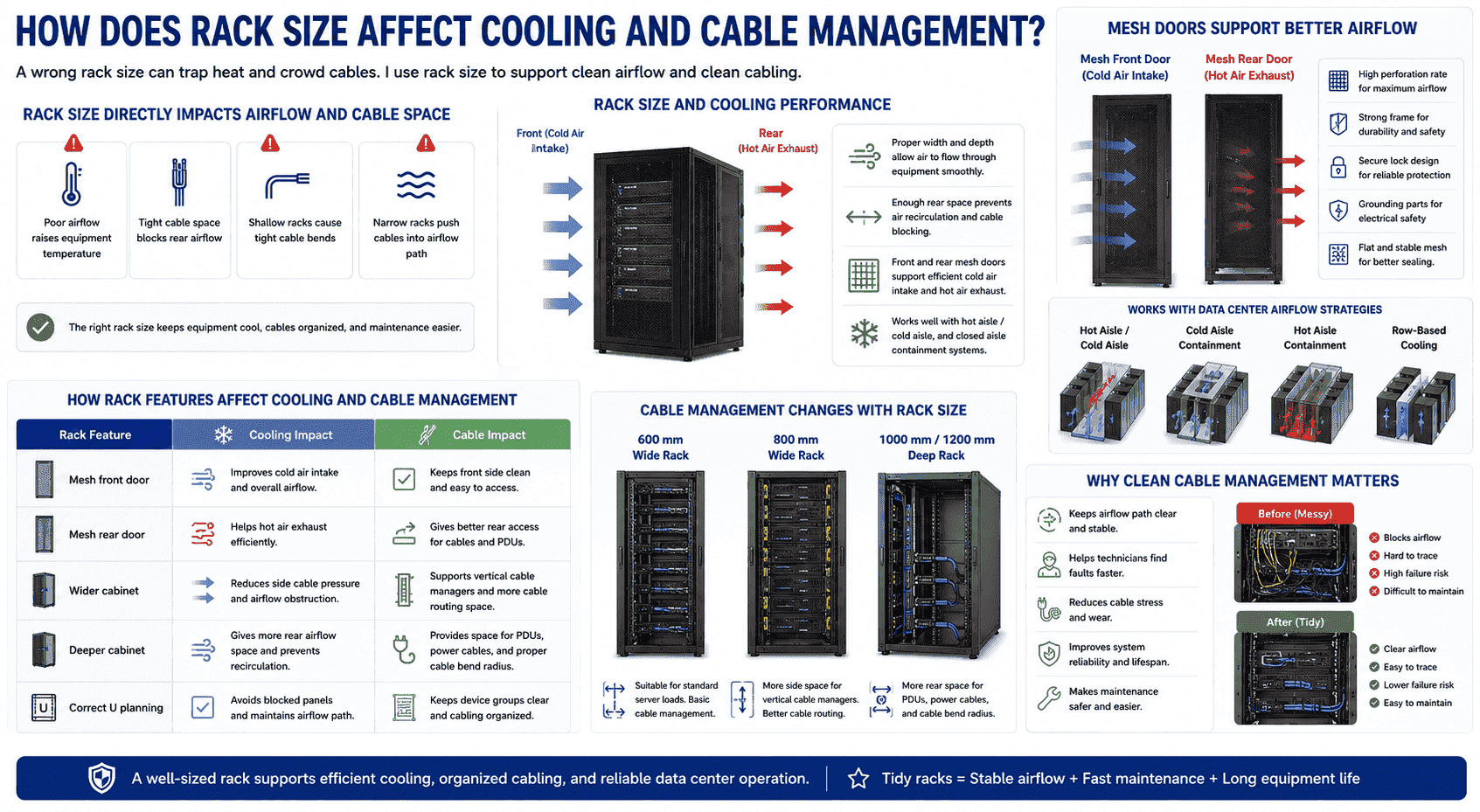
I see cooling as a rack size problem before I see it as an air conditioner problem. A rack with the right width and depth helps air move through equipment. A rack with poor cable space can block the rear airflow.11 A shallow rack can force cables to bend tightly behind servers. A narrow rack can push cables into the airflow path. These small problems can raise equipment temperature and make maintenance harder.
For data centers, I often use front and rear mesh doors. Mesh doors help cold air enter the front side and hot air leave the rear side. This design works well with hot aisle and cold aisle management. It also matches closed cold aisle or closed hot aisle systems. I pay close attention to door perforation, frame strength, lock design, and grounding parts. A mesh door looks simple, but the open area and flatness matter.
Cable management also changes with rack size. A 600 mm wide rack can work well for standard server loads. An 800 mm wide rack gives more side space for vertical cable managers. A 1000 mm or 1200 mm deep rack gives better rear space for PDUs and power cables.
| Rack Feature | Cooling Impact | Cable Impact |
|---|---|---|
| Mesh front door | Improves cold air intake | Keeps front side clean |
| Mesh rear door | Helps hot air exhaust | Gives better rear access |
| Wider cabinet | Reduces side cable pressure | Supports vertical cabling |
| Deeper cabinet | Gives more rear airflow space | Supports PDU and cable bend |
| Correct U planning | Avoids blocked panels | Keeps device groups clear |
I always try to keep cabling clear and readable. A tidy rack is not only nice to look at. It also helps technicians find faults faster. It helps airflow stay stable. It helps the rack serve the data center for a longer time.
What Load Capacity Should a Server Rack Have?
A weak rack can bend, shake, or fail under heavy equipment. I choose high load capacity before I add dense servers.
A data center server rack should usually support more than 800 kg.12 I use high-strength cold-rolled steel, strong frames, firm rails, and stable welding to support heavy servers, UPS units, and storage systems.
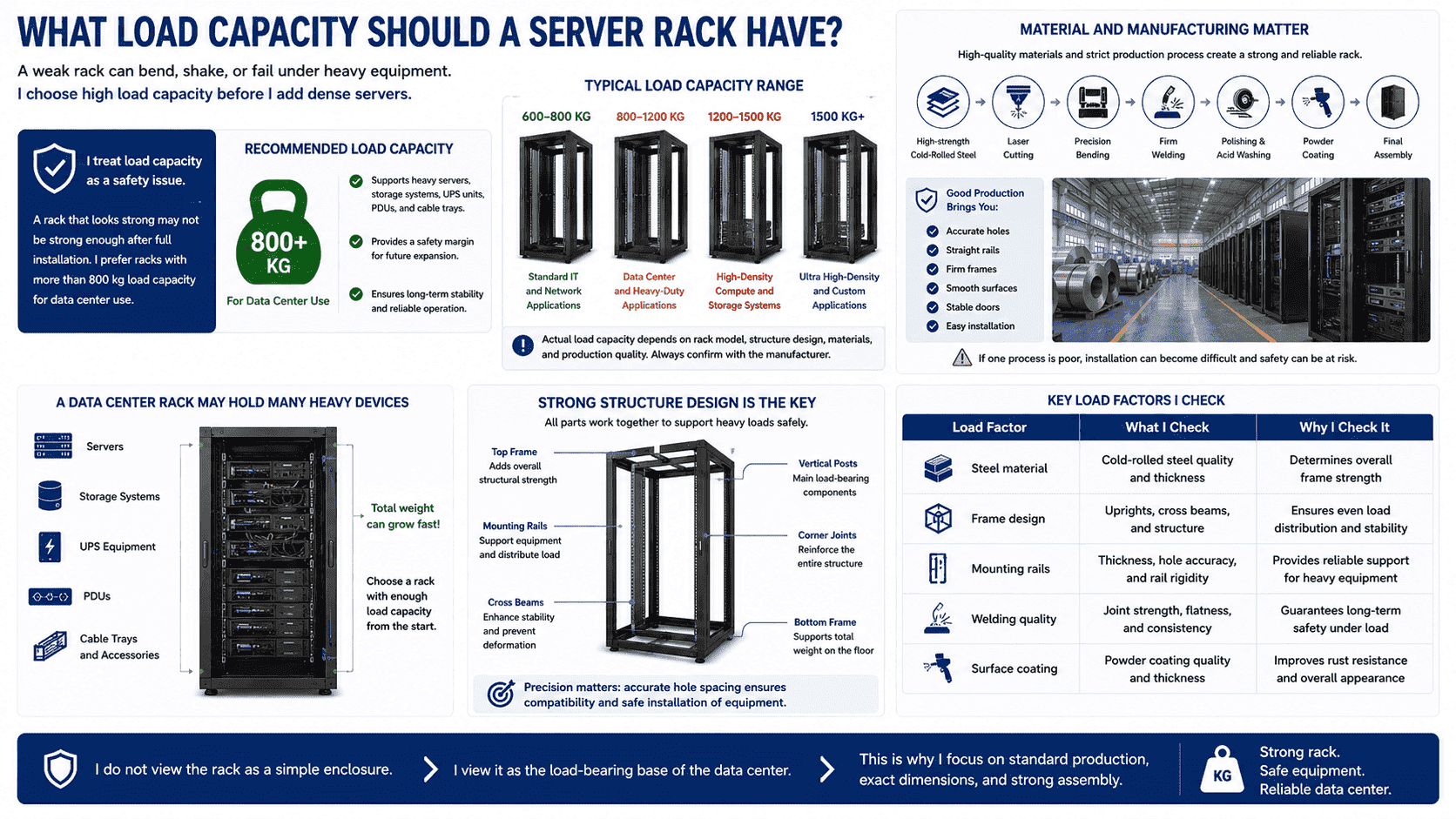
I treat load capacity as a safety issue. A data center rack may hold many servers, storage systems, UPS equipment, PDUs, and cable trays. The total weight can grow fast. A rack that looks strong may not be strong enough after full installation. I prefer racks with more than 800 kg load capacity for data center use. Some high-density projects need higher load capacity, and I check that case by case.
Material matters. I use high-strength cold-rolled steel for reliable cabinet structures. I also care about the whole production process. Raw material selection, laser cutting, precision bending, welding, polishing, acid washing, powder coating, and final assembly all affect the result. A rack needs accurate holes, straight rails, firm frames, smooth surfaces, and stable doors. If one process is poor, installation can become difficult.
Load capacity is not only about thick steel. Structure design matters. The vertical posts, bottom frame, top frame, mounting rails, cross beams, and corner joints must work together. Precision also matters because rack-mounted equipment depends on accurate hole spacing.
| Load Factor | What I Check | Why I Check It |
|---|---|---|
| Steel material | Cold-rolled steel quality | Frame strength |
| Frame design | Uprights and cross beams | Load distribution |
| Mounting rails | Thickness and hole accuracy | Equipment support |
| Welding quality | Joint strength and flatness | Long-term safety |
| Surface coating | Powder coating quality | Rust resistance and appearance |
I do not view the rack as a simple enclosure. I view it as the load-bearing base of the data center. This is why I focus on standard production, exact dimensions, and strong assembly.
How Do I Choose the Right Rack Size for a Data Center Project?
Too many rack options can slow the decision. I use a simple checklist to match size, equipment, cooling, cabling, and future growth.
I choose a server rack size by checking equipment U height, device depth, cable volume, load weight, cooling method, floor layout, and future expansion. I then select width, depth, height, door type, and load capacity.
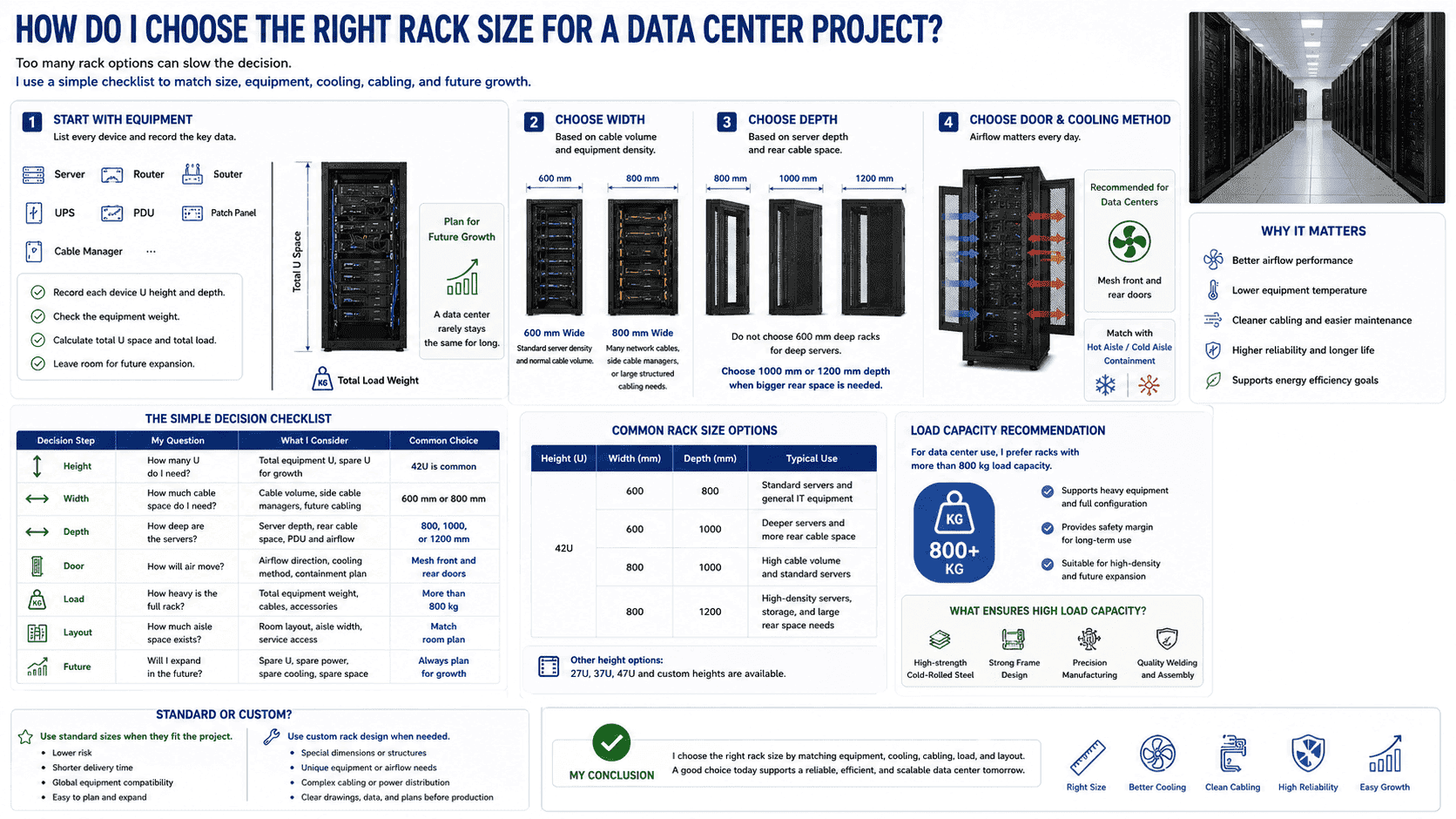
I start with equipment. I list every server, switch, router, UPS, PDU, patch panel, and cable manager. I write down each U height and depth. I also check the equipment weight. After that, I calculate total U space and total load. I leave room for future expansion because a data center rarely stays the same for long.
I then choose width. If the project has standard server density and normal cable volume, I often choose a 600 mm wide rack. If the project has many network cables, side cable managers, or large structured cabling needs, I choose an 800 mm wide rack. I choose depth based on server depth and rear cable space. I do not choose a 600 mm deep rack for deep servers. I choose 1000 mm or 1200 mm depth when the project needs bigger rear space.
I also choose the door style. For data centers, I often choose front and rear mesh doors. I use this because airflow matters every day. I also check whether the rack must match hot aisle and cold aisle containment.
| Decision Step | My Question | Common Choice |
|---|---|---|
| Height | How many U do I need? | 42U is common |
| Width | How much cable space do I need? | 600 mm or 800 mm |
| Depth | How deep are the servers? | 800, 1000, or 1200 mm |
| Door | How will air move? | Mesh front and rear doors |
| Load | How heavy is the full rack? | More than 800 kg |
| Layout | How much aisle space exists? | Match room plan |
I always prefer standard sizes when they fit the project. Standard sizes reduce risk. They also support global equipment compatibility. When the project needs a special structure, I use custom rack design. Custom design works best when the drawing, equipment data, cable plan, and airflow plan are clear before production.
Conclusion
I choose server rack size by matching 19-inch width, U height, depth, load, airflow, cabling, and room layout before production or installation.
"Rack unit", https://en.wikipedia.org/wiki/Rack_unit. IEC 60297 and EIA-310-derived rack standards define one rack unit as 1.75 inches, or 44.45 mm, establishing the unit used for rack-mounted equipment height. Evidence role: definition; source type: institution. Supports: A rack unit is defined as 1.75 inches, equivalent to 44.45 mm, and is used to specify the height of rack-mounted equipment.. ↩
"Rack unit - Wikipedia", https://en.wikipedia.org/wiki/Rack_unit. Reference descriptions of rack units state that rack height designations such as 42U indicate the number of standardized rack-unit spaces available for mounting equipment. Evidence role: definition; source type: encyclopedia. Supports: A 42U rack denotes a rack with forty-two rack-unit spaces, where each rack unit is a standardized vertical increment.. Scope note: This supports the meaning of 42U as a height designation; actual usable space may vary with rack accessories and internal obstructions. ↩
"19-inch rack - Wikipedia", https://en.wikipedia.org/wiki/19-inch_rack. EIA-310 and IEC 60297 standards describe the 19-inch rack format, with a nominal mounting width of 19 inches, or 482.6 mm. Evidence role: definition; source type: institution. Supports: The 19-inch rack format specifies a nominal mounting width of 19 inches, equivalent to 482.6 mm.. ↩
"19-inch rack - Wikipedia", https://en.wikipedia.org/wiki/19-inch_rack. General technical references describe the 19-inch rack as a widely adopted mounting format for computer, networking, telecommunications, and power-related equipment. Evidence role: general_support; source type: encyclopedia. Supports: The 19-inch rack is widely used for mounting servers, networking equipment, telecommunications equipment, and related hardware.. Scope note: This supports broad industry use rather than proving that every listed device type or model conforms to the 19-inch format. ↩
"19-inch rack - Wikipedia", https://en.wikipedia.org/wiki/19-inch_rack. The EIA-310 and IEC 60297 rack standards specify the mechanical arrangement of 19-inch rack mounting rails, including standardized hole spacing used for equipment installation. Evidence role: definition; source type: institution. Supports: Rack standards specify mounting rail geometry and hole spacing for 19-inch racks.. ↩
"19-inch rack - Wikipedia", https://en.wikipedia.org/wiki/19-inch_rack. International 19-inch rack standards such as IEC 60297 define common mechanical interfaces for racks and subracks, providing a basis for interoperability across manufacturers and markets. Evidence role: expert_consensus; source type: institution. Supports: International rack standards define common mechanical dimensions that allow compliant equipment and racks from different manufacturers and regions to interoperate.. Scope note: This supports standardized mechanical compatibility; actual installation can still depend on depth, rail kits, load rating, and accessory clearances. ↩
"19-inch rack - Wikipedia", https://en.wikipedia.org/wiki/19-inch_rack. Technical references on 19-inch and server racks describe common cabinet depths in metric sizes ranging from about 600 mm to 1200 mm, reflecting typical data-center rack offerings. Evidence role: general_support; source type: encyclopedia. Supports: Data-center and 19-inch rack references commonly list rack depths in the 600 mm to 1200 mm range, including 800, 1000, and 1200 mm options.. Scope note: This supports the sizes as common industry practice, not as a universal standard requiring all racks to use these exact depths. ↩
"[PDF] Best Practices Guide for Energy-Efficient Data Center Design", https://www.energy.gov/sites/default/files/2024-07/best-practice-guide-data-center-design.pdf. ASHRAE data-center thermal guidance notes that rack configuration, cabling, and airflow paths affect equipment cooling, supporting the need to reserve rear space beyond the server chassis depth. Evidence role: mechanism; source type: institution. Supports: Data-center guidance identifies cabling and airflow paths as important factors in rack layout and equipment cooling.. Scope note: This supports the design principle; the exact clearance required depends on equipment model, cable type, rail kit, and cooling arrangement. ↩
"[PDF] Best Practices Guide for Energy-Efficient Data Center Design", https://www.energy.gov/sites/default/files/2024-07/best-practice-guide-data-center-design.pdf. Data-center infrastructure guidance such as ANSI/TIA-942 treats cabinet placement, equipment rows, and aisle clearances as part of facility layout planning, supporting the use of external rack dimensions for floor and aisle design. Evidence role: expert_consensus; source type: institution. Supports: Data-center design standards and guidance use cabinet footprints and aisle clearances in planning equipment layouts.. Scope note: This supports the planning rationale; specific clearance values vary by standard edition, jurisdiction, containment design, and operational requirements. ↩
"[PDF] quantifying air flow rate through a server in an operational data", https://mavmatrix.uta.edu/context/mechaerospace_theses/article/1223/type/native/viewcontent. ASHRAE thermal guidance for data-processing environments discusses front-to-back equipment airflow and the role of perforated cabinet doors in reducing airflow restriction through racks. Evidence role: mechanism; source type: institution. Supports: Perforated rack doors are used to permit front-to-back airflow through rack-mounted IT equipment.. Scope note: This supports the airflow mechanism; actual cooling performance depends on perforation open area, fan pressure, containment, bypass airflow, and room cooling design. ↩
"[PDF] Best Practices Guide for Energy-Efficient Data Center Design", https://www.energy.gov/sites/default/files/2024-07/best-practice-guide-data-center-design.pdf. Research and professional guidance on data-center airflow management identify unmanaged rear cabling as a potential obstruction to exhaust airflow and a contributor to inefficient cooling. Evidence role: mechanism; source type: research. Supports: Cable congestion behind IT equipment can impede exhaust airflow and contribute to poorer thermal conditions.. Scope note: This supports the general mechanism; the severity depends on rack density, fan capacity, cable volume, and whether hot-aisle containment or other airflow controls are used. ↩
"Server Rack Weight Explained: Capacity, Distribution & Safety Guide", https://telecare.com.bd/server-rack-weight-explained-capacity-distribution-safety-guide/?srsltid=AfmBOopKqW30KWN-LXVddjqZlyb1nurwBnBA4wH26AUroTFFRPOiaFpS. Engineering guidance and rack specification standards discuss static load ratings as a key cabinet parameter, and many data-center rack specifications use load classes near or above 800 kg for dense IT deployments. Evidence role: general_support; source type: institution. Supports: Data-center racks are commonly specified with high static load ratings to support dense servers, storage, and power equipment.. Scope note: This provides contextual support for the threshold; no single neutral standard makes 800 kg a universal minimum for every data-center rack. ↩
