
How to Distinguish Network Cabinet from Server Rack Cabinet?
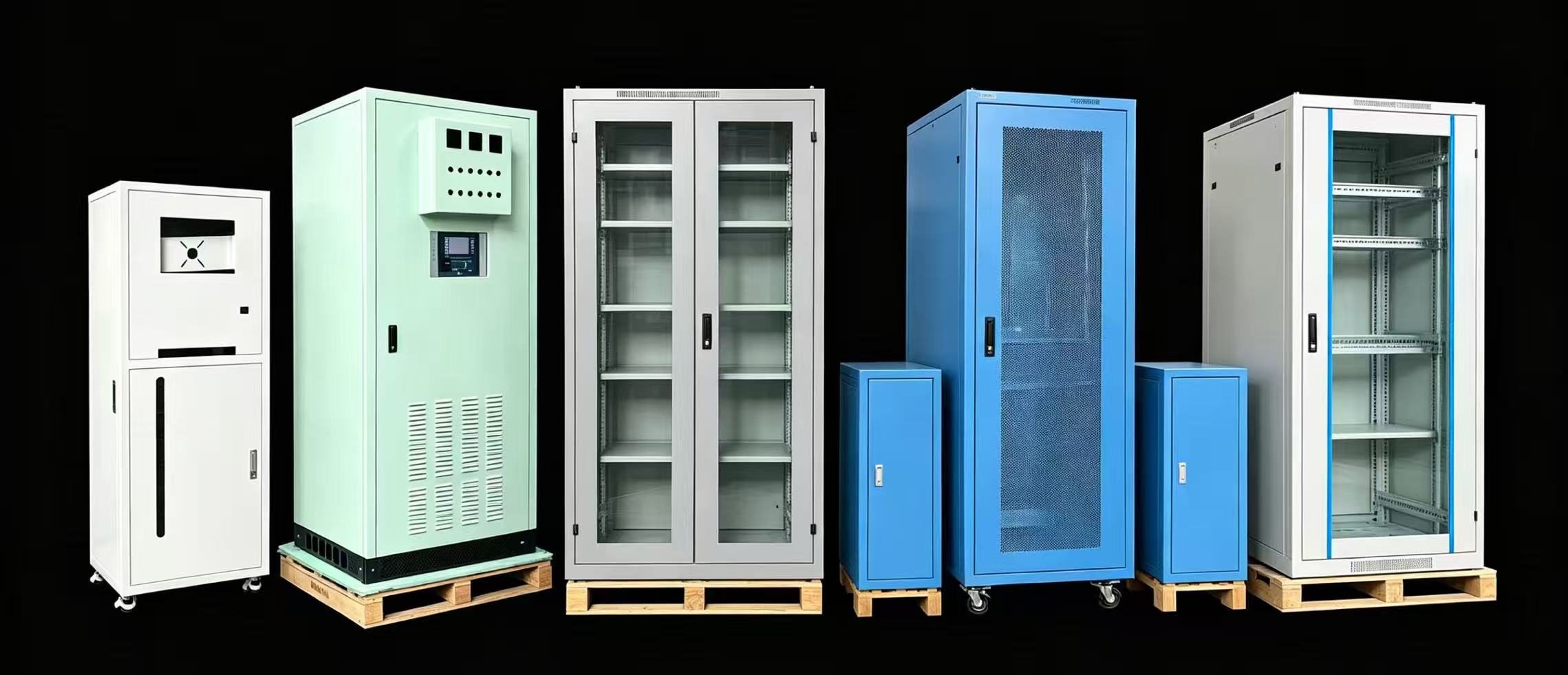
Many buyers choose the wrong cabinet, then they face poor wiring, weak load support, and heat problems. I have seen this mistake delay many IT projects.
-
What Is a Network Cabinet Used For?
Many weak-current projects look simple, but messy cabling can cause later faults1. I use a network cabinet to keep small network equipment clean, safe, and easy to manage.
I use a network cabinet for network wiring, patch panels, switches, routers, cable managers, network modules, optical modems, CCTV recorders, and other light devices. I usually choose 400mm, 450mm, or 600mm depth for shallow equipment and low heat loads.
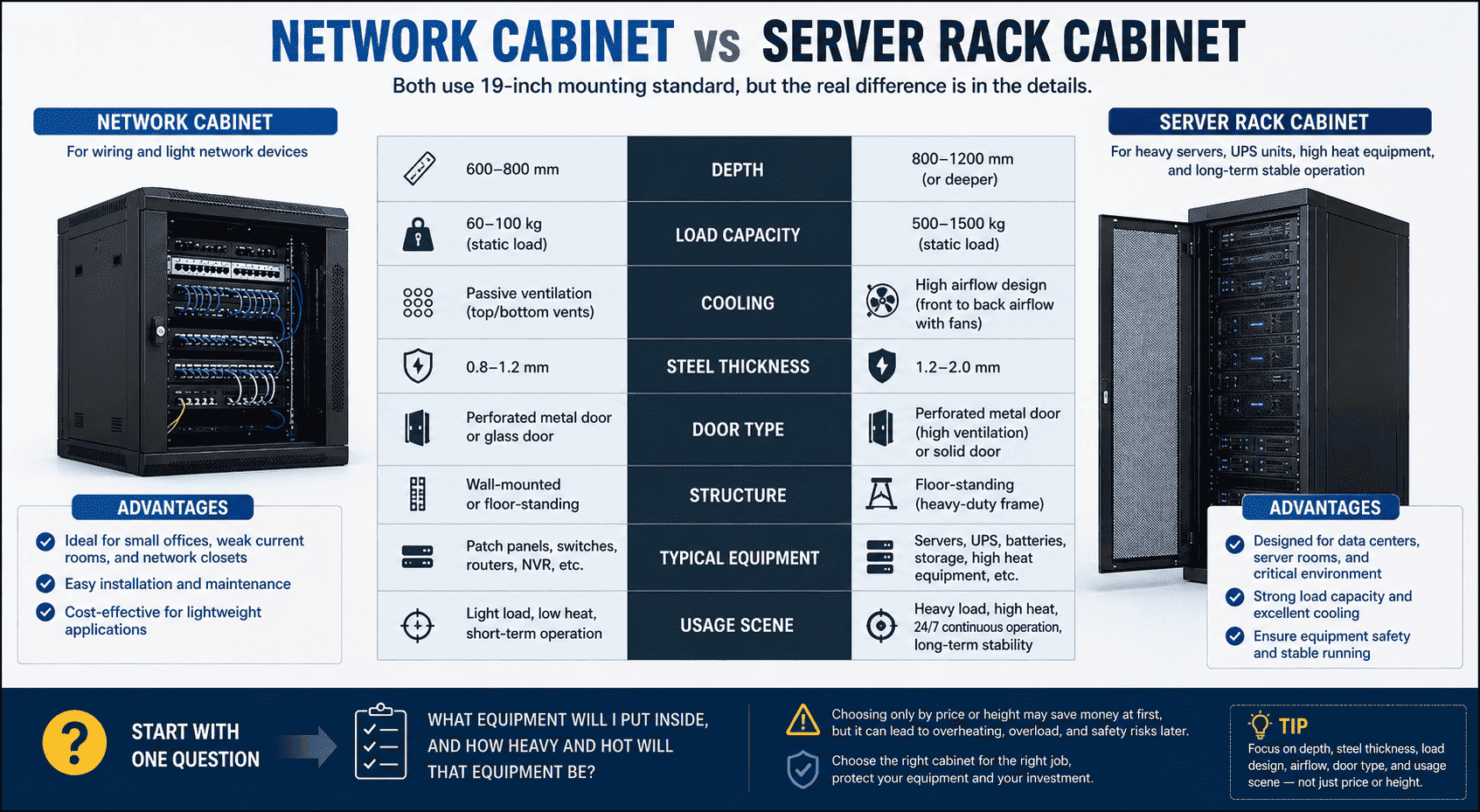
I see network cabinets in many weak-current rooms, small company computer rooms, ceiling spaces, monitoring rooms, office wiring corners, and small communication rooms. I regard them as the normal cabinet choice for structured cabling and light network equipment2. The main job of this cabinet is storage, wiring, and basic protection. It helps me make the room look clean. It also helps me make maintenance faster.
| Item I Check | Network Cabinet Feature | My Practical View |
|---|---|---|
| Main use | Weak-current wiring and network devices | I use it for neat cabling and light equipment |
| Common depth | 400mm, 450mm, 600mm | I choose it when the equipment body is shallow |
| Typical devices | Switch, patch panel, router, cable manager, NVR, optical modem | I avoid heavy servers in this cabinet |
| Heat level | Low to medium | I do not expect data-center airflow |
| Load range | About 200kg to 400kg | I keep the load moderate |
I usually see a network cabinet with a glass front door. The glass door looks clean, and it helps with dust control. The rear door may use a simple mesh design for basic ventilation. The side panels, top cover, and bottom base are often lighter and removable. This structure is enough for wiring and light equipment. But I do not treat it as a heavy-duty cabinet. If I place large servers or heavy UPS units inside for a long time, the cabinet may deform.3 The vertical posts may bend. The cabinet may lean. The installation holes may also lose alignment. I avoid this risk by matching the cabinet to the real equipment weight.
What Is a Server Rack Cabinet Used For?
Heavy server equipment creates heat, weight, and vibration risk.4 I use a server rack cabinet when the project needs stronger support and better airflow.
I use a server rack cabinet for rack servers, UPS power units, precision power distribution, computing equipment, data center hardware, and high-power devices. I usually choose 800mm, 1000mm, 1200mm, or 1400mm depth for these projects.
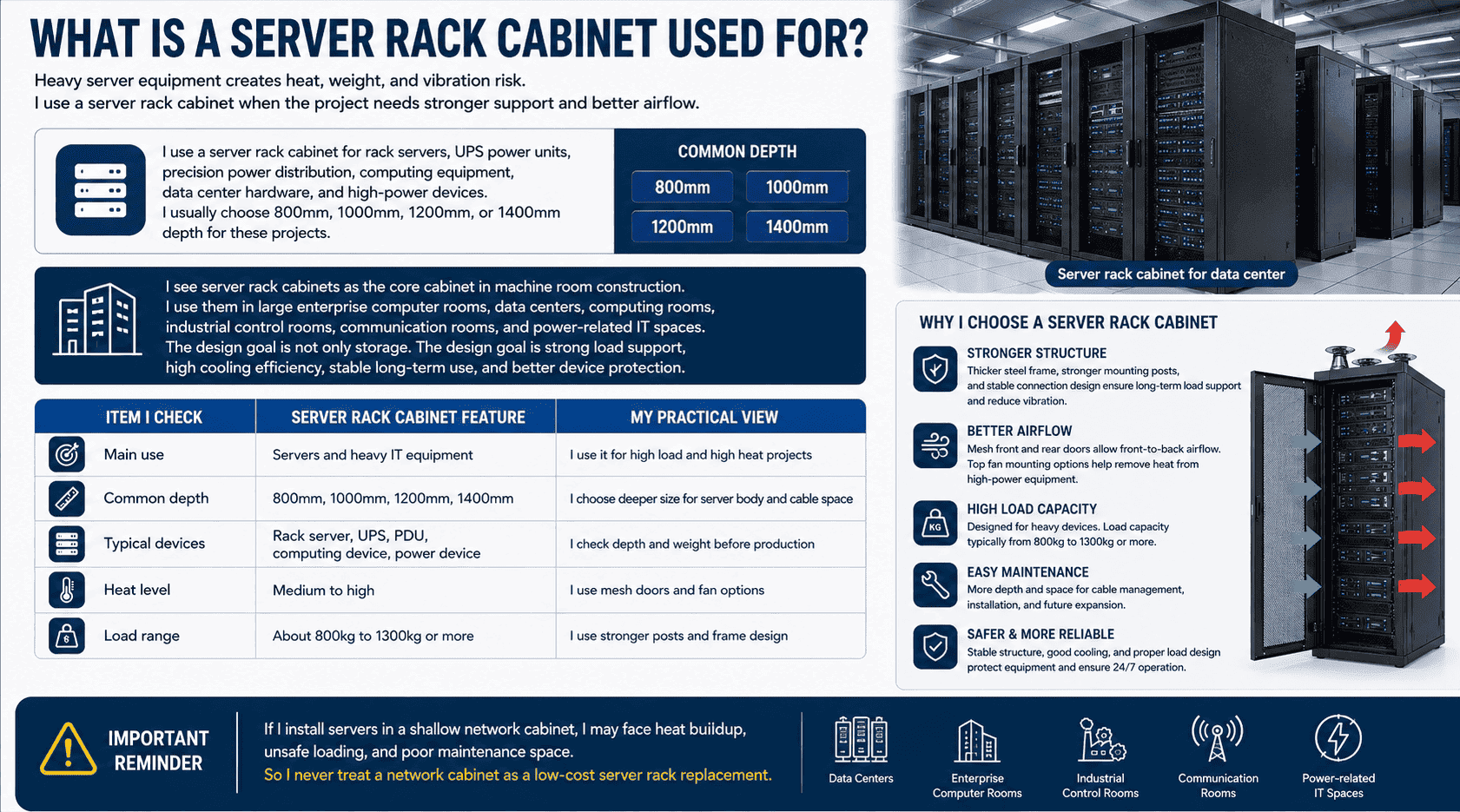
I see server rack cabinets as the core cabinet in machine room construction. I use them in large enterprise computer rooms, data centers, computing rooms, industrial control rooms, communication rooms, and power-related IT spaces. The design goal is not only storage. The design goal is strong load support, high cooling efficiency, stable long-term use, and better device protection.
| Item I Check | Server Rack Cabinet Feature | My Practical View |
|---|---|---|
| Main use | Servers and heavy IT equipment | I use it for high load and high heat projects |
| Common depth | 800mm, 1000mm, 1200mm, 1400mm | I choose deeper size for server body and cable space |
| Typical devices | Rack server, UPS, PDU, computing device, power device | I check depth and weight before production |
| Heat level | Medium to high | I use mesh doors and fan options |
| Load range | About 800kg to 1300kg or more | I use stronger posts and frame design |
I pay close attention to the frame of a server rack cabinet. The steel structure must be stronger. The mounting posts must support long-term load. The beam spacing and frame connection must be stable. The cabinet should not shake easily when technicians install or remove devices. I also care about airflow. Most server cabinets use mesh front and rear doors. This helps air move through the cabinet from front to back.5 The top area can support stronger fans. This design helps remove heat from high-power equipment. If I install servers in a shallow network cabinet, I may face heat buildup, unsafe loading, and poor maintenance space. So I never treat a network cabinet as a low-cost server rack replacement.
How Do Size, Depth, and Load Capacity Show the Difference?
Many cabinets share the same 19-inch width, so buyers may think they are the same. I use depth and load capacity as the fastest way to separate them.
I check cabinet depth first. I use 400mm to 600mm depth for network cabinets. I use 800mm to 1400mm depth for server rack cabinets. I also check load. Network cabinets often support 200kg to 400kg. Server racks can support 800kg to 1300kg or more.6
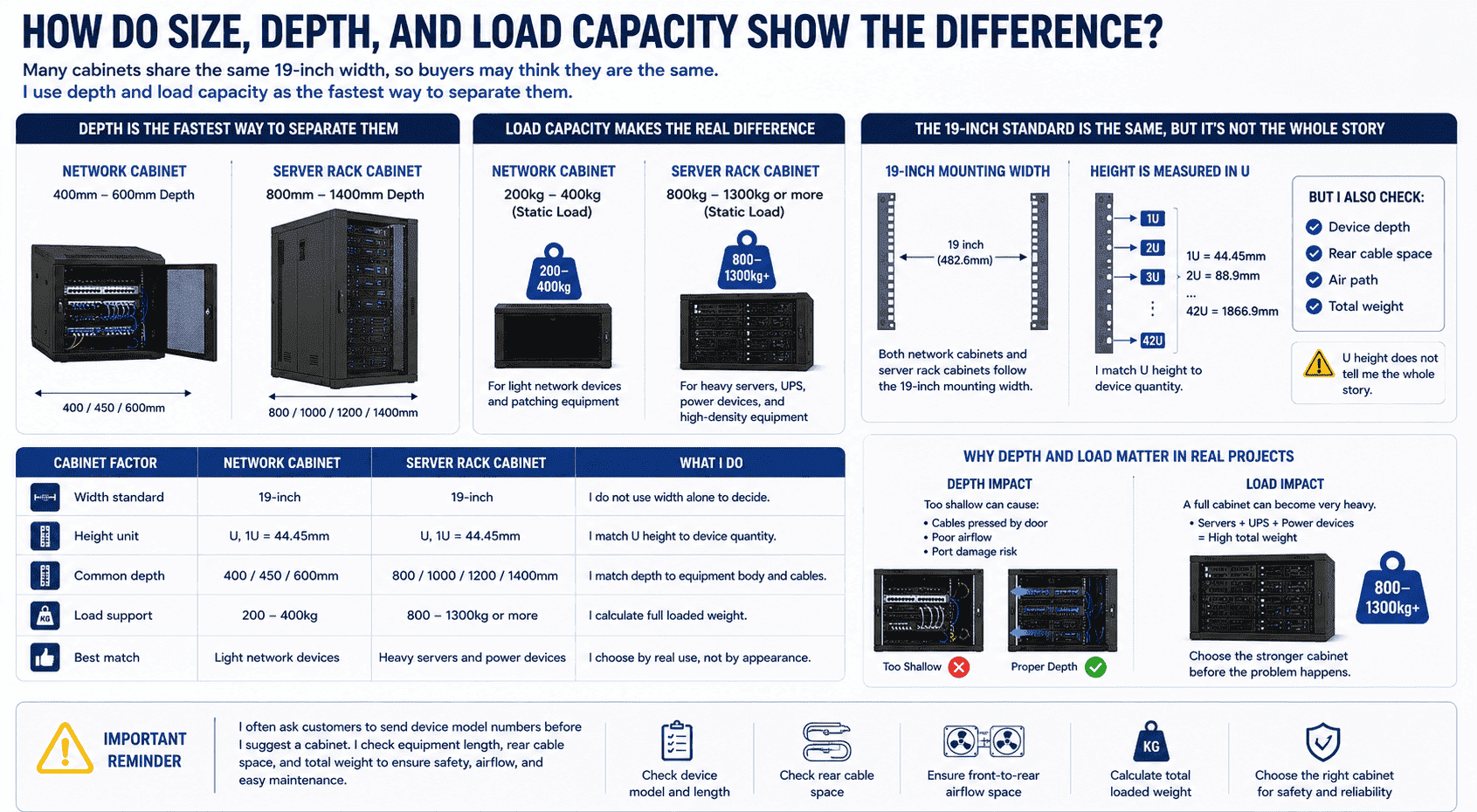
I explain the 19-inch standard to many customers. Both network cabinets and server rack cabinets can follow the 19-inch mounting width.7 This means the horizontal mounting space is standard for many devices. The height is counted by U. One U equals 44.45mm.8 If a device is 2U, it needs about 88.9mm of vertical mounting space. If I buy a 42U cabinet, I can plan many devices by their U height. But U height does not tell me the whole story. I must also look at the device depth, rear cable space, air path, and total weight.
| Cabinet Factor | Network Cabinet | Server Rack Cabinet | What I Do |
|---|---|---|---|
| Width standard | 19-inch | 19-inch | I do not use width alone to decide |
| Height unit | U, 1U = 44.45mm | U, 1U = 44.45mm | I match U height to device quantity |
| Common depth | 400/450/600mm | 800/1000/1200/1400mm | I match depth to equipment body and cables |
| Load support | 200-400kg | 800-1300kg or more | I calculate full loaded weight |
| Best match | Light network devices | Heavy servers and power devices | I choose by real use, not by appearance |
I often ask customers to send device model numbers before I suggest a cabinet. I check the length of the equipment. I also check whether the rear cables need space to bend safely. Many switches and patch panels are shallow. They fit well in 400mm to 600mm cabinets. Many servers are long. They need deeper cabinets. A server also needs front and rear airflow space.9 If the cabinet is too shallow, the door may press against cables. This can damage ports and block airflow. Load is another serious point. A server may not look very heavy in a photo, but a full cabinet can become very heavy. If I add UPS units and power devices, the load increases fast. I choose the stronger cabinet before the problem happens.
How Do Doors, Cooling, and Structure Affect the Choice?
A cabinet can look nice but still cool badly. I always check the door type, fan position, and frame strength before I confirm a model.
I use glass front doors on many network cabinets because they look clean and suit low-heat devices. I use mesh front and rear doors on server rack cabinets because servers need strong front-to-back airflow. I also use stronger frames for server loads.
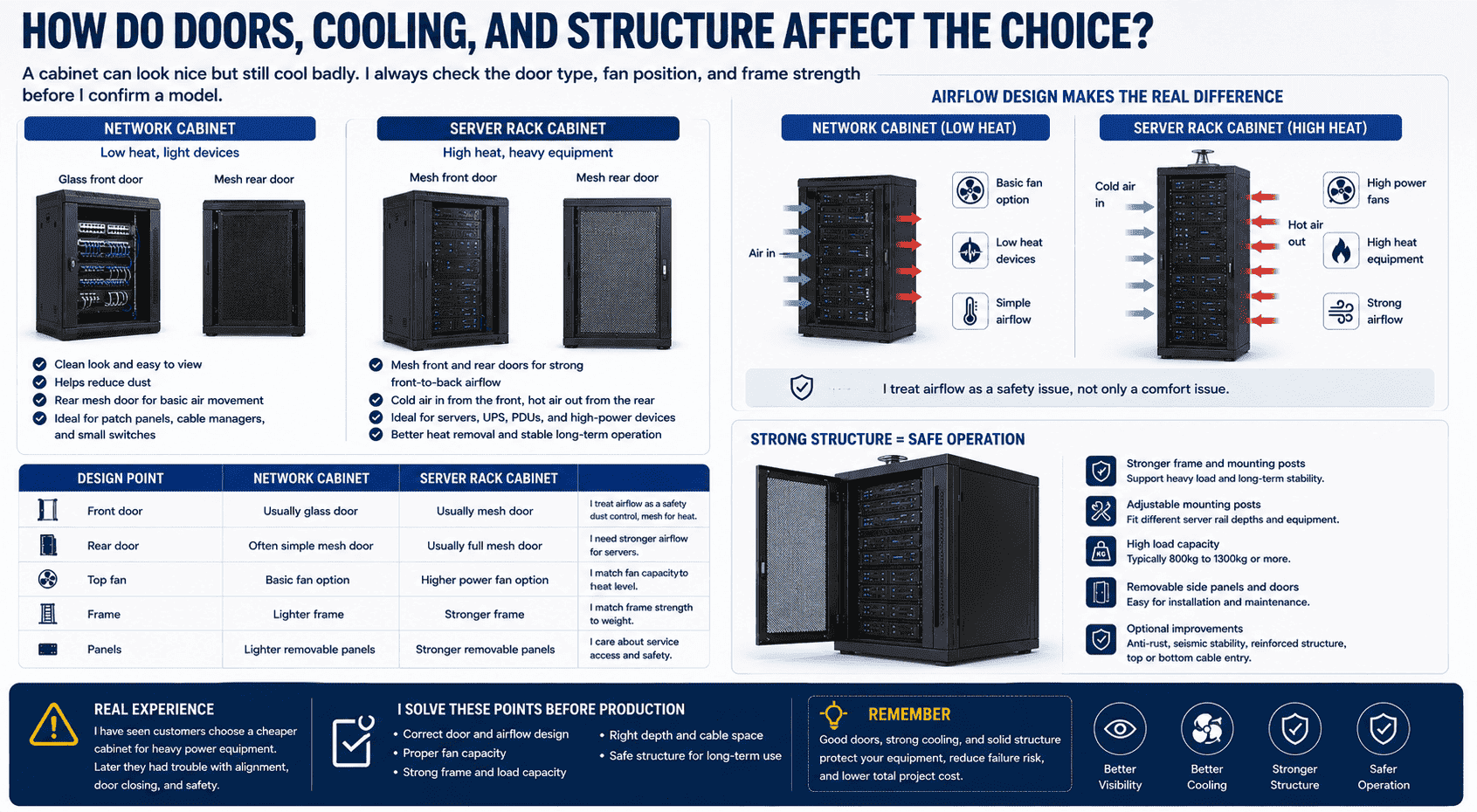
I treat airflow as a safety issue, not only a comfort issue. Network devices like patch panels, cable managers, and small switches usually produce less heat. A glass front door can work well in many of these projects. The door keeps the cabinet neat. It also helps reduce dust. The rear mesh door gives simple air movement. This setup is common in weak-current rooms and small offices.
| Design Point | Network Cabinet | Server Rack Cabinet | My Reason |
|---|---|---|---|
| Front door | Usually glass door | Usually mesh door | I use glass for view and dust control, mesh for heat |
| Rear door | Often simple mesh door | Usually full mesh door | I need stronger airflow for servers |
| Top fan | Basic fan option | Higher power fan option | I match fan capacity to heat level |
| Frame | Lighter frame | Stronger frame | I match frame strength to weight |
| Panels | Lighter removable panels | Stronger removable panels | I care about service access and safety |
Server rack cabinets need a different airflow idea. I usually design or select them with mesh front and rear doors. This helps cold air enter the front and hot air leave the rear. The top may support high-power fans. Some projects need better cable entry from top and bottom. Some projects need stronger anti-rust treatment, seismic stability, or reinforced load-bearing structure.10 I also check whether the posts can be adjusted. This helps match different server rail depths. If a cabinet has weak posts and thin panels, it may work at first. But long-term load can create bending and shaking. I have seen customers choose a cheaper cabinet for heavy power equipment. Later they had trouble with alignment, door closing, and safety. I prefer to solve these points before production.
How Should I Choose Between a Network Cabinet and a Server Rack Cabinet?
Wrong cabinet selection can waste budget and create safety risk. I choose the cabinet by equipment type, depth, weight, heat, and room use.
I choose a network cabinet for switches, patch panels, routers, cable managers, monitoring hosts, and other shallow light equipment. I choose a server rack cabinet for servers, UPS units, computing devices, and high-heat equipment. I use 400-600mm depth for network use and 800-1400mm depth for server use.
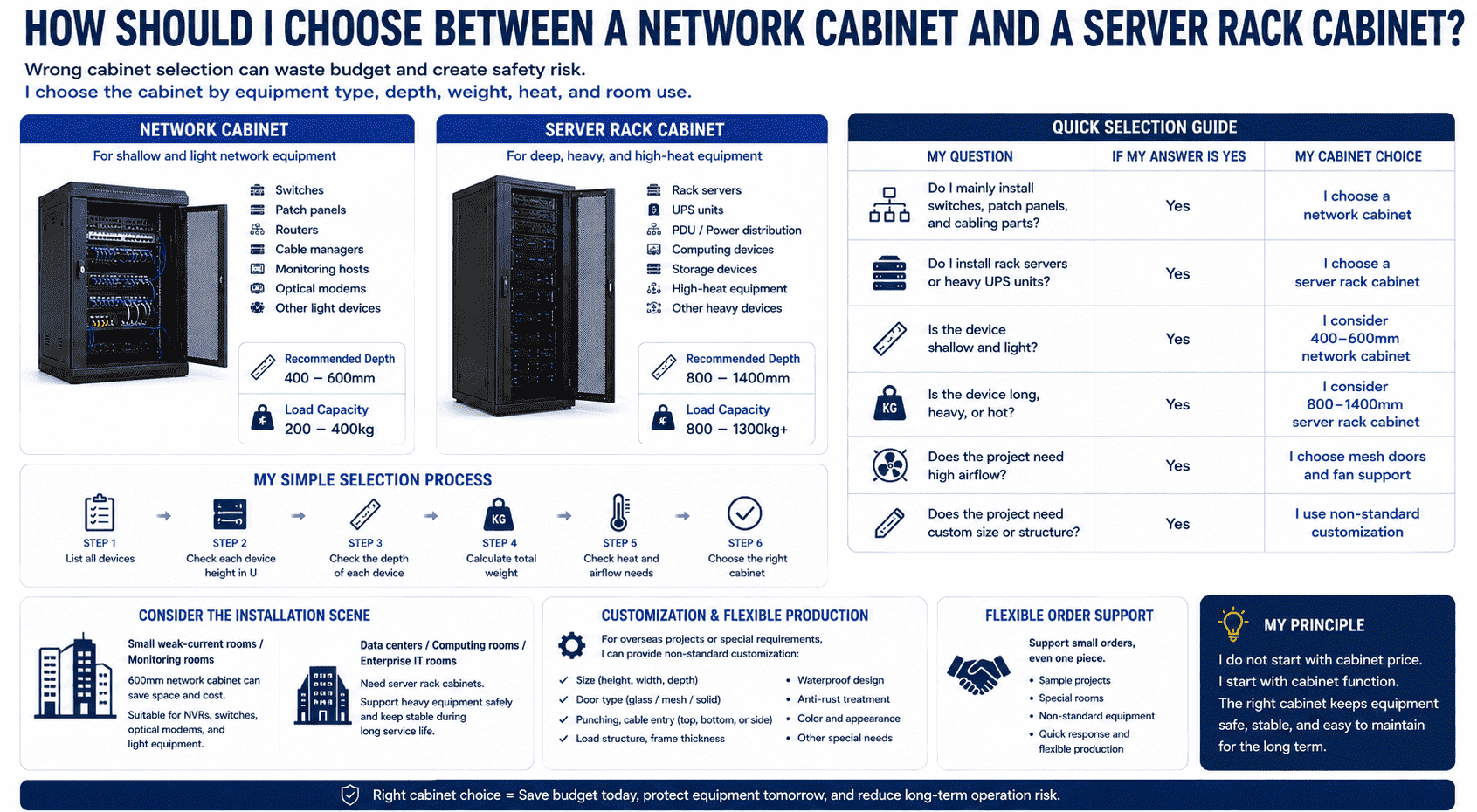
I use a simple selection process when I help a customer. First, I list all devices. Then I check each device height in U. Then I check the depth of each device. Then I calculate weight. Then I check heat and airflow needs. This process is basic, but it prevents many mistakes. I do not start with cabinet price first. I start with cabinet function.
| My Question | If My Answer Is Yes | My Cabinet Choice |
|---|---|---|
| Do I mainly install switches, patch panels, and cabling parts? | Yes | I choose a network cabinet |
| Do I install rack servers or heavy UPS units? | Yes | I choose a server rack cabinet |
| Is the device shallow and light? | Yes | I consider 400-600mm network cabinet |
| Is the device long, heavy, or hot? | Yes | I consider 800-1400mm server rack cabinet |
| Does the project need high airflow? | Yes | I choose mesh doors and fan support |
| Does the project need custom size or structure? | Yes | I use non-standard customization |
I also consider the installation scene. A small weak-current room may not need a deep server cabinet. A 600mm network cabinet may save space and cost. A monitoring room with NVRs, switches, and optical modems can also use a network cabinet. But a data center or computing room needs server rack cabinets. The cabinet must support heavy equipment safely. It must also keep stable during long service life. For overseas projects, I often suggest custom options when standard models do not fit. I can adjust size, door type, punching, cable entry, load structure, waterproof design, and anti-rust treatment. I can also support small orders, even one piece, when the project needs flexible production. This is helpful for sample projects, special rooms, and non-standard equipment.
What Custom Details Should I Confirm Before Ordering?
A standard cabinet may not fit every room. I confirm custom details early so the cabinet can match the equipment, site, and delivery plan.
I confirm cabinet size, depth, door type, load capacity, cable entry, fan layout, material, surface treatment, and protection needs before production. I also confirm whether the project needs glass doors, mesh doors, steel doors, outdoor waterproof design, anti-corrosion treatment, or reinforced structure.
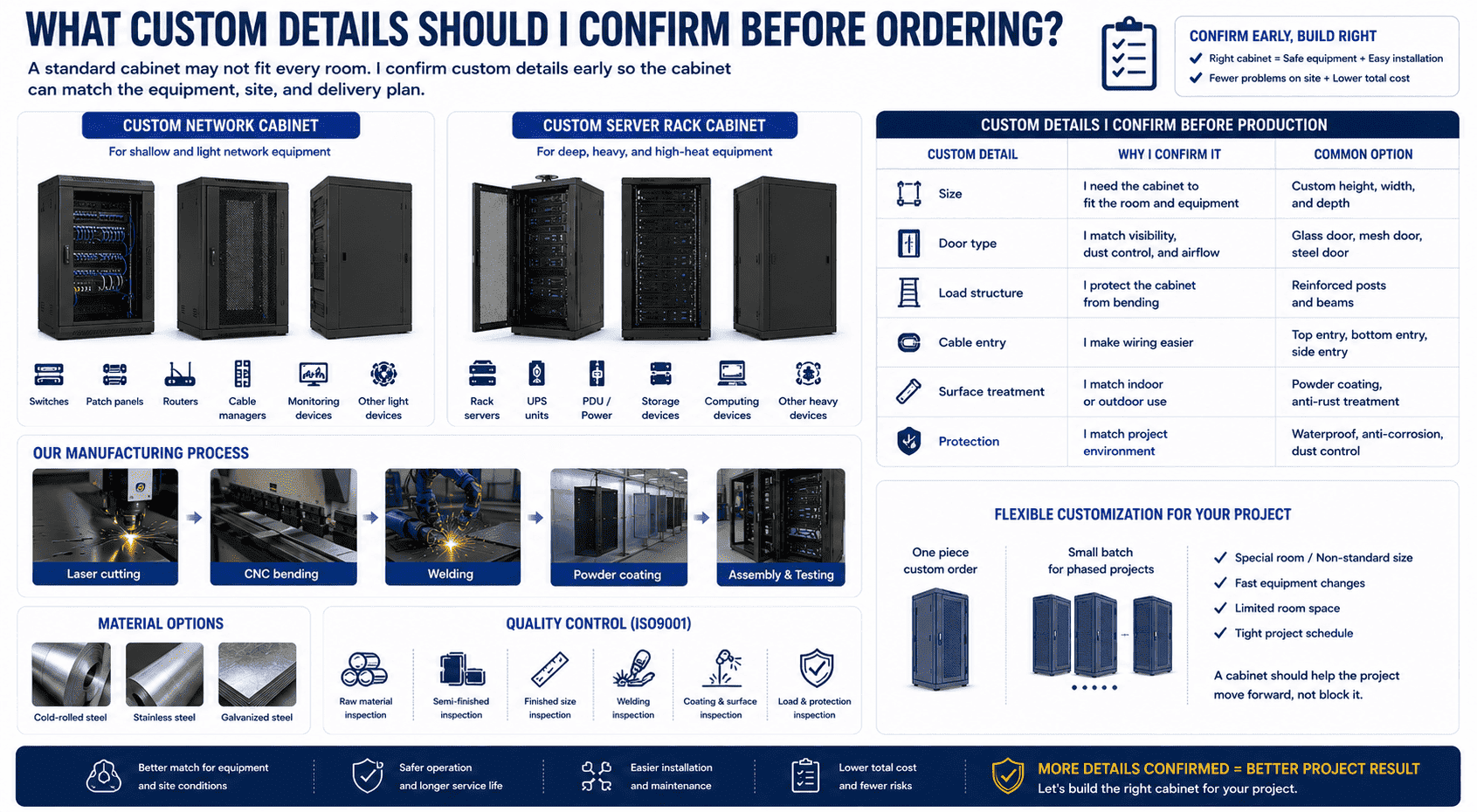
I come from a manufacturing background, so I care about details that may look small on paper. A cabinet is a sheet metal product, but it is also a working system for equipment. If one detail is wrong, the whole site may suffer. The door may not open in the right direction. The cable hole may not match the cable tray. The fan may not remove heat well. The load may exceed the safe range. The coating may not resist the site environment. So I confirm these points before cutting steel.
| Custom Detail | Why I Confirm It | Common Option |
|---|---|---|
| Size | I need the cabinet to fit the room and equipment | Custom height, width, and depth |
| Door type | I match visibility, dust control, and airflow | Glass door, mesh door, steel door |
| Load structure | I protect the cabinet from bending | Reinforced posts and beams |
| Cable entry | I make wiring easier | Top entry, bottom entry, side entry |
| Surface treatment | I match indoor or outdoor use | Powder coating, anti-rust treatment |
| Protection | I match project environment | Waterproof, anti-corrosion, dust control |
In our factory, I can support laser cutting, CNC bending, welding, powder coating, and assembly. I use cold-rolled steel, stainless steel, or galvanized steel based on the project need. I also follow ISO9001 quality control.11 I check raw materials, semi-finished parts, finished size, welding, coating, load support, and protection level. This helps me keep stable quality for different orders. Some customers need one customized cabinet for a special room. Some customers need small batches for phased projects. I support both. I think flexible customization is important because IT rooms are not always standard. Equipment changes fast. Room space is often limited. Project time is also tight. A cabinet should help the project move forward, not block it.
Conclusion
I choose network cabinets for light wiring equipment, and I choose server rack cabinets for heavy, hot, high-value equipment that needs deeper space and stronger support.
"Structured Cabling Standards 2025 Guide - Camali Corp", https://camalicorp.com/news/it/structured-cabling-standards-2025-guide/. Structured-cabling guidance from standards bodies and professional institutions treats cable management, bend-radius control, and routing as reliability and maintainability factors for telecommunications cabling. Evidence role: general_support; source type: institution. Supports: Proper cable management, bend-radius control, and routing practices reduce physical stress and support reliable maintenance of structured cabling.. Scope note: This supports the mechanism by which messy cabling can contribute to faults, but it does not quantify the failure rate for the author's projects. ↩
"Network Infrastructure and Installation Standard - VUIT Support", https://tdx.vanderbilt.edu/TDClient/33/Portal/KB/ArticleDet?ID=306. Telecommunications-room and structured-cabling standards describe racks and cabinets as normal support infrastructure for patch panels, cabling hardware, and network equipment. Evidence role: definition; source type: institution. Supports: Telecommunications-room guidance recognizes racks and cabinets as infrastructure for patch panels, cabling, and network equipment.. Scope note: The source would establish common infrastructure practice, not prove that every light network installation should use a network cabinet. ↩
"IEC 61587-1 - iTeh Standards", https://cdn.standards.iteh.ai/samples/18439/c453ca5ef92d4504b9152ae89ffed413/IEC-61587-1-2011.pdf. Equipment-rack standards define mechanical dimensions and load-related requirements for enclosures, indicating that cabinets must be used within rated load limits to maintain structural integrity. Evidence role: mechanism; source type: institution. Supports: Rack and cabinet structures have defined static-load limits, and loading beyond the rated capacity can compromise structural integrity.. Scope note: This supports the engineering rationale for deformation risk, but it does not prove that a specific cabinet model will deform under a specific server or UPS load. ↩
"[PDF] ASHRAE Thermal Guidelines", https://datacenters.lbl.gov/sites/default/files/ASHRAE%20Thermal%20Guidelines_%20SVLG%202015.pdf. ASHRAE data-center thermal guidance and rack-stability standards identify server heat dissipation and mechanical support as core design considerations for IT enclosures. Evidence role: expert_consensus; source type: institution. Supports: Servers impose significant heat loads and require mechanically stable rack support, especially in environments with vibration or seismic concerns.. Scope note: The support is contextual because no single source may address heat, weight, and vibration risk in exactly the same sentence. ↩
"[PDF] ASHRAE TC9.9 Data Center Power Equipment Thermal Guidelines ...", https://www.ashrae.org/file%20library/technical%20resources/bookstore/ashrae_tc0909_power_white_paper_22_june_2016_revised.pdf. Data-center thermal guidance describes front-to-back airflow as a standard rack-cooling pattern, with low-resistance front and rear openings used to admit supply air and exhaust heated air. Evidence role: mechanism; source type: institution. Supports: Perforated or mesh doors are used to reduce airflow resistance and support front-to-back cooling paths in server racks.. Scope note: This supports the cooling principle, while actual airflow depends on perforation rate, fan placement, equipment layout, and room cooling design. ↩
"Open Rack - Wikipedia", https://en.wikipedia.org/wiki/Open_Rack. Institutional rack specifications, including open hardware rack documentation, report static-load ratings for server racks that can reach or exceed the 800–1300 kg range; load capacity remains a model-specific value that must be verified for each cabinet. Evidence role: statistic; source type: institution. Supports: Published rack specifications show that server racks can have static-load ratings in the 800–1300 kg class, while lighter cabinets are rated lower.. Scope note: Neutral sources may support the server-rack range more directly than the exact 200–400 kg range for all network cabinets. ↩
"Rack unit - Wikipedia", https://en.wikipedia.org/wiki/Rack_unit. The 19-inch rack standard, described in EIA-310 and related IEC 60297 references, defines the common mounting format used by many rack cabinets and rack-mounted devices. Evidence role: definition; source type: encyclopedia. Supports: The 19-inch rack is a standardized mounting system used for equipment racks and cabinets.. ↩
"Rack unit", https://en.wikipedia.org/wiki/Rack_unit. A rack unit is defined as 1.75 inches, or 44.45 mm, and is used to specify the vertical height of rack-mounted equipment. Evidence role: definition; source type: encyclopedia. Supports: A rack unit is defined as 1.75 inches, equivalent to 44.45 mm.. ↩
"[PDF] quantifying air flow rate through a server in an operational data", https://mavmatrix.uta.edu/context/mechaerospace_theses/article/1223/type/native/viewcontent. Data-center thermal-management guidance treats unobstructed front supply-air and rear exhaust-air paths as necessary for effective cooling of rack-mounted servers. Evidence role: mechanism; source type: institution. Supports: Server cooling commonly depends on unobstructed front intake and rear exhaust airflow paths.. Scope note: Specific clearance dimensions vary by server model, cabinet design, and room cooling architecture. ↩
"[PDF] ISO12944 | AkzoNobel", https://international.brand.akzonobel.com/m/5f44067b30402a97/original/ISO12944_UK_LR.pdf. Standards such as ISO 12944 for corrosion environments and NEBS-style seismic guidance for telecommunications equipment show that site conditions can require enhanced coatings, stability measures, and reinforced support structures. Evidence role: expert_consensus; source type: institution. Supports: Environmental corrosivity and seismic or structural conditions can require specified coatings, stability provisions, and reinforced equipment supports.. Scope note: The citation would justify the categories of concern, not determine which treatment is required for a specific project site. ↩
"ISO 9001:2015 - Quality management systems — Requirements", https://www.iso.org/standard/62085.html. ISO 9001 specifies requirements for a quality management system, including controlled production processes, monitoring, measurement, and continual improvement obligations. Evidence role: definition; source type: institution. Supports: ISO 9001 defines quality-management-system requirements, including controlled production and monitoring processes.. Scope note: This explains what ISO 9001 requires but does not independently verify that the author's factory is certified or compliant. ↩
