
Rack Mount PDU: Power Distribution Solutions Explained
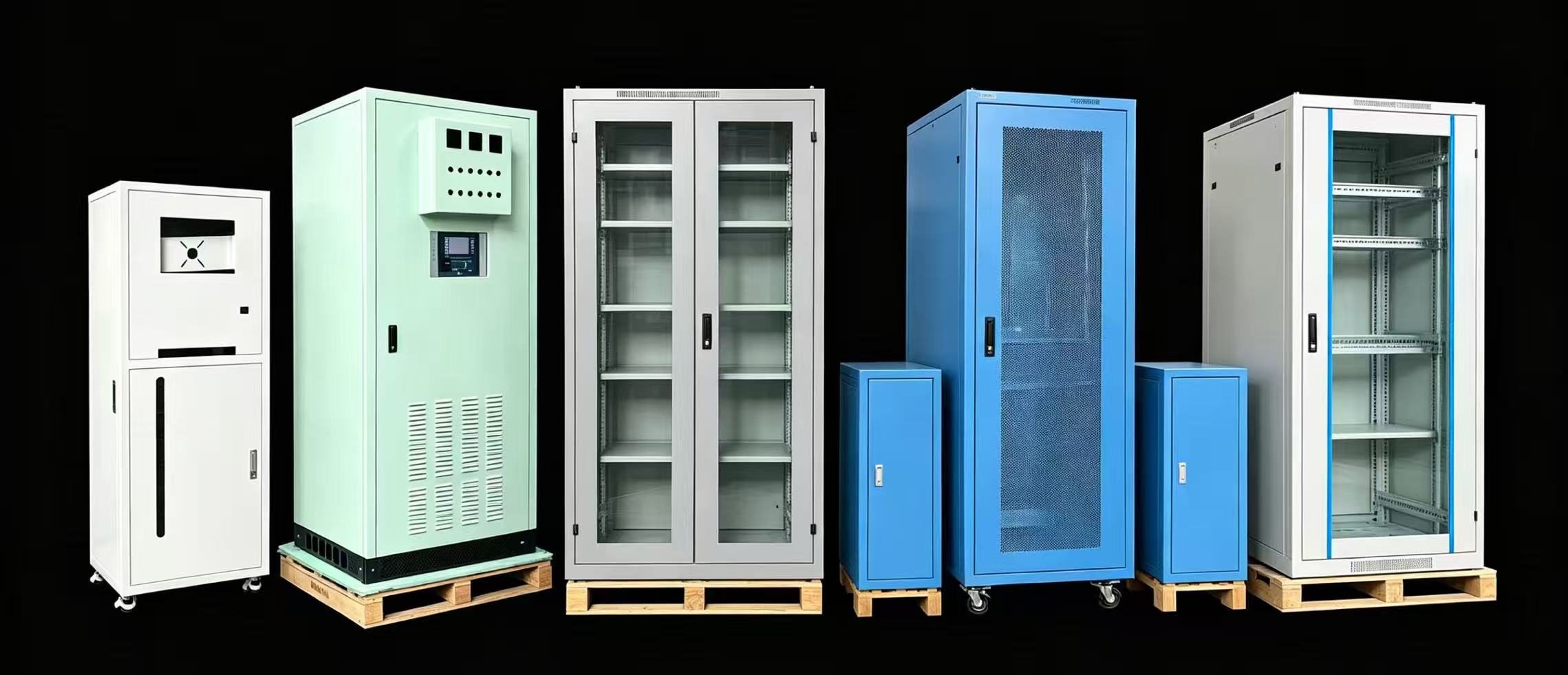
I see many cabinet power problems start small. A loose strip, messy cable, or wrong socket can grow into downtime, heat, and safety risk.
A rack mount PDU distributes power inside a 19-inch cabinet in a safe and organized way.1 I use it to connect servers, switches, industrial hosts, and network devices with stable input, overload protection, clean wiring, and optional remote monitoring.
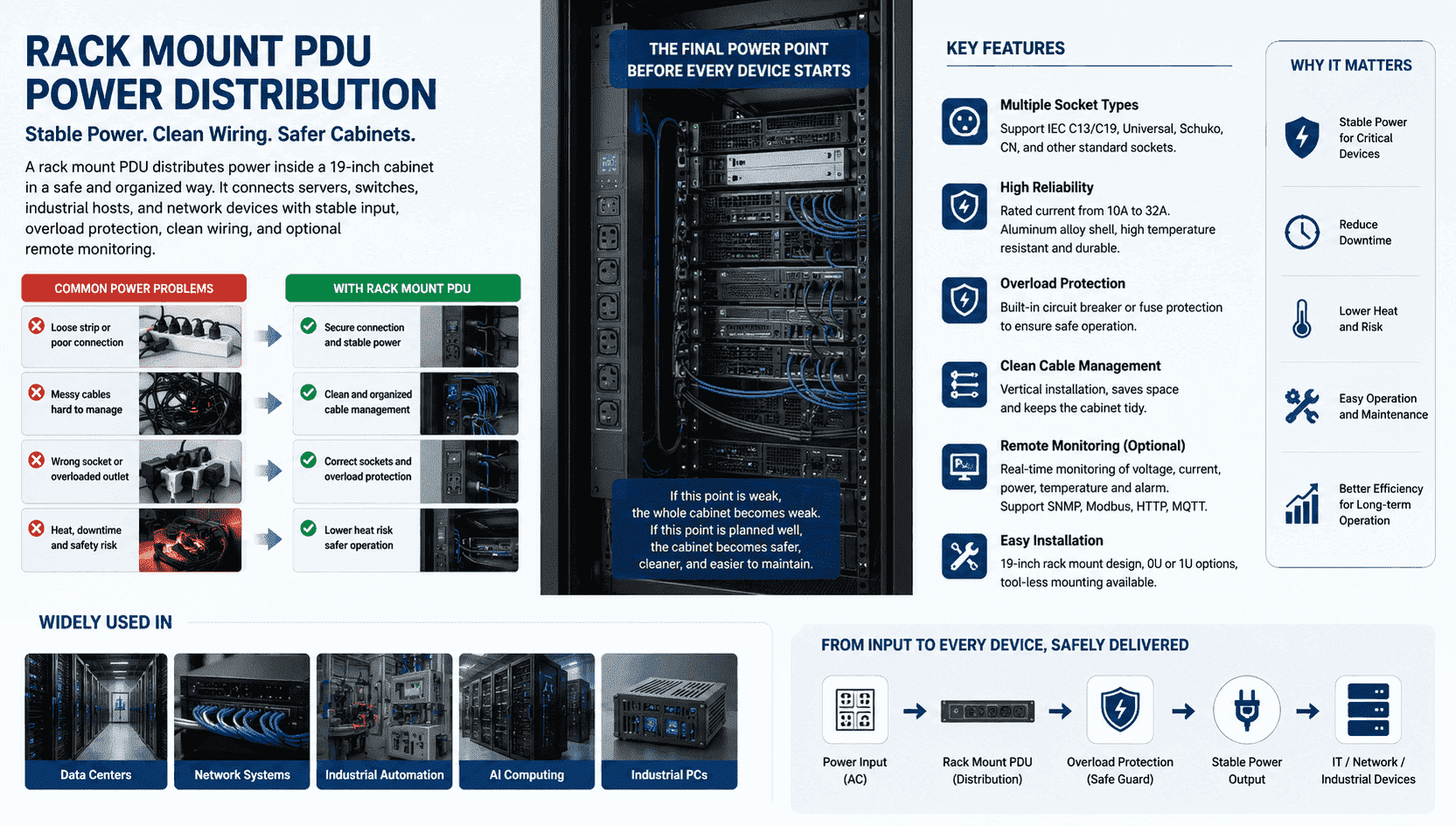
I treat the rack mount PDU as a key station inside the cabinet. It is not only a socket bar. It is the final power point before each device starts to work. If this point is weak, the whole cabinet becomes weak. If this point is planned well, the cabinet becomes safer, cleaner, and easier to maintain. I have seen traditional power strips and terminal blocks used in old rooms. They may work for small loads. They become risky when AI computing devices, servers, industrial PCs, and network systems need long running time. This is why I pay close attention to PDU structure, socket type, rated current, installation method, and monitoring function.
What Is a Rack Mount PDU and Why Do I Use It in a Cabinet?
I often see buyers focus on servers first. Then they leave power distribution as a small detail. That mistake can shorten equipment life.
A rack mount PDU is a power distribution unit made for 19-inch cabinets.2 I use it to receive one power input and distribute stable power to many devices inside server cabinets, network cabinets, and industrial cabinets.
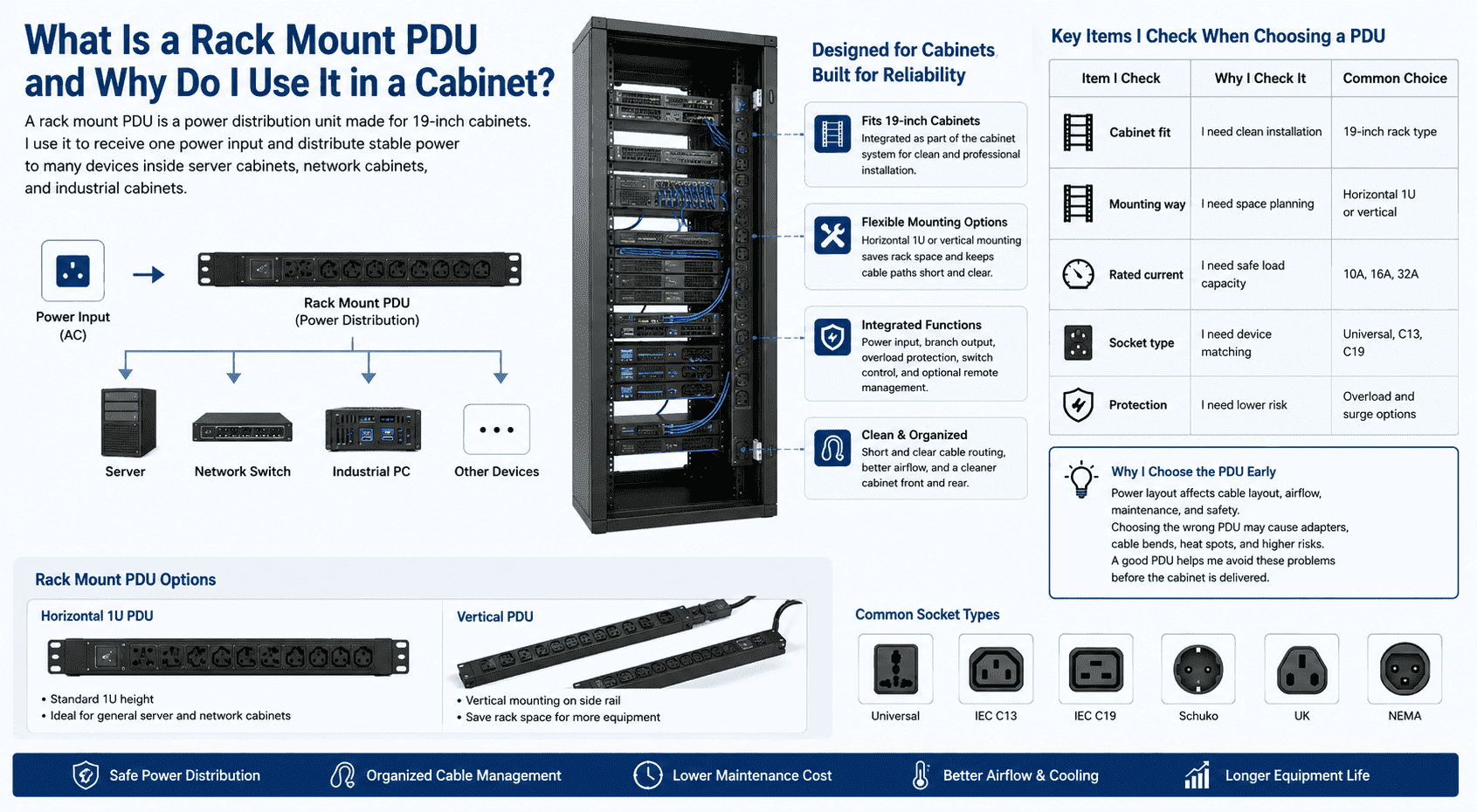
A rack mount PDU is designed around the cabinet system. I see it as part of the cabinet, not as a random accessory. It can be fixed in a 19-inch rack space, or it can be mounted vertically on the side rail. The common horizontal type uses 1U height. The vertical type saves rack space when many devices are installed.3 This design helps me keep the power cable path short and clear. It also keeps the cabinet door area clean.
I also care about the integrated functions. A proper PDU can support power input, branch output, overload protection, switch control, and sometimes remote control.4 A basic strip may only provide sockets. A PDU provides a more controlled power point. This difference matters when the cabinet runs every day.
| Item I Check | Why I Check It | Common Choice |
|---|---|---|
| Cabinet fit | I need clean installation | 19-inch rack type |
| Mounting way | I need space planning | Horizontal 1U or vertical |
| Rated current | I need safe load capacity | 10A, 16A, 32A |
| Socket type | I need device matching | Universal, C13, C19 |
| Protection | I need lower risk | Overload and surge options |
I choose the PDU early when I design a cabinet. I do not wait until the last step. Power layout affects cable layout, airflow, maintenance, and safety. If I choose the wrong PDU, I may need to add adapters. I may also create cable bends and heat spots. A good PDU helps me avoid these problems before the cabinet is delivered.
Why Is a Rack Mount PDU Safer Than a Common Power Strip?
I have seen old cabinet rooms with loose plugs and overloaded strips. The devices still run, but the hidden risk grows every day.
A rack mount PDU is safer because it uses a fixed cabinet structure, stronger materials, rated load design, and better protection. I use it when I need stable long-term power for critical equipment.
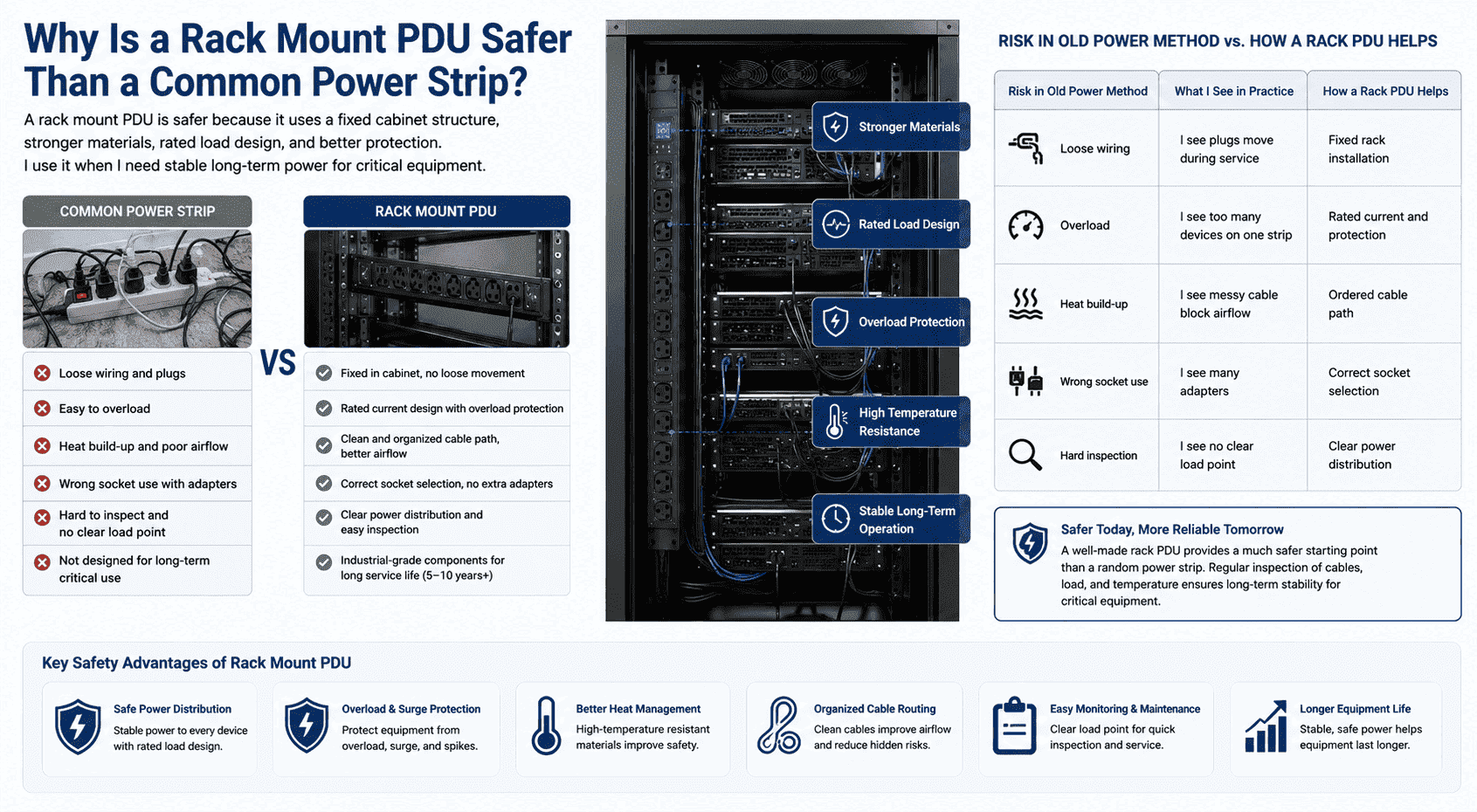
A common power strip is often made for office use. It may work for a computer, monitor, or small printer. It is not the best choice for a full cabinet with switches, routers, storage devices, servers, and industrial control hosts. The cabinet environment has heat, vibration, dense cables, and long running hours.5 I need a product that can handle this working condition.
A rack mount PDU usually uses industrial-grade components. Many models use aluminum alloy shells or strong plastic shells.6 The integrated body can resist aging better. It can also handle vibration better than loose power strips. Some PDUs support high temperature design. This matters because the rear side of a cabinet can become warm when airflow is poor.
| Risk in Old Power Method | What I See in Practice | How a Rack PDU Helps |
|---|---|---|
| Loose wiring | I see plugs move during service | Fixed rack installation |
| Overload | I see too many devices on one strip | Rated current and protection |
| Heat build-up | I see messy cable block airflow | Ordered cable path |
| Wrong socket use | I see many adapters | Correct socket selection |
| Hard inspection | I see no clear load point | Clear power distribution |
I also care about service life. A well-made rack PDU can often work for 5 to 10 years under proper use.7 This does not mean I ignore inspection. I still check cable tightness, load condition, and cabinet temperature. Yet the starting point is much safer than a random strip. In our cabinet projects, I prefer to match the cabinet, PDU, and cable plan together. This makes the final system more stable and more professional for overseas customers.
How Do I Choose the Right Rack Mount PDU Socket and Current Rating?
I see many problems come from a simple mismatch. The PDU looks correct, but the plug, current, or socket type does not match the load.
I choose a rack mount PDU by checking the device plug, total load, current rating, cabinet space, and future expansion. I often compare 10A, 16A, and 32A models before final selection.
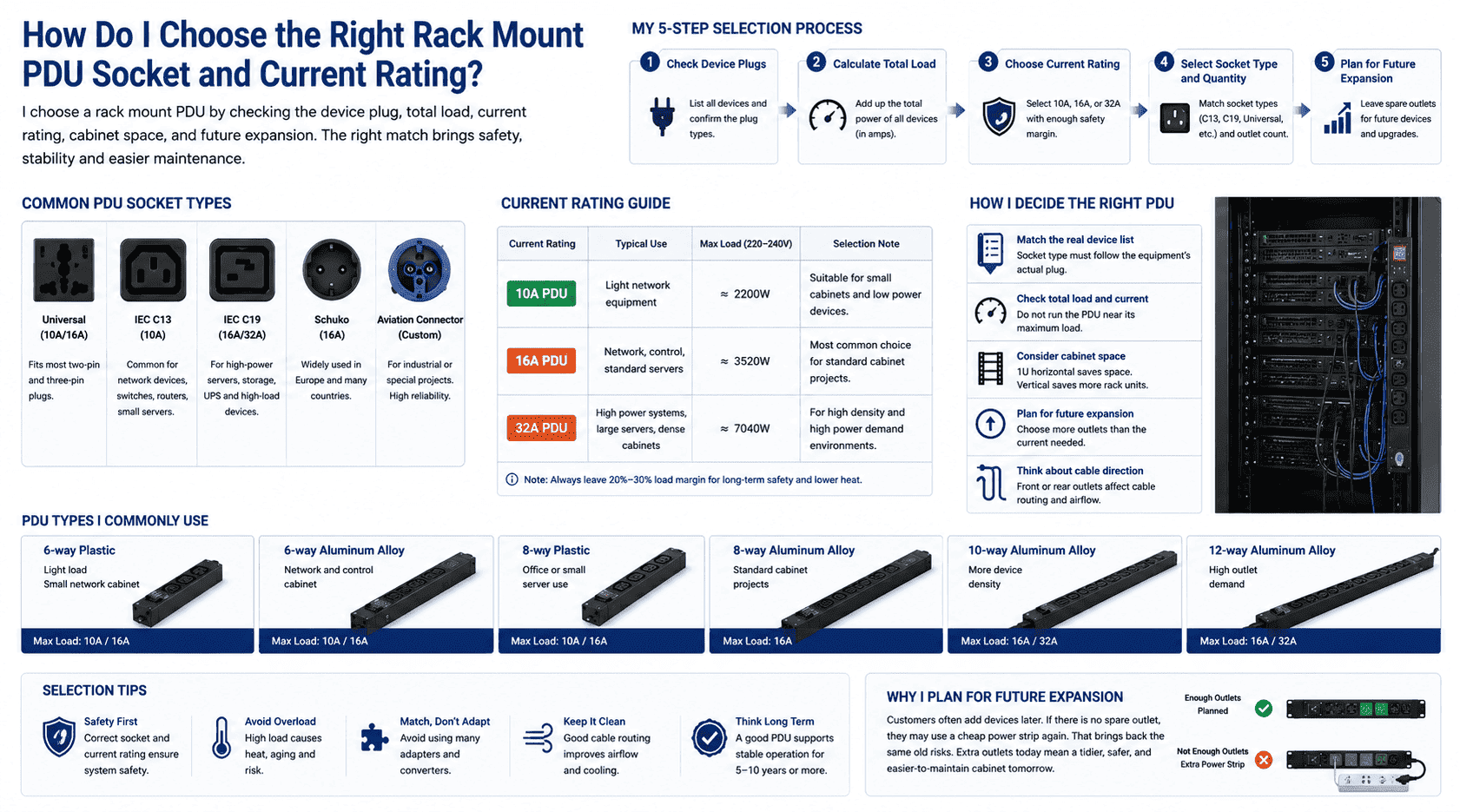
The socket type should follow the equipment. For common network devices and small servers, I often use universal two and three-hole sockets or C13 outlets. For high-power servers, I look at C19 outlets.8 For some industrial or special projects, aviation connectors or custom socket types may be needed. I do not choose the socket only by habit. I check the real device list first.
The current rating is also important. A 10A PDU may be enough for light network equipment. A 16A PDU is common for stronger cabinet loads. A 32A PDU may be needed in larger power systems. I always leave margin. I do not like running a PDU near its maximum load for a long time. Heat and stress rise when the load is too close to the limit.9
| PDU Type I Commonly Use | Typical Use | My Selection Note |
|---|---|---|
| 6-way plastic | Small network cabinet | I use it for light load |
| 6-way aluminum alloy | Network and control cabinet | I use it for better strength |
| 8-way plastic | Office or small server use | I check total current first |
| 8-way aluminum alloy | Standard cabinet projects | I use it often for stable work |
| 10-way aluminum alloy | More device density | I plan cable spacing |
| 12-way aluminum alloy | High outlet demand | I check heat and load margin |
I also ask if the cabinet needs future expansion. Many customers add devices after the first installation. If the PDU has no spare outlet, they may add a cheap strip later. That creates the same old problem again. I prefer to provide a PDU with suitable spare capacity. This keeps the cabinet tidy after expansion. It also makes later maintenance easier. In custom cabinet work, I can match the cabinet depth, rail position, and PDU outlet direction. This helps the customer avoid cable crowding and poor access.
How Does a Rack Mount PDU Improve Cabinet Wiring and Airflow?
I have opened cabinets where cables looked like a net. The equipment worked, but the airflow was poor and the service work was slow.
A rack mount PDU improves wiring by fixing power outlets in a planned position. I use it to reduce cable crossing, keep airflow clear, and make the cabinet easier to inspect.
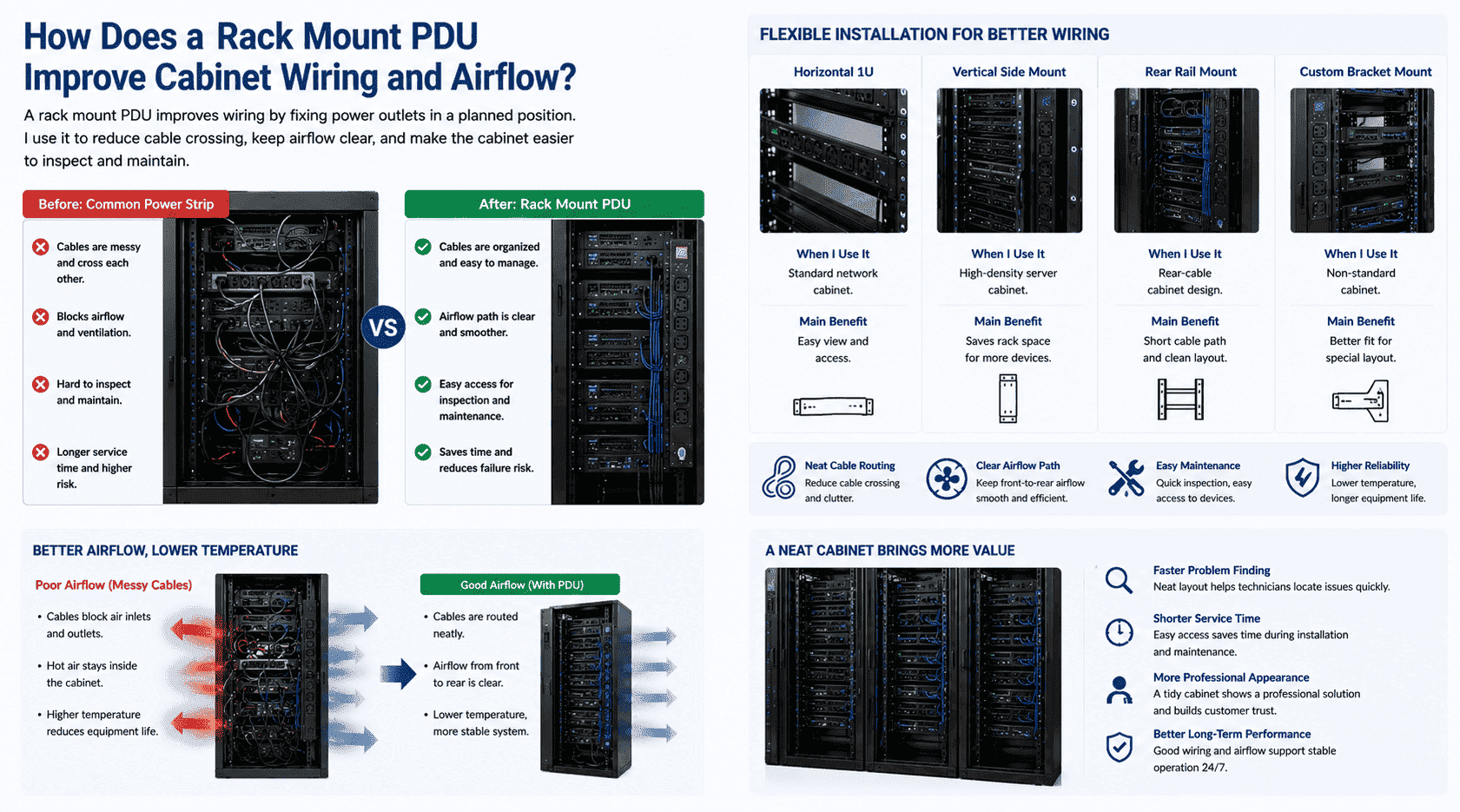
A cabinet is not only a box for equipment. It is a working space for power, data, heat, and service. If I place the PDU poorly, the power cables may cross the network cables. They may block fans or cover ventilation holes. They may also make it hard to pull out a server. When I place the PDU well, the cabinet becomes easier to use.
Horizontal 1U installation is common. I use it when the cabinet has enough rack space and the device count is not too high. Vertical installation works well in deeper cabinets and server cabinets with more equipment. It keeps rack units free for devices. It also lets short power cords run from devices to nearby outlets.
| Installation Style | When I Use It | Main Benefit |
|---|---|---|
| Horizontal 1U | Standard network cabinet | Easy view and access |
| Vertical side mount | High-density server cabinet | Saves rack space |
| Rear rail mount | Rear-cable cabinet design | Short cable path |
| Custom bracket mount | Non-standard cabinet | Better fit for special layout |
I also think about heat. Messy cables can block airflow from front to rear.10 In data rooms and industrial cabinets, this can raise device temperature. High temperature reduces equipment life.11 A PDU cannot cool the cabinet by itself. Yet it helps me arrange power cables in a neat way. This supports better airflow. It also improves the appearance of the cabinet. Appearance is not only for looks. A neat cabinet helps technicians find problems faster. It reduces service time. It also gives the end user more trust in the full solution.
When Should I Use an Intelligent Rack Mount PDU?
I see more customers ask for remote control after one power failure. They want to know the load before a problem becomes downtime.
I use an intelligent rack mount PDU when I need real-time current, voltage, power, temperature, humidity, energy data, and remote outlet control.12 It is useful in data centers and critical sites.
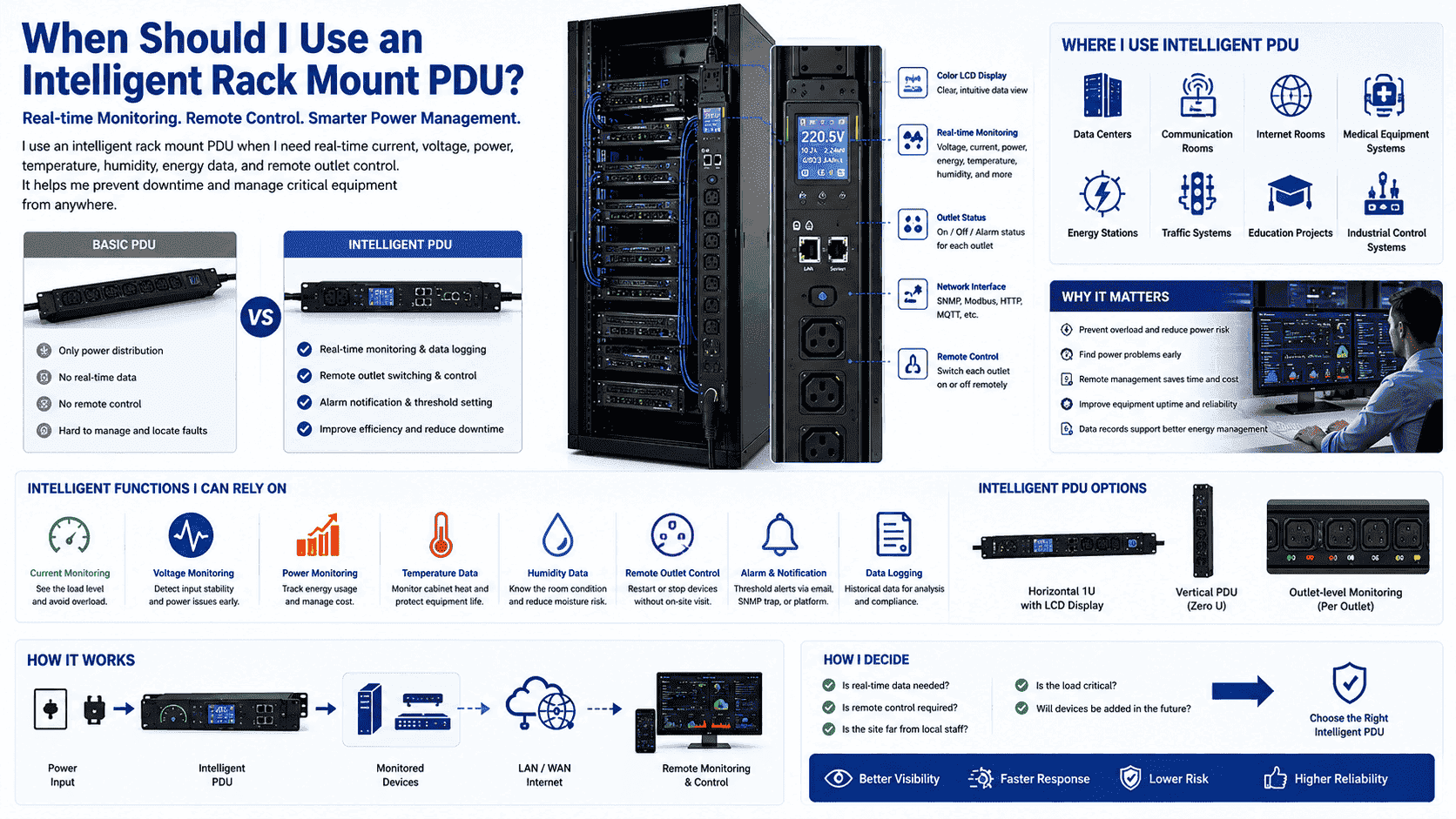
An intelligent PDU is more than a power distributor. It is a monitoring point inside the cabinet. It can show total current, voltage, load power, energy use, and environmental data through an LED or LCD display. Some models can also monitor each outlet. Some models can switch each outlet on or off remotely. I use these functions when a site needs fine power management.
This is helpful in communication rooms, internet rooms, medical equipment systems, energy stations, traffic systems, education projects, and industrial control systems. In these places, the cabinet may not always have staff nearby. Remote power control saves time. If one device freezes, the manager may restart only that outlet. The manager does not need to cut power to the whole cabinet.
| Intelligent Function | What I Can See or Do | Why It Matters |
|---|---|---|
| Current monitoring | I see the load level | I avoid overload |
| Voltage monitoring | I see input stability | I find power problems early |
| Power monitoring | I see energy use | I manage cost and capacity |
| Temperature data | I see cabinet heat | I protect equipment life |
| Humidity data | I see room condition | I reduce moisture risk |
| Remote outlet control | I switch devices remotely | I reduce site visits |
I do not say every cabinet needs an intelligent PDU. A small office cabinet may only need a reliable basic model. A server cabinet, AI computing cabinet, or remote industrial cabinet may need monitoring. The choice depends on risk, budget, site distance, and load importance. I help customers compare these points before production. Since we support non-standard customization and small orders, I can match a basic PDU or smart PDU with the cabinet structure. This is useful for overseas projects with different standards and plug types.
How Do I Match a Rack Mount PDU With a Custom Cabinet Project?
I see power planning fail when the cabinet and PDU are bought separately. The parts may be good, but the full system may not fit well.
I match a rack mount PDU with the cabinet by checking cabinet size, rail position, door type, load needs, socket direction, cable route, and project environment before production.
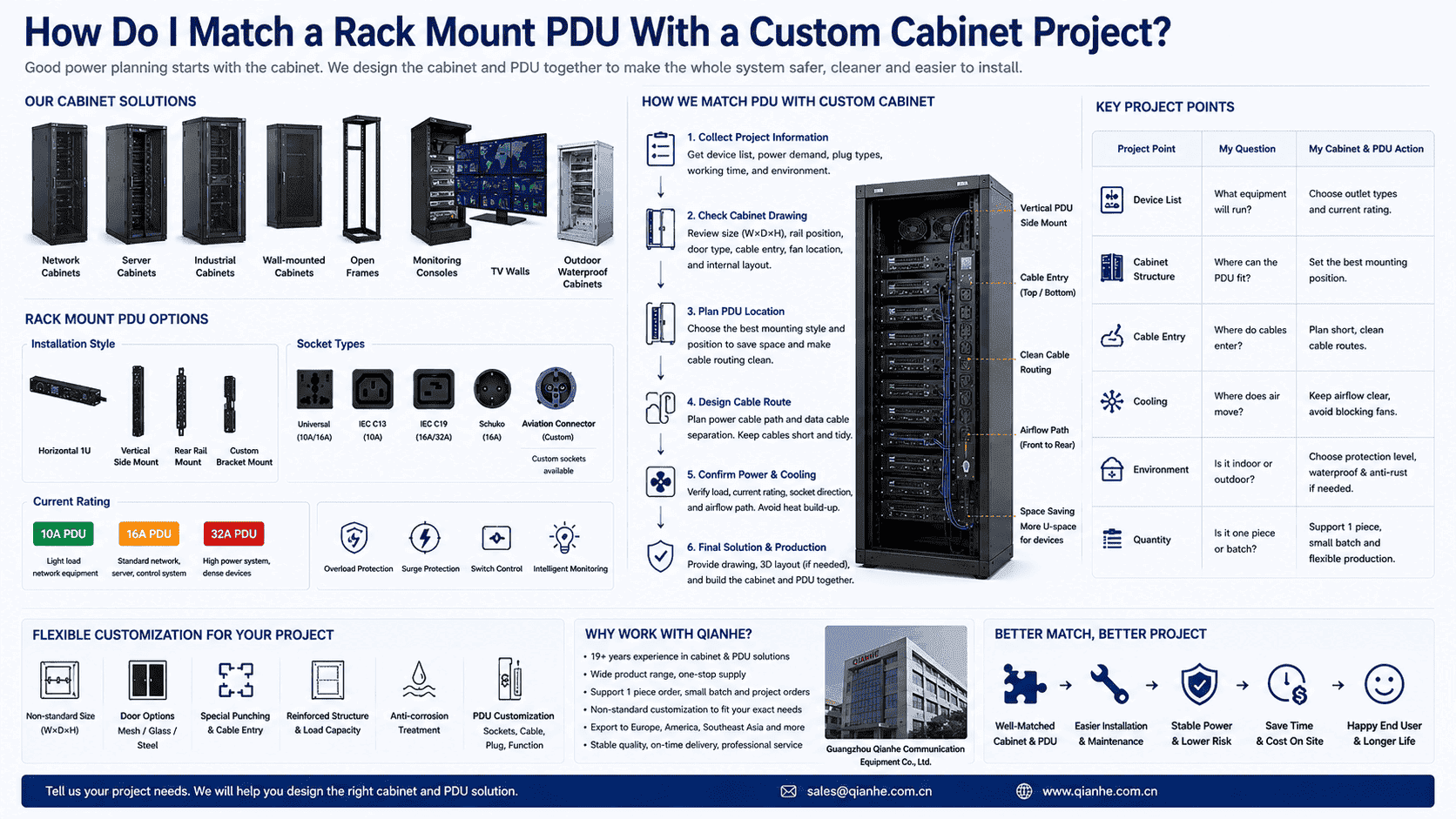
In our work at Guangzhou Qianhe Communication Equipment Co., Ltd., I do not treat the PDU as a last-minute accessory. We make network cabinets, server cabinets, industrial cabinets, wall-mounted cabinets, open frames, monitoring consoles, TV walls, and outdoor waterproof cabinets. Each product has its own power path. A wall-mounted cabinet has limited space. A server cabinet may need high outlet density. An outdoor cabinet may need waterproof and anti-rust design. An industrial cabinet may need stronger structure and better cable protection.
I start with the device list. I check quantity, power, plug type, and working time. Then I check the cabinet drawing. I look at the rail, door, side panel, fan position, and cable entry. If the project needs non-standard size, mesh door, glass door, steel door, special punching, reinforced structure, or anti-corrosion treatment, I include the PDU location in the same plan.
| Project Point | My Question | My Cabinet and PDU Action |
|---|---|---|
| Device list | What equipment will run? | I choose outlets and current |
| Cabinet structure | Where can the PDU fit? | I set mounting position |
| Cable entry | Where do cables enter? | I plan short and clean routes |
| Cooling | Where does air move? | I avoid blocking airflow |
| Environment | Is it indoor or outdoor? | I choose protection needs |
| Quantity | Is it one piece or batch? | I support flexible production |
We support orders starting from one piece. This helps customers test a cabinet solution before larger orders. We also support small-batch and non-standard customization. I see this as important for overseas customers in Europe, America, and Southeast Asia. Many projects have different cabinet depths, plug standards, and installation habits. A fixed mass product may not solve every detail. A flexible cabinet and PDU plan can reduce installation risk and save time on site.
Conclusion
I use a rack mount PDU to make cabinet power safer, cleaner, and easier to control. Good power planning protects the whole cabinet system.
"Power distribution unit - Wikipedia", https://en.wikipedia.org/wiki/Power_distribution_unit. The source defines rack power distribution units as devices that distribute electrical power to equipment within rack-based installations, providing definitional support for the article's description of their role in 19-inch cabinets. Evidence role: definition; source type: encyclopedia. Supports: A rack PDU is a device used to distribute electrical power to equipment installed in racks, including data-center or server-rack environments.. Scope note: The source may support the general definition of rack PDUs but may not directly evaluate the safety or organization of a specific product design. ↩
"19-inch rack - Wikipedia", https://en.wikipedia.org/wiki/19-inch_rack. The source explains that the 19-inch rack is a standardized frame for mounting electronic equipment, contextualizing why rack-mounted PDUs are designed for 19-inch cabinet systems. Evidence role: definition; source type: encyclopedia. Supports: The 19-inch rack is a standardized mounting frame used for electronic equipment, including servers and network devices.. Scope note: The source supports the rack standard rather than the detailed design requirements of every rack PDU. ↩
"What Is Data Center U Space? Key Considerations for ...", https://www.raritan.com/blog/detail/what-is-data-center-u-space-key-considerations-for-choosing-the-right-cabinets-and-pdus. The source describes vertical rack PDUs as side- or rear-mounted devices that preserve rack-unit space for IT equipment, supporting the article's statement about space savings in high-density cabinets. Evidence role: general_support; source type: institution. Supports: Vertical rack PDUs are commonly mounted along the side or rear of racks and do not consume front rack-unit equipment space in the same way as horizontal 1U PDUs.. Scope note: The support is contextual because the exact space saved depends on the cabinet layout and PDU form factor. ↩
"Power distribution unit - Wikipedia", https://en.wikipedia.org/wiki/Power_distribution_unit. The source summarizes common PDU functions, including electrical distribution and optional monitoring or switching features, supporting the article's functional description of rack PDUs. Evidence role: definition; source type: encyclopedia. Supports: Power distribution units can distribute power and may include monitoring, switching, and overload-protection functions depending on model type.. Scope note: The source supports feature categories generally and does not confirm that every PDU includes all listed functions. ↩
"Install In-rack or In-row Cooling - Energy Star", https://www.energystar.gov/products/data_center_equipment/16-more-ways-cut-energy-waste-data-center/install-rack-or-row. The source discusses thermal and operational stresses in rack or enclosure environments, providing context for the article's claim that cabinet installations differ from ordinary office power-strip use. Evidence role: general_support; source type: research. Supports: Rack-mounted electronic systems commonly face thermal-management issues, dense cabling, and continuous operating conditions; industrial enclosures may also face vibration or environmental stress.. Scope note: The source may address data-center or industrial enclosures broadly rather than every cabinet environment. ↩
"Server Technology Rack Power Distribution Units", https://www.legrand.us/critical-power-and-infrastructure/rack-power-distribution/server-technology-intelligent-pdus?srsltid=AfmBOoqa2j5yd9G186UeMXqbdpdd6n_C7WDbUHhT4_JJAnPW4lppITT_. The source documents typical enclosure materials used for rack power distribution units, supporting the article's statement that many models use aluminum-alloy or durable-plastic shells. Evidence role: general_support; source type: institution. Supports: Rack PDU enclosures are commonly manufactured with metal or engineered-plastic housings for electrical and mechanical protection.. Scope note: The source supports common industry practice and may not quantify the proportion of models using each material. ↩
"[PDF] Power Distribution in Data Centers: | Raritan", https://www.raritan.com/assets/re/resources/white_papers/White_Paper_-_Power_Distribution_In_Data_Centers.pdf. The source provides lifecycle or maintenance guidance for rack power distribution units, supporting the article's estimate that a properly used PDU may remain in service for several years. Evidence role: general_support; source type: institution. Supports: Rack PDUs have multi-year operational lifecycles under appropriate loading, environmental conditions, and maintenance practices.. Scope note: The exact lifespan varies with load, ambient temperature, component quality, and inspection practices; a source may support the range only as industry guidance rather than as a guaranteed lifetime. ↩
"IEC 60320 - Wikipedia", https://en.wikipedia.org/wiki/IEC_60320. The source states the current ratings and intended use of IEC 60320 C13/C14 and C19/C20 connector types, supporting the article's distinction between common device outlets and higher-power server outlets. Evidence role: definition; source type: institution. Supports: IEC 60320 C19/C20 connectors are rated for higher current than C13/C14 connectors and are therefore used for higher-power equipment.. Scope note: The source supports connector capacity, while actual server suitability also depends on voltage, circuit rating, and equipment power-supply requirements. ↩
"Electrical equipment", https://irc.wisc.edu/export.php?ID=537. The source explains the relationship between continuous electrical loading and heat generation in conductors or protective devices, supporting the article's caution against operating a PDU near its maximum rating for extended periods. Evidence role: mechanism; source type: government. Supports: Higher continuous electrical load increases heat generation in conductors and electrical components, and electrical codes commonly distinguish continuous loads from short-duration loads.. Scope note: The source supports the electrical principle and code context; the precise safe margin depends on the applicable electrical code, PDU rating, and installation conditions. ↩
"Best Practices Guide for Energy-Efficient Data Center Design", https://www.energy.gov/sites/default/files/2024-07/best-practice-guide-data-center-design.pdf. The source identifies cable management as a factor in rack airflow and cooling performance, supporting the article's claim that messy cables can obstruct front-to-rear air movement. Evidence role: mechanism; source type: institution. Supports: Cable congestion in server racks can impede airflow paths and reduce cooling effectiveness.. Scope note: The source supports the mechanism generally; the magnitude of airflow impact depends on rack density, fan design, cable volume, and containment practices. ↩
"[PDF] Data Center Efficiency and IT Equipment Reliability at Wider ...", https://www.energy.gov/sites/prod/files/2013/12/f5/data_center_efficiency_and_reliabilit_at_wider_operating_ranges.pdf. The source explains that elevated temperature accelerates failure mechanisms in electronic components, supporting the article's statement that high cabinet temperatures can reduce equipment life. Evidence role: mechanism; source type: paper. Supports: Higher temperatures accelerate degradation mechanisms in electronic components and can reduce reliability or expected service life.. Scope note: The source supports the general thermal-reliability relationship; actual lifetime reduction depends on component type, duty cycle, cooling design, and operating temperature range. ↩
"Manage Data Center Power Usage - Raritan", https://www.raritan.com/why-intelligent-pdu/manage-data-center-power-usage. The source describes intelligent rack PDUs as devices that provide electrical monitoring and, in some configurations, environmental sensing and remote outlet switching, supporting the article's description of smart PDU functions. Evidence role: definition; source type: institution. Supports: Intelligent or smart PDUs can monitor electrical parameters and may include environmental sensors and outlet-level switching or control.. Scope note: The source supports the category of intelligent PDU capabilities; individual models vary in whether they include all listed measurements and controls. ↩
