
Flex Data Center Racks and Enclosures?
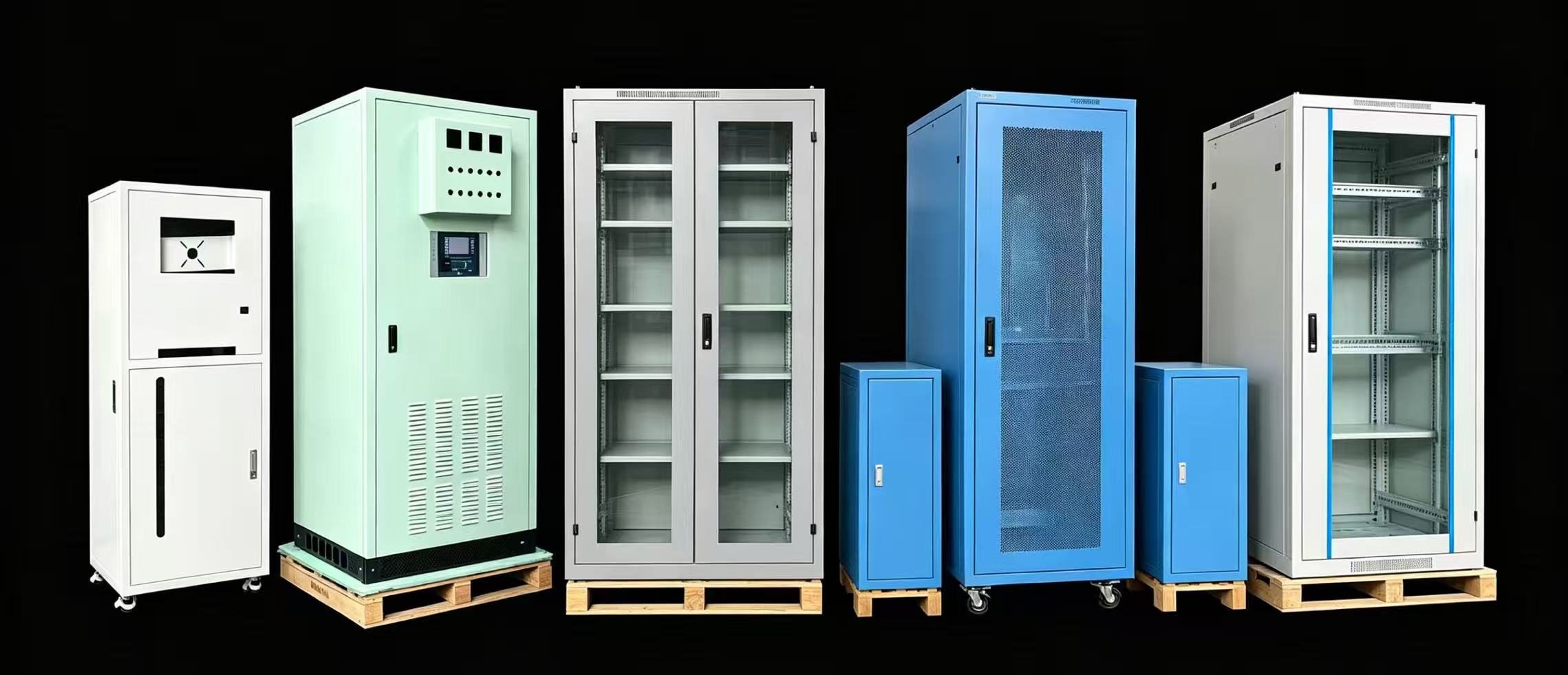
Old racks feel safe until power rises, heat builds, and cables block service. I have seen fixed cabinets turn simple expansion into slow work.
Flex data center racks and enclosures are modular cabinet systems that support changing server loads, better airflow, cleaner cabling, smart monitoring, and lower energy use.1 I use them when a data center needs faster expansion, high-density computing, AI hardware, edge equipment, or custom cabinet structures.
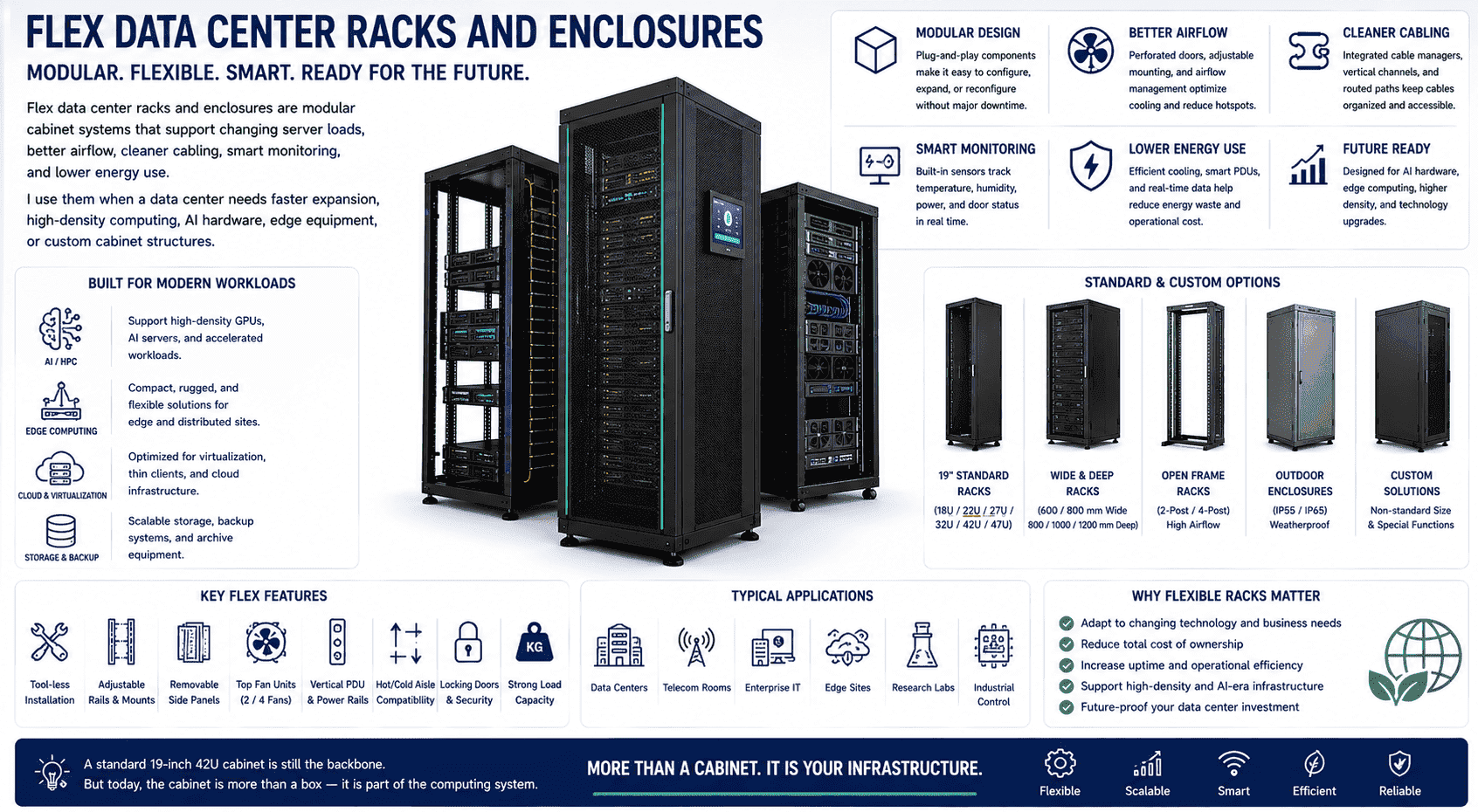
I started to care more about flexible racks when customers asked for cabinets that could handle more than storage. They wanted one cabinet to support servers, switches, power units, sensors, cable paths, and future upgrades. A standard 19-inch 42U cabinet still matters.2 I still see it as the main structure in many data centers. But I also see that the cabinet can no longer stay as a simple metal box. It now needs to become part of the computing system.3
Why Are Flex Data Center Racks Replacing Traditional Racks?
Traditional racks look simple, but they hide problems. I have seen fixed cabinet structures slow down upgrades, create heat zones, and make cable repair hard.
Flex data center racks replace traditional racks because they use modular parts, adjustable layouts, better airflow paths, and smart control options. I can adapt them to new servers, AI hardware, power systems, and cooling needs without rebuilding the whole cabinet.
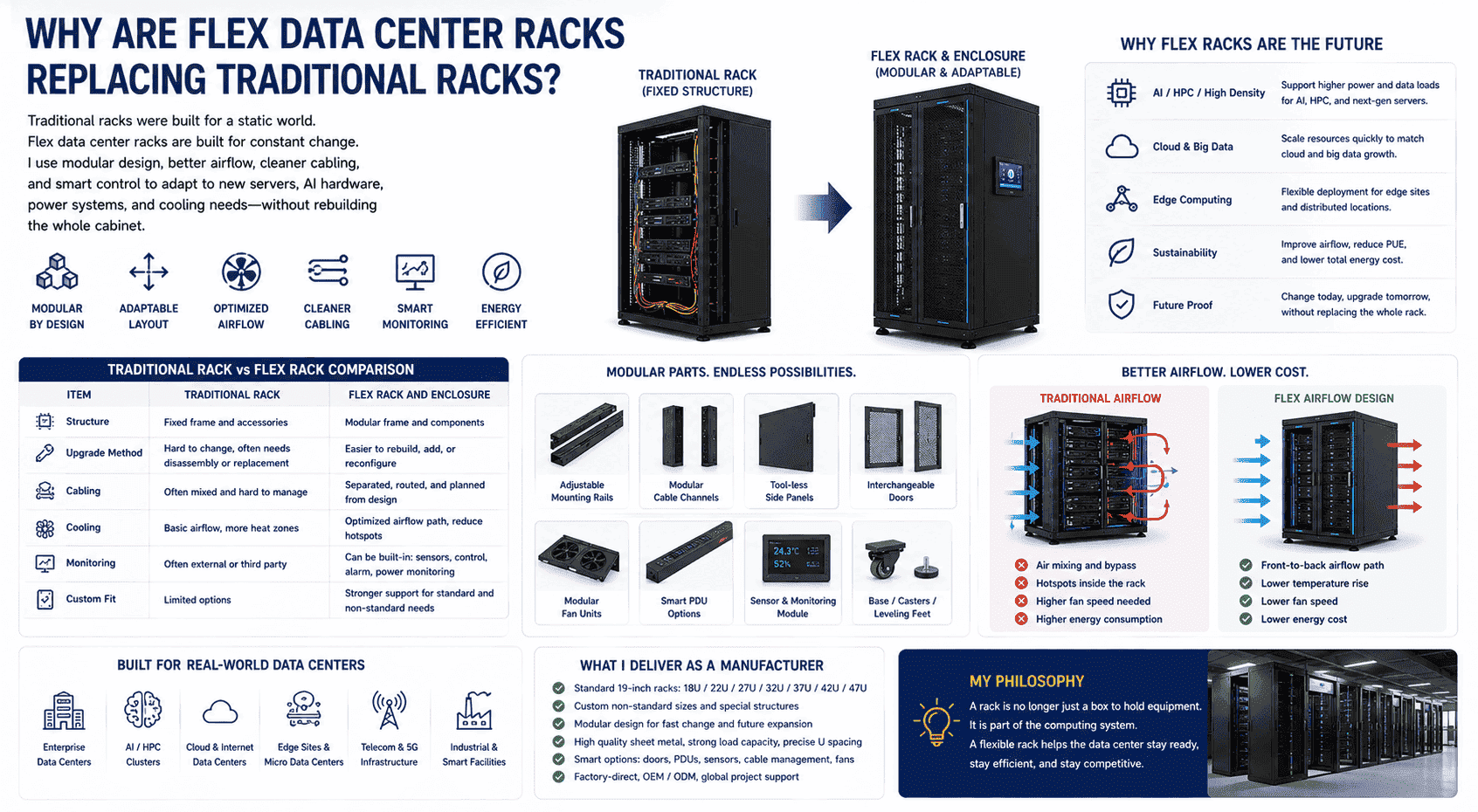
I see the old rack model as a static support frame. It holds devices, but it does not respond well when the data center changes. This was enough when server density was lower. It is not enough when AI computing, cloud platforms, big data, and edge computing keep pushing more power into each cabinet.4
A flex rack works more like a platform. I can change mounting rails, cable channels, doors, side panels, power positions, fan modules, and monitoring parts. This matters because the data center is no longer built once and used unchanged for years. The load changes. The hardware changes. The cooling plan changes.5 The customer may need a standard cabinet today and a non-standard structure later.
| Item | Traditional Rack | Flex Rack and Enclosure |
|---|---|---|
| Structure | Fixed frame | Modular frame |
| Upgrade method | Hard to change | Easier to rebuild |
| Cabling | Often mixed | Separated and planned |
| Cooling | Basic airflow | Designed airflow path |
| Monitoring | Often external | Can be built in |
| Custom fit | Limited | Stronger support |
I have built many network cabinets and server cabinets over the years. I learned that cabinet value is not only in steel thickness or surface finish. It is also in how fast the cabinet can serve a changing machine room. When a cabinet can be adapted, moved, extended, and maintained with less work, it becomes part of the data center capacity plan.
How Does Modular Design Make Data Center Racks More Flexible?
A fixed cabinet can become a limit. I have seen one small design change force a customer to replace many cabinet parts.
Modular design makes data center racks flexible because each function can be separated, installed, removed, or replaced.6 I can adjust rails, panels, cable managers, doors, power units, and monitoring modules based on the equipment plan.
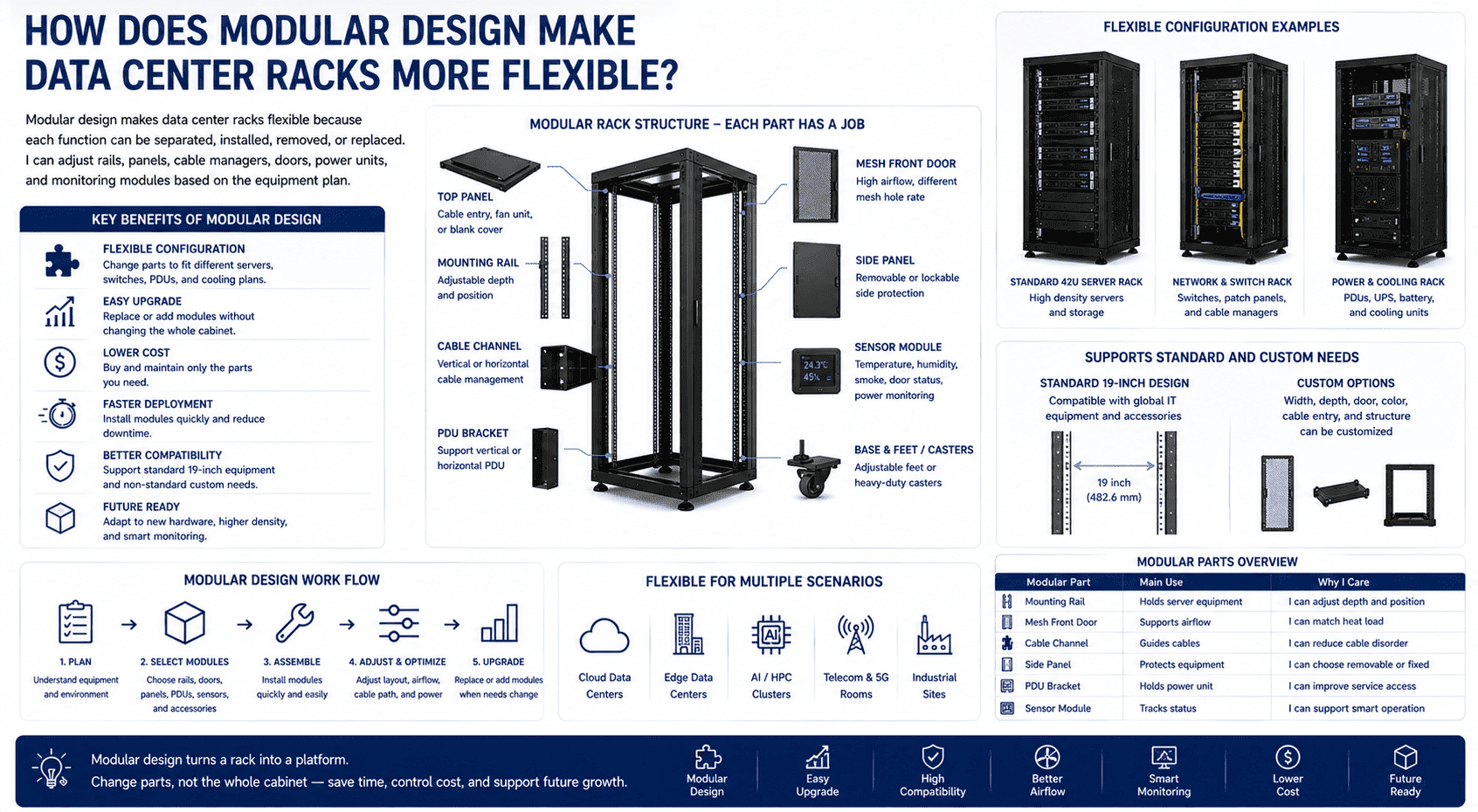
I use modular thinking when I design or produce a cabinet for a customer who does not want a one-time structure. In this design, the cabinet is not treated as one fixed body. I treat it as a group of useful parts. Each part has a job. Each part can work with other parts. This makes the enclosure easier to match with different servers, switches, power units, and cooling layouts.
A common data center still uses a 19-inch standard rack width. A 42U cabinet is still one of the most used heights. But the inside design can be flexible. The mounting depth can change. The door type can change. The mesh hole rate can change. The cable path can be placed on the left, right, top, or bottom. The cabinet can also support special width, special depth, or non-standard doors when the project needs it.
| Modular Part | Main Use | Why I Care |
|---|---|---|
| Mounting rail | Holds server equipment | I can adjust depth and position |
| Mesh front door | Supports airflow | I can match heat load |
| Cable channel | Guides cables | I can reduce cable disorder |
| Side panel | Protects equipment | I can choose removable or fixed |
| PDU bracket | Holds power unit | I can improve service access |
| Sensor module | Tracks status | I can support smart operation |
This kind of design helps both large cloud data centers and edge sites. A cloud site may need high-density racks. An edge site may need smaller custom enclosures. In both cases, modular parts reduce waste. I do not need to redesign the whole cabinet each time. I can keep the basic structure and change the function modules. This saves time, controls cost, and lowers the risk of wrong fit.
How Do Flex Racks Improve Cabling and Space Use?
Cable disorder grows slowly, then it becomes a real fault risk. I have opened cabinets where airflow and service access were both blocked by cables.
Flex racks improve cabling and space use by using layered cable paths, vertical cable channels, horizontal cable managers, and separated strong and weak current routes. I can keep cables clear, safe, and easier to maintain.
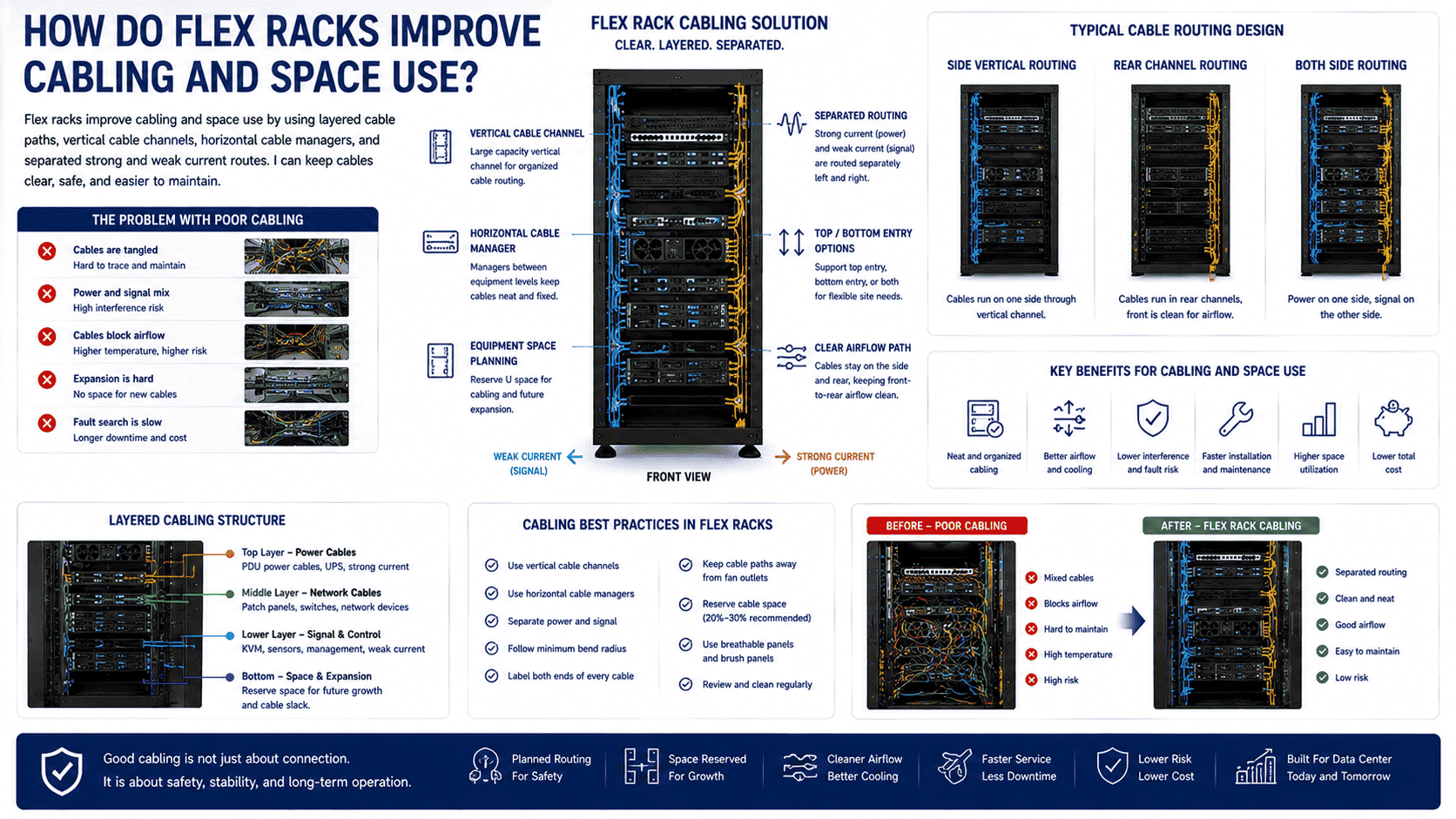
I think cable planning is one of the most ignored parts of a cabinet. Many people first look at frame strength and door style. These are important. But poor cabling can destroy the value of a good rack. If cables cross without order, the engineer needs more time to find faults. If power cables and signal cables are mixed without control, interference risk rises.7 If cables block air paths, the cabinet becomes hotter.8
A flex rack solves this problem by giving cables a planned route. I can leave a vertical cable channel on one side. I can add horizontal cable managers between equipment levels. I can separate strong power cables and weak signal cables. I can also design top entry, bottom entry, or both. This makes the cabinet cleaner and safer.
| Cabling Problem | Flex Rack Solution | Result |
|---|---|---|
| Cables are tangled | Use vertical cable channel | Faster inspection |
| Power and signal mix | Use separated routing | Less interference |
| Cables block airflow | Use side and rear routing | Better cooling |
| Expansion is hard | Reserve cable space | Easier upgrade |
| Fault search is slow | Label and route by layer | Lower service time |
I have seen this difference in factory production and in project feedback. A cabinet with good cable planning may not look very special at first. But after six months of operation, the difference becomes clear. The engineer can open the cabinet and understand the layout fast. The customer can add new equipment without pulling out many old cables. The system can grow with less risk.
How Do Flex Enclosures Support High-Density Cooling?
Heat is not only a comfort problem. I have seen small hot spots reduce equipment life and create hidden risk inside a rack.
Flex enclosures support high-density cooling through perforated doors, clear airflow channels, sealed hot and cold paths, adjustable fans, and better internal layout. I can match cooling design with actual power density.
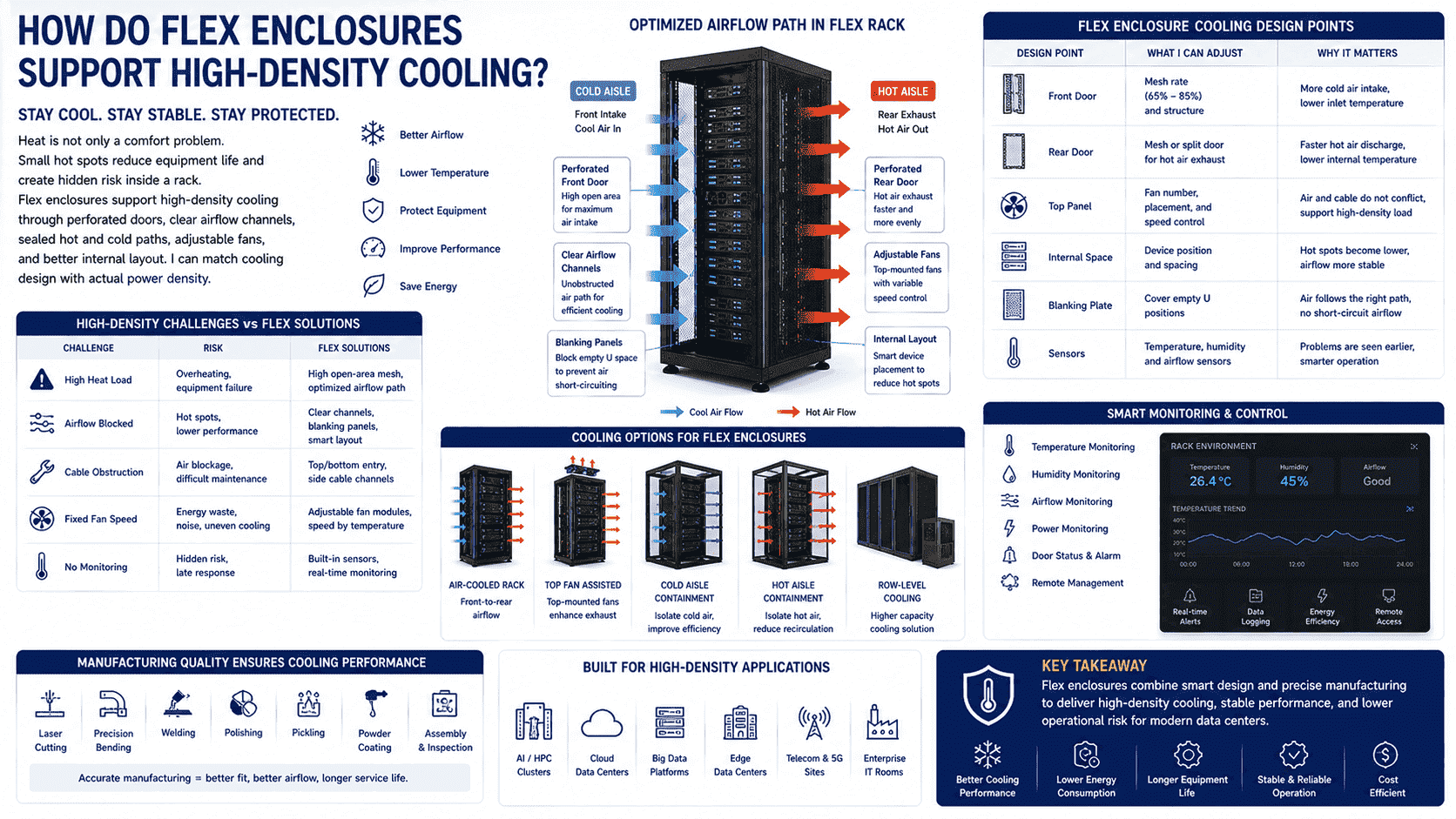
I see cooling as one of the main reasons that flexible racks became important. AI servers and high-density computing equipment can create much more heat than older devices.9 A closed or poorly planned cabinet cannot move this heat well. It may look strong, but it may not protect the equipment well.
A good flex enclosure starts with airflow. The front door and rear door can use high open-area mesh. The internal layout can keep the cold air path clear. The rear side can support hot air exhaust. The top plate can support fan units or cable openings that do not block airflow. The blanking panels can stop air from short-circuiting through empty U spaces.10 The cabinet can also support row-level cooling or more advanced cooling plans when the project requires it.
| Cooling Design Point | What I Can Adjust | Why It Matters |
|---|---|---|
| Front door | Mesh rate and strength | Cold air enters better |
| Rear door | Mesh or split door | Hot air leaves faster |
| Top panel | Fan and cable layout | Air and cable do not fight |
| Internal space | Device position | Hot spots become lower |
| Blanking plate | Empty U blocking | Air follows the right path |
| Sensors | Temperature tracking | Problems are seen earlier |
I also pay attention to manufacturing accuracy. If the frame is not straight, the door gap can be uneven. If the perforated door is not made well, airflow and strength may both suffer. If the surface treatment is poor, corrosion can reduce product life. For this reason, I see laser cutting, precise bending, welding, polishing, pickling, powder coating, and assembly control as part of cooling quality. The cooling result is not only from design. It is also from careful production.
How Does Smart Management Change Rack Operation?
Manual checks work until the site becomes too large. I have seen teams spend too much time finding faults that sensors could show earlier.
Smart management changes rack operation by adding remote monitoring, energy reports, alarm functions, and visual cabinet data.11 I can manage power, cooling, status, and fault response with less manual work.
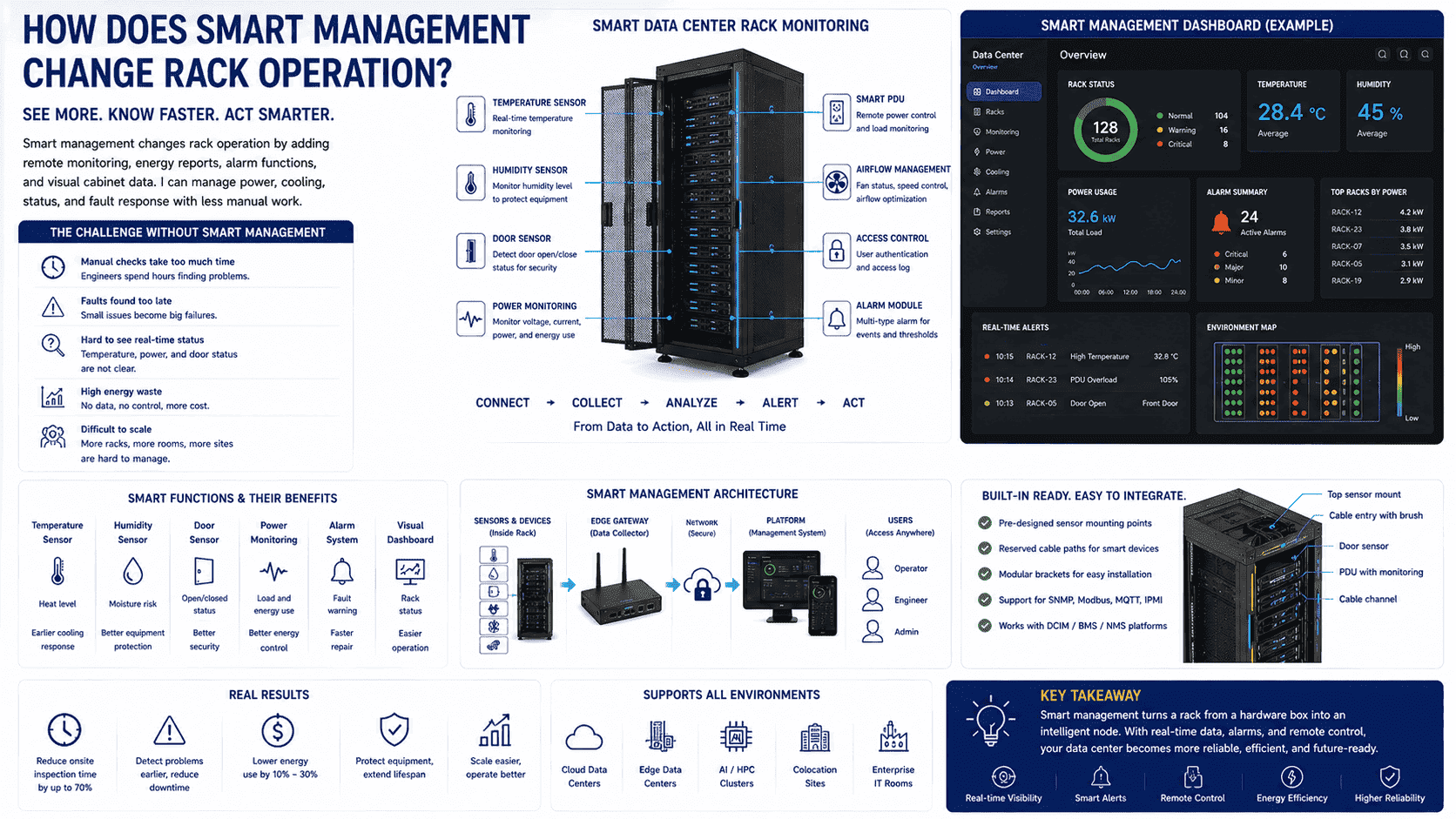
A modern flexible rack can connect with a larger management system. This does not mean every cabinet must be complicated. It means the cabinet can support smart parts when the customer needs them. I can add temperature sensors, humidity sensors, door sensors, power monitoring, access control, and alarm modules. These parts help the data center team see what is happening inside the rack.
Remote control matters because many data centers now operate across many rooms, cities, or countries. A technician may not stand in front of each cabinet every day. The system can show cabinet data, energy use, and alarm messages in the background. The team can see if one rack is too hot. The team can see if one PDU has abnormal load. The team can see if one door was opened.
| Smart Function | What It Shows | Main Benefit |
|---|---|---|
| Temperature sensor | Heat level | Earlier cooling response |
| Humidity sensor | Moisture risk | Better equipment protection |
| Door sensor | Open or closed status | Better security |
| Power monitoring | Load and use | Better energy control |
| Alarm system | Fault warning | Faster repair |
| Visual dashboard | Rack status | Easier operation |
I believe smart management is not only a software topic. The cabinet structure must support it. Sensor holes, cable paths, module positions, brackets, and service access must be planned at the design stage. If the enclosure is not ready, smart devices become extra parts that are hard to install. When the cabinet is designed for smart operation, the full machine room becomes easier to manage. The operator can control cabinets, power, cooling, and computing resources in a more unified way.
Why Does Custom Manufacturing Matter for Flex Data Center Racks?
A standard rack can serve many projects, but it cannot solve every site problem. I often meet customers with special sizes, doors, and load needs.
Custom manufacturing matters because flex data center racks often need special depth, load capacity, mesh doors, cable openings, colors, brackets, and structural changes. I can match the rack to the real equipment and site condition.
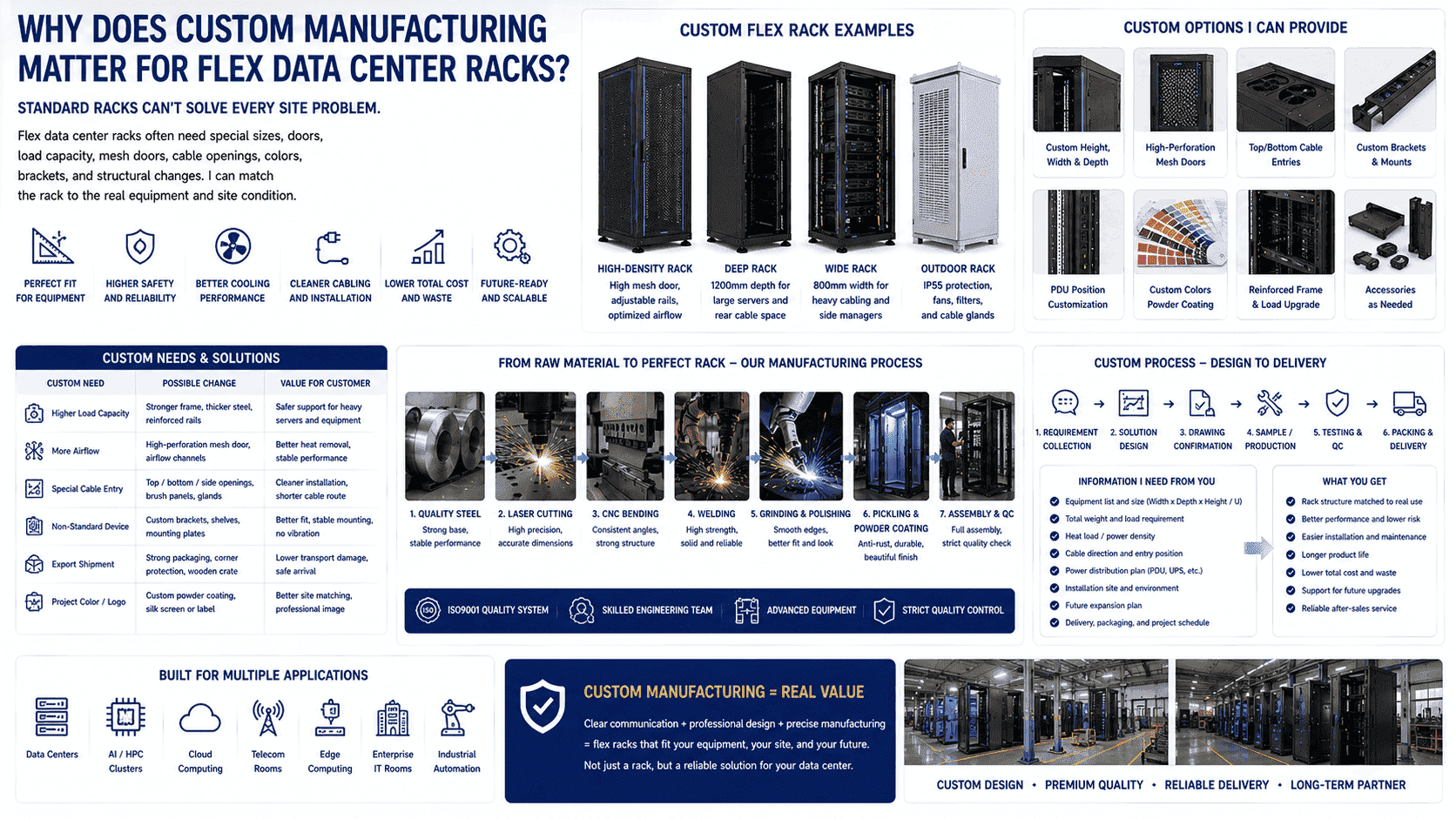
I work in cabinet manufacturing, so I see the gap between drawings and real use. A customer may ask for a standard 42U cabinet at first. After we check the equipment list, cable direction, cooling method, floor load, and transport limits, the cabinet may need many changes. The depth may need to be larger. The rear door may need a higher mesh ratio. The frame may need more load support. The PDU position may need to move. The top cable hole may need a special cover.
Custom work is not random work. It needs a clear process. I usually think from raw material to final assembly. Good steel material gives the cabinet a strong base. Laser cutting keeps parts accurate. Bending controls the shape. Welding controls strength. Grinding and polishing improve fit and appearance. Pickling and powder coating protect the surface. Final assembly checks whether the cabinet works as one complete product.
| Custom Need | Possible Cabinet Change | Value for Customer |
|---|---|---|
| Higher load | Stronger frame and rails | Safer equipment support |
| More airflow | Custom mesh door | Better heat removal |
| Special cable entry | Top or bottom openings | Cleaner installation |
| Non-standard device | Custom bracket | Better equipment fit |
| Export shipment | Strong packaging design | Lower transport damage |
| Project color | Custom powder coating | Better site matching |
I have learned that custom manufacturing is most useful when communication is clear. The customer should share equipment size, total weight, heat load, cable direction, power plan, installation site, and expected expansion. I can then turn these details into a rack structure that is not only possible to build, but also easy to use. This is the reason I see flex racks as both a product and a service.
Why Are Green and Low-Carbon Rack Systems Important?
Energy waste looks normal until the bill rises and cooling pressure grows. I have seen inefficient cabinets make the whole room harder to control.
Green rack systems are important because they improve airflow, reduce cooling waste, support energy monitoring, and extend cabinet life.12 I can lower energy loss and support a more efficient data center base.
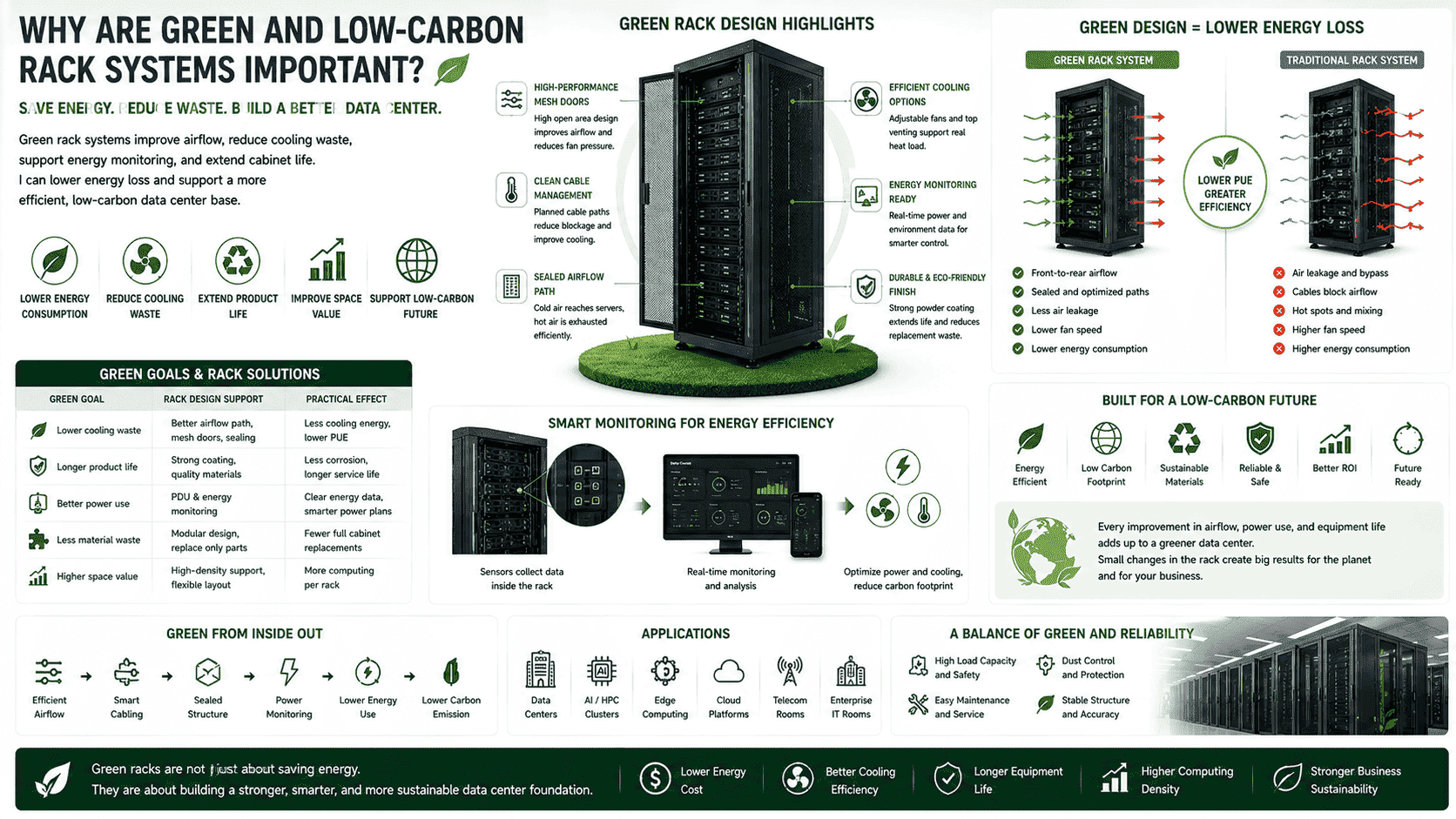
I do not see green design as only a slogan. I see it in small cabinet details. A better mesh door can reduce fan pressure. A cleaner cable path can reduce airflow blockage. A sealed airflow path can help cold air reach the server instead of leaking away. A stronger surface finish can extend product life, which also reduces replacement waste.
Flexible racks also support better capacity planning. If the rack can be rebuilt or expanded, the customer does not need to replace it quickly when the business changes. If the cabinet supports monitoring, the data center can track real energy use instead of guessing. If the cabinet supports high-density computing in a controlled way, the same space can deliver more computing power.
| Green Goal | Rack Design Support | Practical Effect |
|---|---|---|
| Lower cooling waste | Better airflow path | Less energy pressure |
| Longer product life | Strong coating and structure | Less replacement |
| Better power use | PDU and energy monitoring | Clearer energy data |
| Less material waste | Modular replacement | Fewer full cabinet changes |
| Higher space value | High-density support | More computing per rack |
I also think green design must stay practical. A cabinet still needs strength, accuracy, safety, and easy maintenance. It cannot focus on energy saving and ignore load capacity. It cannot focus on airflow and ignore dust control or door strength. A good flex enclosure balances these needs. It supports low-carbon operation, but it still works as a reliable metal structure for expensive equipment.
Conclusion
I see flex data center racks and enclosures as the new base for high-density, smart, modular, and energy-aware data centers.
"Manage Airflow for Cooling Efficiency - Energy Star", https://www.energystar.gov/products/data_center_equipment/16-more-ways-cut-energy-waste-data-center/manage-airflow-cooling-efficiency. Data-center design guidance identifies rack-level airflow management, cable organization, and environmental or power monitoring as factors that affect cooling performance, maintainability, and energy use. Evidence role: general_support; source type: institution. Supports: A neutral data-center guidance source should support that rack-level design choices, including airflow containment, cabling practices, and monitoring, affect operational flexibility and energy performance.. Scope note: This would support the general relationship between rack design and data-center performance, not prove that every product described as a flex rack delivers these outcomes. ↩
"19-inch rack", https://en.wikipedia.org/wiki/19-inch_rack. The 19-inch rack is a standardized equipment-mounting format, and rack cabinet capacity is commonly expressed in rack units, making descriptions such as 42U meaningful within data-center cabinet practice. Evidence role: definition; source type: encyclopedia. Supports: A reference source should define the 19-inch rack standard and explain rack units, including how full-height cabinets are commonly described by U height.. Scope note: This establishes the standard terminology and form factor, but it may not quantify current market prevalence of 42U cabinets. ↩
"[PDF] Best Practices Guide for Energy-Efficient Data Center Design", https://www.energy.gov/sites/default/files/2024-07/best-practice-guide-data-center-design.pdf. Professional data-center infrastructure guidance treats equipment racks as part of the broader facility system because rack layout affects power distribution, cable routing, airflow, and equipment access. Evidence role: expert_consensus; source type: institution. Supports: A standards or professional guidance source should show that rack cabinets are considered part of data-center infrastructure because they interface with IT equipment, power distribution, cabling, airflow, and monitoring.. Scope note: The source would contextualize the role of racks in infrastructure design rather than directly endorse the article’s wording that a cabinet is part of the computing system. ↩
"How Researchers Are Driving Advances for Data Centers", https://eta.lbl.gov/news/how-researchers-are-driving-advances-data-centers. Recent data-center research reports associate AI and other compute-intensive workloads with rising server and rack power densities, increasing demands on power delivery and cooling infrastructure. Evidence role: statistic; source type: research. Supports: A research or institutional report should document that AI and other compute-intensive workloads have increased server and rack power densities.. Scope note: The evidence would support a broad industry trend, not the specific power level of any cabinet in the article. ↩
"[PDF] ASHRAE Thermal Guidelines", https://datacenters.lbl.gov/sites/default/files/ASHRAE%20Thermal%20Guidelines_%20SVLG%202015.pdf. Data-center thermal and capacity-planning guidance notes that IT equipment characteristics and utilization levels affect power and cooling requirements over time. Evidence role: general_support; source type: institution. Supports: A data-center thermal or capacity-planning source should support that equipment refreshes and load changes affect power and cooling requirements.. Scope note: This supports the need for adaptable planning, but it does not specifically prove that modular racks are the only or primary solution. ↩
"Modular design", https://en.wikipedia.org/wiki/Modular_design. Engineering literature defines modular design as a product architecture in which functions are divided among separable modules, enabling components to be changed or replaced with less redesign of the whole system. Evidence role: definition; source type: education. Supports: An engineering or academic source should define modular design as the use of separable components or modules that can be independently changed or replaced.. Scope note: This supports the design mechanism generally and would need to be applied by inference to rack cabinets. ↩
"BICSI Standards Frequently Asked Questions (FAQs)", https://www.bicsi.org/standards/bicsi-standards/resources/standards-frequently-asked-questions. Structured-cabling guidance recognizes separation of power and telecommunications cabling as a method for reducing electromagnetic interference and preserving signal integrity. Evidence role: mechanism; source type: institution. Supports: A cabling standard or technical guide should explain that power cables can be a source of electromagnetic interference and that separation from signal cabling reduces coupling risk.. Scope note: The level of risk depends on cable type, shielding, current, routing distance, and installation conditions. ↩
"[PDF] Data Center Airflow Management Retrofit", https://datacenters.lbl.gov/sites/default/files/airflow-doe-femp.pdf. Data-center airflow management studies identify physical obstructions and unmanaged cabling as factors that can reduce cooling airflow and increase the risk of elevated equipment inlet temperatures. Evidence role: mechanism; source type: research. Supports: A data-center airflow management source should support that obstructions, including poorly managed cabling, can impair airflow and contribute to higher equipment inlet temperatures.. Scope note: This supports the thermal mechanism but does not quantify the temperature rise for the specific cabinet configurations described. ↩
"Electricity Demand and Grid Impacts of AI Data Centers - arXiv", https://arxiv.org/html/2509.07218v3. Research on AI-oriented data-center hardware links high accelerator power consumption and dense server configurations to increased heat dissipation requirements at the rack level. Evidence role: statistic; source type: research. Supports: A research or institutional source should show that AI accelerators and high-density servers increase power consumption and heat dissipation requirements compared with conventional server deployments.. Scope note: The comparison with older devices depends on the specific generation and configuration of both the AI servers and the legacy equipment. ↩
"Data Center Air Management Research", https://datacenters.lbl.gov/sites/default/files/AirManagement_Herrlin2010.pdf. Data-center airflow management guidance states that blanking panels should be used in unused rack positions to limit air recirculation and maintain intended front-to-back cooling paths. Evidence role: mechanism; source type: government. Supports: A government or institutional energy-efficiency guide should explain that blanking panels in unused rack spaces help prevent hot-air recirculation or cooling-air bypass.. Scope note: The effectiveness depends on the broader room layout, containment design, and rack sealing quality. ↩
"Energy Sector Asset Management - NIST | NCCoE", https://www.nccoe.nist.gov/sites/default/files/legacy-files/esam-nist-sp1800-23b-final.pdf. Data-center infrastructure management literature describes the use of environmental sensors, power monitoring, alerting, and visualization tools to support remote operational oversight of IT facilities. Evidence role: general_support; source type: institution. Supports: A data-center management source should support that environmental sensors, power monitoring, alarms, and dashboards are standard functions used to manage rack or facility operations.. Scope note: This supports common functions of monitoring systems but not the performance of any specific smart rack implementation. ↩
"Improving Data Center Energy Efficiency Through End-To-End", https://sites.psu.edu/sbslab/research/buildings/doe-datacenter/. Government data-center efficiency guidance identifies airflow management and energy monitoring as practical measures for reducing cooling waste and improving facility energy performance. Evidence role: general_support; source type: government. Supports: A government or institutional energy-efficiency source should support that airflow management and energy monitoring are recognized strategies for reducing data-center cooling energy use.. Scope note: This supports the energy-efficiency portion of the claim; extending cabinet life would require additional material durability or life-cycle evidence. ↩
