
Choosing the Right Door for the Server Rack?
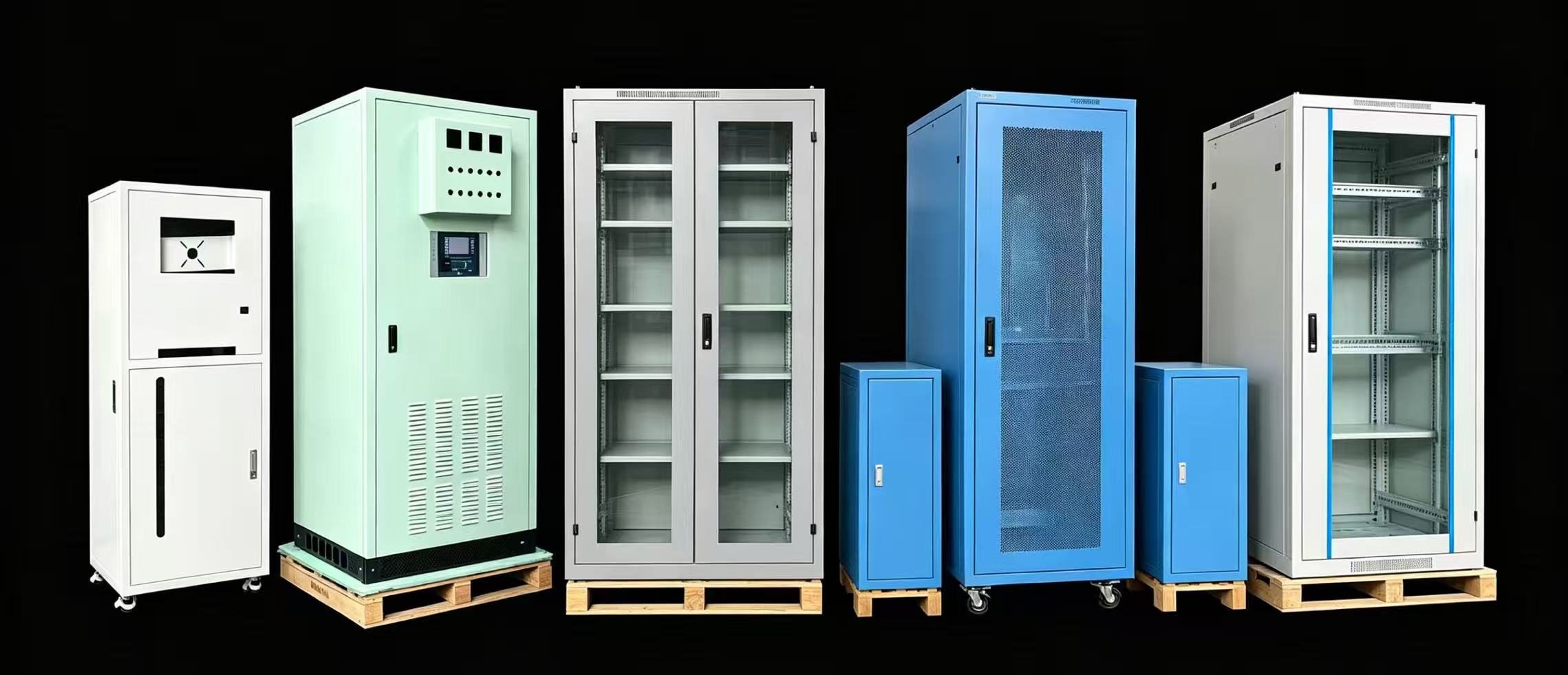
I see many stable systems become risky because the rack door is treated as a small part. Heat, dust, noise, and poor access then grow fast.
-
Why Does The Server Rack Door Matter More Than Many Buyers Think?
I often meet projects where the rack looks correct from outside. The real trouble starts after switches, servers, and storage units run for many hours.
The server rack door matters because it controls airflow, access, safety, dust entry, sound leakage, and daily inspection.1 A wrong door can trap heat, block maintenance, increase dust buildup, and raise long-term failure risk.

I treat the rack door as part of the thermal design, not as a loose accessory. Modern servers, switches, storage equipment, and power units create constant heat. When many devices sit in one cabinet, heat gathers in certain areas. A small hot spot can become a long-term fault point.2 I have seen this happen in rooms where the cabinet depth was correct, but the door blocked air movement. The equipment did not fail on the first day. It failed after many weeks of heat stress.
| Door factor | What I check | Why I care |
|---|---|---|
| Airflow | Open area, hole rate, air path | I need heat to leave the rack |
| Security | Lock, steel strength, hinge design | I need to protect equipment and cables |
| Dust control | Door gap, sealing, closed design | I need to reduce dust on fans and boards |
| Maintenance | View, opening angle, removable design | I need fast service and less downtime |
| Site fit | Noise, water, space, depth | I need the door to match the environment |
I also pay attention to positioning parts and hinge design. A weak hinge can sag after long use. A poor latch can shake during transport or vibration. A bad opening angle can make service work slow. I have learned that the right door saves time every month, not only during installation.
When Should I Choose A Mesh Door For A Server Rack?
I choose a mesh door when heat is my main concern and the room already has good cooling, air flow, and basic dust control.
A mesh door is best for data centers, enterprise equipment rooms, power rooms, and high-density racks.3 It allows strong front-to-back airflow, supports heat release, and reduces the risk of equipment overheating.
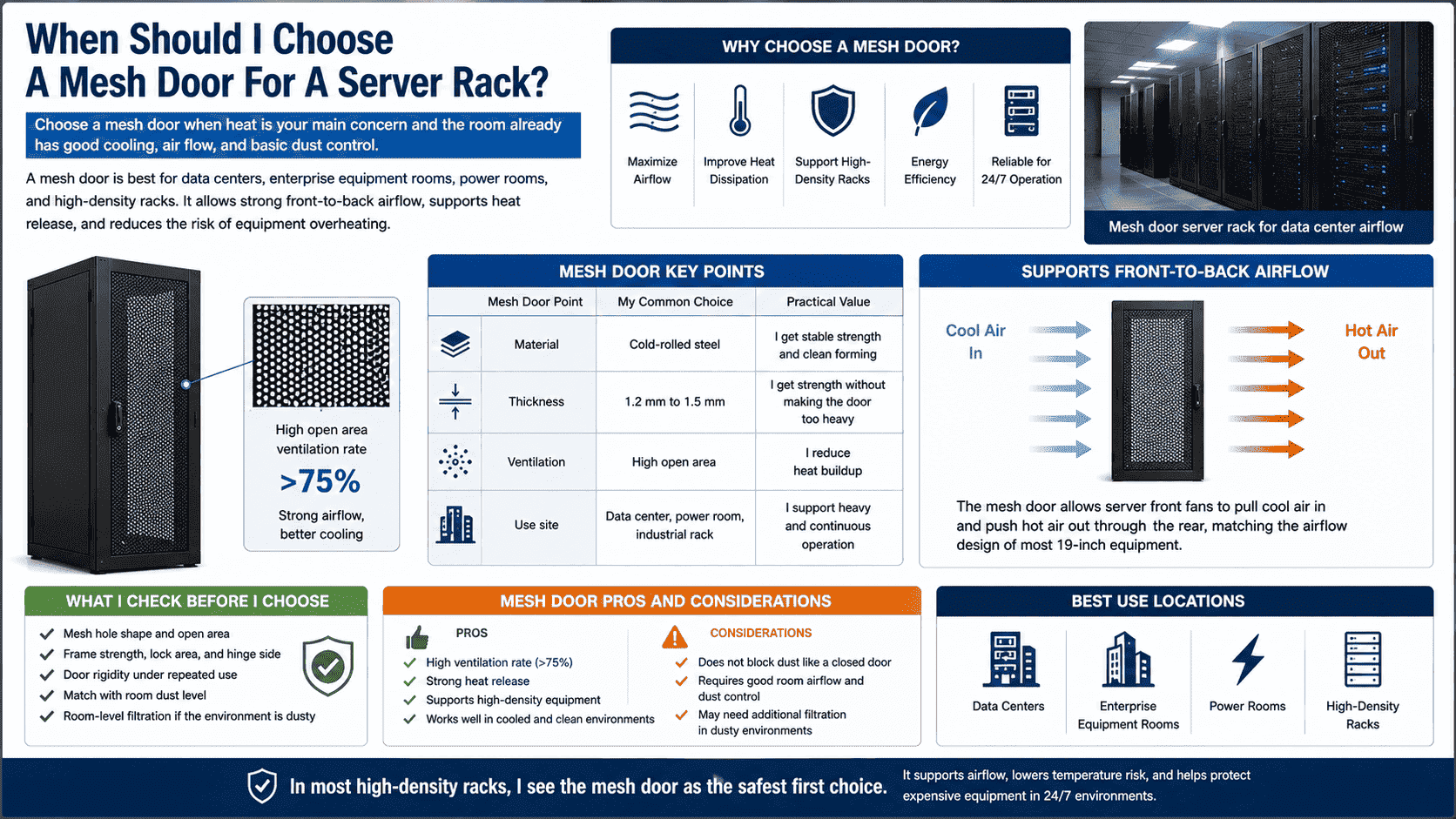
I usually recommend a mesh door for cabinets with servers, switches, storage devices, and other heat-making equipment. A good mesh door is often made from cold-rolled steel sheet with punched mesh holes. In many designs, the ventilation rate can reach more than 75%%%%FOOTNOTE_REF4%%%. This high open area helps the server [front fan pull cool air in and push hot air out through the rear](https://datacenters.lbl.gov/sites/default/files/ASHRAE%20Thermal%20Guidelines%20SVLG%202015.pdf)5. I like this design because it does not fight the airflow design of most 19-inch equipment.
| Mesh door point | My common choice | Practical value |
|---|---|---|
| Material | Cold-rolled steel | I get stable strength and clean forming |
| Thickness | 1.2 mm to 1.5 mm | I get strength without making the door too heavy |
| Ventilation | High open area | I reduce heat buildup |
| Use site | Data center, power room, industrial rack | I support heavy and continuous operation |
I also look at the mesh hole shape and frame strength. A door with many holes still needs a strong frame. The lock area and hinge side must not feel weak. If the rack carries expensive servers, I do not want the door to bend after repeated use. I also check whether the mesh pattern matches the room dust level. A mesh door gives great airflow, but it does not block dust like a closed door. If the room is dusty, I may add room-level filtration or choose a design with better dust protection. In most high-density racks, I still see the mesh door as the safest first choice.
When Is A Tempered Glass Door The Better Choice?
I choose a tempered glass door when I need visibility, a clean look, and easier daily checking, but I do not have heavy heat load inside the rack.
A tempered glass door fits office equipment rooms, display cabinets, weak-current cabinets, and low to medium heat racks. It allows visual inspection, blocks dust better, reduces noise, and makes the cabinet look clean.
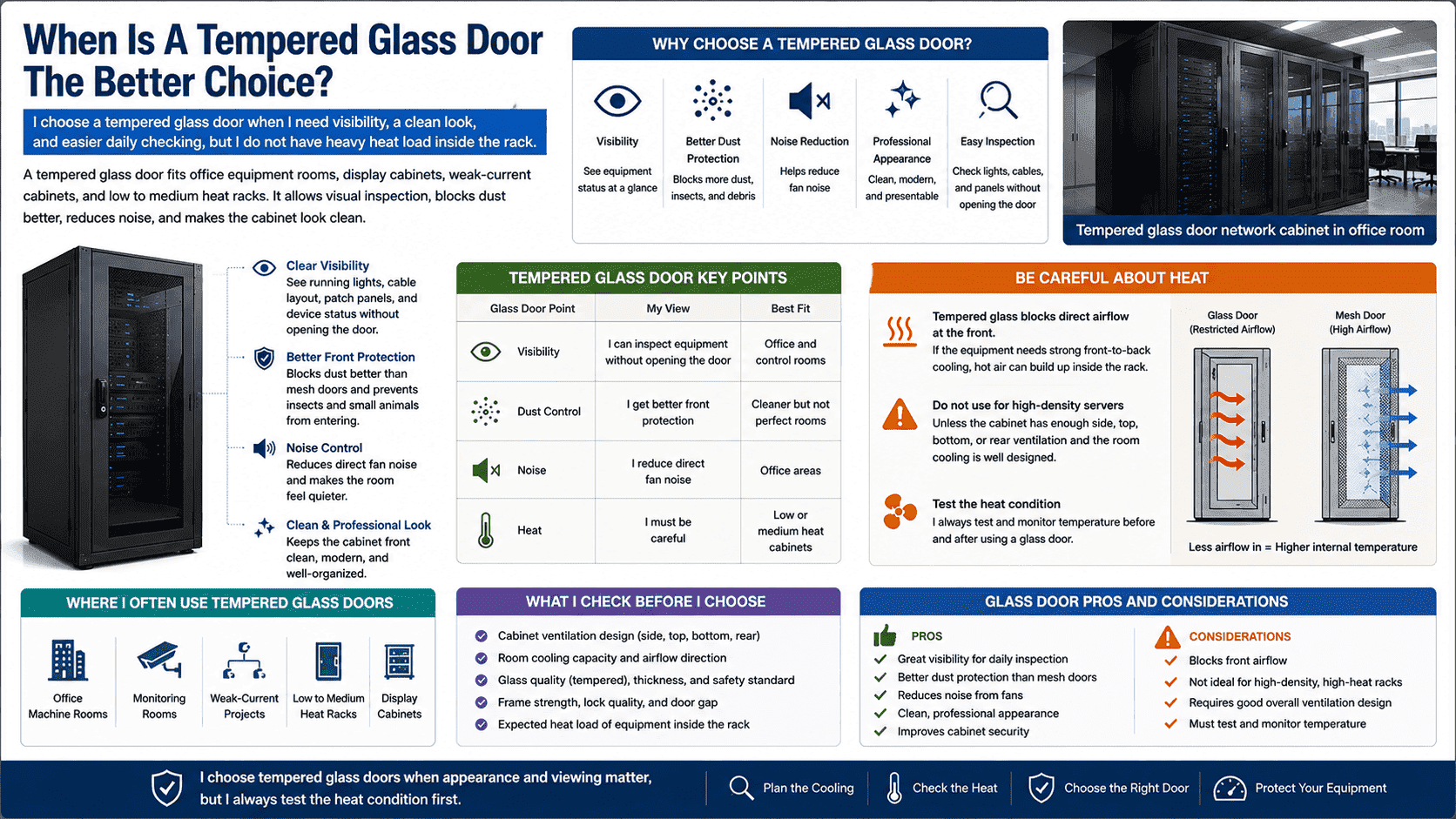
I often see tempered glass doors in office machine rooms, monitoring rooms, and weak-current projects. The main value is visibility. I can see running lights, cable layout, patch panels, and device status without opening the door. This helps daily inspection. It also keeps the cabinet front clean and professional. The glass door can reduce dust entry better than a mesh door.6 It can also stop insects and small animals from entering through large openings. In some office places, it can reduce noise from fans and make the room feel quieter.
| Glass door point | My view | Best fit |
|---|---|---|
| Visibility | I can inspect equipment without opening the door | Office and control rooms |
| Dust control | I get better front protection | Cleaner but not perfect rooms |
| Noise | I reduce direct fan noise | Office areas |
| Heat | I must be careful | Low or medium heat cabinets |
The weak point is heat. Tempered glass blocks direct airflow at the front. If the equipment needs strong front-to-back cooling, hot air can build up inside the rack. I have seen racks look neat but run too warm because the glass door trapped heat. I do not use a glass door for high-density servers unless the cabinet has enough side, top, bottom, or rear ventilation and the room cooling is well designed. I also check the gap, lock, frame strength, and glass quality. Tempered glass is safer than normal glass7, but it still needs correct installation. I choose it when appearance and viewing matter, but I always test the heat condition first.
When Should I Use A Solid Steel Door?
I choose a solid steel door when protection, privacy, dust control, water resistance, or noise blocking matters more than direct airflow.
A solid steel door fits secure rooms, dusty places, special protection sites, and some outdoor waterproof cabinets.8 It hides internal equipment, blocks more noise, improves privacy, and gives strong physical protection.
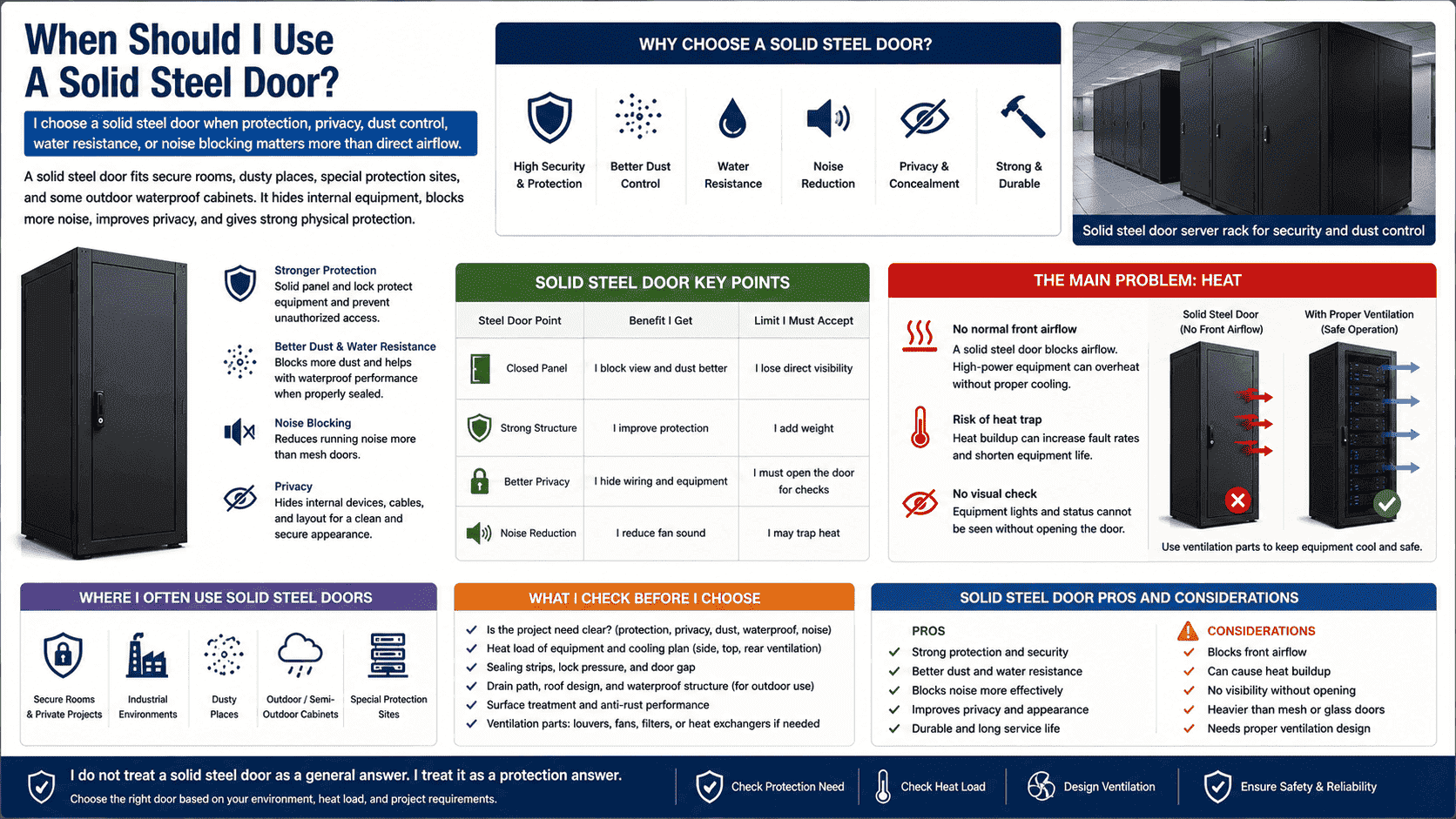
I see the solid steel door as a closed protection choice. It is usually made as a full steel panel. It gives a strong front face and hides internal devices, cables, and layout. This is useful in secure rooms, private network projects, industrial sites, and outdoor cabinets with higher protection needs. It can also reduce running noise more than a mesh door.9 If a rack is placed near working staff, the closed surface can make the sound feel lower.
| Steel door point | Benefit I get | Limit I must accept |
|---|---|---|
| Closed panel | I block view and dust better | I lose direct visibility |
| Strong structure | I improve protection | I add weight |
| Better privacy | I hide wiring and equipment | I must open the door for checks |
| Noise reduction | I reduce fan sound | I may trap heat |
The main problem is heat. A solid steel door does not allow normal front airflow. If I place high-power servers behind it without forced ventilation, I create a heat trap. This may raise fault rates over time. I also cannot see equipment lights without opening the door. Daily inspection becomes slower. Because of this, I use the solid steel door only when the project need is clear. If the customer needs waterproof features, I also check sealing strips, lock pressure, drain path, roof design, and surface treatment. For outdoor or semi-outdoor cabinets, I often combine solid steel with louvers, fans, filters, or special ventilation parts. I do not treat a solid steel door as a general answer. I treat it as a protection answer.
What Makes A Louvered Ventilation Door Useful?
I choose a louvered ventilation door when I need some airflow, some dust and water protection, and a practical cost level.
A louvered ventilation door uses layered vent openings to support airflow while reducing direct dust and water entry10. It fits many small, medium, and large equipment rooms, but it is not ideal for very dense server racks.
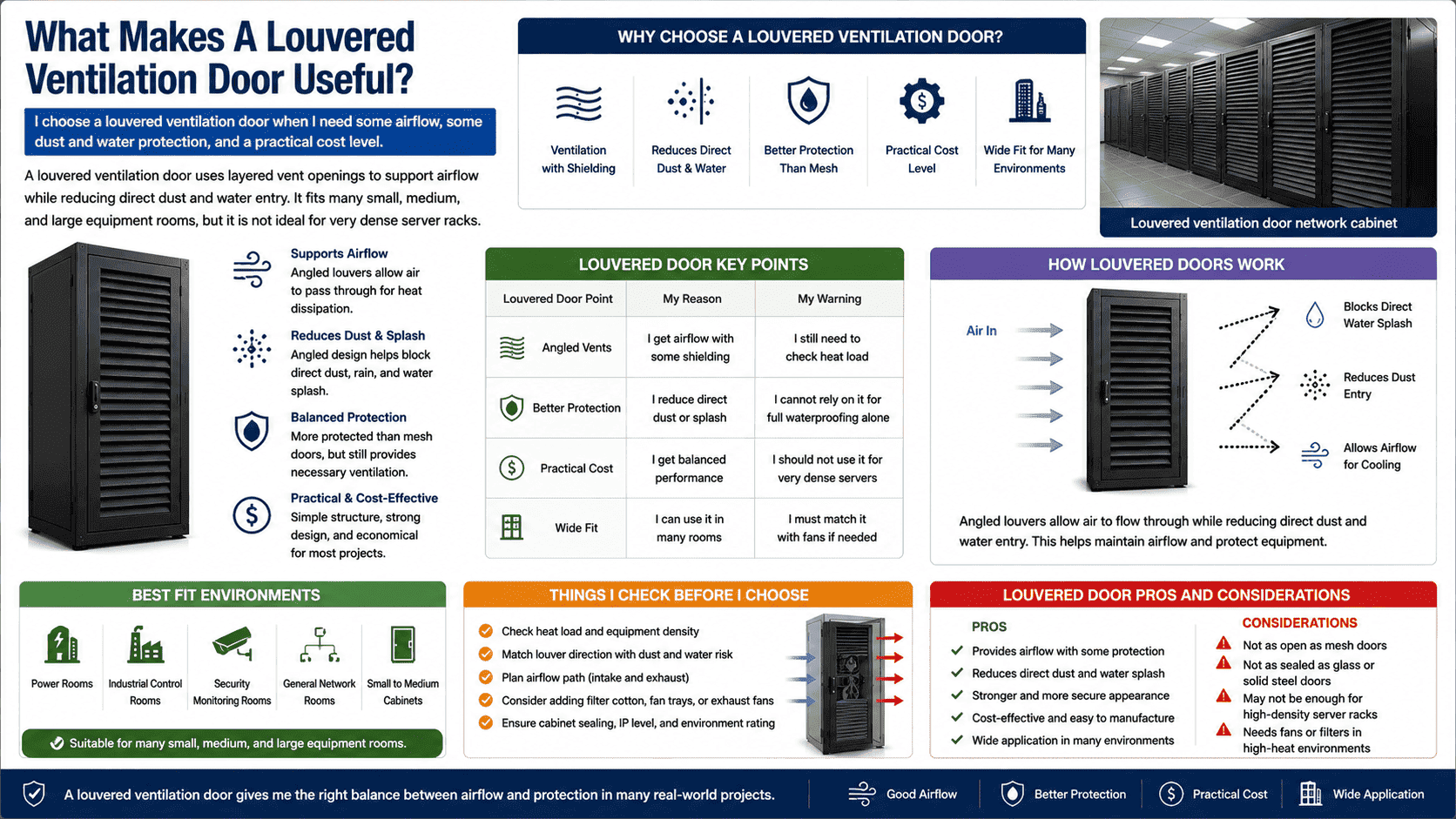
A louvered door is a middle choice. It is not as open as a mesh door. It is not as closed as a glass or solid steel door. I use it when the site needs ventilation but also needs some front protection. The louver design lets air pass through angled openings. It can also reduce direct water splash and large dust entry compared with a simple open mesh. This makes it useful in power rooms, industrial control rooms, security monitoring rooms, and general network rooms.
| Louvered door point | My reason | My warning |
|---|---|---|
| Angled vents | I get airflow with some shielding | I still need to check heat load |
| Better protection | I reduce direct dust or splash | I cannot rely on it for full waterproofing alone |
| Practical cost | I get balanced performance | I should not use it for very dense servers |
| Wide fit | I can use it in many rooms | I must match it with fans if needed |
I like the value of louvered doors in many small and medium projects. They are simple, strong, and easy to produce. They also look more closed than full mesh, so some customers feel more secure. But I do not choose them blindly. If a rack is full of servers and storage devices, the louver opening may not be enough. Heat may still stay inside the rack. I also check whether the louver direction matches the site. If dust falls from above or water spray comes from one side, the louver design must match that risk. In some projects, I add filter cotton, fan trays, or exhaust fans. This helps me keep the balance between airflow and protection.
Why Would I Need A Custom Protruding Mesh Door?
I choose a custom protruding mesh door when installed equipment extends beyond the cabinet depth and a normal flat door cannot close.
A custom protruding mesh door adds extra front depth, such as 5 cm, 10 cm, 15 cm, 20 cm, or more. It solves door closing problems and keeps airflow for oversized equipment.
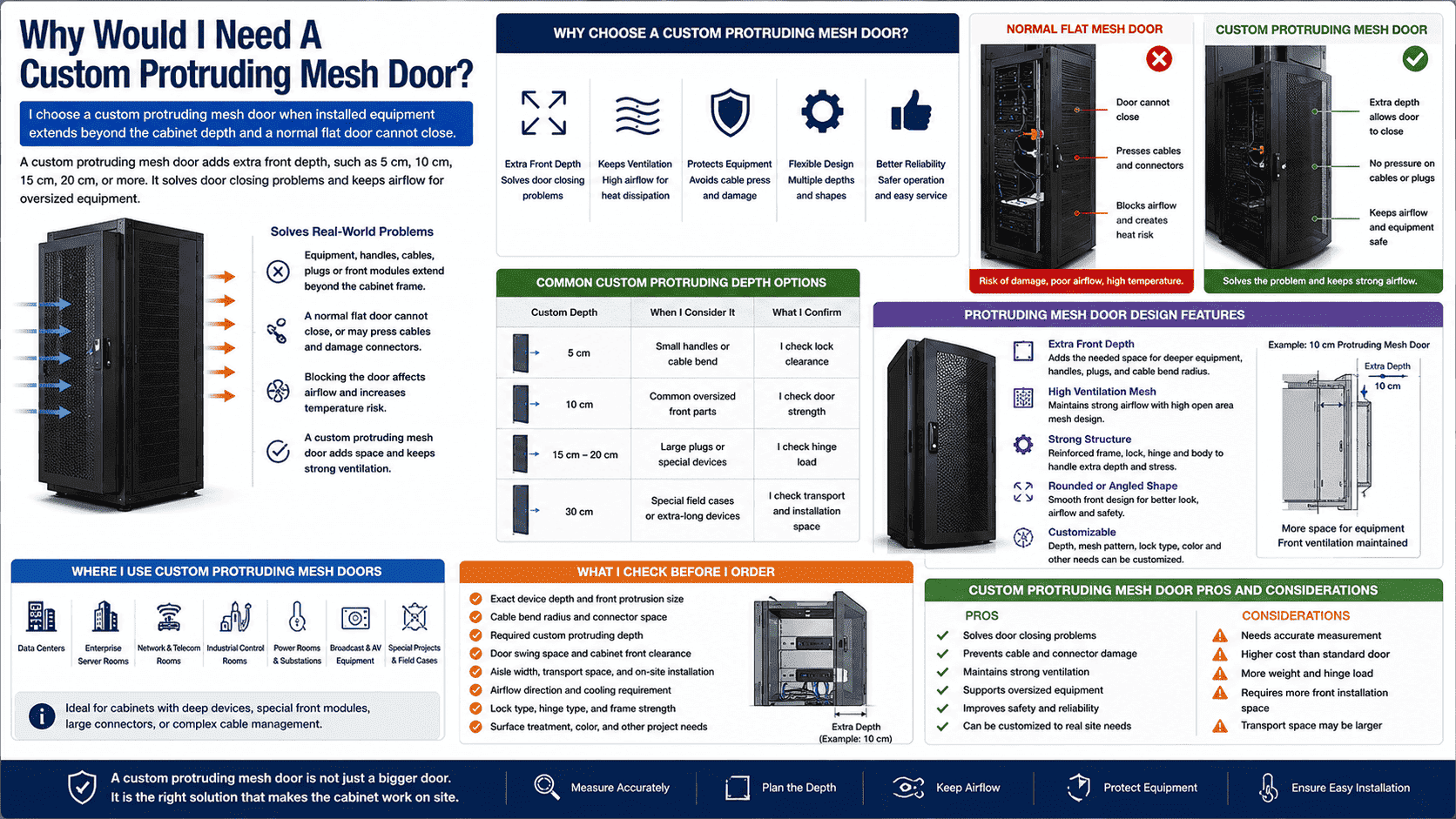
I often meet this problem in real projects. The cabinet depth looks enough on paper. After installation, the device handle, cable bend, plug, power connector, or front module extends beyond the frame. A normal door then cannot close. If I force the door, I may press cables, damage connectors, or block airflow.11 A custom protruding mesh door solves this issue by adding extra depth at the door surface. The common protruding sizes I use are 5 cm and 10 cm. I can also make 8 cm, 12 cm, 15 cm, 20 cm, or 30 cm based on site needs.
| Custom depth | When I consider it | What I confirm |
|---|---|---|
| 5 cm | Small handles or cable bend | I check lock clearance |
| 10 cm | Common oversized front parts | I check door strength |
| 15 cm to 20 cm | Large plugs or special devices | I check hinge load |
| 30 cm | Special field cases | I check transport and installation space |
I like the protruding mesh design because it solves two problems at the same time. It gives more front space, and it keeps ventilation. The shape can be made with a rounded or angled front structure. The mesh area can match the cooling need. The lock, hinge, and frame must be stronger than a simple flat door because the door has more depth and may carry more stress. I also ask for exact site measurements before production. I need the protruding size, device depth, cable bend radius, door swing space, and aisle width. Customization is not only about making a larger part. It is about making the door work on site after the rack is loaded with real equipment.
How Do I Match The Door Type With The Real Site?
I start with heat load, then I check dust, security, noise, visibility, water risk, and service space. I do not choose by appearance only.
I match the door type by ranking the project needs. If heat is highest, I choose mesh. If visibility is highest, I choose glass. If protection is highest, I choose steel. If balance is needed, I choose louvered. If depth is not enough, I choose custom protruding mesh.
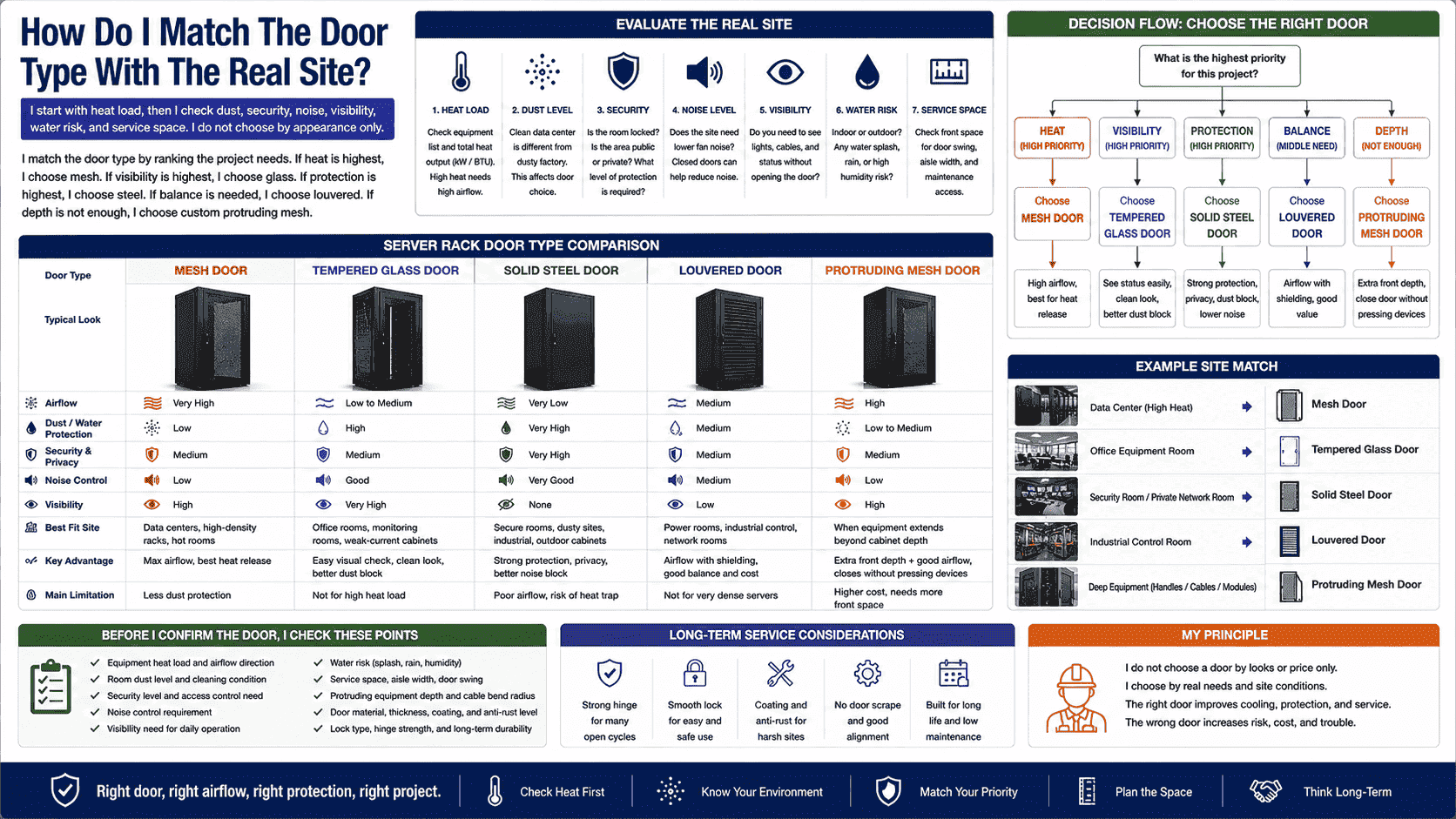
I use a simple decision method in my own work. First, I check the equipment list. I look at servers, switches, UPS units, storage devices, and power distribution parts. I then check how much heat they create. If the heat is high, the door must help airflow. I do not choose a glass or solid steel door only because it looks nice. Then I check the room. A clean data center is different from a dusty factory. A locked server room is different from a public hallway. An indoor room is different from an outdoor power site.
| Main need | Door I usually choose | Reason I choose it |
|---|---|---|
| Strong heat release | Mesh door | I get high airflow |
| Visual checking | Tempered glass door | I see status without opening |
| Security and privacy | Solid steel door | I protect and hide equipment |
| Balanced airflow and shielding | Louvered door | I get middle performance |
| Extra front depth | Protruding mesh door | I close the door without pressing devices |
I also look at long-term service. A rack door will be opened many times during its life. The hinge must be strong. The lock must be smooth. The door must not scrape the frame. The coating must resist rust. If the rack is used in a coastal area or a humid room, I may use stronger anti-rust treatment.12 If the site needs outdoor protection, I may choose galvanized steel, stainless steel, sealing design, and waterproof structure. I also think about small-batch needs. Some projects need only one special cabinet. I still treat the door design seriously because one wrong cabinet can stop one whole system.
Conclusion
I choose the rack door as a working system part, because the right door protects airflow, safety, maintenance, and long-term equipment stability.
"Data Center and Server Room Standards - The University of Kansas", https://services.ku.edu/TDClient/818/Portal/KB/PrintArticle?ID=21009. ASHRAE and data-center infrastructure guidance treat cabinet perforation, airflow paths, access control, and environmental exposure as design factors in reliable IT-equipment operation, supporting the view that the rack door is part of the enclosure system rather than a cosmetic accessory. Evidence role: expert_consensus; source type: institution. Supports: Rack enclosure design, including doors and openings, affects cooling airflow, physical access, environmental exposure, and operational maintenance.. Scope note: The support is contextual and does not verify every listed function for every rack-door design. ↩
"[PDF] Data Center Efficiency and IT Equipment Reliability at Wider ...", https://www.energy.gov/sites/prod/files/2013/12/f5/data_center_efficiency_and_reliabilit_at_wider_operating_ranges.pdf. Research on data-center thermal management identifies localized hot spots and elevated equipment inlet temperatures as sources of thermal stress that can reduce IT-equipment reliability over extended operation. Evidence role: mechanism; source type: paper. Supports: Elevated local temperatures and hot spots increase thermal stress on IT equipment and can affect reliability over time.. Scope note: Such studies support the mechanism generally but do not prove that any particular rack will fail after a specific number of weeks. ↩
"[PDF] Best Practices Guide for Energy-Efficient Data Center Design", https://www.energy.gov/sites/default/files/2024-07/best-practice-guide-data-center-design.pdf. Data-center thermal guidance from ASHRAE and related infrastructure organizations emphasizes low-resistance front-to-rear airflow for high-density IT loads, providing contextual support for using perforated or mesh rack doors in heat-intensive rooms. Evidence role: expert_consensus; source type: institution. Supports: High-density racks typically require unobstructed front-to-rear airflow, which is supported by high-open-area perforated or mesh doors.. Scope note: This support is conditional on the room cooling design and does not mean mesh doors are best in dusty, wet, or security-sensitive sites. ↩
"[PDF] Data Center Rack Cooling with Rear-door Heat Exchanger", https://datacenters.lbl.gov/sites/default/files/rdhx-doe-femp.pdf. Published rack-cabinet specifications and data-center enclosure guidance describe perforated doors by percentage open area and document high-open-area designs in the approximate 75% or greater range. Evidence role: statistic; source type: institution. Supports: Perforated or mesh cabinet doors can be specified with open-area percentages at or above approximately 75% in some designs.. Scope note: The figure applies only to particular perforation patterns and door constructions, not to all mesh doors. ↩
"ASHRAE Thermal Guidelines", https://datacenters.lbl.gov/sites/default/files/ASHRAE%20Thermal%20Guidelines_%20SVLG%202015.pdf. ASHRAE thermal guidance for data-processing environments describes the prevailing front-intake, rear-exhaust airflow pattern of rack-mounted IT equipment, supporting the need for door designs that do not obstruct that path. Evidence role: mechanism; source type: institution. Supports: Rack-mounted servers commonly draw cooling air from the front and exhaust warmed air at the rear.. Scope note: Some specialized equipment may use side-to-side or nonstandard airflow patterns. ↩
"A Laboratory Study of the Dust Deposition and Suppression Process ...", https://stacks.cdc.gov/view/cdc/215499. Research on airborne particulate ingress and deposition shows that openings and pressure-driven airflow paths influence dust entry into enclosures, providing contextual support for a closed glass door admitting less front-side dust than a mesh door. Evidence role: mechanism; source type: research. Supports: Reduced open area and fewer direct airflow paths can lower particle ingress compared with highly perforated surfaces.. Scope note: Actual dust reduction depends on gasket quality, pressure differences, room cleanliness, and other openings in the cabinet. ↩
"[PDF] Tempered Glass Safety Alert - CPSC", https://www.cpsc.gov/s3fs-public/1801-Tempered-Glass-Safety-Alert.pdf. Safety-glazing guidance from government and standards bodies describes tempered glass as heat-treated glass that fractures into relatively small granular pieces, supporting the statement that it is safer than ordinary annealed glass in breakage scenarios. Evidence role: definition; source type: government. Supports: Tempered glass is classified as safety glazing because it is heat-treated and tends to break into smaller granular pieces rather than large sharp shards.. Scope note: Tempered glass can still cause injury and must be correctly specified and installed. ↩
"NEMA Rating Guide for Electronic Enclosures - Bud Industries", https://www.budind.com/nema-rating-guide-for-electronic-enclosures/. NEMA and IEC enclosure-rating frameworks define degrees of protection against access, dust, and water ingress, supporting the use of solid metal doors as components of protective equipment cabinets when combined with suitable seals and construction. Evidence role: definition; source type: institution. Supports: Enclosure standards classify cabinets by protection against access, solid foreign objects, dust, and water, and metal doors with appropriate sealing can contribute to those protection levels.. Scope note: A solid steel door alone does not establish a waterproof or dust-tight rating without the full rated enclosure design. ↩
"[PDF] Acoustic Transmission Loss of Perforated Plates", https://supersonic.eng.uci.edu/download/AIAA-2012-2071.pdf. Acoustics references on sound transmission loss explain that continuous, more massive barriers attenuate airborne sound more effectively than barriers with substantial openings, supporting the comparison between solid steel and mesh rack doors. Evidence role: mechanism; source type: education. Supports: Closed, massive panels generally provide greater sound transmission loss than panels with large open areas.. Scope note: Noise reduction depends on panel mass, gaps, seals, vibration paths, and the frequency spectrum of the equipment noise. ↩
"[PDF] Understanding the ANSI/AMCA Standard 500-L Tests", https://www.amca.org/assets/resources/public/documents/Understanding_the_ANSI-AMCA_Standard_500-L_Tests.pdf. AMCA louver test methods evaluate both airflow performance and water penetration, supporting the claim that louvered openings can ventilate an enclosure while limiting direct water entry relative to an unshielded opening. Evidence role: mechanism; source type: institution. Supports: Louvers are designed and tested for both airflow and resistance to water penetration, with angled blades reducing direct splash paths.. Scope note: Performance varies by blade geometry, air velocity, wind direction, and whether filters or drains are included. ↩
"EAI/TIA 568 B.3 For Fiber Optics", https://www.thefoa.org/tech/tia568b3.htm. Structured-cabling guidance from TIA and BICSI specifies minimum bend-radius and cable-management practices, supporting the concern that compressing cables or connectors with a rack door can damage connections and interfere with cooling airflow. Evidence role: mechanism; source type: institution. Supports: Cabling standards and installation guidance require minimum bend radius, strain control, and organized cable management to prevent damage and avoid airflow obstruction.. Scope note: The standards address cabling practices generally and may not discuss protruding rack doors specifically. ↩
"Marine Atmospheric Corrosion of Carbon Steel: A Review - PMC", https://pmc.ncbi.nlm.nih.gov/articles/PMC5506973/. Government corrosion references and ISO coating guidance identify high humidity and chloride-containing coastal atmospheres as corrosive conditions for steel, supporting the use of stronger anti-rust treatments in such environments. Evidence role: mechanism; source type: government. Supports: Moisture and chloride-rich coastal air accelerate steel corrosion, and protective coatings or corrosion-resistant materials are used to reduce that risk.. Scope note: The appropriate treatment depends on the exposure category, material, coating system, and expected service life. ↩
