
Are ready-to-assemble cabinets good quality?
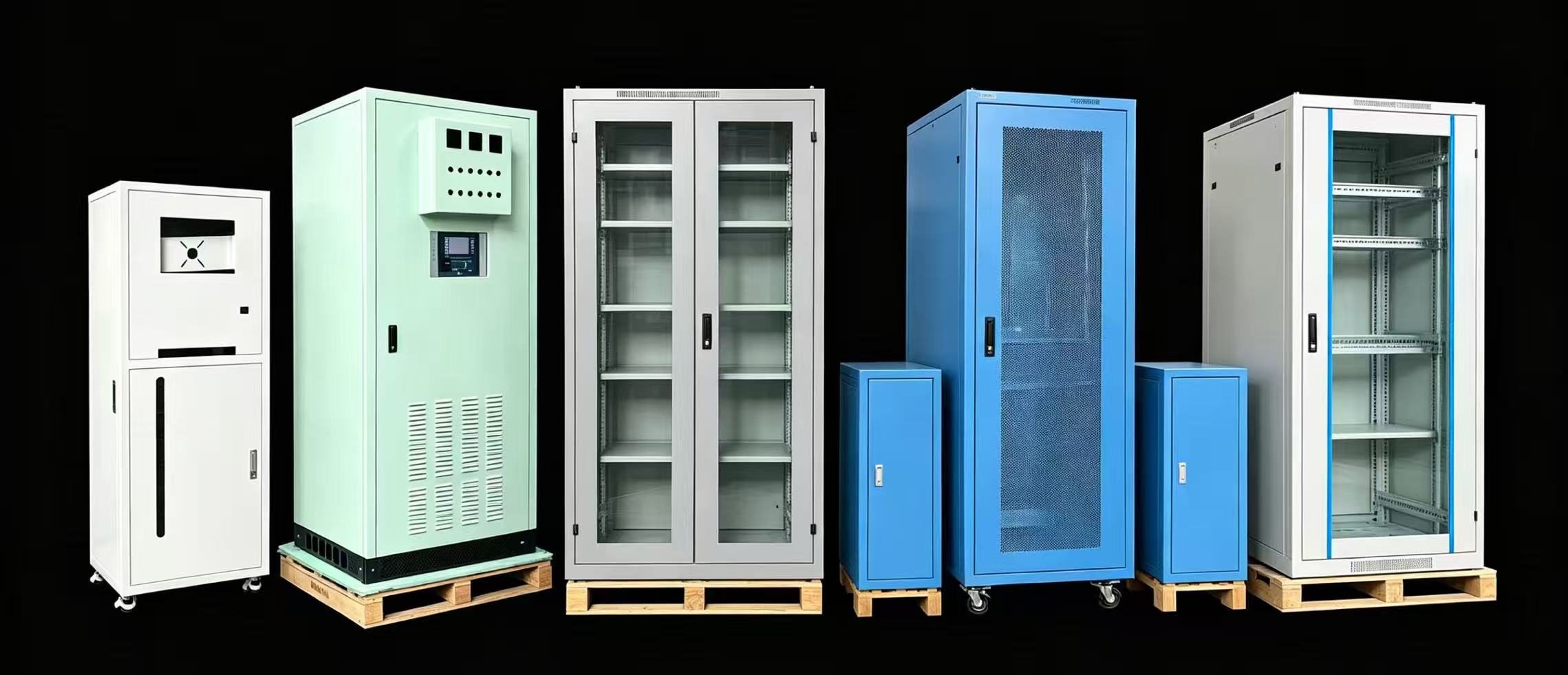
A weak cabinet can bend, shake, and waste money. I see this risk often. The real problem is not flat packing. It is poor design.
Yes, ready-to-assemble cabinets can be good quality when they use strong steel, accurate holes, stable frames, and proper surface treatment. I judge the quality by material thickness, load capacity, structure design, assembly accuracy, and protection level1, not by whether the cabinet is welded or assembled.
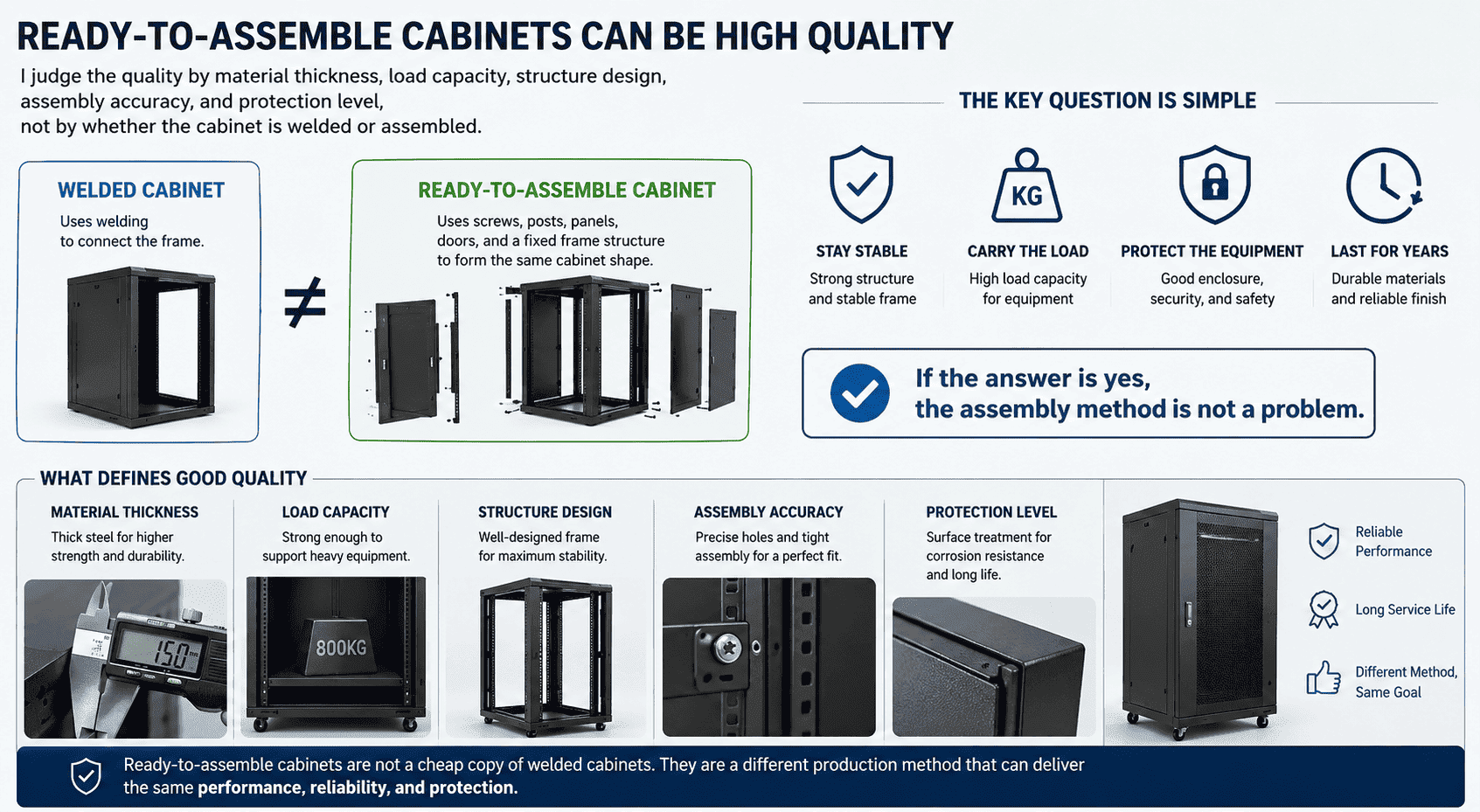
I do not see ready-to-assemble cabinets as a cheap copy of welded cabinets. I see them as a different production method. A welded cabinet uses welding to connect the frame. A ready-to-assemble cabinet uses screws, posts, panels, doors, and a fixed frame structure to form the same cabinet shape. The key question is simple. I need to know whether the cabinet can stay stable, carry the load, protect the equipment, and last for years. If the answer is yes, the assembly method is not a problem.
What is a ready-to-assemble cabinet?
A wrong cabinet choice can delay a project. I have seen buyers confuse flat-packed cabinets with weak cabinets. This mistake can lead to poor buying decisions.
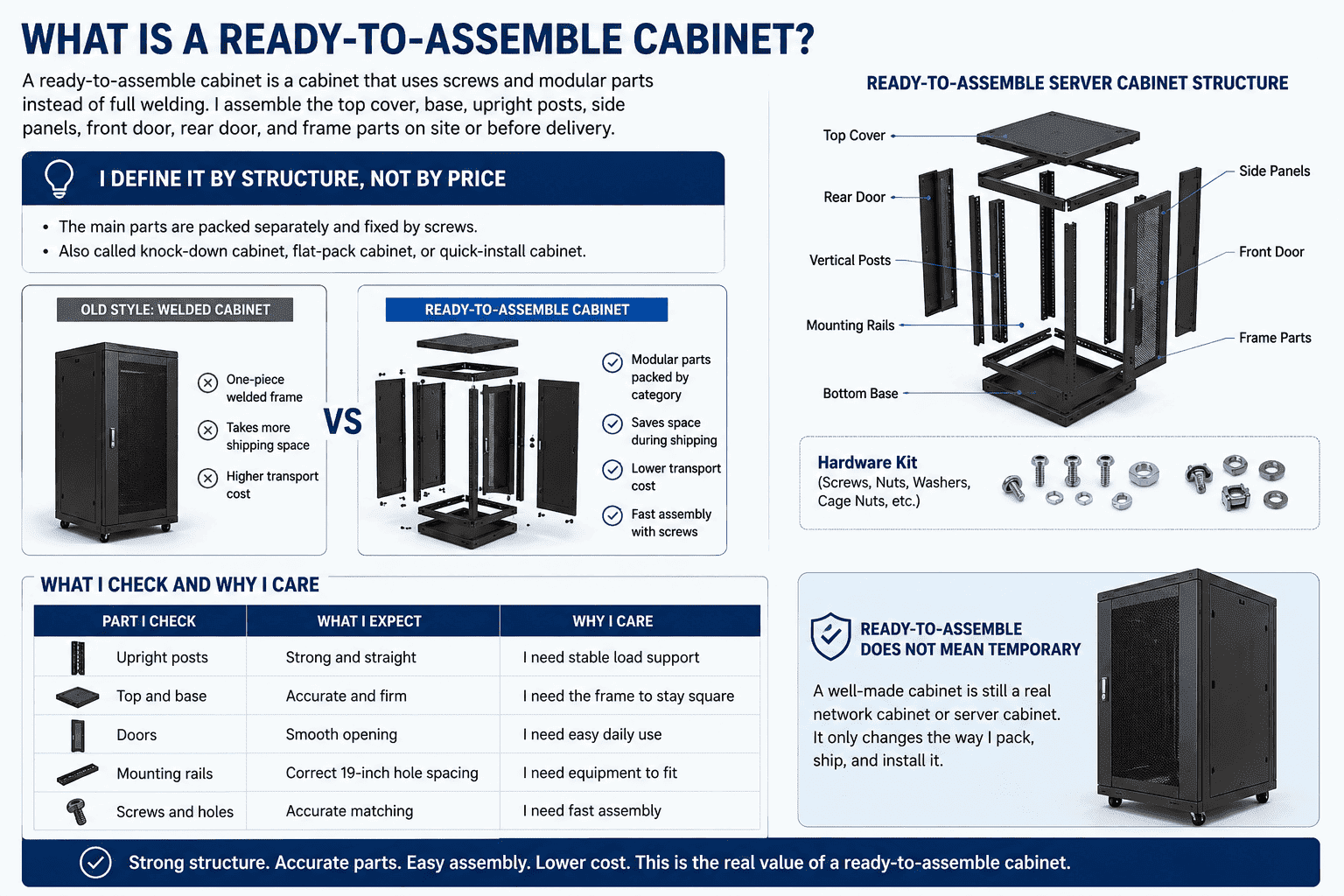
A ready-to-assemble cabinet is a cabinet that uses screws and modular parts instead of full welding.2 I assemble the top cover, base, upright posts, side panels, front door, rear door, and frame parts on site or before delivery.
I define it by structure, not by price
I call it a ready-to-assemble cabinet because the main parts are packed separately and fixed by screws. I also hear people call it a knock-down cabinet, flat-pack cabinet, or quick-install cabinet. The old cabinet style often used one-piece welded frames. That design is strong, but it takes more space during shipping. A ready-to-assemble cabinet solves this shipping problem. I can pack the parts by category, reduce empty space, and lower transport cost3.
The structure is not simple in a bad way. It still includes the same important cabinet parts. It has a top cover, bottom base, vertical posts, side doors, front door, rear door, mounting rails, frames, and small hardware. The real difference is the connection method.
| Part I check | What I expect | Why I care |
|---|---|---|
| Upright posts | Strong and straight | I need stable load support |
| Top and base | Accurate and firm | I need the frame to stay square |
| Doors | Smooth opening | I need easy daily use |
| Mounting rails | Correct 19-inch hole spacing4 | I need equipment to fit |
| Screws and holes | Accurate matching | I need fast assembly |
I usually tell customers that ready-to-assemble does not mean temporary. A well-made cabinet is still a real network cabinet or server cabinet. It only changes the way I pack, ship, and install it.
Why can ready-to-assemble cabinets save cost?
High freight cost can reduce project profit fast. I see this issue more often in export orders. A large welded cabinet can ship too much air.
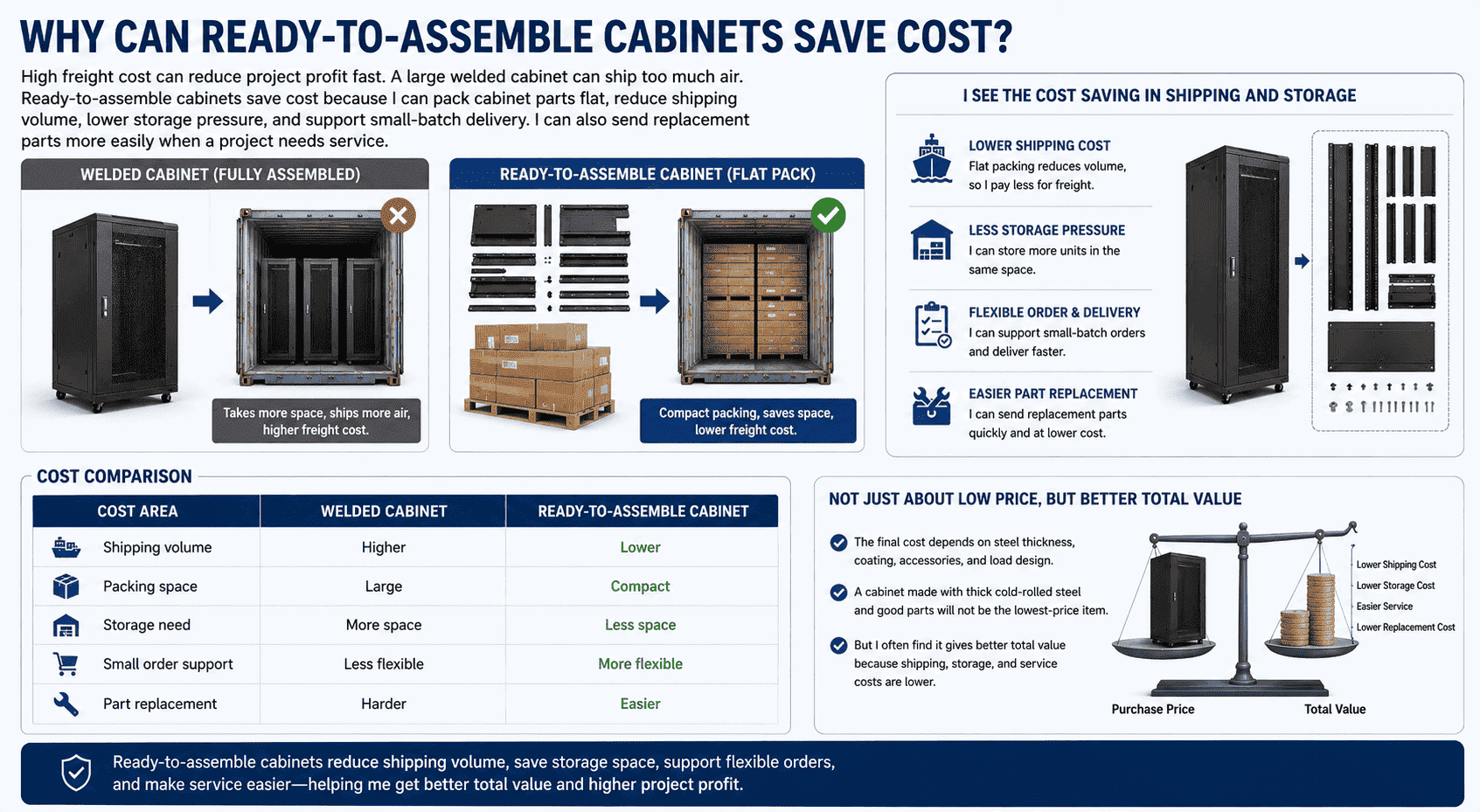
Ready-to-assemble cabinets save cost because I can pack cabinet parts flat, reduce shipping volume, lower storage pressure, and support small-batch delivery. I can also send replacement parts more easily when a project needs service.
I see the cost saving in shipping and storage
The main cost advantage comes from packaging. A welded cabinet keeps its full shape during transport. It takes large space even when the inside is empty. A ready-to-assemble cabinet can be disassembled and packed in layers. This makes the carton or pallet more compact. For overseas customers, this is very important. Freight cost can be a large part of the total purchase cost.5
I also see another benefit in warehouse use. A distributor can store more units in the same space.6 A project buyer can order small batches without filling a large warehouse. For my factory, this model also supports flexible customization. I can prepare parts, change doors, change panels, or change mounting rails based on the project need.
| Cost area | Welded cabinet | Ready-to-assemble cabinet |
|---|---|---|
| Shipping volume | Higher | Lower |
| Packing space | Large | Compact |
| Storage need | More space | Less space |
| Small order support | Less flexible | More flexible |
| Part replacement | Harder | Easier |
I do not say every ready-to-assemble cabinet is cheaper in every case. The final cost still depends on steel thickness, coating, accessories, and load design. A cabinet made with thick cold-rolled steel and good parts will not be the lowest-price item. Yet I often find it gives better total value because shipping, storage, and service costs are lower.
Are ready-to-assemble cabinets as strong as welded cabinets?
A shaking cabinet can damage equipment and create safety risk. I never judge strength by appearance alone. I check the frame, steel, screws, and load test.
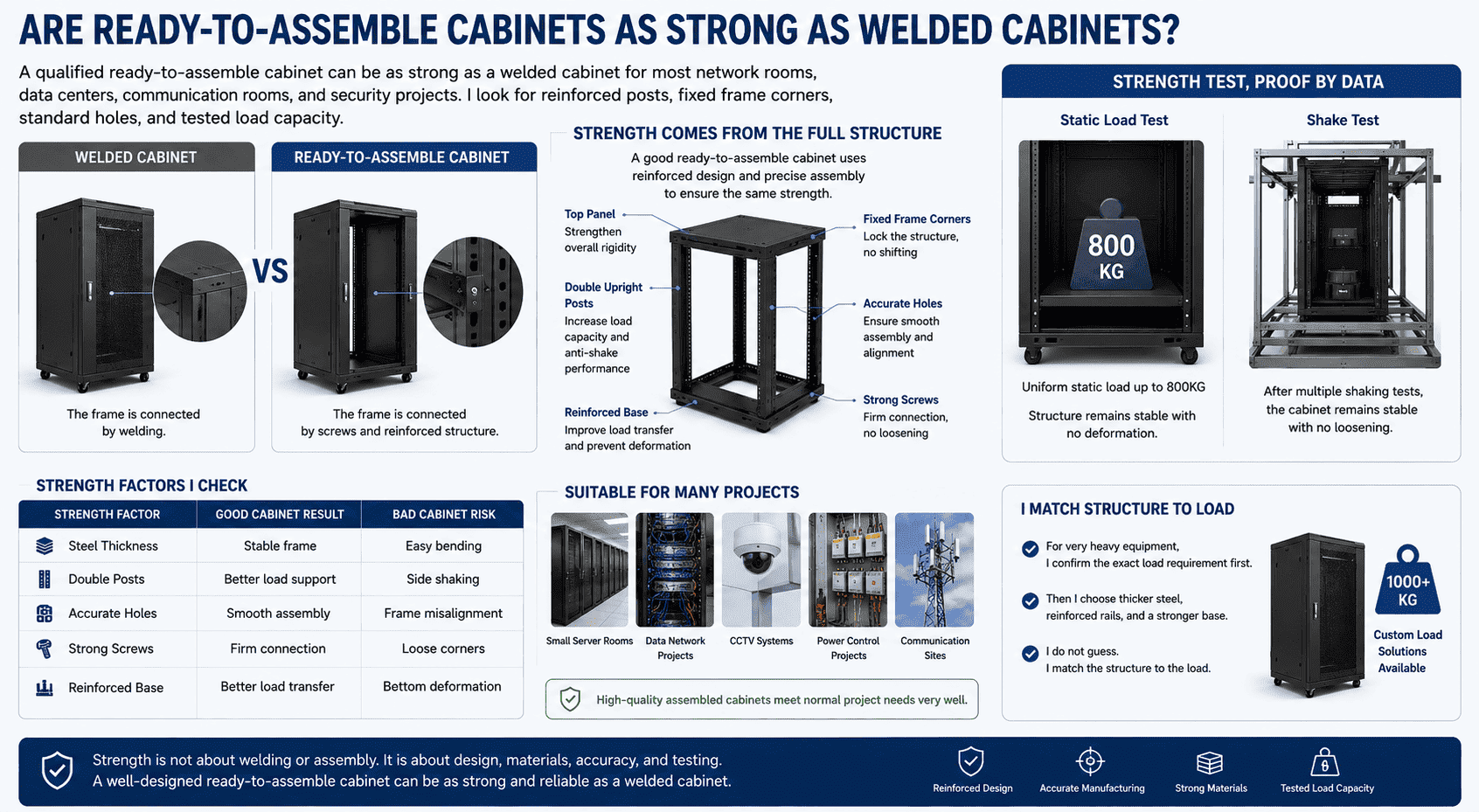
A qualified ready-to-assemble cabinet can be as strong as a welded cabinet for most network rooms, data centers, communication rooms, and security projects.7 I look for reinforced posts, fixed frame corners, standard holes, and tested load capacity.
I compare strength through design details
The strength of a cabinet does not come only from welding. It comes from the full structure.8 A good ready-to-assemble cabinet uses double upright post reinforcement. It uses screws around the frame to lock the structure. It does not hang loose. It does not shift sideways after assembly. The top, base, and four corners work together as one frame.
I pay close attention to the connection points. If the hole position is wrong, the cabinet will twist during assembly.9 If the steel is too thin, the cabinet can deform under load.10 If the screws are weak, the frame can loosen after movement. So I check tolerance, steel grade, post design, and fastening method.
| Strength factor | Good cabinet result | Bad cabinet risk |
|---|---|---|
| Steel thickness | Stable frame | Easy bending |
| Double posts | Better load support | Side shaking |
| Accurate holes | Smooth assembly | Frame misalignment |
| Strong screws | Firm connection | Loose corners |
| Reinforced base | Better load transfer | Bottom deformation |
In my work, I have seen high-quality assembled cabinets meet normal project needs very well. Small server rooms, data network projects, CCTV systems, power control projects, and communication sites can all use this type. For very heavy equipment, I still ask for the exact load requirement first. Then I choose thicker steel, reinforced rails, and a stronger base. I do not guess. I match the structure to the load.
What affects the quality of a ready-to-assemble cabinet?
A low-price cabinet can look fine in a photo. I have seen some products fail after installation. The hidden issue is often material and process control.
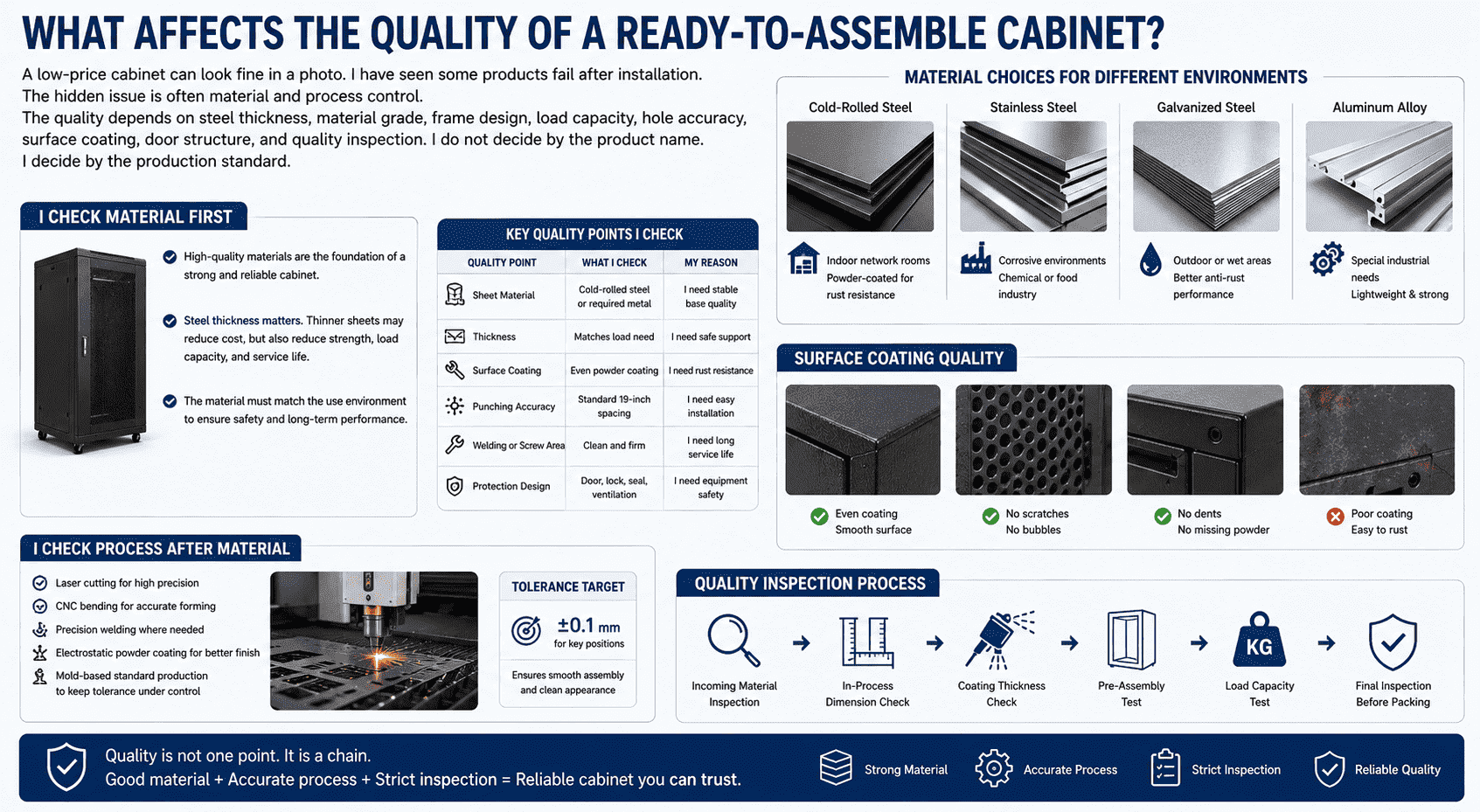
The quality depends on steel thickness, material grade, frame design, load capacity, hole accuracy, surface coating, door structure, and quality inspection. I do not decide by the product name. I decide by the production standard.
I check material first
Material is the first point. Many good cabinets use high-quality cold-rolled steel. Some products use stainless steel, galvanized steel, or high-strength aluminum alloy for special industrial needs. The material must match the use environment. Indoor network rooms may use powder-coated cold-rolled steel. Outdoor or wet areas may need waterproof design, anti-rust treatment, and better sealing.11
Steel thickness matters a lot. Some low-cost products use thinner sheets to reduce price. Sometimes the factory chooses this. Sometimes the customer asks for it to control budget. I understand both cases. Yet I always tell customers the trade-off. Thin material can reduce strength, load capacity, and service life.
| Quality point | What I check | My reason |
|---|---|---|
| Sheet material | Cold-rolled steel or required metal | I need stable base quality |
| Thickness | Matches load need | I need safe support |
| Surface coating | Even powder coating | I need rust resistance |
| Punching accuracy | Standard 19-inch spacing | I need easy installation |
| Welding or screw area | Clean and firm | I need long service life |
| Protection design | Door, lock, seal, ventilation | I need equipment safety |
I check process after material
A good cabinet needs accurate production. I prefer laser cutting, CNC bending, precision welding where needed, and electrostatic powder coating12. I also value mold-based standard production because it keeps tolerance under control. In some of my production checks, I use a tolerance target around 0.1 mm for key positions. This helps the cabinet assemble smoothly and keeps the appearance clean.
The finish also matters. I check whether the coating is even. I check whether the surface has scratches, dents, bubbles, or missing powder. A cabinet may be strong, but a poor surface can affect rust resistance and buyer confidence. Quality is not one point. It is a chain.
How do I identify a reliable ready-to-assemble cabinet supplier?
A bad supplier can make a good design fail. I have seen projects suffer because the cabinet looked correct but the details were not controlled.
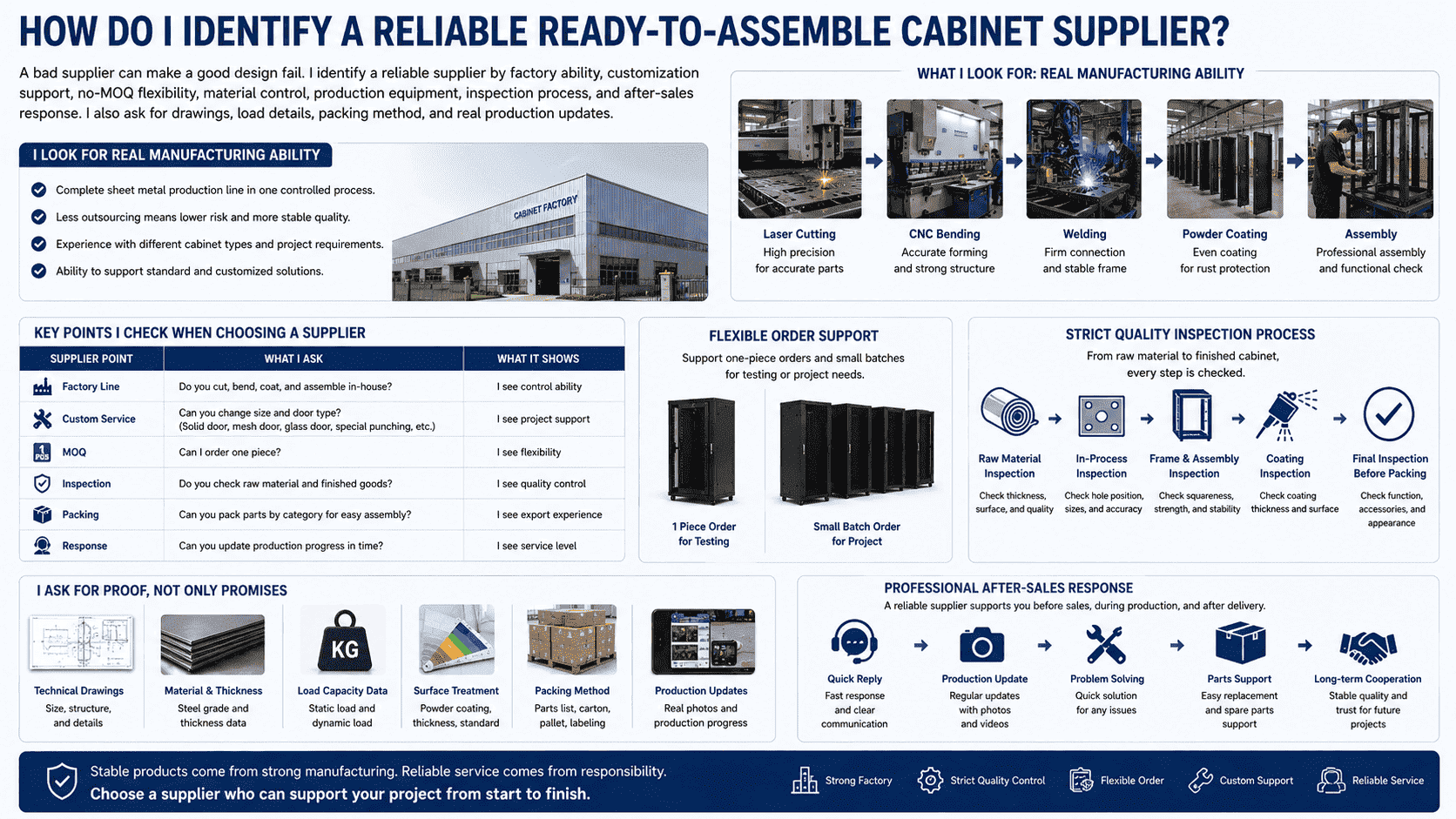
I identify a reliable supplier by factory ability, customization support, no-MOQ flexibility, material control, production equipment, inspection process, and after-sales response. I also ask for drawings, load details, packing method, and real production updates.
I look for real manufacturing ability
I prefer suppliers with a complete sheet metal production line. I want to see laser cutting, CNC bending, welding, powder coating, and assembly in one controlled process. This helps quality stay stable. If too many steps are outsourced, the control risk becomes higher. I also want the supplier to understand customization. Standard cabinets are not enough for many overseas projects. Some customers need special size, mesh door, glass door, steel door, special punching, outdoor waterproof design, anti-corrosion treatment, or reinforced load-bearing structure.
I also care about order flexibility. Many buyers do not want a large minimum order. Some projects only need one cabinet for testing or a small batch for a site. A factory that supports one-piece orders can help these buyers move faster.
| Supplier point | What I ask | What it shows |
|---|---|---|
| Factory line | Do you cut, bend, coat, and assemble in-house? | I see control ability |
| Custom service | Can you change size and door type? | I see project support |
| MOQ | Can I order one piece? | I see flexibility |
| Inspection | Do you check raw material and finished goods? | I see quality control |
| Packing | Can you pack parts by category? | I see export experience |
| Response | Can you update production progress? | I see service level |
I ask for proof, not only promises
I do not rely only on words like “high quality.” I ask for drawings, sheet thickness, load data, surface treatment details, and packing photos. I also ask how the supplier checks hole position, frame squareness, coating, and accessories. If a supplier can answer clearly, I feel more confident.
For export buyers in Europe, America, and Southeast Asia, communication speed also matters. A good supplier should help before sales, during production, and after delivery. If the customer needs a change, the supplier should answer fast and give a clear solution. Cabinet projects are practical projects. I need stable products and stable service at the same time.
When should I choose a welded cabinet instead?
A ready-to-assemble cabinet is useful, but I do not force it into every project. A wrong use case can reduce safety and project value.
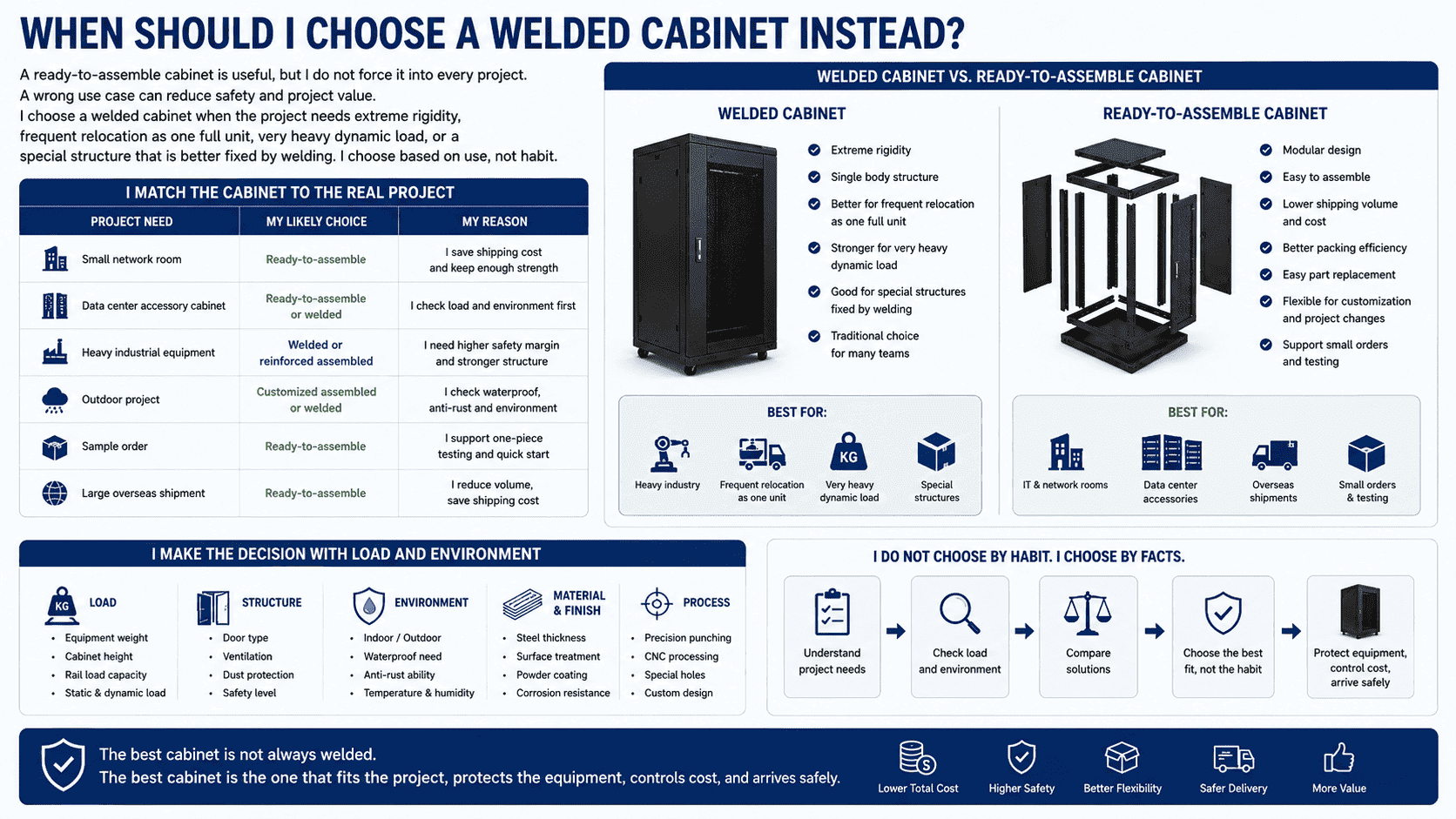
I choose a welded cabinet when the project needs extreme rigidity, frequent relocation as one full unit, very heavy dynamic load, or a special structure that is better fixed by welding. I choose based on use, not habit.
I match the cabinet to the real project
A welded cabinet still has its place. It can be a good choice when the cabinet must be moved many times after full installation. It can also be useful for very heavy industrial equipment or special structures that need a single welded body. Some customers also prefer welded cabinets because their team is used to them. I respect that choice.
At the same time, many normal projects do not need a fully welded body. A well-designed ready-to-assemble cabinet can meet the need with lower shipping cost and better packing efficiency. I usually compare the real working conditions before I suggest a solution.
| Project need | My likely choice | My reason |
|---|---|---|
| Small network room | Ready-to-assemble | I save shipping and keep enough strength |
| Data center accessory cabinet | Ready-to-assemble or welded | I check load first |
| Heavy industrial equipment | Welded or reinforced assembled | I need higher safety margin |
| Outdoor project | Customized assembled or welded | I check waterproof and rust protection |
| Sample order | Ready-to-assemble | I support one-piece testing |
| Large overseas shipment | Ready-to-assemble | I reduce volume and cost |
I make the decision with load and environment
I start with equipment weight. Then I check cabinet height, rail load, door type, ventilation, dust protection, and site environment. If the project needs waterproof protection, I design sealing, roof structure, drainage, and surface treatment. If the project needs anti-rust ability, I choose better material or coating. If the project needs special punching, I use controlled CNC processing.
I do not want customers to choose only by old habits. I want them to choose by facts. The best cabinet is not always welded. The best cabinet is the one that fits the project, protects the equipment, controls cost, and arrives safely.
Conclusion
I trust a ready-to-assemble cabinet when its material, structure, load capacity, accuracy, coating, and supplier quality are all proven.
"NEMA enclosure types - Wikipedia", https://en.wikipedia.org/wiki/NEMA_enclosure_types. Standards for electronic racks and enclosures specify dimensional, structural, loading, and protection requirements, supporting the view that cabinet quality is assessed through measurable performance characteristics rather than assembly method alone; this is contextual evidence and does not certify any specific ready-to-assemble cabinet. Evidence role: expert_consensus; source type: institution. Supports: Recognized rack and enclosure standards evaluate cabinets through dimensional compatibility, construction, loading or stability, and environmental protection requirements.. Scope note: Contextual support only; a standard can define relevant quality criteria, but product-specific test reports are needed to prove an individual cabinet meets them. ↩
"Ready-to-assemble furniture - Wikipedia", https://en.wikipedia.org/wiki/Ready-to-assemble_furniture. Definitions of ready-to-assemble or knock-down construction describe products supplied in separate components for later assembly, generally using fasteners, which supports the article’s use of the term for modular cabinet frames. Evidence role: definition; source type: encyclopedia. Supports: Ready-to-assemble or knock-down products are supplied as separate parts and assembled by the user or installer, typically with mechanical fasteners.. ↩
"ikea and the flat-pack concept on scandinavian design traces", https://www.academia.edu/33038997/IKEA_AND_THE_FLAT_PACK_CONCEPT_ON_SCANDINAVIAN_DESIGN_TRACES. Research on flat-pack and knock-down product logistics shows that disassembled components can improve packing density and reduce transported volume, supporting the mechanism by which ready-to-assemble cabinets may lower freight cost; this evidence is general and not cabinet-specific. Evidence role: mechanism; source type: paper. Supports: Flat-pack or knock-down product design can improve packing density, reduce shipped volume, and lower logistics costs.. Scope note: Contextual support only; the actual savings depend on cabinet dimensions, packaging design, freight mode, and shipment quantity. ↩
"19-inch rack - Wikipedia", https://en.wikipedia.org/wiki/19-inch_rack. EIA-310 and IEC 60297 rack standards define 19-inch rack mounting dimensions and hole patterns, supporting the claim that correct hole spacing is necessary for equipment fit. Evidence role: definition; source type: institution. Supports: Rack standards define the mechanical dimensions and mounting-hole patterns used for 19-inch equipment racks.. ↩
"[PDF] Fathoming Shipping Costs: An Exploration - World Bank Document", https://documents1.worldbank.org/curated/en/099436104042241280/pdf/IDU0c20d2ae90046304ca009ab508217e50747bd.pdf. International trade and maritime transport studies report that freight and transport charges can form a significant share of landed costs, supporting the article’s claim that shipping expense can materially affect overseas cabinet purchases; this does not quantify the share for any specific cabinet order. Evidence role: general_support; source type: institution. Supports: International trade research shows that freight and transport costs can be a significant component of landed costs, especially for bulky goods.. Scope note: Contextual support only; the cost share varies by route, mode, volume, weight, fuel prices, and contract terms. ↩
"ikea and the flat-pack concept on scandinavian design traces", https://www.academia.edu/33038997/IKEA_AND_THE_FLAT_PACK_CONCEPT_ON_SCANDINAVIAN_DESIGN_TRACES. Logistics research on flat-pack product design indicates that disassembled packaging can reduce storage volume per unit and improve warehouse space utilization, supporting the article’s storage-efficiency claim; the evidence is general rather than specific to network cabinets. Evidence role: mechanism; source type: paper. Supports: Flat-pack product designs can reduce unit storage volume and improve warehouse space utilization.. Scope note: Contextual support only; warehouse gains depend on packaging dimensions, pallet patterns, stacking limits, and inventory handling rules. ↩
"Load-bearing and failure behavior of welded horizontal joints ... - PMC", https://pmc.ncbi.nlm.nih.gov/articles/PMC13031660/. Mechanical-engineering studies of bolted and mechanically fastened structures show that joint design, preload, material, and frame geometry can provide substantial stiffness and load capacity, supporting the possibility that ready-to-assemble cabinets can meet ordinary service requirements; this does not prove equivalence for all ready-to-assemble and welded cabinet models. Evidence role: general_support; source type: paper. Supports: Mechanical fastening and bolted-frame structures can achieve high structural performance when properly designed and tested.. Scope note: Contextual support only; direct proof would require comparative load, vibration, and stability tests on the specific cabinet designs. ↩
"Mechanics of Materials: Strain - Boston University", https://www.bu.edu/moss/mechanics-of-materials-strain/. Engineering mechanics texts explain that structural strength and stiffness depend on material properties, member geometry, load paths, and connection behavior, supporting the claim that welding is only one factor in cabinet frame strength. Evidence role: mechanism; source type: education. Supports: Structural strength and stiffness are determined by material properties, geometry, load paths, and connection behavior.. ↩
"[PDF] Hole Alignment Tolerance Stacking Issues", http://www.stat.washington.edu/fritz/Reports/holematch.pdf. Manufacturing and geometric-dimensioning references state that positional tolerances control part alignment and assembly fit, supporting the claim that inaccurate holes can produce misalignment or distortion during cabinet assembly. Evidence role: mechanism; source type: education. Supports: Dimensional and positional tolerances affect whether manufactured parts align and assemble without distortion.. ↩
"[PDF] 2.080 Structural Mechanics Lecture 7: Bending Response of Plates ...", https://ocw.mit.edu/courses/2-080j-structural-mechanics-fall-2013/f8fd2ad49d100766335b4e129a8a4791_MIT2_080JF13_Lecture7.pdf. Mechanics-of-materials references show that bending stiffness is strongly dependent on section thickness, supporting the claim that thinner steel cabinet parts are more likely to deform under load. Evidence role: mechanism; source type: education. Supports: For plates and beams, bending stiffness increases strongly with thickness, so thinner steel sections deflect more under comparable loads.. ↩
"[PDF] Coatings for corrosion protection - NIST Technical Series Publications", https://nvlpubs.nist.gov/nistpubs/Legacy/SP/nistspecialpublication1035.pdf. NEMA 250 and IEC 60529 classify enclosure protection against water ingress and environmental exposure, supporting the claim that outdoor or wet-area cabinets require sealing and protection measures; these standards define protection levels but do not prescribe one universal cabinet design. Evidence role: expert_consensus; source type: institution. Supports: Enclosure standards classify protection against water ingress and environmental exposure, and corrosion guidance supports protective materials or coatings for wet environments.. Scope note: Contextual support only; the required protection level depends on the specific site exposure and applicable rating. ↩
"Accelerated Corrosion Tests in Quality Labels for Powder Coatings ...", https://pmc.ncbi.nlm.nih.gov/articles/PMC8585214/. Coatings research shows that properly applied and cured powder coatings can provide a protective film on steel and improve corrosion resistance, supporting the article’s emphasis on powder coating as a cabinet-quality factor. Evidence role: mechanism; source type: paper. Supports: Powder coatings can form protective polymer films on metal surfaces and improve corrosion resistance when properly applied and cured.. ↩
