
What is the standard size of a network cabinet?
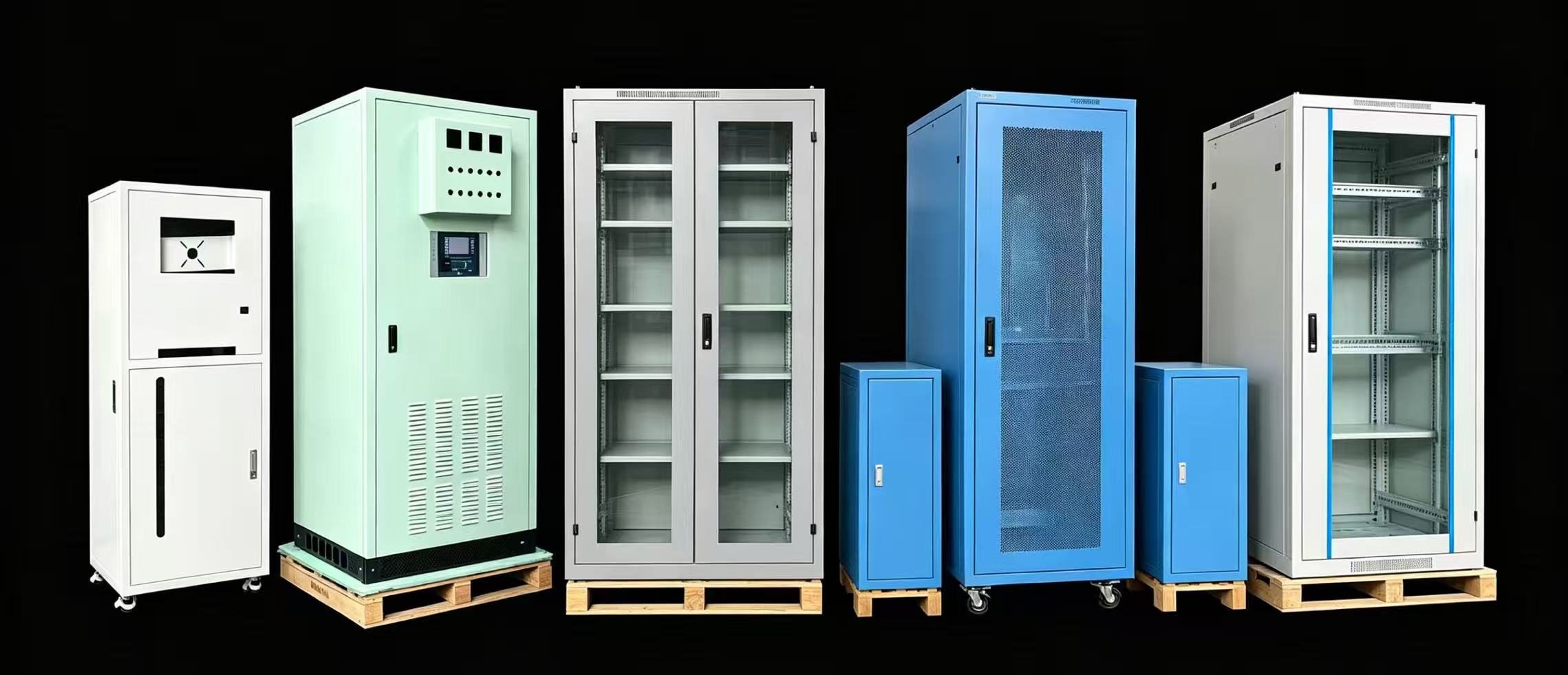
Confused by network cabinet sizes? You worry your expensive equipment won't fit, wasting time and money. Understanding the universal 19-inch standard is the key to getting it right.
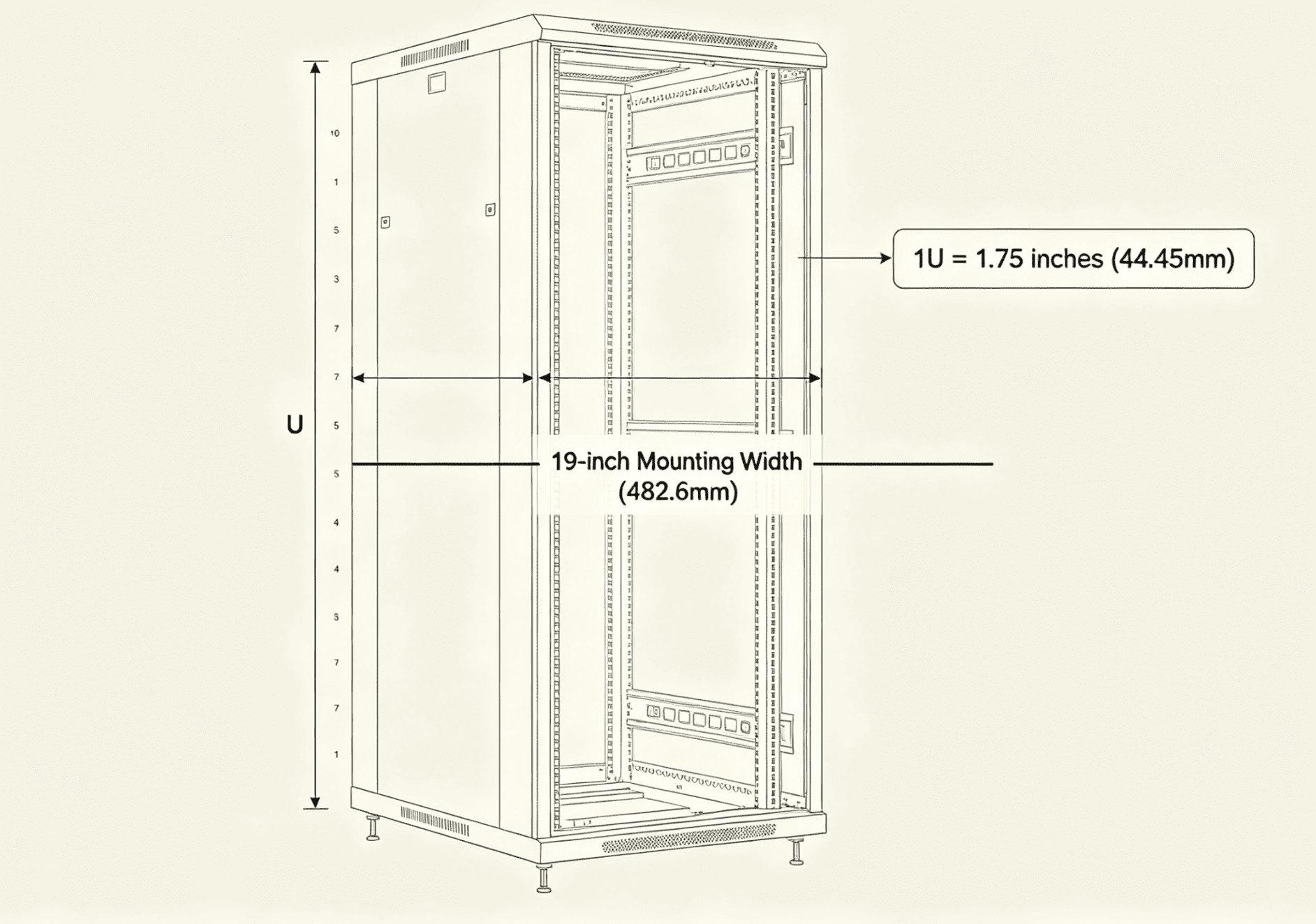
The standard size for network cabinets is the 19-inch rack format.1 This refers to the internal mounting width of 482.6mm2 for equipment. This ensures that any 19-inch rack-mountable device will fit, no matter the brand.3 Height is measured in "U"s, not metric units.4
The 19-inch standard is a great starting point. But it's only one piece of the puzzle. To choose the perfect cabinet, you also need to understand the external width, the height in "U"s, and the different depth options. Getting these details right ensures your project goes smoothly from start to finish. Let's break down each part so you can order with confidence.
But isn't a 19-inch cabinet wider than 19 inches?
It's confusing when a product is called "19-inch" but the spec sheet says it's 600mm wide. This makes you second-guess if it will fit in your space.
Yes, the cabinet is wider. The "19-inch" (482.6mm) part is the standard internal width between the mounting rails where your equipment bolts in. The overall cabinet is wider, usually 600mm5, to include the frame, side panels, and room for cable management.
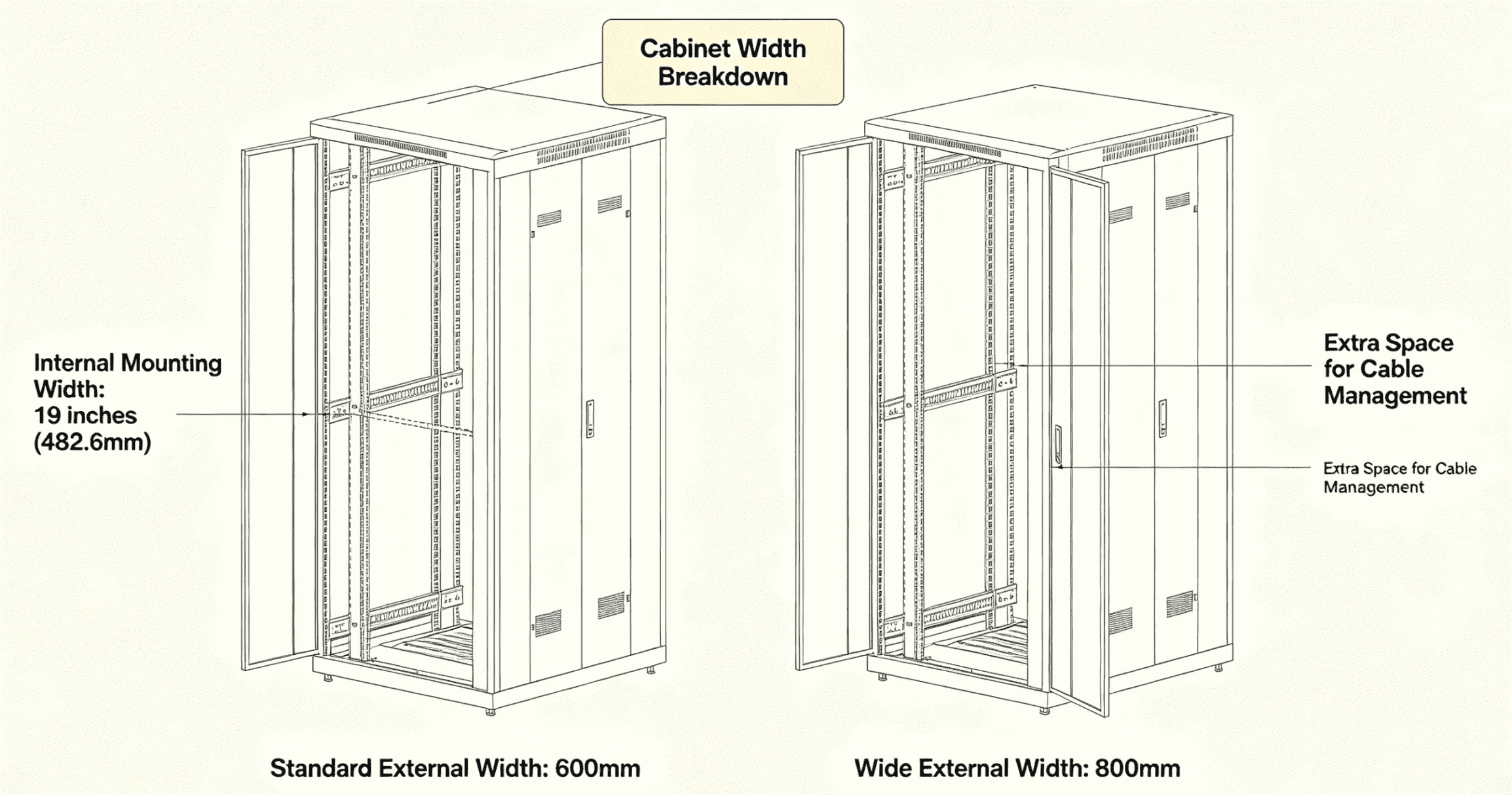
The 19-inch standard is the most important dimension because it guarantees compatibility. Any server, switch, or patch panel sold as "19-inch rack-mountable" will fit between those vertical rails. The external width gives you the complete physical footprint of the cabinet. The most common size you will see is 600mm wide. This is a very efficient size for most data centers and server rooms. We also see 800mm wide cabinets becoming popular. This extra width doesn't change the internal 19-inch mounting.6 Instead, it provides much more space on the sides for cable management7, which is very helpful in high-density setups.
I remember a client in Europe who had a very tight space. They needed the internal mounting to be standard, but a 600mm cabinet was just a little too wide. We designed and built a custom 580mm wide cabinet for them. It gave them just enough room to squeeze it into the alcove.
Cabinet Width Breakdown
| Dimension Type | Measurement | Purpose |
|---|---|---|
| Internal Mounting Width | 19 inches (482.6mm) | Universal standard for mounting equipment |
| Standard External Width | 600mm | Space-efficient footprint for most applications |
| Wide External Width | 800mm | Extra room for vertical cable management |
| Custom Width | As required | Fits unique space constraints or special equipment |
How is the height of a network cabinet measured in 'U's?
You see cabinets listed as 24U, 42U, or 48U. If you don't know what a 'U' is, you can't be sure your cabinet will be the right height.
A "U" is a standard rack unit of height, equal to 1.75 inches or 44.45mm.8 This measures the usable vertical space inside the cabinet. A 42U cabinet, for example, gives you 42 of these 1.75-inch slots to mount your equipment.
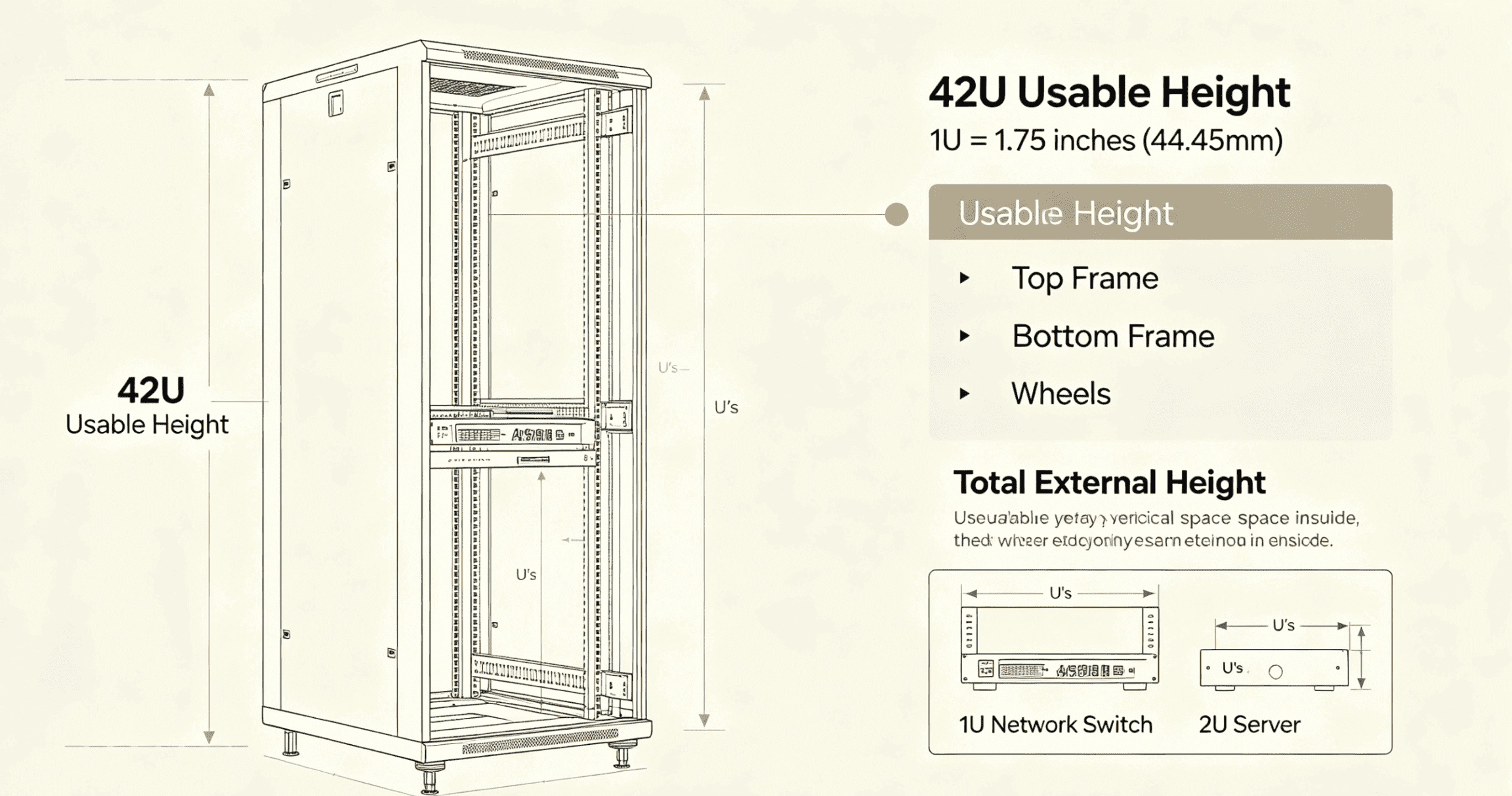
Most rack-mountable equipment has its height measured in U's. A thin network switch might be 1U tall. A larger server could be 2U or 4U tall. You can calculate how much U-space you need by simply adding up the height of all your devices. It's smart to add some extra U's for future expansion and for blank panels to manage airflow.9
But be careful. The U-height is not the total external height of the cabinet. The total height also includes the top and bottom frames, the roof, and the wheels or leveling feet. A 42U cabinet is not simply 42 x 44.45mm tall.10 I had a customer once who almost ordered a 48U cabinet for his basement. We had a quick chat, and I asked him to measure his ceiling height. He realized the total external height of the cabinet would not clear the water pipes. We switched him to a 42U model, and it fit perfectly. Always check the full technical specifications for the overall dimensions before you buy.
Common 'U' Conversions
| Rack Units (U) | Inches (") | Millimeters (mm) |
|---|---|---|
| 1U | 1.75" | 44.45 mm |
| 2U | 3.5" | 88.9 mm |
| 4U | 7" | 177.8 mm |
| 24U (Usable) | 42" | 1066.8 mm |
| 42U (Usable) | 73.5" | 1866.9 mm |
What's the right depth for my server cabinet?
You figured out width and height, but now you see depth options like 600mm, 800mm, or 1000mm. Choosing a depth that is too shallow is a disaster because your equipment won't fit.
Choose a cabinet depth based on your deepest piece of equipment, then add at least 150mm for cables and airflow11. A 600mm depth is for network gear, but most servers require 1000mm or 1200mm deep cabinets for proper installation and cooling12.
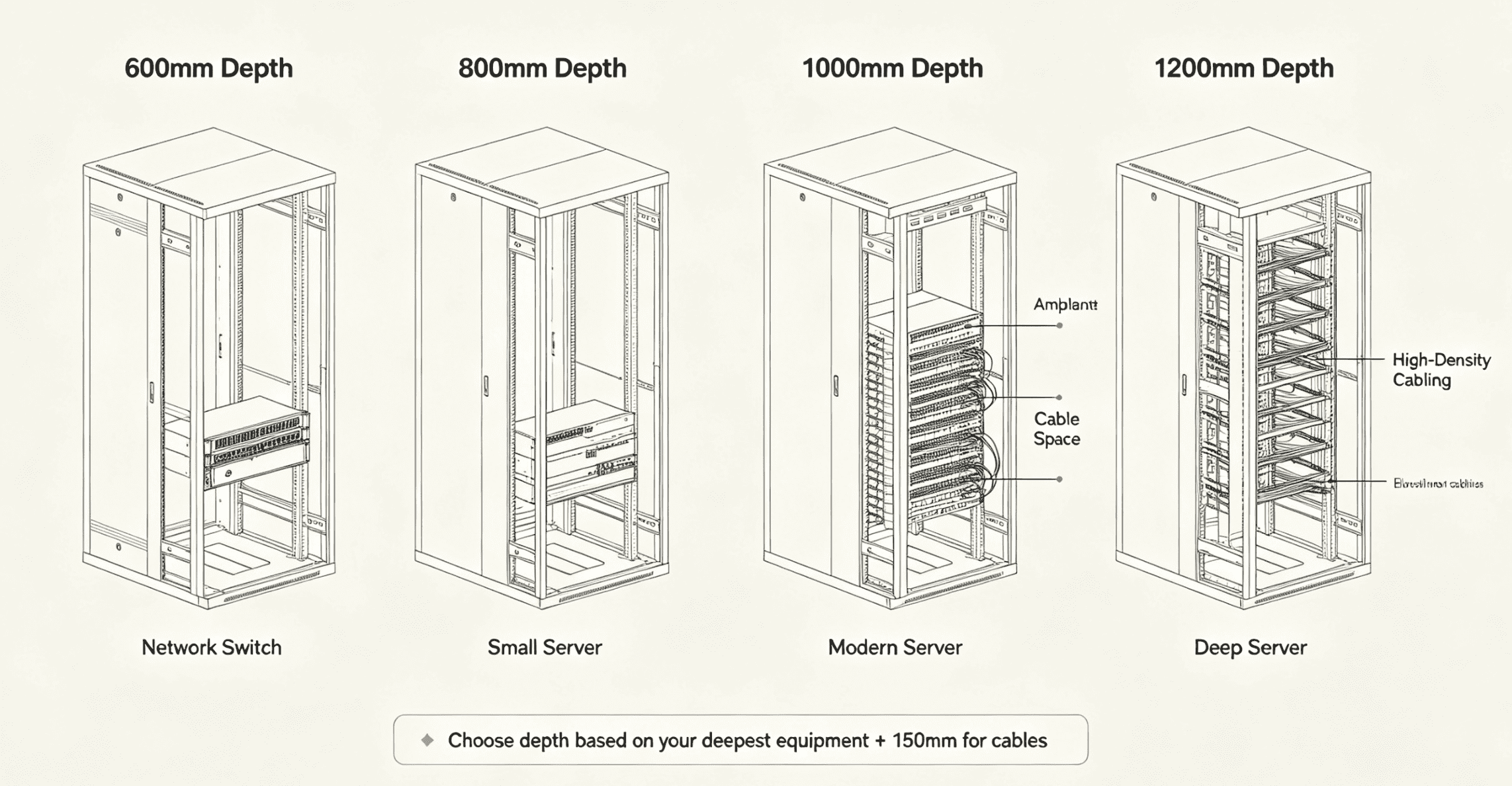
The depth you need depends entirely on what you will put inside. You must measure from the front mounting face of your equipment to the very back, including any power plugs or cables that stick out. A common mistake is only measuring the server chassis and forgetting about the power supply cables.
Here's a simple guide:
- 600mm Depth: Best for network racks. This depth is perfect for patch panels, network switches, and other short-bodied equipment.
- 800mm Depth: A middle ground. It can house some smaller servers or provide extra cabling room in a network rack.
- 1000mm Depth: This is the most common depth for modern servers from brands like Dell, HP, and Supermicro. It allows room for server rails, the server itself, and rear cable management.
- 1200mm Depth: For very deep servers or high-density computing. This extra space is essential for managing large bundles of cables and ensuring proper front-to-back airflow.
Since 1999, we've seen equipment get deeper and deeper. We recently helped a client in Southeast Asia who had a mix of network gear and servers. A 1000mm cabinet was too deep and wasted space, but 800mm was too tight. So, we made them a custom batch of 900mm depth cabinets. It was the perfect solution for their unique needs.
What if standard cabinet sizes don't work for me?
Your project is special and a standard, off-the-shelf cabinet just won't work. You might feel stuck, forced to change your plans or pay a huge price for a custom order.
If standard sizes don't fit, a custom cabinet is the best solution. We specialize in non-standard cabinets. We can change dimensions, doors, materials, and more, even if you only need one piece. We build the exact cabinet you need.
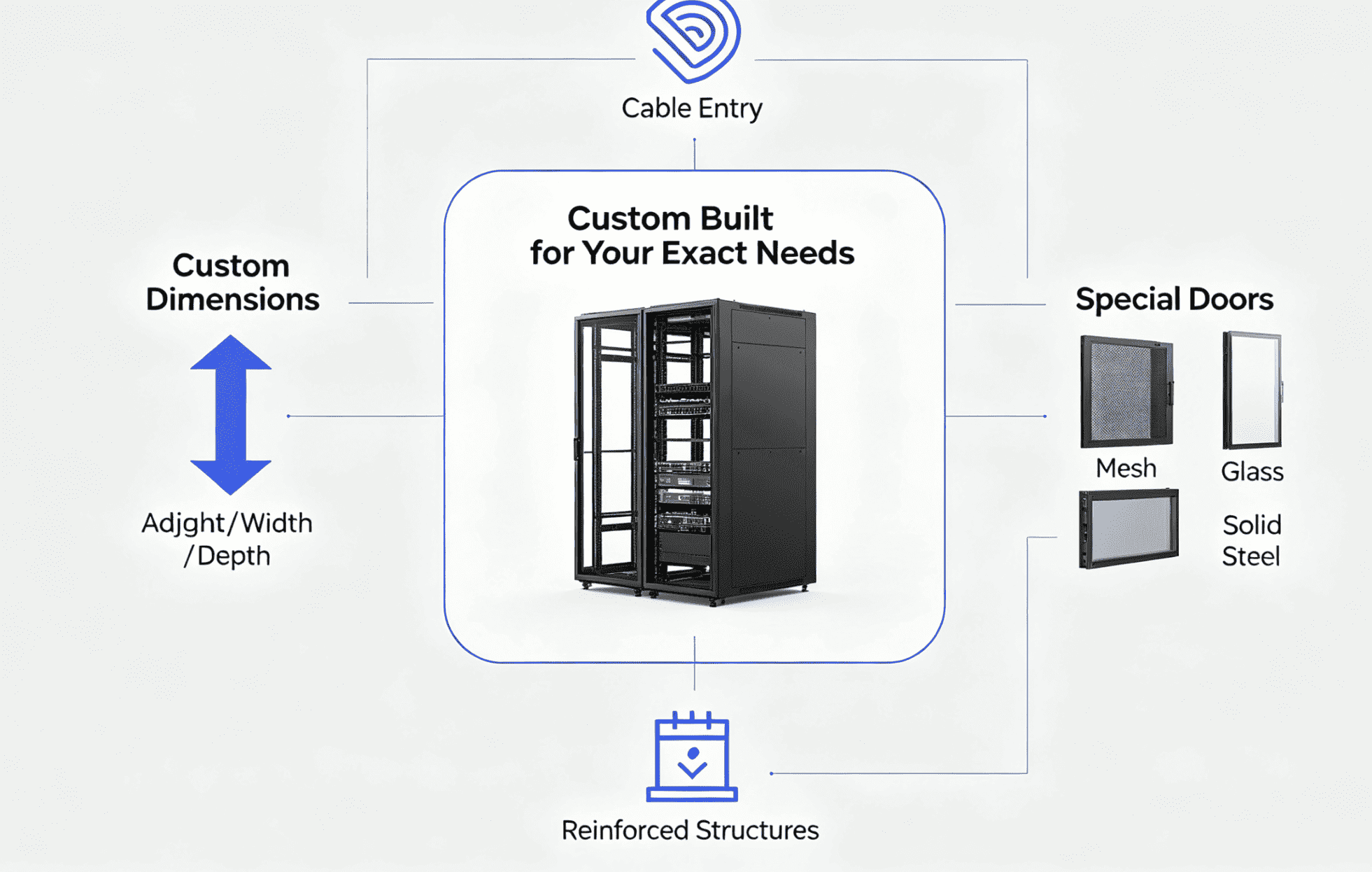
Standardization is great for efficiency, but innovation often happens in the exceptions. That's where we come in. Because we have our own complete sheet metal production line, we are not limited by what's already on the shelf. We can make almost any change you can think of. I love it when a customer sends me a simple sketch of what they need. We take that idea and turn it into a professional CAD drawing, and then into a finished product that solves their exact problem.
We don't have a minimum order quantity. So if you need just one special cabinet, that is perfectly fine. This flexibility is how we've built our business for over two decades.
Some common customizations we do include:
- Custom Dimensions: We can adjust the height, width, and depth to your exact specifications.
- Special Doors: You can choose from high-airflow mesh, tempered glass, solid steel, or a combination.
- Cable Entry: We can add custom cutouts for cable entry on the top, bottom, or side panels.
- Reinforced Structures: If you have extremely heavy equipment, we can reinforce the frame to handle higher load capacities.
- Outdoor Cabinets: We can build cabinets with waterproof seals, special anti-corrosion coatings, and internal climate control for outdoor use.
Conclusion
Understanding the 19-inch standard, U-height, and equipment depth is key. For everything else, flexible customization means you never have to compromise on getting the perfect cabinet for your project.
"19-inch rack - Wikipedia", https://en.wikipedia.org/wiki/19-inch_rack. A neutral reference on 19-inch racks defines the format as a standardized mounting system for electronic equipment and traces its dimensional basis to rack standards such as EIA-310 and IEC 60297. Evidence role: definition; source type: encyclopedia. Supports: A neutral source should define the 19-inch rack and identify it as a standardized frame or enclosure format for mounting electronic equipment.. Scope note: This supports the general standardization of the format, not the availability or dimensions of every cabinet sold commercially. ↩
"19-inch rack", https://en.wikipedia.org/wiki/19-inch_rack. Rack-dimension references based on EIA-310 and IEC 60297 identify the nominal 19-inch rack width as 482.6 mm. Evidence role: definition; source type: institution. Supports: A standards or institutional source should confirm that the nominal 19-inch rack dimension corresponds to 482.6 mm.. ↩
"19-inch rack - Wikipedia", https://en.wikipedia.org/wiki/19-inch_rack. Standards for 19-inch racks specify common mounting dimensions so that compliant equipment and enclosures can be mechanically compatible across manufacturers. Evidence role: expert_consensus; source type: institution. Supports: A standards-based source should show that standardized rack-mounting dimensions are intended to permit equipment from different manufacturers to be installed in compatible racks.. Scope note: The support is limited to standardized mounting dimensions; it does not prove that every device will fit every cabinet when depth, slide rails, cabling, load rating, or thermal constraints are considered. ↩
"Rack unit", https://en.wikipedia.org/wiki/Rack_unit. The rack unit, abbreviated U or RU, is the conventional unit used to express the height of rack-mounted equipment. Evidence role: definition; source type: encyclopedia. Supports: A neutral reference should define rack units and explain their use for expressing the height of rack-mounted equipment.. ↩
"Exploring Server Rack Sizes & Dimensions: Depth, Width, & Height", https://blog.enconnex.com/exploring-server-rack-sizes-and-dimensions-depth-width-height. Data-center infrastructure references commonly describe 19-inch cabinets with nominal external widths such as 600 mm, reflecting space for the enclosure frame and side structures around the standardized mounting rails. Evidence role: general_support; source type: institution. Supports: A data-center or infrastructure reference should show that 600 mm is a common nominal external width for cabinets built around 19-inch mounting rails.. Scope note: This is contextual support for common cabinet practice rather than proof that 600 mm is the usual width in all markets or product categories. ↩
"19-inch rack - Wikipedia", https://en.wikipedia.org/wiki/19-inch_rack. Technical descriptions of rack cabinets distinguish the standardized 19-inch mounting interface from the cabinet’s outside width, allowing wider enclosures to retain the same rail spacing while adding side space. Evidence role: mechanism; source type: institution. Supports: A technical infrastructure source should explain that cabinets may have different external widths while preserving the standardized 19-inch rail spacing.. Scope note: The source would support the design principle, not verify the dimensions of any specific cabinet model. ↩
"Cable Management Tray Cable Manager For Data Center Rack", https://www.cobtel.com/cable-manager/data-center-cabinet-cable-arrangement-tray.html. Data-center cabling guidance notes that vertical cable management requires dedicated side or adjacent space, which is one reason wider rack enclosures are used in high-density installations. Evidence role: mechanism; source type: institution. Supports: A cabling or data-center planning source should support that additional rack width can be used for vertical cable management space.. Scope note: This supports the cable-management rationale generally; it does not establish that every 800 mm cabinet provides adequate cable capacity for every installation. ↩
"Rack unit - Wikipedia", https://en.wikipedia.org/wiki/Rack_unit. A rack unit is defined as 1.75 inches, or 44.45 mm, and is used to specify the vertical height of rack-mounted equipment. Evidence role: definition; source type: encyclopedia. Supports: A neutral reference should define the rack unit as 1.75 inches, equivalent to 44.45 mm.. ↩
"Manage Airflow for Cooling Efficiency - Energy Star", https://www.energystar.gov/products/data_center_equipment/16-more-ways-cut-energy-waste-data-center/manage-airflow-cooling-efficiency. Data-center airflow guidance describes blanking panels as a method for limiting unwanted air recirculation through unused rack openings, thereby improving cooling management. Evidence role: mechanism; source type: government. Supports: A government or ASHRAE-aligned data-center efficiency source should support that blanking panels reduce bypass or recirculated airflow in racks.. Scope note: The source would support the airflow role of blanking panels; the amount of extra U-space needed for future expansion remains project-specific. ↩
"What Is a 42U Rack Size? Dimensions, Height, Width & Depth ...", https://electronics.alibaba.com/question/42u-rack-size-explained-dimensions,-capacity-real-world-use. Rack-cabinet specifications typically distinguish usable rack-unit capacity from the cabinet’s overall external height, which includes the enclosure structure and base components. Evidence role: general_support; source type: institution. Supports: A technical rack specification source should show that cabinets list both usable rack-unit capacity and separate external dimensions.. Scope note: This is contextual support based on specification practice; exact external height varies by cabinet design. ↩
"[PDF] quantifying air flow rate through a server in an operational data", https://mavmatrix.uta.edu/context/mechaerospace_theses/article/1223/type/native/viewcontent. Rack-installation guidance emphasizes that cabinet depth must account not only for chassis depth but also for rear connectors, cable bend space, and airflow clearance. Evidence role: mechanism; source type: institution. Supports: A data-center or rack-installation source should support the principle that rear clearance is needed for cable bend radius, connectors, and airflow.. Scope note: The source may support the need for clearance without prescribing an exact universal 150 mm allowance, which can vary by equipment and cabling. ↩
"[PDF] quantifying air flow rate through a server in an operational data", https://mavmatrix.uta.edu/context/mechaerospace_theses/article/1223/type/native/viewcontent. Data-center rack planning references commonly list 1000 mm and 1200 mm as server-cabinet depths used to accommodate equipment, rails, rear cabling, and cooling airflow. Evidence role: general_support; source type: institution. Supports: A data-center infrastructure source should support that 1000 mm and 1200 mm are common cabinet depths for server installations requiring rear cabling and airflow clearance.. Scope note: This provides contextual support for common server-rack depths; the required depth still depends on the exact server model, rail kit, power connections, and cooling design. ↩
