
What Are High Density Racks?
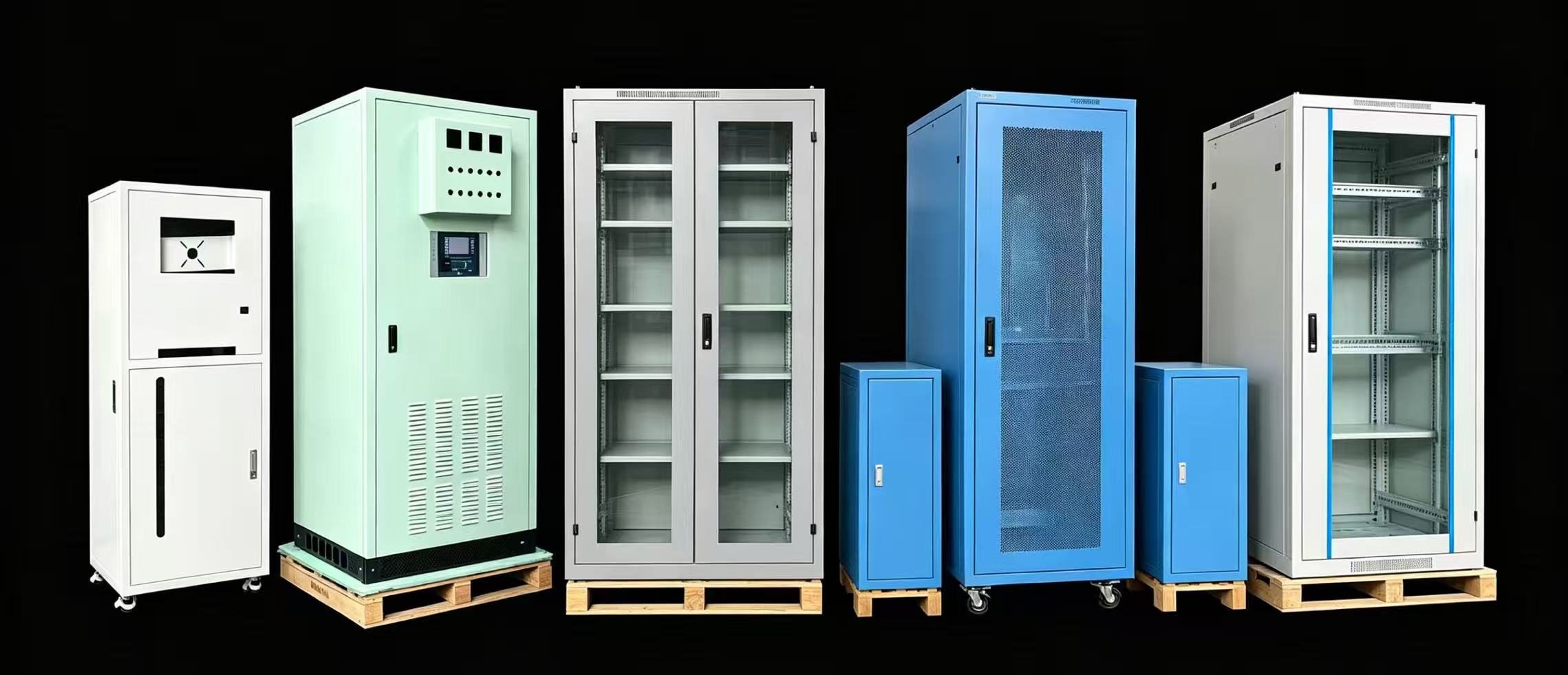
-
What Makes High Density Racks Different From Standard Server Racks?
Many data centers still use traditional racks built for older IT loads. That creates a hidden risk. The rack may look stable at first, but dense servers can expose weak frames, poor ventilation, shallow depth, and limited load capacity. I have seen projects lose time because the rack looked acceptable but failed once real equipment arrived.
High density racks differ from standard server racks because they are engineered for heavier equipment, higher power density, stronger thermal performance, deeper device compatibility, and long-term continuous operation. I usually define them by four areas: load capacity, airflow design, power readiness, and structural stability under full-density deployment.
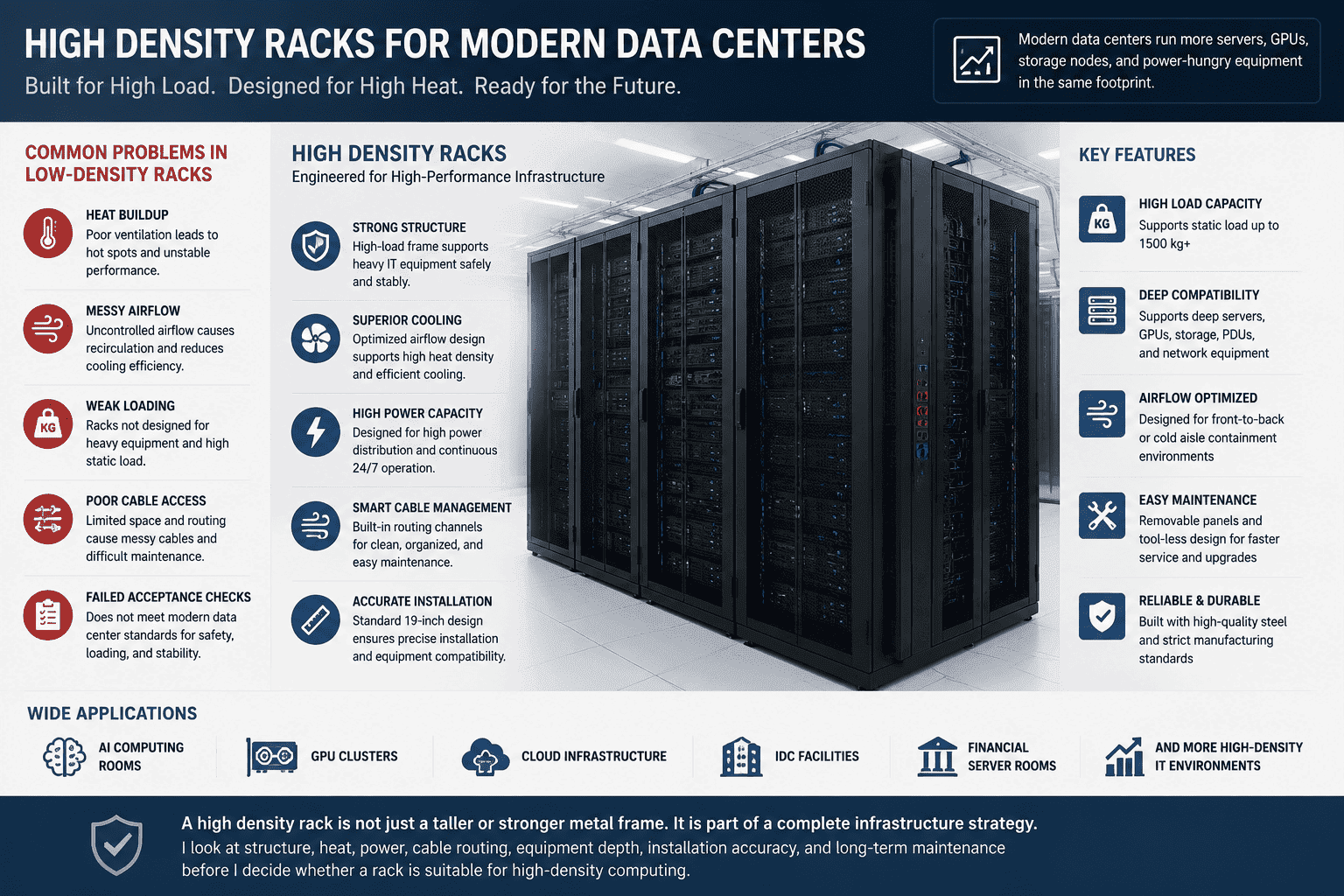
The core difference is engineering margin
A standard rack may work well for light switches, patch panels, small servers, and low-density storage. However, modern AI servers, GPU nodes, high-performance computing equipment, and dense storage arrays create a completely different environment.
I usually explain it this way:
A low-density rack holds equipment. A high-density rack protects an entire computing workload.
That difference matters because dense equipment creates combined stress:
- Mechanical stress from heavy servers and rails
- Thermal stress from high heat output
- Electrical stress from higher rack-level power draw
- Operational stress from frequent maintenance and cable changes
- Expansion stress when the client adds more equipment later
Standard racks vs high density racks
| Feature | Standard Server Rack | High Density Rack |
|---|---|---|
| Typical use | Light to medium IT equipment | Dense servers, GPU clusters, cloud nodes |
| Power density | Often below 5–10 kW per rack | Commonly 20–50 kW per rack1 |
| Structure | General frame design | Reinforced frame, beams, posts, base |
| Load capacity | Lower or medium load | Often up to 1000–1200 kg static load, depending design |
| Airflow | Basic ventilation | Open-frame or optimized perforated airflow |
| Depth flexibility | Limited adjustment | Adjustable mounting depth for short and long equipment |
| Maintenance | Basic access | Easier cabling, equipment replacement, and inspection |
| Best fit | Traditional server rooms | AI rooms, IDC centers, cloud, finance, government, enterprise core rooms |
Why I do not recommend low-density racks for high-density equipment
When a client asks whether they can use a common low-density rack for high-density servers, my answer is usually no. The risk is not only that the rack may deform. The larger risk is that the whole room becomes unstable.
A weak rack can cause:
-
Uneven load distribution
Heavy servers may concentrate force on local points. Over time, rails, mounting posts, or the bottom frame can bend. -
Hot spots inside the rack
Dense devices exhaust more heat. If airflow is blocked or uncontrolled, equipment can throttle, shut down, or fail early2. -
Poor cable management
High-density servers need more power cables, network cables, fiber, and management lines. A narrow or shallow rack becomes difficult to maintain. -
Expansion problems
A rack that works today may fail tomorrow when the data center adds more GPUs, storage trays, or redundant power systems. -
Acceptance failure
Many overseas projects and large engineering sites have strict acceptance standards. Rack structure, coating quality, grounding, dimensions, and loading all matter.
From my manufacturing experience, the best high-density projects start with the rack design. If the frame is wrong, every later system becomes harder to control.
Why Do High Density Racks Need Stronger Load Capacity?
Dense computing equipment is heavy, and that weight does not always spread evenly. If the rack structure is weak, the frame may twist, the rails may bend, or the equipment may sag. I care about this issue because structural failure is expensive, dangerous, and difficult to fix after installation.
High density racks need stronger load capacity because modern servers, GPU systems, storage arrays, and power equipment can create hundreds of kilograms of static load inside one cabinet footprint. A reinforced rack uses stronger posts, beams, bases, weld points, and mounting structures to keep the frame stable under long-term full-load operation.
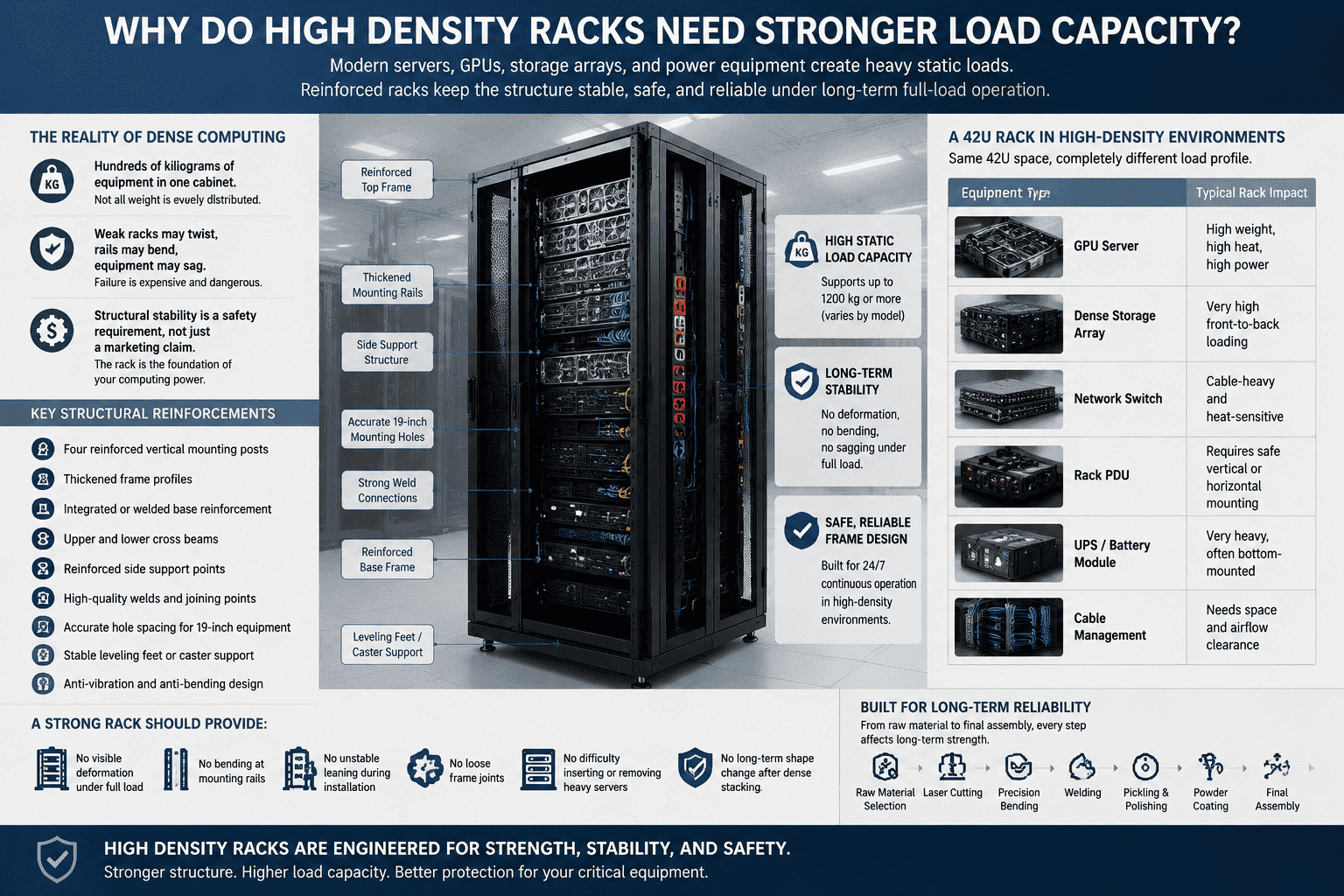
Load capacity is not just a number
Many buyers ask for “1200 kg loading” as if one number explains everything. I understand why they ask, but I always look deeper. A rack may claim a high static load, but the real performance depends on how that load transfers through the structure.
Important structural details include:
- Four reinforced vertical mounting posts
- Thickened frame profiles
- Integrated or welded base reinforcement
- Upper and lower cross beams
- Reinforced side support points
- High-quality welds and joining points
- Accurate hole spacing for 19-inch equipment
- Stable leveling feet or caster support
- Anti-vibration and anti-bending design
For EIA-310 19-inch equipment3, the mounting system must be accurate. If the vertical rails are misaligned, heavy servers become difficult to install. If the frame twists, rails may bind. If the base is too light, long-term loading can create permanent deformation.
A 42U example
A 42U rack gives a large vertical space for equipment. In a low-density server room, that space may contain patch panels, switches, a few servers, and blanking panels. In a high-density computing room, that same 42U space may contain dense 2U or 4U GPU servers, storage nodes, PDUs, cable managers, and monitoring devices.
That creates a very different load profile.
| Equipment Type | Typical Rack Impact |
|---|---|
| GPU server | High weight, high heat, high power |
| Dense storage array | Very high front-to-back loading |
| Network switch | Cable-heavy and heat-sensitive |
| Rack PDU | Requires safe vertical or horizontal mounting |
| UPS or battery module | Very heavy, often bottom-mounted |
| Cable management | Needs space and airflow clearance |
I design for long-term stability, not short-term appearance
A rack can look good when empty. The real test begins after the equipment is installed and operates for months or years. In my factory work, I pay attention to the full process: raw material selection, laser cutting, precision bending, welding, polishing, pickling, powder coating, and final assembly. Each step affects long-term strength.
For high density racks, I usually prefer a structure that spreads the force evenly. The equipment should not create only local pressure on thin points. The frame should behave as one locked structure, not as several weak pieces connected loosely.
A strong rack should provide:
- No visible deformation under full load
- No bending at mounting rails
- No unstable leaning during installation
- No loose frame joints
- No difficulty inserting or removing heavy servers
- No long-term shape change after dense stacking
This is why I treat load capacity as a safety requirement, not a marketing claim. In high-density infrastructure, the rack is the physical foundation of computing power.
How Do High Density Racks Manage Heat And Airflow?
Heat is often the first problem that appears in dense server rooms. The equipment runs normally at the beginning, but temperature rises after more servers are added. Then alarms, throttling, unstable operation, and maintenance complaints begin. I always check airflow early because cooling problems can destroy an otherwise good project.
High density racks manage heat through open airflow paths, front-to-rear ventilation, perforated or mesh door options, proper cable clearance, aisle planning, and space for high-power equipment. In many high-load sites, I prefer open-frame or highly ventilated rack designs because they reduce air blockage and make maintenance faster.
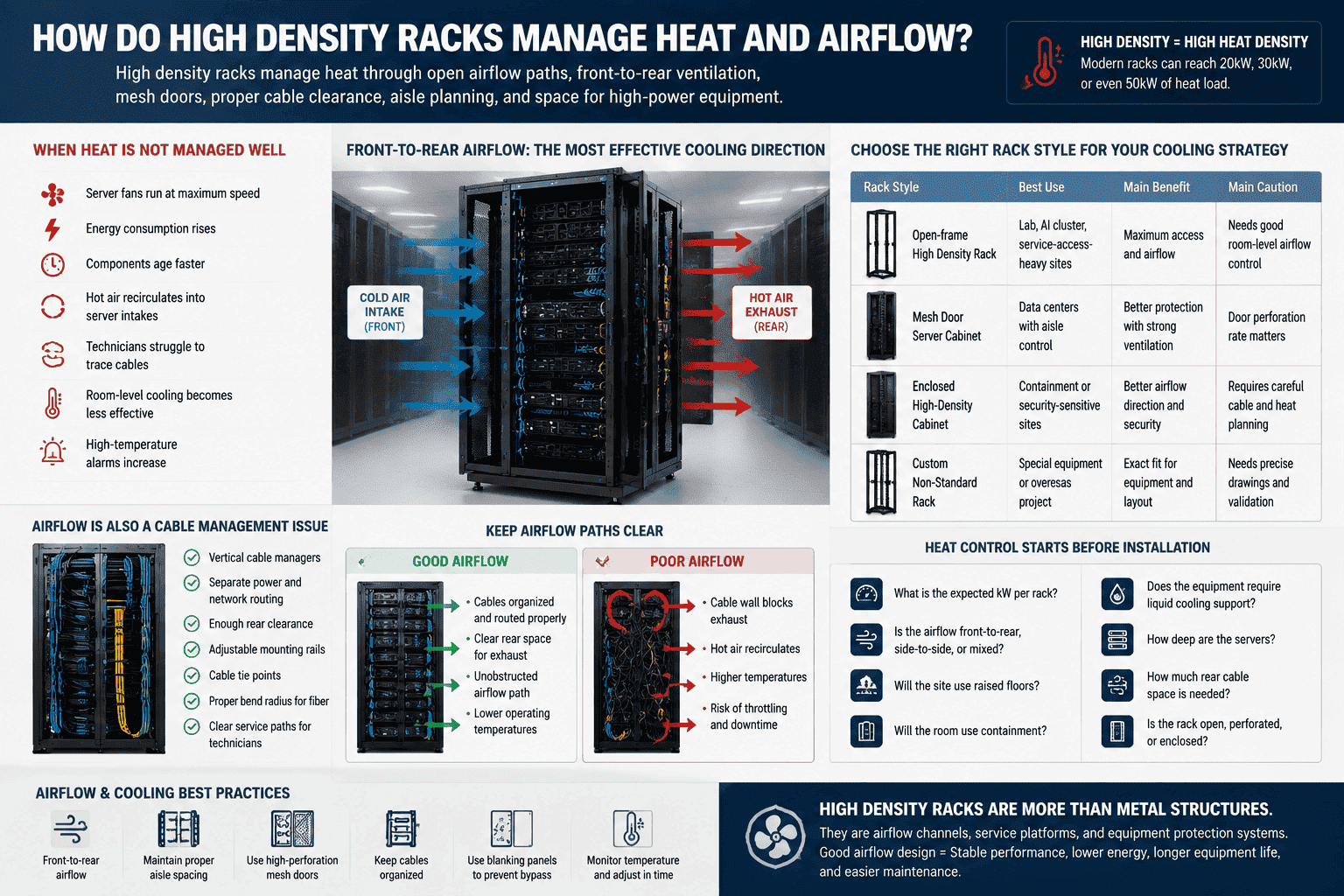
High density means high heat density
A traditional rack may consume a few kilowatts. A modern high-density rack can reach 20 kW, 30 kW, or even 50 kW depending on equipment type and cooling system. AI servers and GPU clusters are especially demanding because they produce heat continuously during training, inference, and data processing.4
That heat must move out of the rack quickly. If not, several problems appear:
- Server fans run at maximum speed
- Energy consumption rises
- Components age faster
- Hot air recirculates into server intakes
- Technicians struggle to trace cables
- Room-level cooling becomes less effective
- High-temperature alarms increase
Open rack, mesh door, or enclosed cabinet?
There is no single answer for every site. I choose the rack style based on the cooling strategy.
| Rack Style | Best Use | Main Benefit | Main Caution |
|---|---|---|---|
| Open-frame high density rack | Lab, AI cluster, service-access-heavy sites | Maximum access and airflow | Needs good room-level airflow control |
| Mesh door server cabinet | Data centers with aisle control | Better protection with strong ventilation | Door perforation rate matters |
| Enclosed high-density cabinet | Containment or security-sensitive sites | Better airflow direction and security | Requires careful cable and heat planning |
| Custom non-standard rack | Special equipment or overseas project | Exact fit for equipment and layout | Needs precise drawings and validation |
In many high-density projects, open-style racks are useful because they do not block airflow from the sides or rear. They also make it easier for workers to plug cables, replace devices, adjust rails, and inspect equipment. However, if the data center uses hot aisle and cold aisle containment, mesh doors or perforated doors may be better.5
Airflow is also a cable management issue
I often see airflow problems caused by cables, not by the rack frame itself. Dense servers require many connections. If the rear of the rack becomes a cable wall, hot air cannot exhaust smoothly.6
Good cable planning should include:
- Vertical cable managers
- Separate power and network routing
- Enough rear clearance
- Adjustable mounting rails
- Cable tie points
- Proper bend radius for fiber
- Clear service paths for technicians
Heat control starts before installation
The best cooling results happen when the rack, room, equipment, and power design work together. I always recommend checking these details before production:
- What is the expected kW per rack?
- Is the airflow front-to-rear, side-to-side, or mixed?
- Will the site use raised floors?
- Will the room use containment?
- Does the equipment require liquid cooling support?
- How deep are the servers?
- How much rear cable space is needed?
- Is the rack open, perforated, or enclosed?
High density racks are not only metal structures. They are airflow channels, service platforms, and equipment protection systems. If heat is not planned correctly, even the strongest rack cannot save the project.
Where Are High Density Racks Used Most Often?
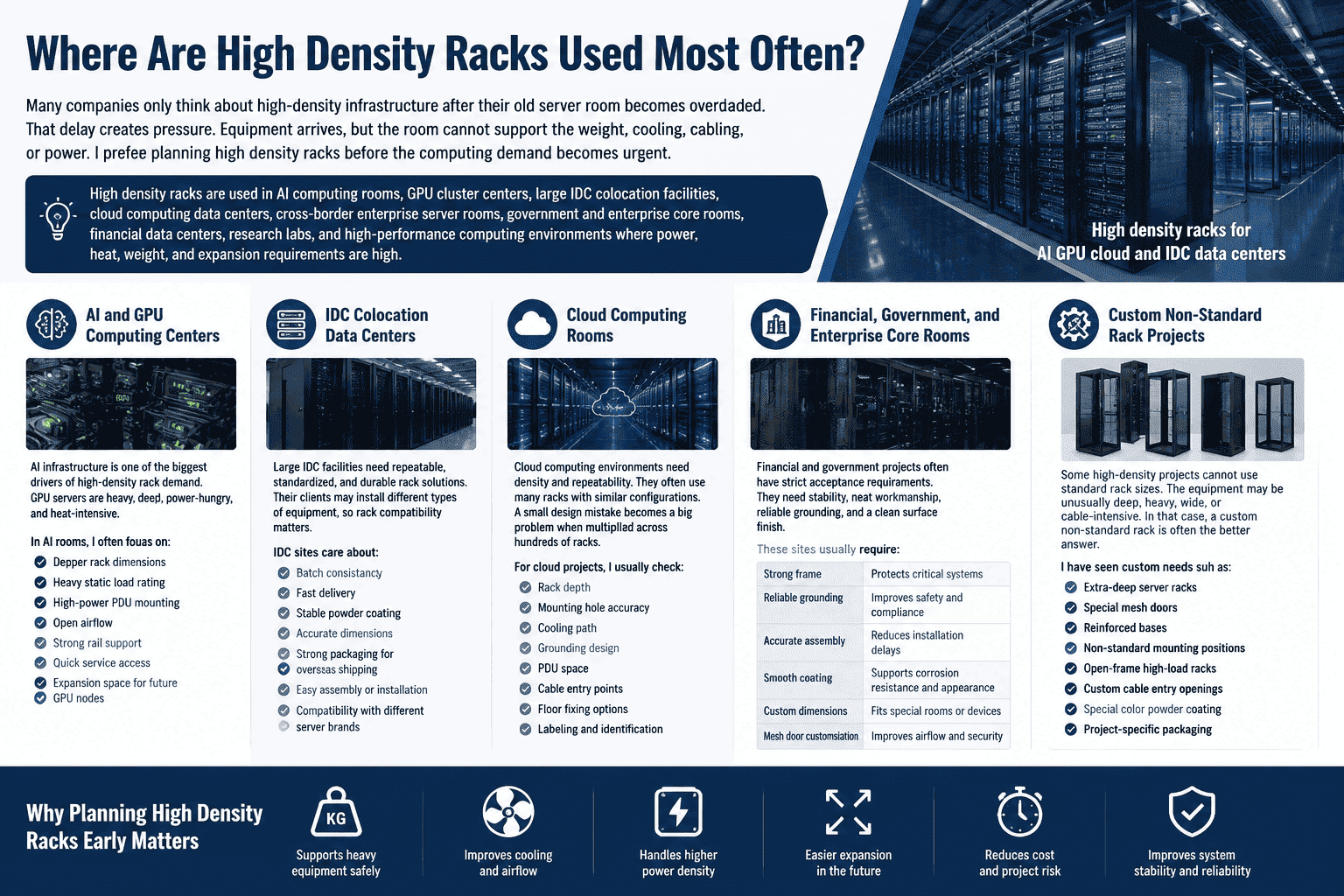
Many companies only think about high-density infrastructure after their old server room becomes overloaded. That delay creates pressure. Equipment arrives, but the room cannot support the weight, cooling, cabling, or power. I prefer planning high density racks before the computing demand becomes urgent.
High density racks are used in AI computing rooms, GPU cluster centers, large IDC colocation facilities, cloud computing data centers, cross-border enterprise server rooms, government and enterprise core rooms, financial data centers, research labs, and high-performance computing environments where power, heat, weight, and expansion requirements are high.
AI and GPU computing centers
AI infrastructure is one of the biggest drivers of high-density rack demand. GPU servers are heavy, deep, power-hungry, and heat-intensive. They need stable mounting, strong rear cable access, and excellent ventilation.
In AI rooms, I often focus on:
- Deeper rack dimensions
- Heavy static load rating
- High-power PDU mounting
- Open airflow
- Strong rail support
- Quick service access
- Expansion space for future GPU nodes
AI projects move fast. If the rack is not flexible, the client may need another round of modification after equipment arrives.
IDC colocation data centers
Large IDC facilities need repeatable, standardized, and durable rack solutions.7 Their clients may install different types of equipment, so rack compatibility matters. I usually recommend designs that follow the EIA-310 19-inch standard while allowing depth adjustment.
IDC sites care about:
- Batch consistency
- Fast delivery
- Stable powder coating
- Accurate dimensions
- Strong packaging for overseas shipping
- Easy assembly or installation
- Compatibility with different server brands
For overseas projects, packaging is also important. A rack may be strong, but poor packaging can damage corners, doors, rails, or coating during sea freight. I always treat export packaging as part of the product quality.
Cloud computing rooms
Cloud computing environments need density and repeatability. They often use many racks with similar configurations. A small design mistake becomes a big problem when multiplied across hundreds of racks.
For cloud projects, I usually check:
- Rack depth
- Mounting hole accuracy
- Cooling path
- Grounding design
- PDU space
- Cable entry points
- Floor fixing options
- Labeling and identification
Financial, government, and enterprise core rooms
Financial and government projects often have strict acceptance requirements.8 They need stability, neat workmanship, reliable grounding, and a clean surface finish. In these projects, I pay close attention to precision manufacturing and documentation.
These sites usually require:
| Requirement | Why It Matters |
|---|---|
| Strong frame | Protects critical systems |
| Reliable grounding | Improves safety and compliance |
| Accurate assembly | Reduces installation delays |
| Smooth coating | Supports corrosion resistance and appearance |
| Custom dimensions | Fits special rooms or devices |
| Mesh door customization | Improves airflow and security |
Custom non-standard rack projects
Some high-density projects cannot use standard rack sizes. The equipment may be unusually deep, heavy, wide, or cable-intensive. In that case, a custom non-standard rack is often the better answer.
I have seen custom needs such as:
- Extra-deep server racks
- Special mesh doors
- Reinforced bases
- Non-standard mounting positions
- Open-frame high-load racks
- Custom cable entry openings
- Special color powder coating
- Project-specific packaging
This is where manufacturing experience matters. A custom rack must not only fit the drawing. It must also survive real operation.
How Should I Choose High Density Racks For A Modern Data Center?
Choosing the wrong rack can create long-term operating problems. The price difference may look small at the purchasing stage, but the cost of overheating, downtime, deformation, or failed inspection is much higher. I always recommend selecting high density racks based on the equipment load, power density, cooling method, depth, and future expansion plan.
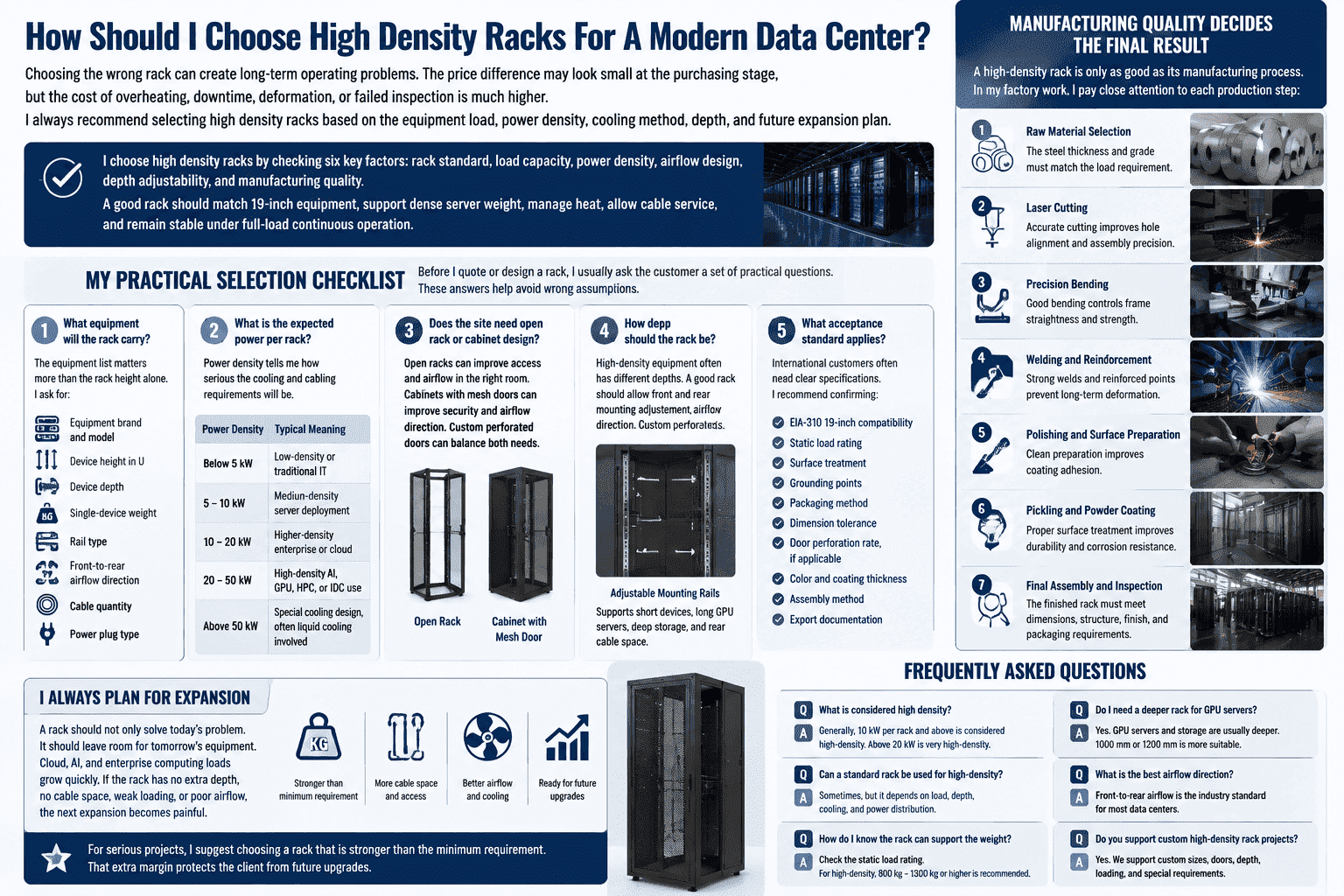
I choose high density racks by checking six key factors: rack standard, load capacity, power density, airflow design, depth adjustability, and manufacturing quality. A good rack should match 19-inch equipment, support dense server weight, manage heat, allow cable service, and remain stable under full-load continuous operation.
My practical selection checklist
Before I quote or design a rack, I usually ask the customer a set of practical questions. These answers help avoid wrong assumptions.
1. What equipment will the rack carry?
The equipment list matters more than the rack height alone. A 42U rack filled with light switches is very different from a 42U rack filled with GPU servers.
I ask for:
- Equipment brand and model
- Device height in U
- Device depth
- Single-device weight
- Rail type
- Front-to-rear airflow direction
- Cable quantity
- Power plug type
2. What is the expected power per rack?
Power density tells me how serious the cooling and cabling requirements will be. A 5 kW rack and a 30 kW rack should not be treated the same.9
Common ranges include:
| Power Density | Typical Meaning |
|---|---|
| Below 5 kW | Low-density or traditional IT |
| 5–10 kW | Medium-density server deployment |
| 10–20 kW | Higher-density enterprise or cloud |
| 20–50 kW | High-density AI, GPU, HPC, or IDC use |
| [Above 50 kW | Special cooling design, often liquid cooling involved](https://datacenters.lbl.gov/liquid-cooling)%%%FOOTNOTE_REF_10%%% |
3. Does the site need open rack or cabinet design?
Open racks can improve access and airflow in the right room. Cabinets with mesh doors can improve security and airflow direction. Custom perforated doors can balance both needs. I do not choose based on appearance only. I choose based on the cooling strategy.
4. How deep should the rack be?
High-density equipment often has different depths. A good rack should allow front and rear mounting adjustment. This is important when one rack must support short devices, long GPU servers, deep storage, and rear cable space.
5. What acceptance standard applies?
International customers often need clear specifications. I recommend confirming:
- EIA-310 19-inch compatibility
- Static load rating
- Surface treatment
- Grounding points
- Packaging method
- Dimension tolerance
- Door perforation rate, if applicable
- Color and coating thickness
- Assembly method
- Export documentation
Manufacturing quality decides the final result
A high-density rack is only as good as its manufacturing process. In my factory work, I pay close attention to each production step:
-
Raw material selection
The steel thickness and grade must match the load requirement. -
Laser cutting
Accurate cutting improves hole alignment and assembly precision. -
Precision bending
Good bending controls frame straightness and strength. -
Welding and reinforcement
Strong welds and reinforced points prevent long-term deformation. -
Polishing and surface preparation
Clean preparation improves coating adhesion. -
Pickling and powder coating
Proper surface treatment improves durability and corrosion resistance. -
Final assembly and inspection
The finished rack must meet dimensions, structure, finish, and packaging requirements.
I always plan for expansion
A rack should not only solve today’s problem. It should leave room for tomorrow’s equipment. Cloud, AI, and enterprise computing loads grow quickly. If the rack has no extra depth, no cable space, weak loading, or poor airflow, the next expansion becomes painful.
For serious projects, I suggest choosing a rack that is stronger than the minimum requirement. That extra margin protects the client from future upgrades.
Frequently Asked Questions
Are high density racks the same as server cabinets?
High density racks can be open-frame racks or enclosed server cabinets. I use the term for any rack system designed for dense IT loads, higher power, strong airflow, and heavy equipment. A cabinet adds doors and side panels, while an open rack gives maximum access and ventilation.
What power level counts as high density?
I usually consider a rack high density when it goes beyond traditional power levels and reaches around 10–20 kW or more. Many AI, GPU, cloud, and IDC projects require 20–50 kW per rack, which demands stronger cooling, cabling, and structural design.
Can I use a standard rack for GPU servers?
I do not recommend using a standard low-density rack for heavy GPU servers unless the load, depth, airflow, and rail support are fully verified. GPU servers are often heavy, deep, and hot. A reinforced high-density rack is safer for long-term full-load operation.
Why is rack depth important?
Rack depth matters because high-density servers can be much longer than traditional equipment. Extra depth allows proper rail installation, rear cable bending, PDU mounting, and airflow clearance. If the rack is too shallow, installation and maintenance become difficult.
Do high density racks need mesh doors?
Some high density racks need mesh doors, but not all. If the data center uses aisle containment or needs equipment protection, mesh doors are useful. If the site needs maximum access and open airflow, an open-frame rack may be better.
Conclusion
High density racks are the foundation of modern high-computing infrastructure. I use them when ordinary racks cannot handle dense servers, heavy GPU equipment, high heat, higher power, complex cabling, and future expansion. The best rack is not only strong. It must also support airflow, precision installation, maintenance access, and long-term stability. If you need standard server racks, custom non-standard racks, reinforced high-load structures, or custom mesh doors for overseas data center projects, contact us and I can help you build the right rack from the source factory.
"Uptime Institute Global Data Center Survey 2024", https://datacenter.uptimeinstitute.com/rs/711-RIA-145/images/2024.GlobalDataCenterSurvey.Report.pdf. Rack-density surveys and data center engineering guidance describe high-density deployments reaching tens of kilowatts per rack, which supports the stated 20–50 kW range as a plausible high-density operating band. Evidence role: statistic; source type: institution. Supports: A neutral technical or industry source should show that high-density data center deployments may fall in the 20–50 kW per rack range.. Scope note: Reported ranges vary by facility type, cooling architecture, and server generation, so the source would contextualize rather than prove every rack in this category operates at that level. ↩
"ASHRAE Thermal Guidelines", https://datacenters.lbl.gov/sites/default/files/ASHRAE%20Thermal%20Guidelines_%20SVLG%202015.pdf. Thermal guidelines for data processing environments state that server inlet temperature and airflow management are critical to reliable operation, supporting the claim that obstructed airflow can lead to throttling, shutdown, or reduced equipment life. Evidence role: mechanism; source type: institution. Supports: A thermal engineering source should explain that inadequate airflow and elevated inlet temperatures can reduce performance, trigger protective shutdowns, or affect reliability.. Scope note: Thermal guidelines establish the mechanism and risk; they may not quantify failure probability for the specific rack design discussed in the article. ↩
"19-inch rack", https://en.wikipedia.org/wiki/19-inch_rack. The EIA-310 standard is commonly cited for dimensional requirements of 19-inch rack-mounted equipment, including rack width and mounting features relevant to server installation. Evidence role: definition; source type: institution. Supports: A standards or reference source should confirm that EIA-310 specifies key dimensions for 19-inch rack-mounted equipment.. ↩
"Measurement of Generative AI Workload Power Profiles for Whole ...", https://arxiv.org/html/2604.07345v1. Research on AI accelerator and GPU-based workloads shows that training and inference can draw substantial sustained electrical power, which provides the thermal basis for describing AI and GPU clusters as demanding high-heat rack loads. Evidence role: mechanism; source type: paper. Supports: A research paper should show that GPU-accelerated AI workloads consume substantial electrical power, which is converted largely into heat that must be removed by cooling systems.. Scope note: The source would support the workload-to-heat mechanism generally, not the exact heat output of every AI server configuration. ↩
"Move to a Hot Aisle/Cold Aisle Layout", https://www.energystar.gov/products/data_center_equipment/16-more-ways-cut-energy-waste-data-center/move-hot-aislecold-aisle-layout. Data center airflow-management guidance describes hot-aisle/cold-aisle containment as a method for separating supply and return air, and notes that cabinet airflow openings must be compatible with that strategy. Evidence role: expert_consensus; source type: government. Supports: A government or engineering best-practice source should explain that rack airflow design, perforated doors, and aisle containment interact in controlling hot and cold air streams.. Scope note: This supports the airflow-management rationale, while the best door choice still depends on site-specific pressure, containment, security, and equipment requirements. ↩
"Data Center Airflow Management Retrofit", https://datacenters.lbl.gov/sites/default/files/airflow-doe-femp.pdf. Data center airflow-management guidance identifies physical obstructions, including poorly managed cabling, as factors that can restrict airflow paths and reduce the effectiveness of rack cooling. Evidence role: mechanism; source type: institution. Supports: A technical source should support that cable congestion can impede airflow and contribute to thermal management problems in server racks.. Scope note: The source supports the mechanism generally and does not assess the cabling arrangement in a particular installation. ↩
"Open Compute Project", https://en.wikipedia.org/wiki/Open_Compute_Project. Research and institutional discussions of large-scale data center design describe standardization and modularity as common methods for improving deployment consistency and operational scalability. Evidence role: general_support; source type: research. Supports: A neutral research or institutional source should show that large data centers often use standardized and modular infrastructure to improve deployment, maintenance, and scalability.. Scope note: This supports the general design principle and does not prove that every IDC facility requires the same rack specification. ↩
"Cybersecurity and privacy | NIST", https://www.nist.gov/cybersecurity-and-privacy. Government information-system standards and resilience guidance establish formal controls for security, availability, and infrastructure management, providing context for stricter acceptance expectations in government and regulated data center projects. Evidence role: historical_context; source type: government. Supports: A government or regulatory source should demonstrate that government and regulated-sector IT facilities are subject to formal security, resilience, or compliance controls.. Scope note: The source would support the regulatory context, not the author’s specific manufacturing or inspection checklist. ↩
"2024 United States Data Center Energy Usage Report", https://eta-publications.lbl.gov/sites/default/files/2024-12/lbnl-2024-united-states-data-center-energy-usage-report_1.pdf. Data center thermal-design guidance treats rack electrical power as a principal driver of heat load and cooling requirements, supporting the distinction between low-power racks and racks drawing tens of kilowatts. Evidence role: mechanism; source type: institution. Supports: A technical data center source should explain that cooling design depends on rack heat load, which is closely related to electrical power draw.. Scope note: The source supports the engineering principle; exact design thresholds depend on local cooling architecture and equipment airflow. ↩
"Liquid Cooling | Center of Expertise for Data Center Efficiency", https://datacenters.lbl.gov/liquid-cooling. Thermal-management guidance for high-density data centers describes liquid and hybrid cooling as important options when rack heat loads rise beyond the practical capacity of conventional air-cooling approaches. Evidence role: expert_consensus; source type: institution. Supports: A data center thermal guidance source should show that very high rack densities can exceed practical air-cooling limits and motivate liquid or hybrid cooling approaches.. Scope note: The 50 kW figure should be treated as a contextual planning threshold rather than a universal cutoff, because air-cooling feasibility depends on airflow rate, temperature targets, containment, and equipment design. ↩
