
Custom Rackmount Enclosures: What Should I Customize First?
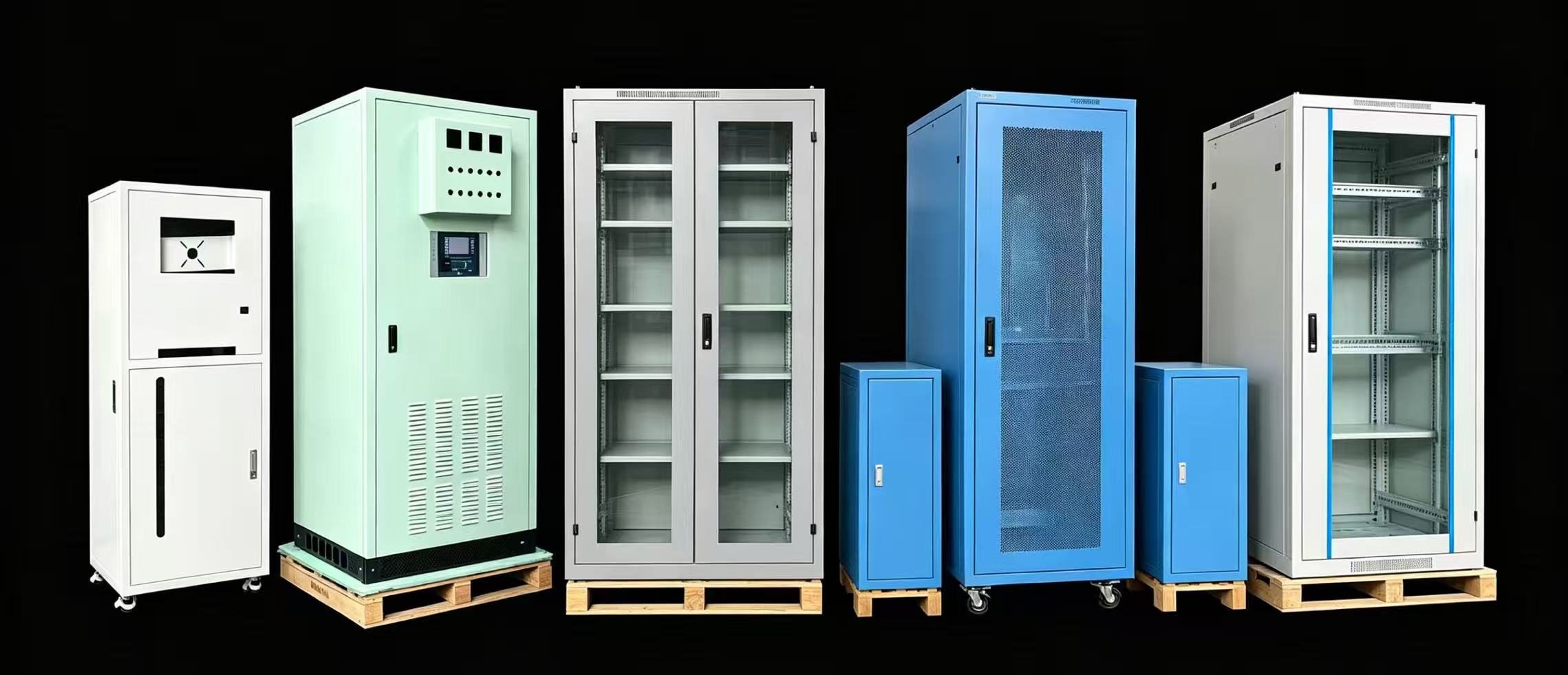
Standard racks look simple. But when devices do not fit, projects slow down. I use custom rackmount enclosures to remove that pain.
Custom rackmount enclosures should be customized by internal layout, rack size, material, holes, doors, panels, load structure, shipping design, and maintenance access. I choose these details based on device type, site space, use environment, and long-term service needs.
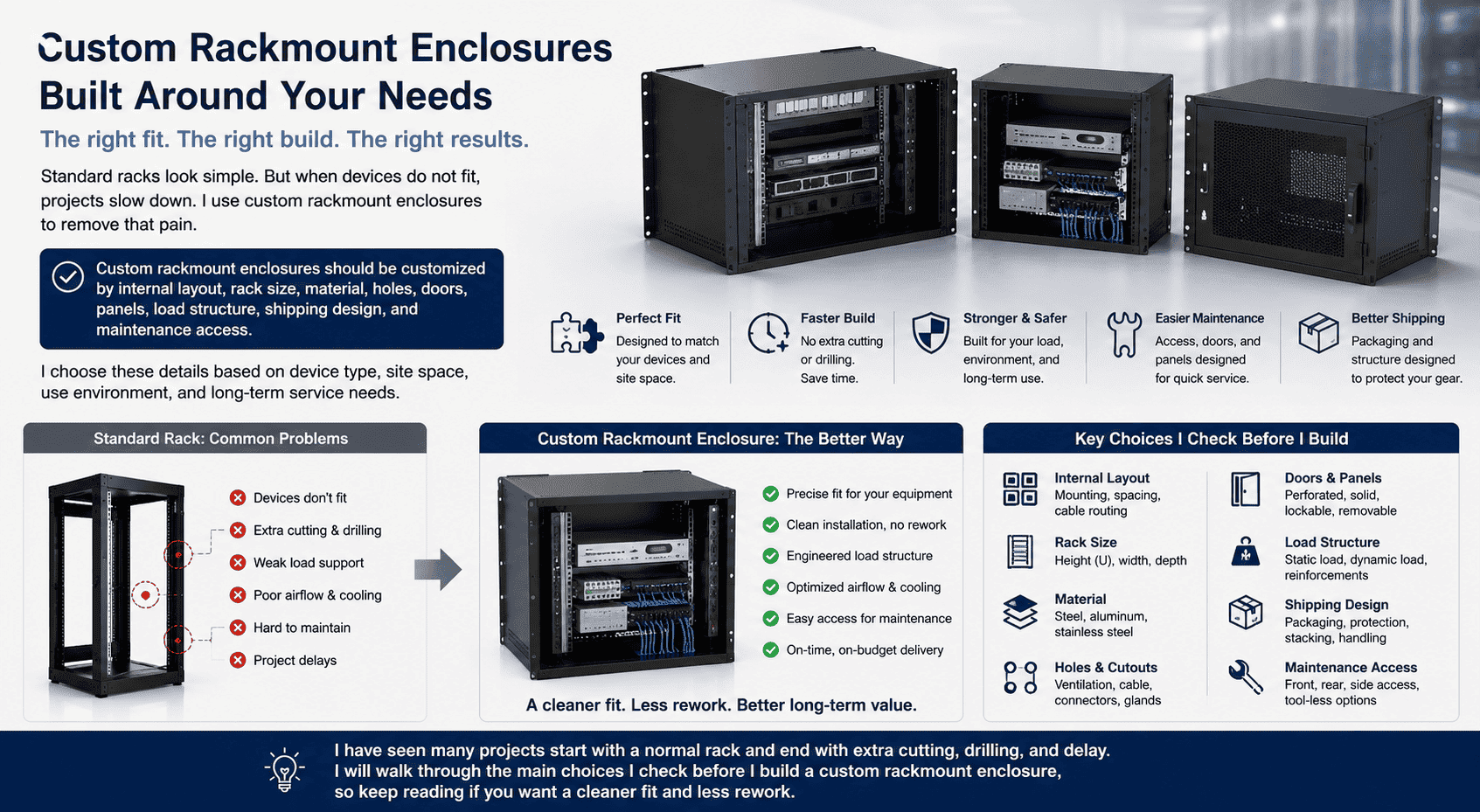
I have seen many projects start with a normal rack and end with extra cutting, drilling, and delay. I will walk through the main choices I check before I build a custom rackmount enclosure, so keep reading if you want a cleaner fit and less rework.
Why Do Standard Rack Sizes Fail in Real Projects?
A standard rack can look safe at first. But I see trouble when the inside space, cable path, or site layout does not match the equipment.
A standard rack size is best for common network and server devices. I choose a custom rackmount enclosure when the device layout, mounting style, cooling path, cable entry, or installation site needs a more exact structure.
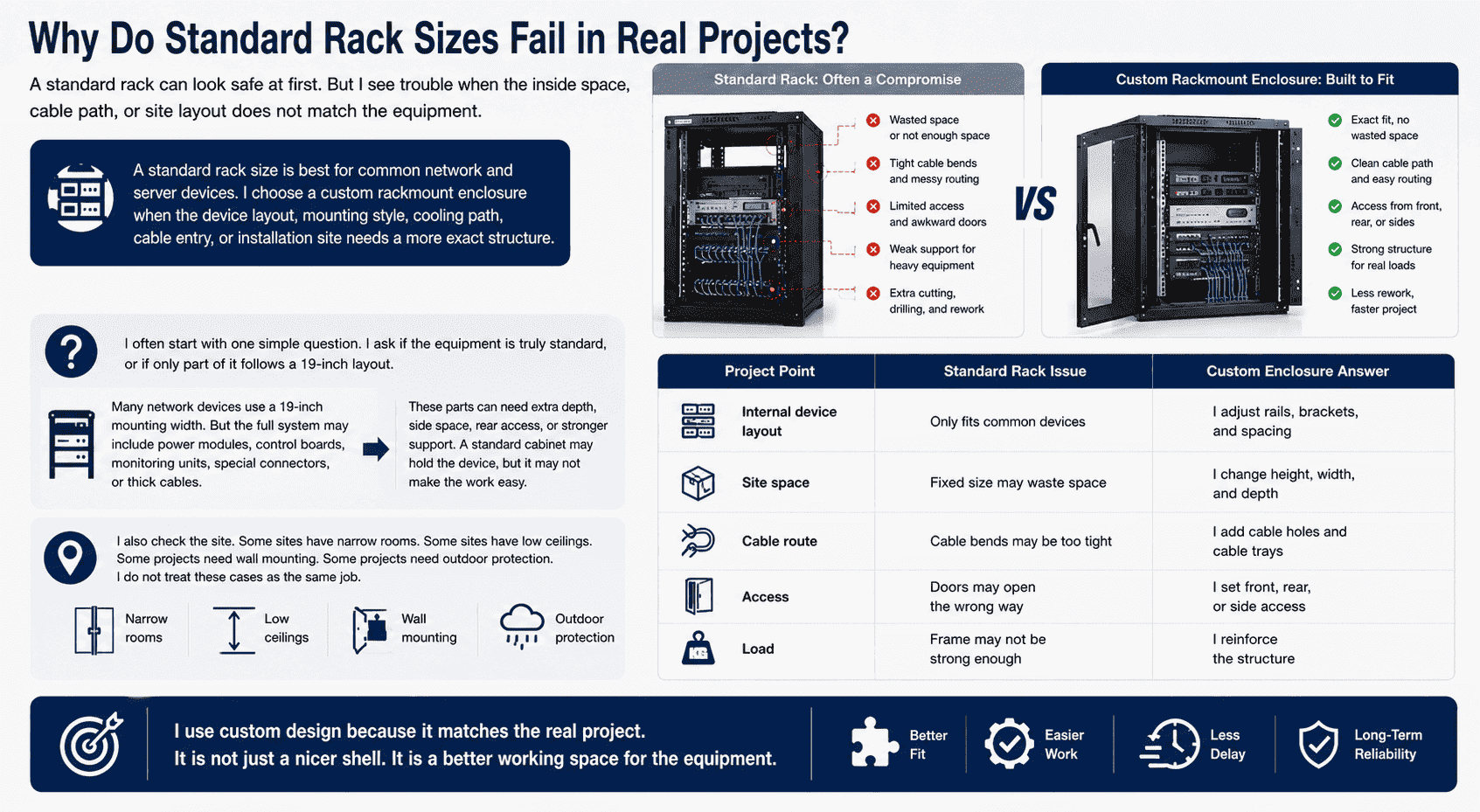
I often start with one simple question. I ask if the equipment is truly standard, or if only part of it follows a 19-inch layout. Many network devices use a 19-inch mounting width.1 But the full system may include power modules, control boards, monitoring units, special connectors, or thick cables. These parts can need extra depth, side space, rear access, or stronger support2. A standard cabinet may hold the device, but it may not make the work easy.
I also check the site. Some sites have narrow rooms. Some sites have low ceilings. Some projects need wall mounting. Some projects need outdoor protection. I do not treat these cases as the same job.
| Project point | Standard rack issue | Custom enclosure answer |
|---|---|---|
| Internal device layout | Only fits common devices | I adjust rails, brackets, and spacing |
| Site space | Fixed size may waste space | I change height, width, and depth |
| Cable route | Cable bends may be too tight3 | I add cable holes and cable trays |
| Access | Doors may open the wrong way | I set front, rear, or side access |
| Load | Frame may not be strong enough | I reinforce the structure |
I use custom design because it matches the real project. It is not just a nicer shell. It is a better working space for the equipment.
How Can I Customize the Internal Structure?
A nice outside shell can still fail inside. I see this problem when brackets, rails, and supports do not match the device.
I customize the internal structure by changing the rack frame, mounting rails, support bars, trays, cable channels, fan positions, and load-bearing points. The inside can be a standard 19-inch rack or a non-standard structure.
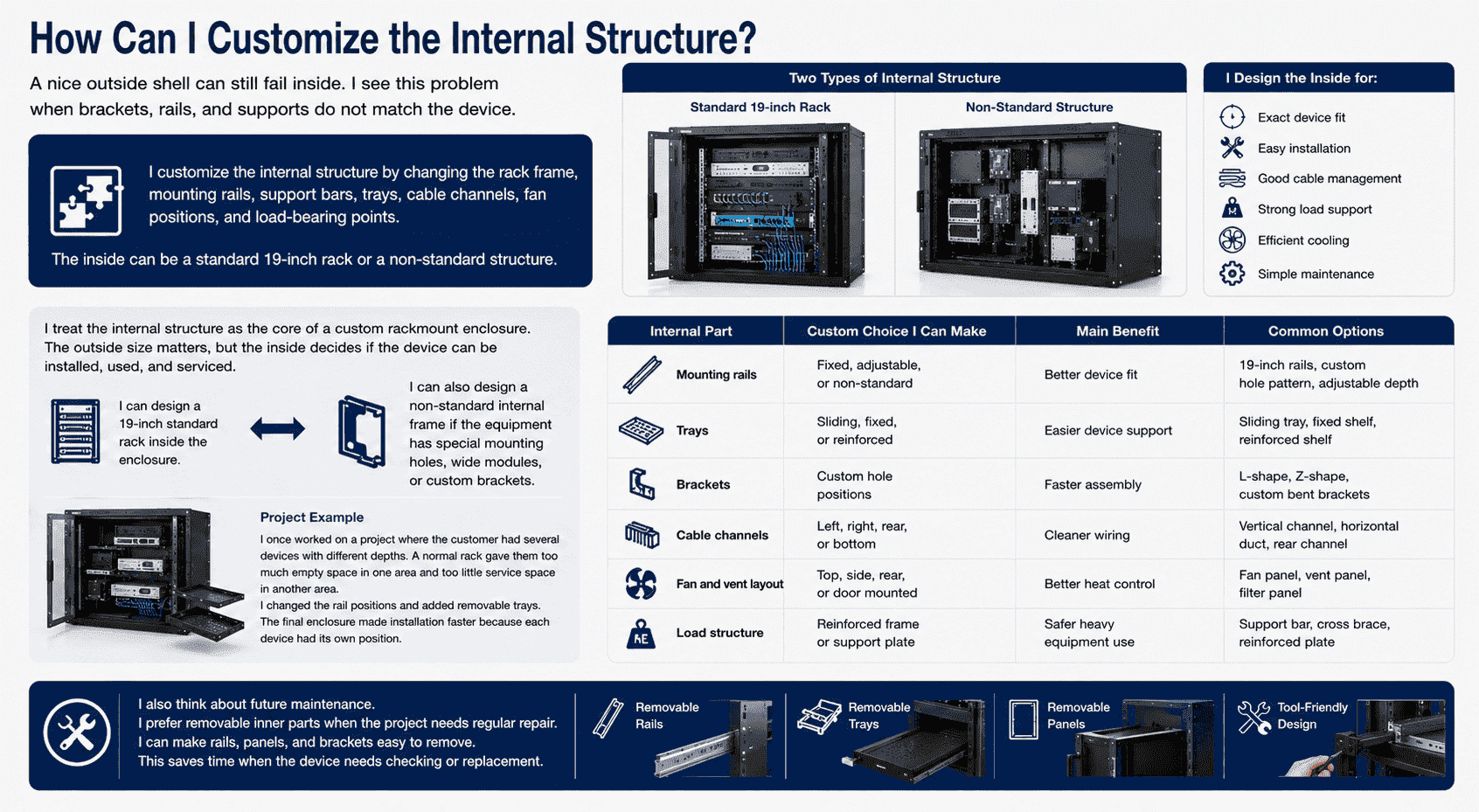
I treat the internal structure as the core of a custom rackmount enclosure. The outside size matters, but the inside decides if the device can be installed, used, and serviced. I can design a 19-inch standard rack inside the enclosure. I can also design a non-standard internal frame if the equipment has special mounting holes, wide modules, or custom brackets.
I once worked on a project where the customer had several devices with different depths. A normal rack gave them too much empty space in one area and too little service space in another area. I changed the rail positions and added removable trays. The final enclosure made installation faster because each device had its own position.
| Internal part | Custom choice I can make | Main benefit |
|---|---|---|
| Mounting rails | Fixed, adjustable, or non-standard | Better device fit |
| Trays | Sliding, fixed, or reinforced | Easier device support |
| Brackets | Custom hole positions | Faster assembly |
| Cable channels | Left, right, rear, or bottom | Cleaner wiring |
| Fan and vent layout | Top, side, rear, or door mounted | Better heat control4 |
| Load structure | Reinforced frame or support plate | Safer heavy equipment use |
I also think about future maintenance. I prefer removable inner parts when the project needs regular repair. I can make rails, panels, and brackets easy to remove. This saves time when the device needs checking or replacement.
Which Materials and Surface Treatments Should I Choose?
A wrong material can make a good design weak. I see this risk when the site has moisture, salt air, dust, or heavy use.
I choose materials based on strength, weight, cost, and environment. Common options include cold-rolled steel, stainless steel, galvanized steel, and aluminum alloy, with surface treatments such as powder coating, anti-rust coating, and anti-corrosion protection.
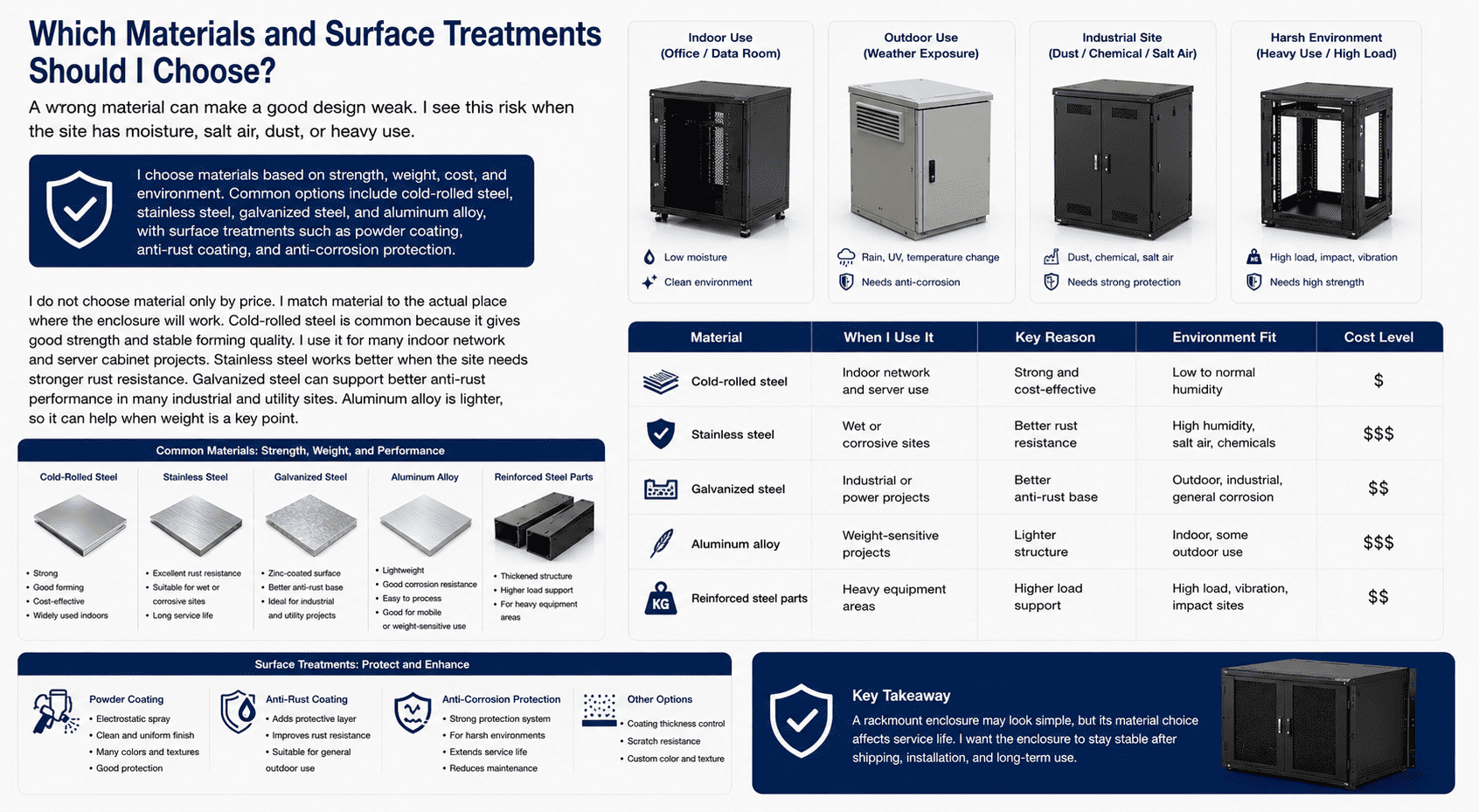
I do not choose material only by price. I match material to the actual place where the enclosure will work. Cold-rolled steel is common because it gives good strength and stable forming quality.5 I use it for many indoor network and server cabinet projects. Stainless steel works better when the site needs stronger rust resistance.6 Galvanized steel can support better anti-rust performance in many industrial and utility sites.7 Aluminum alloy is lighter, so it can help when weight is a key point.8
Surface treatment also matters. Electrostatic powder coating gives a clean look and a protective layer.9 It also helps the enclosure match the color and finish that the customer wants. For outdoor or wet use, I check anti-rust and anti-corrosion needs more carefully.
| Material | When I use it | Key reason |
|---|---|---|
| Cold-rolled steel | Indoor network and server use | Strong and cost-effective |
| Stainless steel | Wet or corrosive sites | Better rust resistance |
| Galvanized steel | Industrial or power projects | Better anti-rust base |
| Aluminum alloy | Weight-sensitive projects | Lighter structure |
| Reinforced steel parts | Heavy equipment areas | Higher load support |
I also consider coating thickness, color, texture, and scratch resistance. A rackmount enclosure may look simple, but its material choice affects service life. I want the enclosure to stay stable after shipping, installation, and daily use.
How Do Custom Holes and Panels Improve Equipment Use?
Small hole errors can create big site problems. I see this often when cable plugs, switches, fans, and screens do not line up.
Custom holes and panels improve equipment use by placing openings, vents, ports, switches, and display windows in the exact positions needed. I can set hole size, hole shape, spacing, and panel layout to match each device.
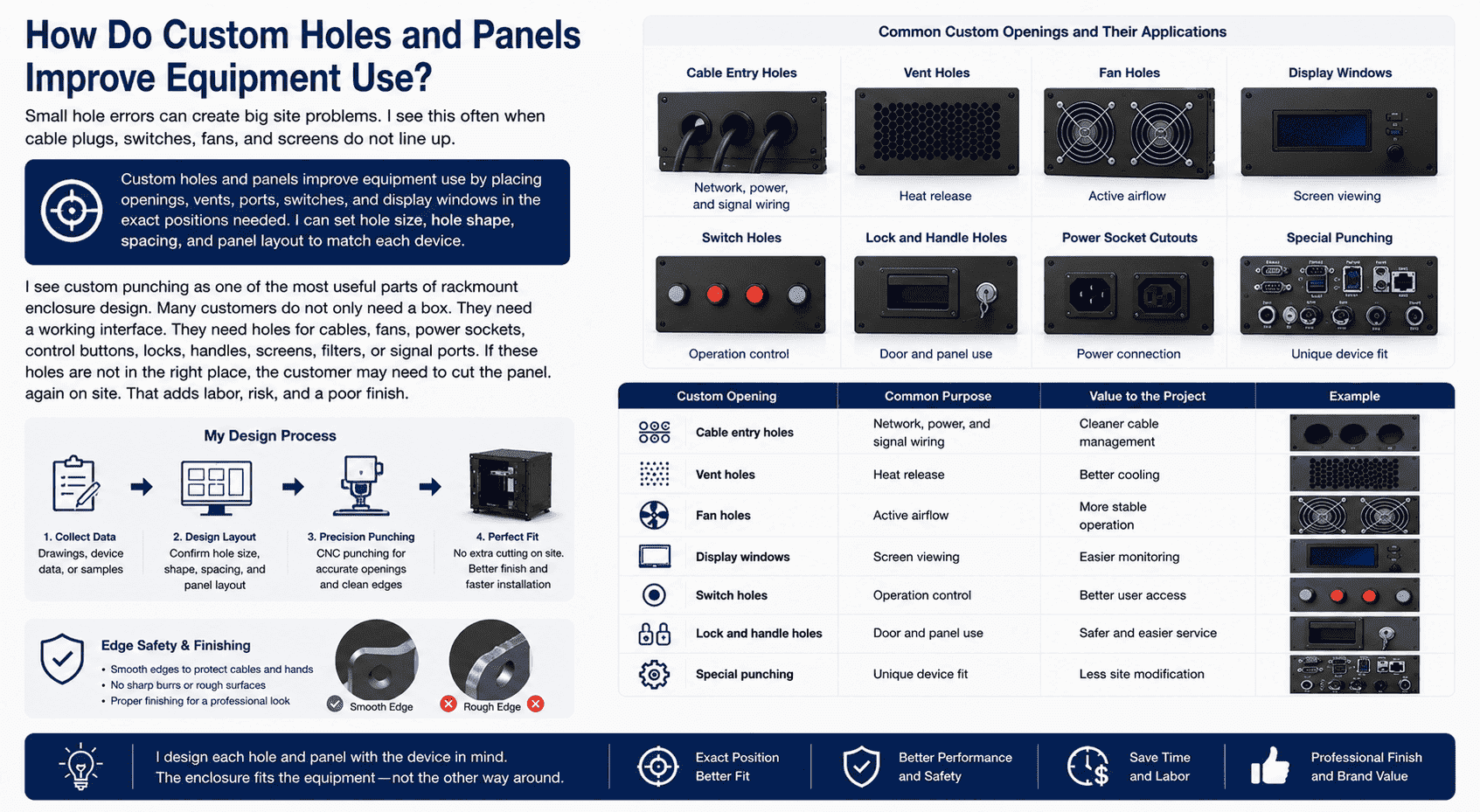
I see custom punching as one of the most useful parts of rackmount enclosure design. Many customers do not only need a box. They need a working interface. They need holes for cables, fans, power sockets, control buttons, locks, handles, screens, filters, or signal ports. If these holes are not in the right place, the customer may need to cut the panel again on site. That adds labor, risk, and a poor finish.
I can design the hole position before production. I can use drawings, device data, or samples to confirm the opening size. I can also add special punching for ventilation, heat release, wire routing, and mounting.
| Custom opening | Common purpose | Value to the project |
|---|---|---|
| Cable entry holes | Network, power, and signal wiring | Cleaner cable management |
| Vent holes | Heat release | Better cooling |
| Fan holes | Active airflow | More stable operation |
| Display windows | Screen viewing | Easier monitoring |
| Switch holes | Operation control | Better user access |
| Lock and handle holes | Door and panel use | Safer and easier service |
| Special punching | Unique device fit | Less site modification |
I also think about edge safety. I prefer smooth edges and proper finishing, so cables and hands do not get damaged10. I treat custom holes as part of the professional value. They make the enclosure match the device, not the other way around.
Can a Knock-Down Rackmount Enclosure Cut Shipping and Maintenance Costs?
Shipping a large welded cabinet can be expensive. I see cost rise fast when volume is high and the enclosure cannot be packed flat.
A knock-down rackmount enclosure can reduce shipping cost and maintenance time because panels, doors, covers, brackets, and frames can be removed, packed, assembled, and replaced more easily.
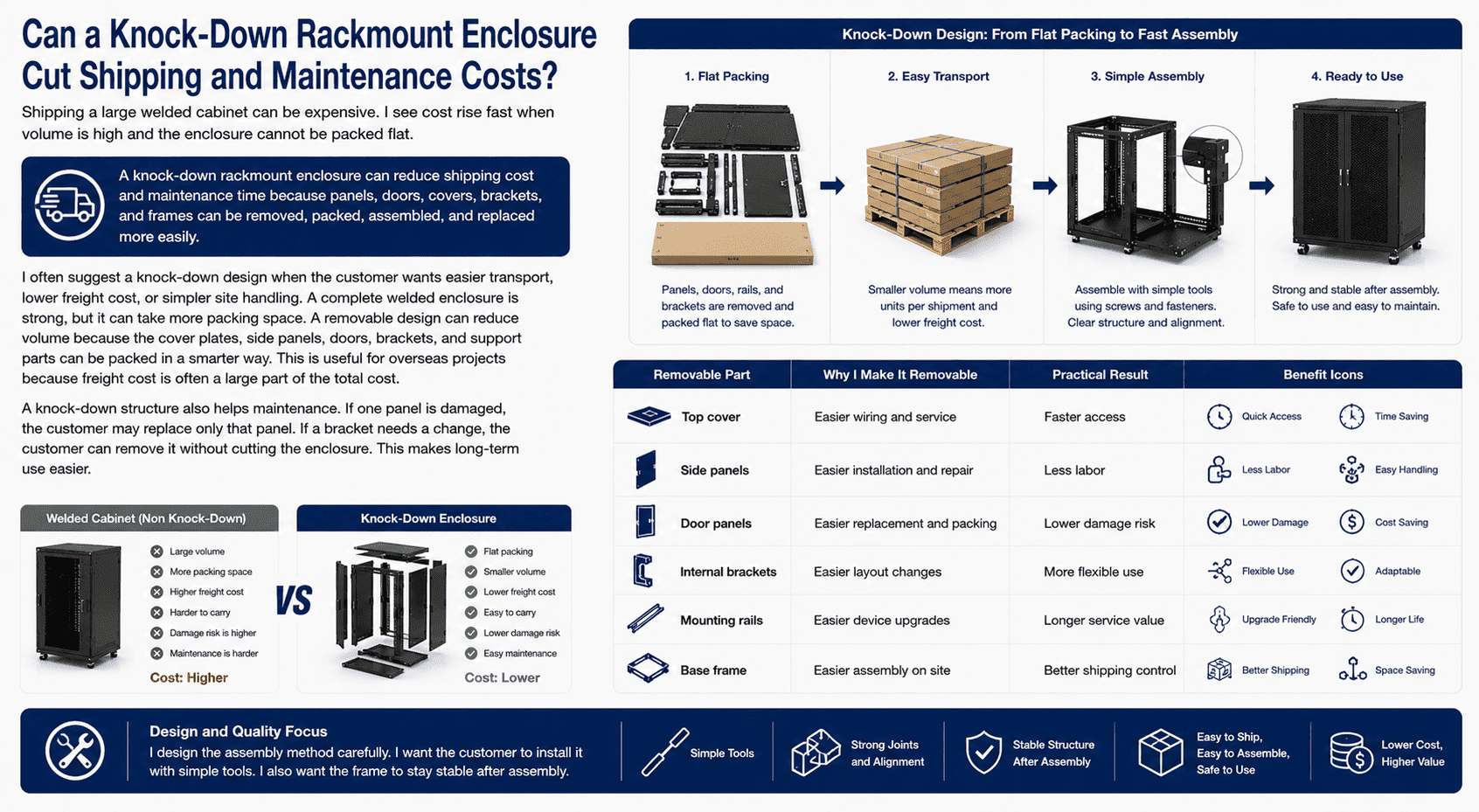
I often suggest a knock-down design when the customer wants easier transport, lower freight cost, or simpler site handling. A complete welded enclosure is strong, but it can take more packing space. A removable design can reduce volume11 because the cover plates, side panels, doors, brackets, and support parts can be packed in a smarter way. This is useful for overseas projects because freight cost is often a large part of the total cost.
A knock-down structure also helps maintenance. If one panel is damaged, the customer may replace only that panel. If a bracket needs a change, the customer can remove it without cutting the enclosure. This makes long-term use easier.
| Removable part | Why I make it removable | Practical result |
|---|---|---|
| Top cover | Easier wiring and service | Faster access |
| Side panels | Easier installation and repair | Less labor |
| Door panels | Easier replacement and packing | Lower damage risk |
| Internal brackets | Easier layout changes | More flexible use |
| Mounting rails | Easier device upgrades | Longer service value |
| Base frame | Easier assembly on site | Better shipping control |
I design the assembly method carefully. I want the customer to install it with simple tools. I also want the frame to stay stable after assembly. I pay attention to screw positions, joint strength, and alignment. A good knock-down design should not feel loose. It should be easy to ship, easy to assemble, and safe to use.
What Should I Check Before Production Starts?
A custom enclosure can go wrong if the design data is unclear. I avoid this by checking key points before cutting metal.
Before production starts, I check equipment size, mounting method, load, material, surface finish, door type, hole layout, cooling method, cable entry, packing method, and installation environment.
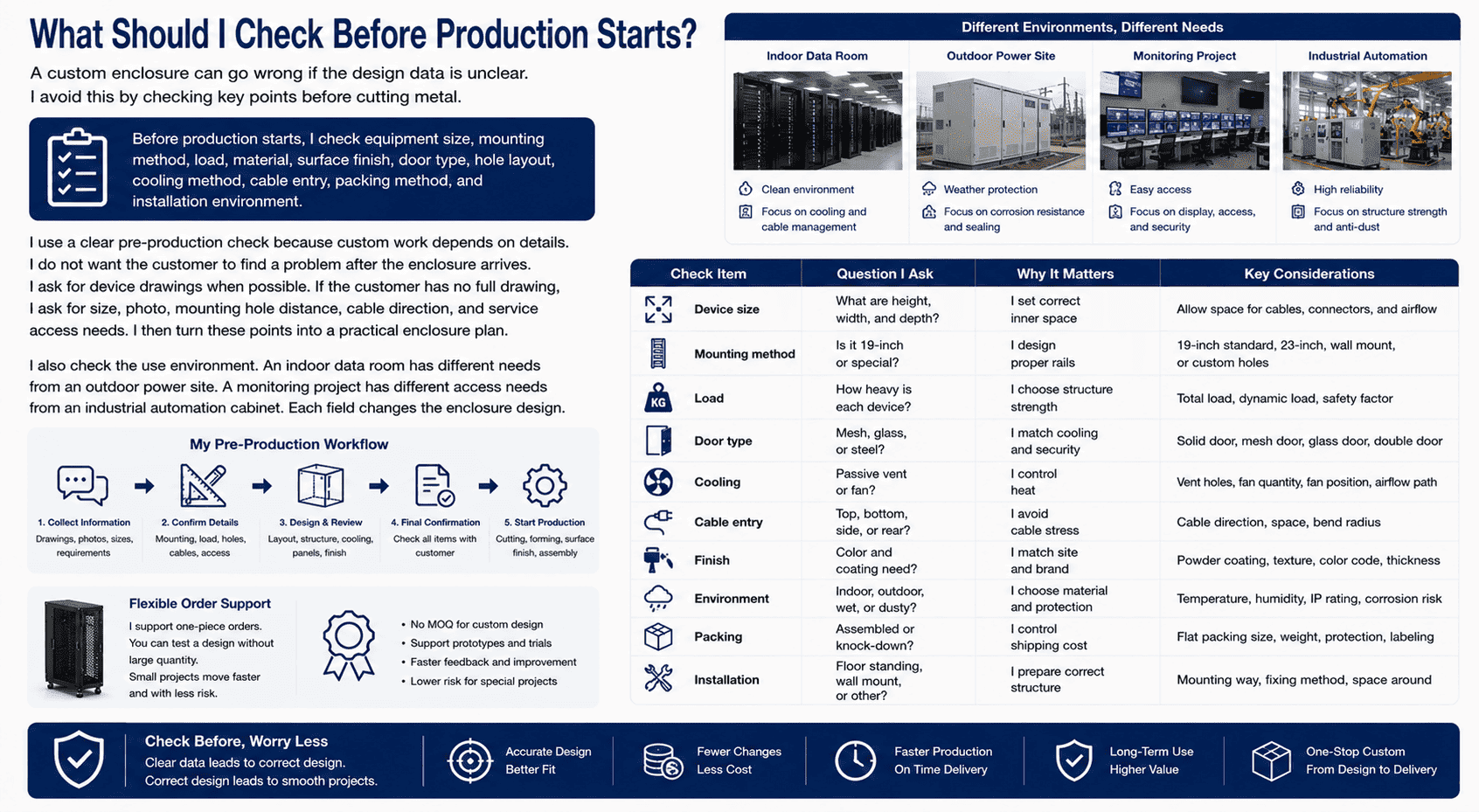
I use a clear pre-production check because custom work depends on details. I do not want the customer to find a problem after the enclosure arrives. I ask for device drawings when possible. If the customer has no full drawing, I ask for size, photo, mounting hole distance, cable direction, and service access needs. I then turn these points into a practical enclosure plan.
I also check the use environment. An indoor data room has different needs from an outdoor power site.12 A monitoring project has different access needs from an industrial automation cabinet. Each field changes the enclosure design.
| Check item | Question I ask | Why it matters |
|---|---|---|
| Device size | What are height, width, and depth? | I set correct inner space |
| Mounting method | Is it 19-inch or special? | I design proper rails |
| Load | How heavy is each device? | I choose structure strength |
| Door type | Mesh, glass, or steel? | I match cooling and security |
| Cooling | Passive vent or fan? | I control heat |
| Cable entry | Top, bottom, side, or rear? | I avoid cable stress |
| Finish | Color and coating need? | I match site and brand |
| Environment | Indoor, outdoor, wet, or dusty? | I choose material and protection |
| Packing | Assembled or knock-down? | I control shipping cost |
I also confirm quantity. I support one-piece orders, so the customer does not need to order a large batch just to test a design. This helps small projects and special projects move faster.
Why Is No MOQ Important for Custom Rackmount Enclosures?
A project can be blocked by high order quantity. I see many customers need one special enclosure before they need a full batch.
No MOQ is important because custom rackmount enclosures often serve special projects, samples, repairs, or small-batch systems. I can support orders starting from one piece, so customers can test the design first.
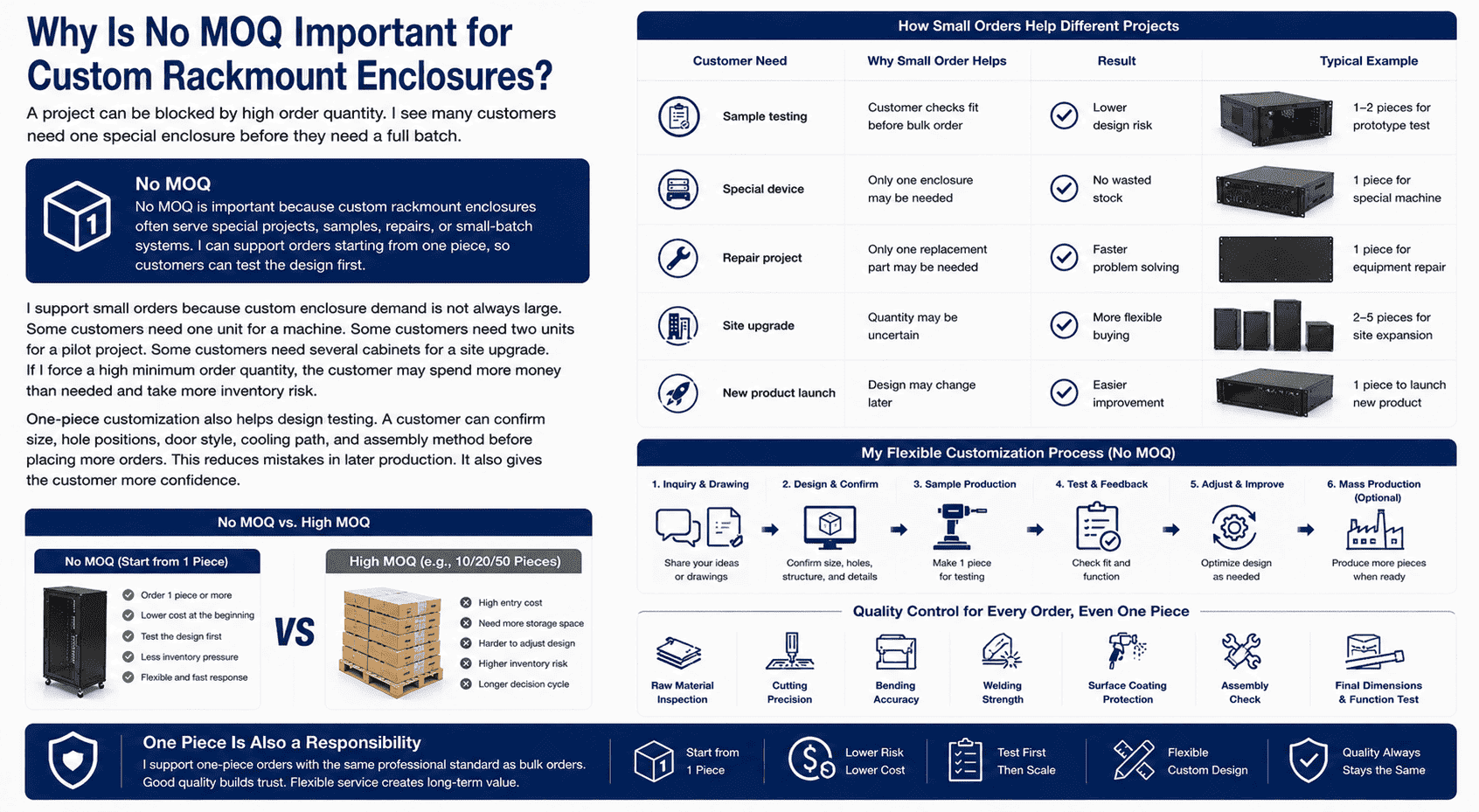
I support small orders because custom enclosure demand is not always large. Some customers need one unit for a machine. Some customers need two units for a pilot project. Some customers need several cabinets for a site upgrade. If I force a high minimum order quantity, the customer may spend more money than needed and take more inventory risk.
One-piece customization also helps design testing. A customer can confirm size, hole positions, door style, cooling path, and assembly method before placing more orders. This reduces mistakes in later production. It also gives the customer more confidence.
| Customer need | Why small order helps | Result |
|---|---|---|
| Sample testing | Customer checks fit before bulk order | Lower design risk |
| Special device | Only one enclosure may be needed | No wasted stock |
| Repair project | Only one replacement part may be needed | Faster problem solving |
| Site upgrade | Quantity may be uncertain | More flexible buying |
| New product launch | Design may change later | Easier improvement |
I built my production thinking around flexible customization. I can adjust size, material, internal layout, surface finish, and accessories for different orders. I still keep quality control serious, even for one unit. I check raw material, cutting, bending, welding, coating, assembly, and final dimensions. A small order should not mean a loose standard.
Conclusion
I customize rackmount enclosures to match real equipment, real sites, and real service needs, while keeping production flexible, practical, and easy to maintain.
"19-inch rack - Wikipedia", https://en.wikipedia.org/wiki/19-inch_rack. A rack-standard reference such as EIA-310 or IEC 60297 defines the 19-inch equipment mounting format, supporting the statement that many network devices are built for that mounting width. Evidence role: definition; source type: institution. Supports: A standards or encyclopedia source should define the 19-inch rack format and its use for electronic equipment mounting.. Scope note: The source would support the industry standard, not prove that every network device uses this width. ↩
"[PDF] IEC 61587-1 - iTeh Standards", https://cdn.standards.iteh.ai/samples/103716/a6a6a6bccab8465d9b51a91ed598f901/IEC-61587-1-2022.pdf. Mechanical standards for electronic equipment racks include load and structural-strength requirements, supporting the need to consider reinforced support when equipment weight or mounting conditions exceed ordinary assumptions. Evidence role: general_support; source type: institution. Supports: A rack or telecom-equipment standard should show that cabinets are evaluated for load, mechanical strength, and structural performance.. Scope note: The source would establish the engineering relevance of load support, not determine whether a particular project needs reinforcement. ↩
"EAI/TIA 568 B.3 For Fiber Optics", https://www.thefoa.org/tech/tia568b3.htm. Structured-cabling guidance specifies minimum bend-radius limits for copper and fiber cables, supporting the claim that inadequate rack routing space can create unacceptable cable bends. Evidence role: mechanism; source type: institution. Supports: A cabling standard or university technical note should explain that cables have minimum bend-radius requirements and that excessive bending can impair performance or damage the cable.. Scope note: The source would support the cabling principle generally, not the dimensions of any specific enclosure in the article. ↩
"[PDF] Thermal Guidelines and Temperature Measurements in Data Centers", https://datacenters.lbl.gov/sites/default/files/FINAL%20Thermal%20Guidelines%20and%20Temp%20Measurements%209-15-2020.pdf. Thermal-management literature for electronic equipment identifies airflow path, vent placement, and fan-driven circulation as determinants of internal temperature, supporting the claim that fan and vent layout affects heat control. Evidence role: mechanism; source type: research. Supports: A thermal-management paper or ASHRAE-style guidance should explain that airflow paths, ventilation, and fan placement affect equipment temperature.. Scope note: The evidence would support the mechanism generally, not validate a specific vent pattern shown in the article. ↩
"Effect of Strain Rate on the Formability Prediction of Cold-Rolled ...", https://pmc.ncbi.nlm.nih.gov/articles/PMC12786505/. Materials-engineering references describe cold-rolled steel as having improved dimensional control and surface finish compared with hot-rolled material, while retaining useful strength and formability, supporting its use in formed metal enclosures. Evidence role: general_support; source type: education. Supports: A university or materials-engineering source should describe cold-rolled steel properties such as dimensional accuracy, surface finish, strength, and formability.. Scope note: The source would support material suitability in general, not prove that it is the best choice for every indoor rack project. ↩
"Revealing the Corrosion Resistance of 316 L Stainless Steel ...", https://pmc.ncbi.nlm.nih.gov/articles/PMC9920300/. Materials references explain that stainless steels resist rust through a chromium-rich passive oxide layer, supporting their selection where stronger corrosion resistance is required. Evidence role: mechanism; source type: education. Supports: A materials source should explain that stainless steel corrosion resistance comes from chromium-rich passive film formation.. Scope note: The source would support the general material property, while actual performance still depends on alloy grade and exposure conditions. ↩
"Cathodic protection", https://en.wikipedia.org/wiki/Cathodic_protection. Corrosion references describe galvanizing as the application of a zinc coating that protects steel through barrier and sacrificial mechanisms, supporting its use for improved anti-rust performance. Evidence role: mechanism; source type: education. Supports: A materials or corrosion source should describe how zinc coatings protect steel from corrosion.. Scope note: The source would support the corrosion-protection mechanism generally, not guarantee suitability for every industrial or utility site. ↩
"Aluminium - Wikipedia", https://en.wikipedia.org/wiki/Aluminium. Reference data show that aluminum has a much lower density than steel, supporting the statement that aluminum-alloy enclosures can be useful when weight reduction is important. Evidence role: general_support; source type: encyclopedia. Supports: A reference source should provide typical density values showing aluminum is substantially less dense than steel.. Scope note: The source would support the weight comparison, while final enclosure weight also depends on thickness, geometry, and reinforcement. ↩
"Application of electrostatic powder coating on wood composite ...", https://bioresources.cnr.ncsu.edu/resources/application-of-electrostatic-powder-coating-on-wood-composite-panels-using-a-cooling-method-part-1-investigation-of-water-intake-abrasion-scratch-resistance-and-adhesion-strength/. Coatings literature describes electrostatic powder coating as a cured polymer finish that can provide decorative appearance and protective coverage on metal substrates, supporting the article’s statement about both appearance and protection. Evidence role: general_support; source type: research. Supports: A coatings paper or institutional source should describe powder coating as a durable protective finish used on metal substrates.. Scope note: The source would support the general function of powder coating, while performance depends on pretreatment, film thickness, curing, and service environment. ↩
"1910.305 - Wiring methods, components, and equipment for ... - OSHA", http://www.osha.gov/laws-regs/regulations/standardnumber/1910/1910.305. Equipment-safety and occupational-safety guidance treats accessible sharp edges as laceration hazards and recognizes abrasion risks from rough metal edges, supporting the need for smooth finished openings around cables and service areas. Evidence role: general_support; source type: institution. Supports: A safety standard or occupational-safety source should identify sharp edges as hazards for users and potentially for contacted materials.. Scope note: The source would support the safety rationale generally, not verify the finishing quality of any particular enclosure. ↩
"Optimizing distribution center packing operations to reduce ...", https://dspace.mit.edu/handle/1721.1/128405. Packaging and product-design literature on flat-pack or knock-down systems reports that disassembly can reduce transport volume by allowing components to be packed more densely, supporting the claim that removable enclosure designs can lower packed volume. Evidence role: general_support; source type: paper. Supports: A packaging or product-design study should explain that flat-pack or knock-down designs can reduce transport volume by disassembly and denser packing.. Scope note: The source would support the principle, while actual volume reduction depends on the enclosure geometry and packing method. ↩
"IP code - Wikipedia", https://en.wikipedia.org/wiki/IP_code. Enclosure-rating systems such as NEMA types and IEC 60529 IP codes define different protection requirements for indoor use, outdoor exposure, dust, and water ingress, supporting the statement that indoor data rooms and outdoor power sites have different enclosure needs. Evidence role: definition; source type: institution. Supports: An enclosure-rating standard should distinguish protection levels for indoor, outdoor, dust, water, and corrosive environments.. Scope note: The source would support the environmental distinction, not prescribe a complete design for the specific projects discussed. ↩
