
Custom Cabinetry vs RTA Cabinets: What’s the Difference?
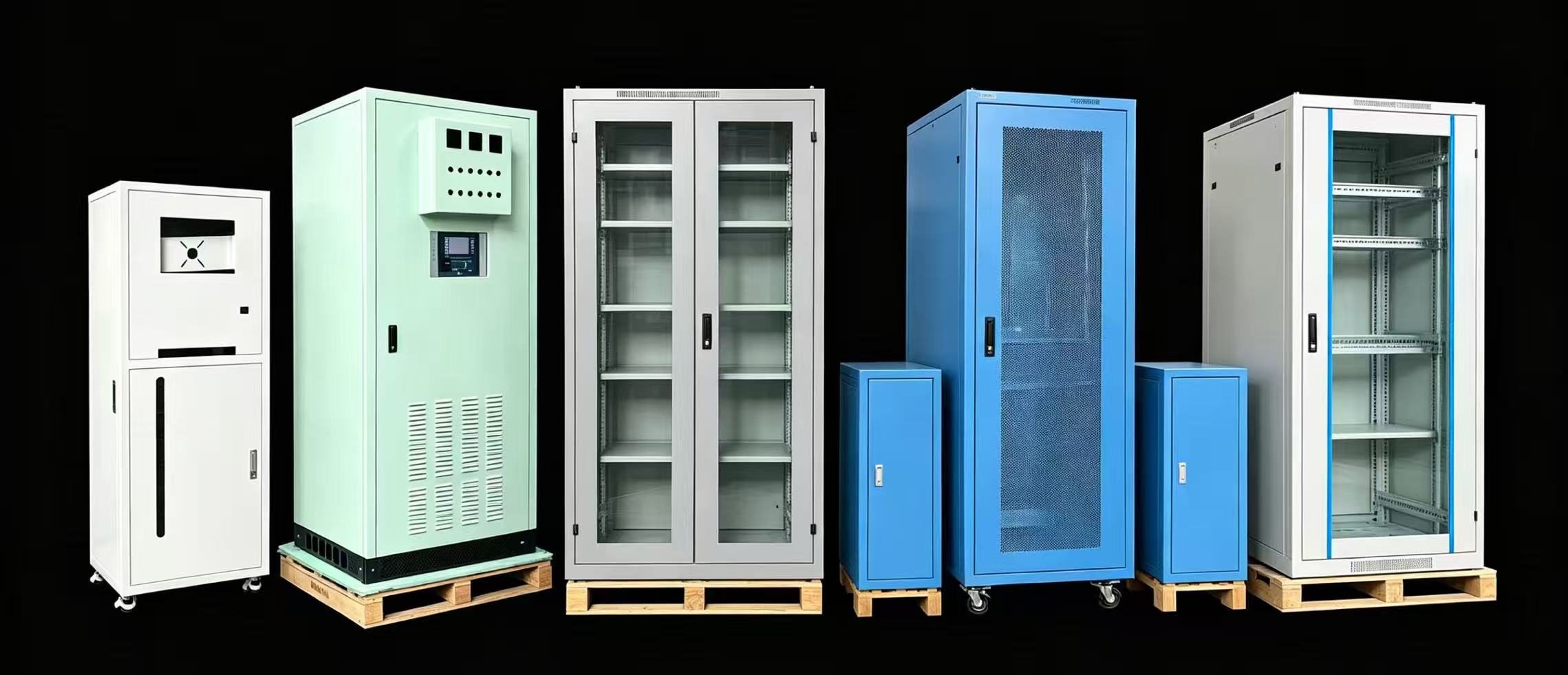
When you need a network cabinet, the wrong choice can cost you time, money, and a lot of headaches. So which one actually fits your needs?
There are two main types of network cabinets on the market: ready-to-ship (RTA) standard cabinets and custom non-standard cabinets. RTA cabinets follow fixed international size specs and ship immediately from stock. Custom cabinets are built to your exact dimensions, color, configuration, and installation requirements — one at a time.
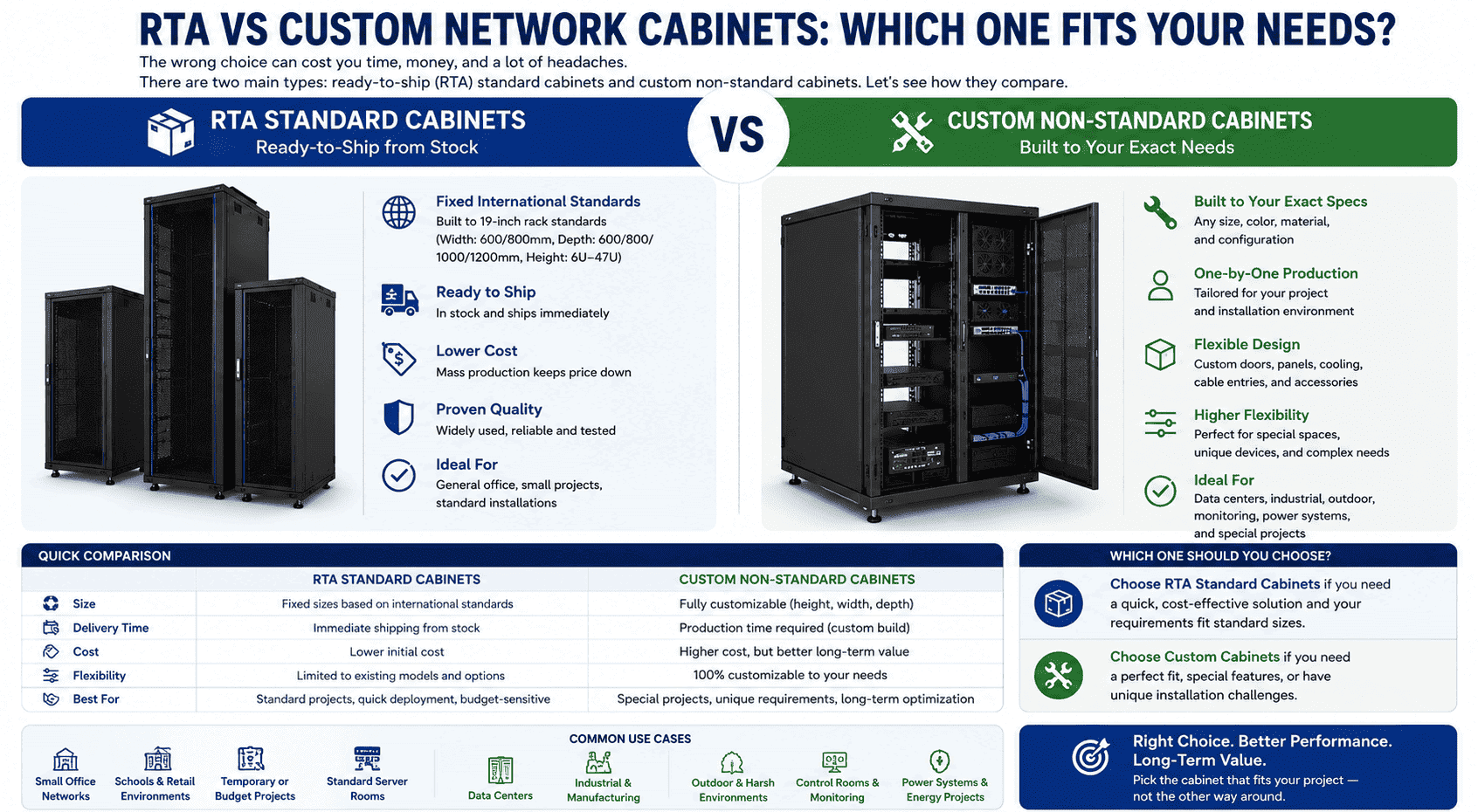
I have worked with both types of cabinets for years. I have seen clients pick the wrong one and regret it. The difference between these two options is bigger than most people think. Let me walk you through exactly what sets them apart, so you can make the right call for your project.
What Are RTA Standard Network Cabinets?
Most buyers do not realize how limited their options are until they measure their actual space. Then the frustration starts.
RTA standard network cabinets are pre-built to international size standards1 and kept in stock for immediate shipment. Wall-mount heights run from 2U to 15U. Floor-standing units come in 15U, 18U, 22U, 27U, 32U, 37U, 42U, and 47U. Width options are 530mm, 560mm, and 600mm, with matching depth dimensions.1
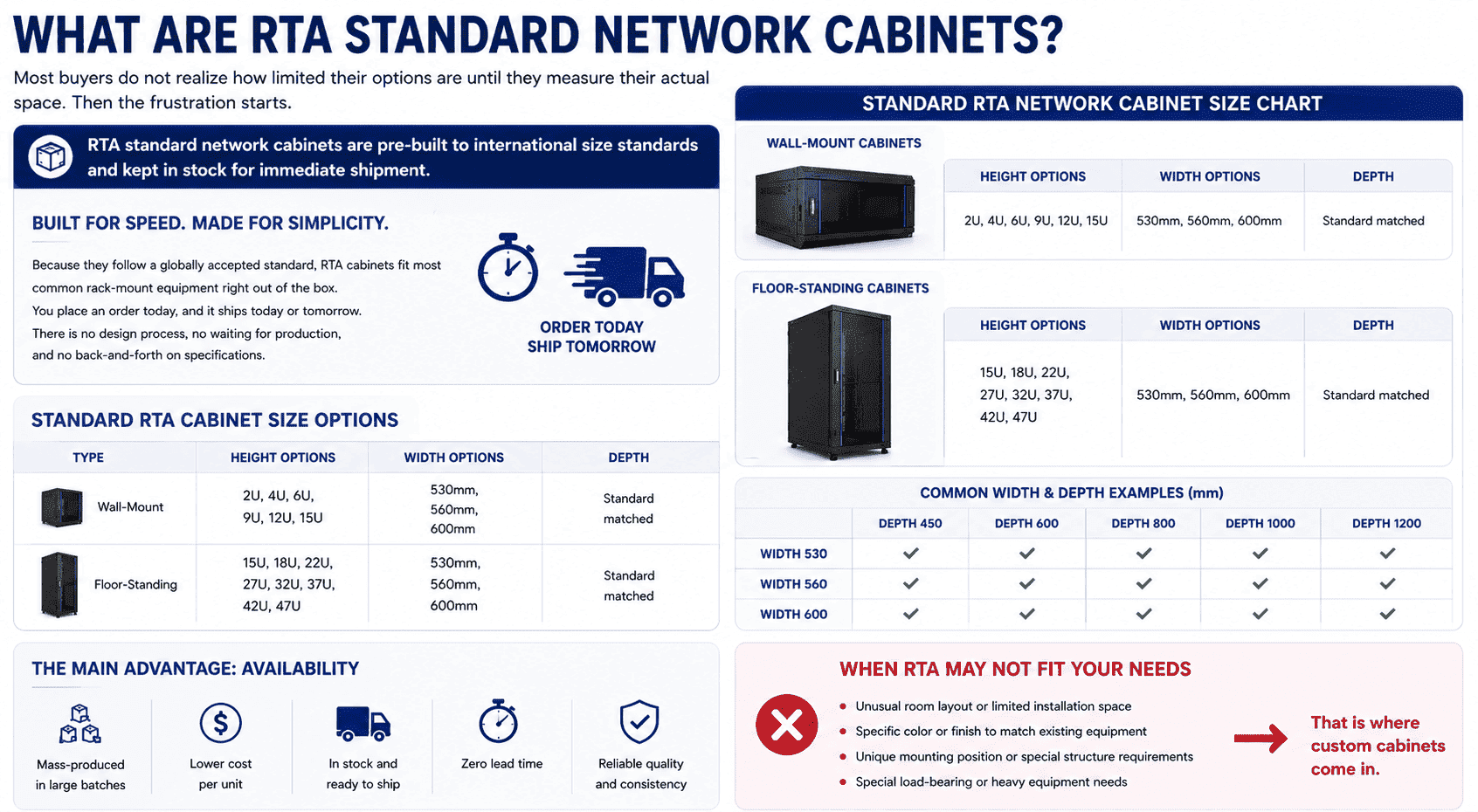
RTA cabinets are made for speed and simplicity. Because they follow a globally accepted standard, they fit most common rack-mount equipment right out of the box2. You place an order today, and it ships today or tomorrow. There is no design process, no waiting for production, and no back-and-forth on specifications.
Here is a breakdown of the standard RTA cabinet size options I work with most often:
| Type | Height Options | Width Options | Depth |
|---|---|---|---|
| Wall-Mount | 2U, 4U, 6U, 9U, 12U, 15U | 530mm, 560mm, 600mm | Standard matched |
| Floor-Standing | 15U, 18U, 22U, 27U, 32U, 37U, 42U, 47U | 530mm, 560mm, 600mm | Standard matched |
The main advantage here is availability. RTA cabinets are mass-produced in large batches3. Because no individual design or fabrication is needed, the cost per unit is lower4 and lead times are basically zero5. If your project uses standard equipment and your space has no unusual constraints, an RTA cabinet is the fast, practical answer.
However, the moment your project has a non-standard requirement — an unusual room layout, a specific color to match existing equipment, a unique mounting position, or a special load-bearing need6 — an RTA cabinet will not solve your problem. That is where custom cabinets come in.
What Are Custom Non-Standard Network Cabinets?
Standard sizes look fine on paper. But when you get to the job site and realize the cabinet does not fit the space, it is already too late.
Custom non-standard network cabinets are built from scratch based on the exact specifications a client provides. This includes any height, width, or depth7, plus specific colors, panel configurations, door styles, mounting methods, and structural requirements. Every unit is designed and produced individually to match a specific application.
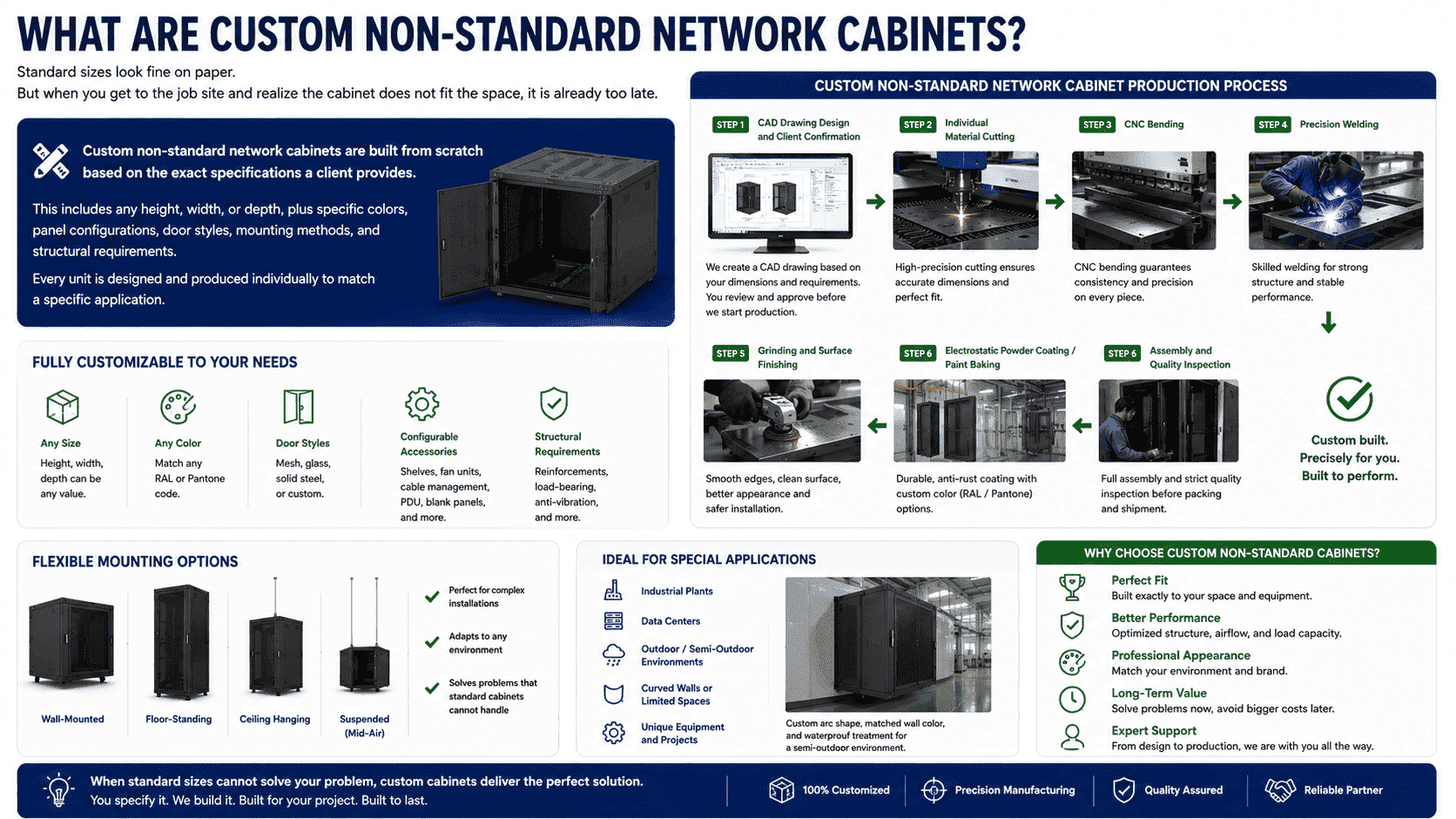
When a client comes to us with a custom request, the first thing we do is create a CAD drawing based on their dimensions and requirements8. The client reviews and approves that drawing before we cut a single piece of material. Only after approval do we begin production.
The production steps go in this order:
| Step | Process |
|---|---|
| 1 | CAD drawing design and client confirmation2 |
| 2 | Individual material cutting |
| 3 | CNC bending |
| 4 | Precision welding |
| 5 | Grinding and surface finishing |
| 6 | Electrostatic powder coating / paint baking9 |
| 7 | Assembly and quality inspection |
This process gives the client complete control over the final product. The height, width, and depth can be any value. The angles and curves can follow any shape the installation requires. The color can match any RAL or Pantone code.10 Door styles can be mesh, glass, or solid steel. Internal accessories, cable management, and load-bearing reinforcements are all configurable.
Mounting options are also fully flexible. We build cabinets for wall mounting, floor standing, ceiling hanging, and suspended mid-air installations. This matters a lot in industrial plants, data centers with raised floors11, or outdoor environments where a standard floor-standing cabinet simply cannot be used.
I remember one project where a client needed a cabinet to fit inside a curved wall enclosure. No standard size came close. We built a unit with a custom arc shape on the back panel, matched the exact RAL color of the surrounding wall, and added a waterproof treatment for the semi-outdoor environment. That is the kind of problem a custom cabinet solves.
How Do You Choose Between RTA and Custom?
The wrong choice is not always obvious at first. But the cost of fixing it later is almost always higher than getting it right from the start.
Choose RTA cabinets when your equipment fits standard rack sizes, your space has no unusual dimensions, and fast delivery is your top priority. Choose custom cabinets when you have specific size requirements, unique installation conditions, special color or finish needs, or structural demands that standard products cannot meet.
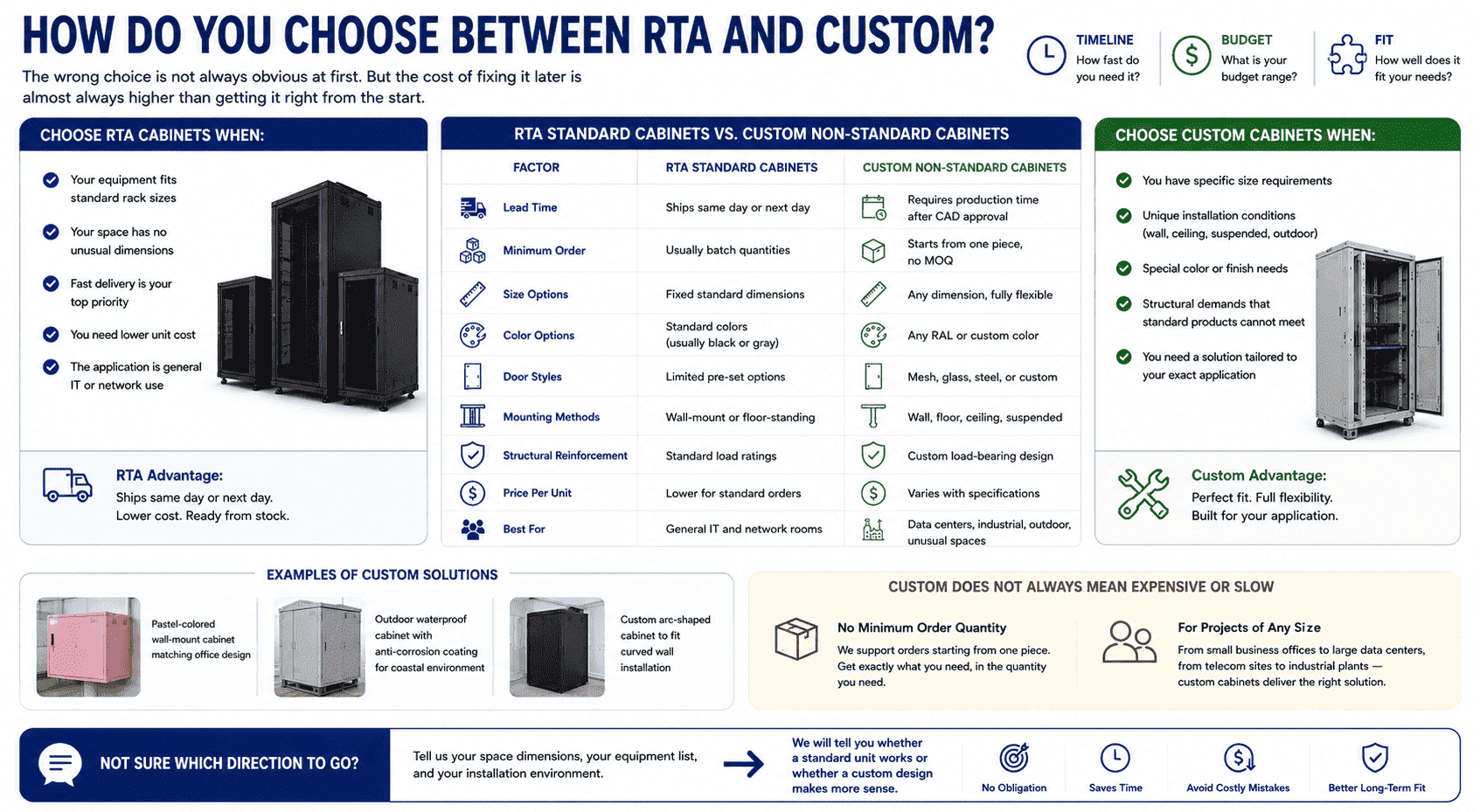
The decision usually comes down to three factors: timeline, budget, and fit. RTA cabinets win on timeline and upfront unit cost. Custom cabinets win on fit, flexibility, and long-term suitability for the specific application.
Here is a direct comparison to make this easier:
| Factor | RTA Standard Cabinets | Custom Non-Standard Cabinets |
|---|---|---|
| Lead Time | Ships same day or next day | Requires production time after CAD approval |
| Minimum Order | Usually batch quantities | Starts from one piece, no MOQ |
| Size Options | Fixed standard dimensions | Any dimension, fully flexible |
| Color Options | Standard colors (usually black or gray) | Any RAL or custom color |
| Door Styles | Limited pre-set options | Mesh, glass, steel, or custom |
| Mounting Methods | Wall-mount or floor-standing | Wall, floor, ceiling, suspended |
| Structural Reinforcement | Standard load ratings | Custom load-bearing design |
| Price Per Unit | Lower for standard orders | Varies with specifications |
| Best For | General IT and network rooms | Data centers, industrial, outdoor, unusual spaces |
One thing I want to point out is that custom does not always mean expensive or slow. At our factory, we support orders starting from one piece with no minimum order quantity. A client in Europe or Southeast Asia who needs just three custom cabinets for a specialized rack room does not have to order fifty units to make it work. That flexibility is something most manufacturers in this space do not offer3.
The other thing worth saying is that custom cabinets are not just for large data center projects. I have worked with small businesses that needed a wall-mounted cabinet in a specific pastel color to match their office design. I have worked with telecom contractors who needed an outdoor waterproof cabinet with anti-corrosion coating for a harsh coastal environment12. Both are custom jobs. Both required a solution that no RTA product could provide.
If you are unsure which direction to go, the honest answer is this: tell us your space dimensions, your equipment list, and your installation environment. We will tell you whether a standard unit works or whether a custom design makes more sense. There is no obligation, and it saves a lot of time compared to guessing.
Conclusion
RTA cabinets offer speed and simplicity for standard needs. Custom cabinets offer precise fit for complex requirements. Know your space, know your equipment, and choose accordingly.
"19-inch rack - Wikipedia", https://en.wikipedia.org/wiki/19-inch_rack. IEC 60297 and EIA/ECA-310 define key mechanical dimensions for 19-inch rack-mounted equipment and enclosures, supporting the use of standardized rack-cabinet sizes; these standards do not prescribe every commercial height, width, or depth offered by individual suppliers. Evidence role: definition; source type: institution. Supports: A standards-body or neutral reference should show that 19-inch rack and cabinet dimensions are governed by recognized international or industry standards.. Scope note: The source would support the existence of rack standards, not every specific stock size listed in the article. ↩
"19-inch rack - Wikipedia", https://en.wikipedia.org/wiki/19-inch_rack. The 19-inch rack standard establishes a common mounting interface used by many servers, network switches, and telecommunications devices, supporting the claim that standardized cabinets are generally interoperable with rack-mount equipment; actual fit still depends on depth, cable clearance, airflow, and load rating. Evidence role: mechanism; source type: encyclopedia. Supports: A source should explain that the 19-inch rack standard creates a common mounting interface for many servers, switches, and telecommunications devices.. Scope note: The support is general compatibility, not a guarantee that every device fits every RTA cabinet. ↩
"Mass production - Wikipedia", https://en.wikipedia.org/wiki/Mass_production. Operations-management literature describes make-to-stock production as the manufacture of standardized products for inventory before specific customer orders are received, providing context for the claim that standard cabinets can be produced in batches. Evidence role: general_support; source type: education. Supports: A manufacturing or operations-management source should define make-to-stock or mass production as producing standardized goods in advance of customer orders.. Scope note: The source would support the production model generally, not verify the production practices of a specific cabinet supplier. ↩
"Economies of scale - Wikipedia", https://en.wikipedia.org/wiki/Economies_of_scale. Manufacturing economics identifies economies of scale as a mechanism by which larger production runs and standardized processes can lower average unit costs, supporting the article’s comparison of standard and custom cabinet costs in general terms. Evidence role: mechanism; source type: education. Supports: A source should explain that economies of scale and standardization can reduce average unit costs in manufacturing.. Scope note: The source would not establish exact cabinet prices or prove that every RTA unit is cheaper than every custom unit. ↩
"Understanding Lead Time: Definition, Process, and Impact on ...", https://www.investopedia.com/terms/l/leadtime.asp. Make-to-stock systems reduce customer lead time by holding finished goods inventory before orders are placed, which supports the claim that stocked standard cabinets can ship faster than made-to-order units; it does not prove that lead time is literally zero in all cases. Evidence role: mechanism; source type: institution. Supports: A source should show that make-to-stock inventory can reduce customer order lead time because goods are already produced.. Scope note: The source supports shorter lead time, not same-day availability for every order, location, or quantity. ↩
"SIST EN IEC 61587-1:2022 - Mechanical Structure Tests ...", https://standards.iteh.ai/catalog/standards/sist/16c5f37b-4637-4a3d-a9d7-432cc5489c0e/sist-en-iec-61587-1-2022?srsltid=AfmBOoorjFRmG4gS0zSURpWDnBGQTIDAQVi0JF9KPCh3YzWc0qN5H_10. Standards for electronic-equipment mechanical structures include structural and load-related testing for racks and cabinets, supporting the article’s point that some installations may require specified load-bearing performance beyond a generic enclosure. Evidence role: expert_consensus; source type: institution. Supports: A source should show that equipment racks and cabinets are evaluated with mechanical load or structural-performance criteria.. Scope note: The source would support the importance of load ratings, not determine the required load capacity for a particular project. ↩
"The Limits of Mass Customization - MIT Sloan Management Review", https://sloanreview.mit.edu/article/the-limits-of-mass-customization/. Research on engineer-to-order and mass-customization manufacturing describes products being designed or configured to customer-specific requirements, supporting the article’s distinction between fixed standard dimensions and custom dimensions; practical limits still depend on materials, tooling, certification, and engineering constraints. Evidence role: general_support; source type: research. Supports: A source should describe engineer-to-order or mass-customization production as manufacturing products to customer-specific requirements.. Scope note: The source would support customer-specific dimensional design in principle, not the literal feasibility of every possible dimension. ↩
"Engineering Drawing and Computer-Aided Design (CAD)", https://nnmc.edu/academics/engineering-and-technology/computer-aided-design.html. Computer-aided design is widely used to create engineering drawings and digital models for manufactured products, supporting the article’s description of using CAD drawings to formalize customer dimensions before fabrication. Evidence role: mechanism; source type: education. Supports: A source should explain that CAD is used to create technical drawings and models that guide product design and manufacturing.. Scope note: The source would explain CAD’s general role, not document the workflow of the specific factory described. ↩
"Application of electrostatic powder coating on wood composite ...", https://bioresources.cnr.ncsu.edu/resources/application-of-electrostatic-powder-coating-on-wood-composite-panels-using-a-cooling-method-part-1-investigation-of-water-intake-abrasion-scratch-resistance-and-adhesion-strength/. Technical descriptions of powder coating identify it as a process in which dry powder is typically applied electrostatically to a metal surface and then heat-cured, supporting the article’s reference to electrostatic powder coating and baking as a cabinet-finishing step. Evidence role: definition; source type: government. Supports: A source should define powder coating as an electrostatic application process followed by heat curing or baking.. Scope note: The source would define the process, not verify that a particular manufacturer uses it on every cabinet. ↩
"RAL colour standard - Wikipedia", https://en.wikipedia.org/wiki/RAL_colour_standard. RAL and Pantone are established color-reference systems used to specify and communicate colors across design and manufacturing contexts, supporting the article’s claim that cabinet finishes may be specified by such codes. Evidence role: definition; source type: institution. Supports: A source should establish that RAL and Pantone are color-reference systems used to specify colors in design, coatings, or manufacturing.. Scope note: The source would support the role of the color systems, not prove that every coating supplier can reproduce every listed color exactly. ↩
"Airflow Management in Focus: The Raised Floor - Upsite Technologies", https://www.upsite.com/blog/airflow-management-in-focus-the-raised-floor/. Data-center guidance describes raised floors as infrastructure used for air distribution, cabling, or service routing, providing context for why cabinet mounting and installation requirements may differ in such environments. Evidence role: general_support; source type: institution. Supports: A source should explain that raised floors are used in data centers for airflow distribution, cabling, or infrastructure routing.. Scope note: The source would provide contextual support, not prove that a standard floor-standing cabinet can never be used on a raised floor. ↩
"Corrosion Protection for Coastal & Offshore Enclosures | topcabinet", https://topcabinet.com/corrosion-protection-coastal-offshore-enclosures/. Corrosion and enclosure standards recognize coastal or salt-laden environments as aggressive conditions for metals and identify protective coatings and weather-resistant enclosure ratings as relevant controls, supporting the article’s example of an outdoor cabinet requiring waterproofing and anti-corrosion treatment. Evidence role: mechanism; source type: institution. Supports: A source should show that coastal or salt-laden environments increase corrosion risk and that outdoor enclosures are commonly specified for ingress and corrosion protection.. Scope note: The source would support the environmental rationale, not verify the performance of the specific custom cabinet described. ↩
